The alert looks simple. A brand's dashboard shows an organic query it has always covered, yet the AI assistant returns nothing, no mention, no citation, no summary. The page still exists, the topic still matters, and the dashboard still marks a blank where a response should have been.
That blank is one of the clearest failure modes in AI search because it is harder to dismiss than a weak mention count. A low score at least gives a signal. A zero-answer result says the system either did not surface anything, did not answer, or did not make that absence obvious to the person monitoring it. For SEO and content teams, that difference matters because the dashboard can look healthy while the user experience is empty.
Published audits suggest that empty results are not a fringe event. They sit alongside fabricated links, wrong-source citations, and answer surfaces that seem useful until someone checks the trail back to the publisher. In other words, the problem is not only what AI search says. It is also what it leaves out, and whether the omission is visible enough to measure.
The hidden gaps that distort visibility
Metrics that can be pushed down the list
Three checks worth running first
What to Verify First, and What to Drop
What teams can check this week
Structural Visibility Gaps Brands Miss
What teams should measure instead
Visibility and traffic can move in opposite directions
When Being Cited Stops Meaning Business
Aggregate dashboards hide the gap
Query shape changes what gets found
Retrieval Failures by Query Type and Language
Why these errors distort measurement
Citation Errors and Hallucinated Sources
The terms that keep getting mixed up
How to Read AI Search Problems Before They Bite
Why absence is more useful than a low score
What the blank dashboard really means
The Empty Result That Keeps Showing Up
The Empty Result That Keeps Showing Up
A search team opens its AI visibility tool and sees a familiar pattern. The query is one that the brand covers well in organic search, yet the AI panel is blank. No cited page appears. No summary box appears. The tracker records a missed mention, but the core issue is harsher than a soft miss. The system behaved as if the answer space did not exist.
What the blank dashboard really means
A low-mention score still leaves room for interpretation. Maybe the brand was surfaced in a minority of runs. Maybe another source was cited instead. A zero-answer condition is different. It suggests that the system did not produce a usable response for that query, or it produced one that the tracking layer could not capture cleanly.
That matters because AI visibility tools often sit between the brand and the assistant. If the assistant returns nothing, the tool can't always tell whether the model declined to answer, the retrieval layer failed, or the query phrasing fell outside the system's response pattern. Teams report the same pattern across ChatGPT, Perplexity, and Google: the practical question becomes whether the platform was silent or whether the upstream scraping layer missed the response. We have not tested this across tools ourselves.
Practical rule: an empty result should be treated as a measurement event, not just a content event. It can mean the answer was absent, the source was absent, or the tracker failed to observe the answer cleanly.
That distinction is why blank results deserve more attention than ordinary misses. A low hit rate still produces data. A blank result is a diagnostic clue. It points to a failure mode somewhere in the chain, and that chain runs from query form to retrieval, citation generation, and source verification.
Why absence is more useful than a low score
The blank outcome also helps separate one-off misses from systemic failure. A single query can be noisy. A recurring zero-answer pattern across similar prompts suggests that the assistant and the monitoring setup are not aligned on what counts as a result. That is a measurement problem as much as a search problem.
Columbia Journalism Review's audit of eight AI search engines found that the systems were generally bad at declining to answer questions they could not answer accurately, and they often fabricated links or cited syndicated or copycat versions instead of original sources, according to the March 6, 2025 audit. That is relevant here because a blank result sits on the same spectrum as a bad answer. Both are failures of reliability. One is easier to see.
The next step is vocabulary. Without it, the same dashboard can mean a retrieval miss, a citation error, or a source-quality problem, and those are not the same thing.
How to Read AI Search Problems Before They Bite
The fastest way to get lost in AI search is to treat every failure as the same failure. It isn't. Some problems sit in the answer. Others sit underneath it, in the retrieval layer. A newsroom editor would never confuse a wrong byline with a missing archive record, and marketers shouldn't confuse a bad citation with a retrieval miss.
multi-model evaluation of citation URLs
The terms that keep getting mixed up
Hallucination means the assistant produced something that looks like a fact, link, or source detail, but doesn't hold up under verification. In editorial work, that's the equivalent of a cleanly written sentence with a made-up source.
Citation subsetting means the answer pulled only part of the source material into view. Think of a clipping desk that quotes one line from a long report and leaves out the rest. The source may be real, but the representation is incomplete.
Source-of-truth drift happens when the assistant keeps surfacing older or secondary material after the brand has already updated the page. It's like a library card catalog that still points readers to an old shelf label.
Retrieval miss means the system didn't pull the page or passage into the answer path at all. That's a cataloging failure, not a writing failure.
Prompt-conditioned answer shape means the phrasing of the query changes what gets surfaced. A keyword-style prompt and a conversational prompt can act like two different research requests even when the intent feels identical to the human asking.
A useful test is to ask whether the problem would still exist if a human editor were checking the result line by line. If the answer is no, the issue is likely citation or grounding. If the answer is yes, the issue is probably retrieval or prompt shape.
These distinctions matter because they tell teams where to look first. A hallucinated citation needs URL validation. A retrieval miss needs query replay. Source-of-truth drift needs content cleanup and freshness checks. Prompt-conditioned shape needs repeated testing with different phrasings.
The audit literature shows why this vocabulary matters. One review of AI search engines found fabricated links and wrong-source citations in production-style responses, while another found that citations could come from material already touched by AI generation. Those are different failures, and the fix won't be the same.
Citation Errors and Hallucinated Sources
The most visible AI search failure is also the easiest to misread. A citation appears. The answer looks polished. The link even looks plausible. Then someone checks it, and the trail breaks. In published audits, that break has shown up in several forms, and each one distorts what a brand sees in visibility tooling.
Three ways citations go wrong
First, the assistant can point to a fabricated URL. The link looks like evidence, but it has no record in the Wayback Machine and likely never existed. A multi-model evaluation found that 3 to 13% of citation URLs were hallucinated and 5 to 18% were non-resolving overall, according to the multi-model evaluation of citation URLs. That evaluation covered ten commercial models and deep research agents; the same paper reported that deep research agents produced more citations per query than search-augmented models but hallucinated URLs at higher rates. The presence of web retrieval doesn't guarantee a usable citation trail.
Second, a real URL can be attached to the wrong publication, author, or excerpt. Columbia Journalism Review's audit of eight AI search engines found DeepSeek misattributed the source of quoted excerpts 115 times out of 200 checks in its March 6, 2025 review, which shows that a citation can look right at a glance and still be wrong at the source level. The article also reported that content licensing deals with news publishers did not guarantee correct citation behavior, which matters for teams that assume a licensing relationship solves attribution problems. It doesn't.
Third, syndicated-source substitution can push a secondary version into the answer when the original page would have been more useful. That pattern weakens both trust and traffic because the assistant may appear to cite the topic while routing attention away from the original publisher. In a visibility dashboard, that can look like success. In practice, it can be a mispointed mention.
Why these errors distort measurement
A brand's visibility tool may record a mention, but that mention can be attached to the wrong page type or the wrong version of the story. That changes the meaning of the metric. It's no longer “was the brand cited.” It becomes “what was cited, and did the citation land on the publisher that mattered?”
One possibility is that these failures track answerability rather than random noise. We have not seen that tested directly. What the audits do show is that systems willing to answer when they should decline create a false sense of coverage. The dashboard fills with activity while the citation trail degrades.
Source errors also matter because AI search users increasingly rely on the link trail to verify claims. When the trail is broken, the user can't tell whether the assistant found the original reporting or a copycat version. The brand can't tell whether its page earned the mention. And the analyst can't tell whether the tool is measuring visibility or merely echoing a malformed citation.
Retrieval Failures by Query Type and Language
AI search doesn't fail evenly. Some prompts bring back a clean answer. Others go thin or vanish entirely, depending on how the question is phrased. That makes query testing feel unstable, and the instability itself is worth paying attention to.
Query shape changes what gets found
For marketers, this is why natural-language prompts and keyword-style prompts can't be treated as interchangeable. A conversational query can surface a different passage set than a head term. A long-tail prompt can expose a specific page section, while a shorter query may pull in a competitor's summary or a listicle. The page may still rank in organic search. The AI answer may not reach it.
Aggregate dashboards hide the gap
Most visibility tools compress all of that into one score. That hides the conditions under which a brand disappears. Averages smooth over language, format, and length. They also smooth over the fact that a page can be present for one wording and absent for another, with no internal model change at all.
A simple replay test is often more revealing than a broad dashboard. Rephrase the same intent as a question, a keyword cluster, and a conversational request. If the source list changes materially, the issue may not be the page. It may be the retrieval path.
| Query Condition | Typical Retrieval Behavior | Brand Visibility Impact |
|---|---|---|
| Conversational phrasing | A more specific passage was surfaced | The brand can appear in one wording and disappear in another |
| Keyword-style phrasing | A different source set was retrieved | The brand may be visible in organic search but absent in the answer |
| Non-English or cross-language query | Thinner or mismatched retrieval can appear | Visibility can drop even when the topic exists in the corpus |
| Longer passage or chunk boundary | The relevant section may be missed | The page can be technically present but practically invisible |
That table is the cleanest reminder that AI search problems are often conditional. The page doesn't just “rank” or “not rank.” It can be found in one query shape and missed in another, which means dashboards need to preserve the query itself, not just the outcome.
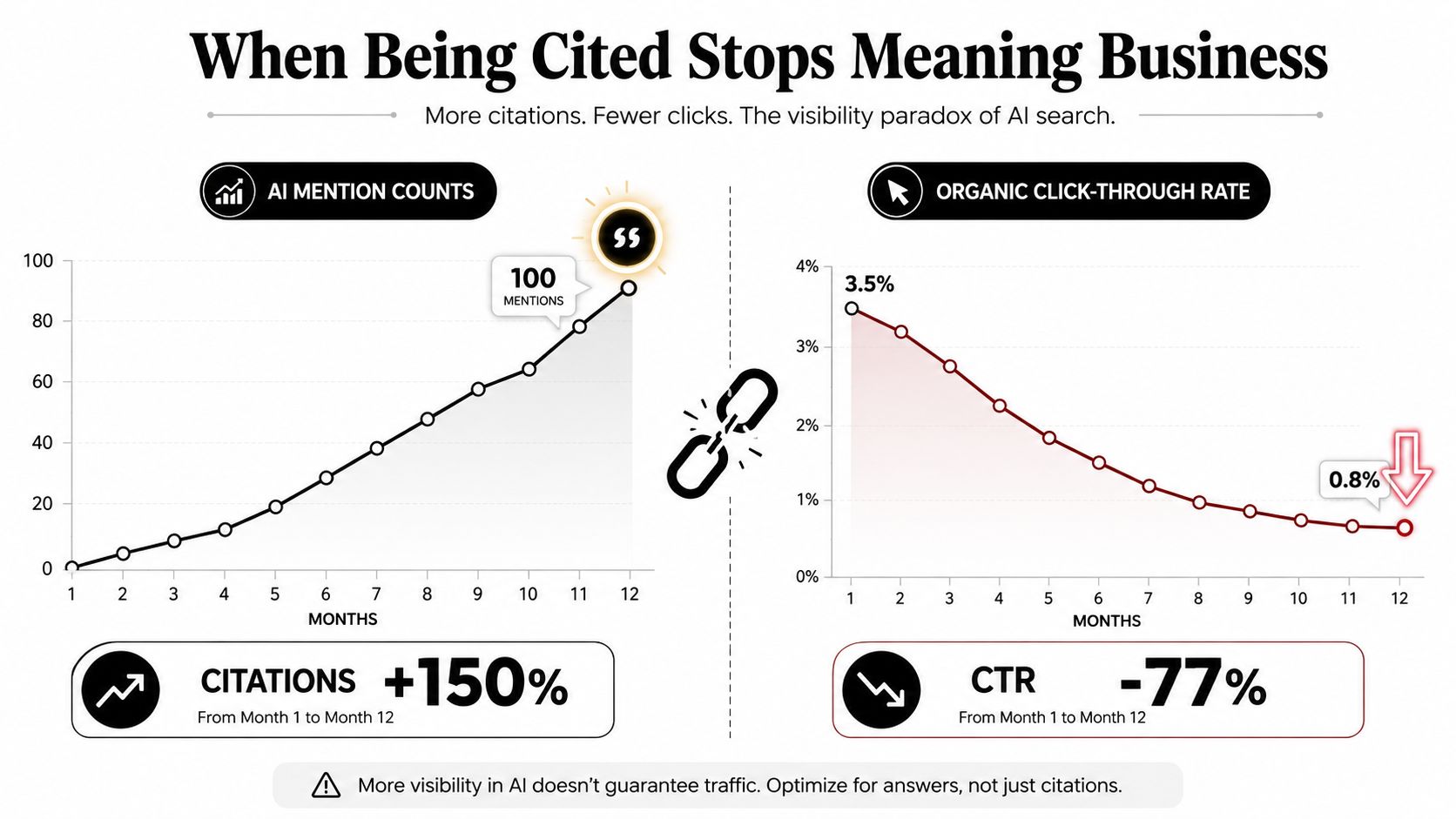
When Being Cited Stops Meaning Business
A citation is not a conversion. It's not even always a click. That gap has become one of the most misunderstood AI search problems, because teams still celebrate mention counts while the user behavior underneath those mentions moves the other way.
Visibility and traffic can move in opposite directions
Pew reported that on Google summary pages, 8% of users clicked traditional links versus 15% without summaries, and only 1% clicked the cited sources inside the summary, according to the Pew-reported behavior summarized in independent UX coverage. Independent UX research also found outbound click-through can drop sharply when AI Overviews are present, including a reported 66% desktop decline in one study, in the same coverage. The exact business impact will vary by query and category, but the direction is hard to ignore.
That is why a brand with more AI mentions can still drive fewer sessions than a brand with fewer mentions. A category that is fully summarized inline gives the user less reason to click. A page that is cited in a small footer link can be visible without being visited. The dashboard may celebrate the mention. The analytics platform may record a quieter referral line.
A worked comparison makes the trap obvious. If one brand shows up in 40 monthly AI mentions and another appears in 12, the first brand does not automatically win. If the 40-mention brand sits in a category that AI answers summarize inline, it can lose more clicks than the 12-mention brand, especially if the smaller brand appears in a prompt where the assistant still sends people out to read. That isn't a mathematical certainty, but it's a realistic measurement warning.
Useful metric shift: track downstream conversions tied to AI-attributed sessions, not raw mention volume alone.
What teams should measure instead
The best reporting stack for this problem is narrower and more honest. Raw mention counts still matter, but only as a visibility layer. They need to sit beside click-through, assisted conversions, and source-level referral quality. Otherwise, the team may optimize for a citation that never produced a visit.
This is also where the marketing question changes. Instead of asking whether the brand was cited, the better question is whether the citation changed user behavior. If it didn't, the mention may be informative but not valuable. If it did, the referral path deserves priority over the count.
Structural Visibility Gaps Brands Miss
Some AI search problems never show up as broken pages or obvious hallucinations. The page is live. The content is solid. The issue is structural. The assistant still finds a different source, a thinner snippet, or an AI-generated page that has entered the citation ecosystem and started circulating back into it.
The hidden gaps that distort visibility
A recent audit of four major generative search engines, ChatGPT, Copilot, Gemini, and Perplexity, found evidence that roughly 16% of successfully scraped unique cited sources were classified as “Highly Likely AI” or “Likely AI” by a detection system, according to the Synthetic Sources review. At the provider level, the share of AI-generated citations varied, with Copilot at 27.8%, Gemini at 14.7%, Perplexity at 9.4%, and ChatGPT at 7.3%, in the same review. The important point is not the exact spread. It's that citation provenance can be contaminated before a human marketer ever sees the result.
That contamination sits beside another published pattern. Independent reporting summarized by Nieman Lab noted a strong bias toward earned media and authoritative third-party sources, while brand-owned pages were cited less often than many marketers expect. The same reporting also noted that answer engines often cite only a limited subset of the sources they surface, which creates a bottleneck even when many relevant pages exist. A page can be healthy and still not be the one that gets used.
What teams can check this week
- Search the brand inside listicle formats. If the same competitor list keeps appearing, note which third-party domains are used and whether the brand's own page ever appears alongside them.
- Compare summary wording to the live page. If the summary box describes the brand differently from the page itself, flag a possible citation-subsetting problem.
- Inspect the domains that keep showing up. Review sites, directories, and forum-style pages can become the default evidence layer in some category queries.
- Audit for duplicate or stale versions. Multiple page variants can split visibility and make it harder for the assistant to resolve the current source.
- Check whether the cited page is AI-written. If the citation trail repeatedly lands on machine-generated summaries, the brand may be competing with synthetic material rather than original reporting.
The publisher's own service, The AI Search Signals, sits in this kind of evidence and mention tracking space, alongside other visibility tools and audits. Its relevance here is practical, not promotional. Teams need more than a mention ledger. They need to know which sources were surfaced, which ones were attributed, and whether the citation trail is drifting away from original work.
The takeaway is blunt. A healthy page is not enough if the surrounding source ecosystem keeps substituting something else. Visibility problems can live in the structure around the page, not inside the page itself.
What to Verify First, and What to Drop
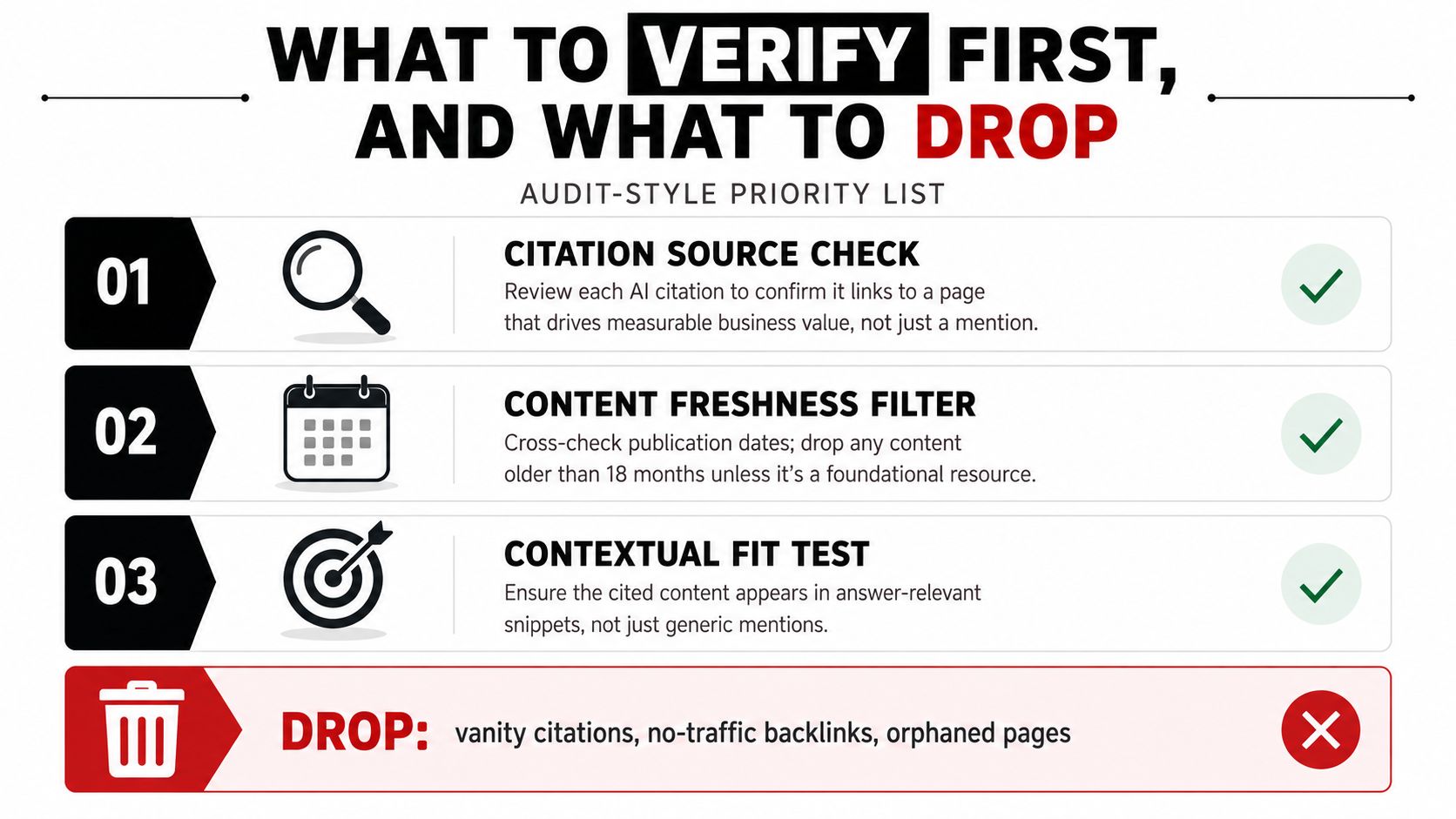
The first pass through AI search problems should be a source check, not a vanity check. Once the source trail is clean, the reporting can get more ambitious. Before that, the team needs to know whether the assistant pointed to the right page, the right wording, and the right user behavior.
Three checks worth running first
Citation source check. Open every cited URL and confirm that it resolves to the claim that was surfaced. If the page doesn't match the answer, the citation is not dependable enough to count as a win.
Query replay check. Re-run the same intent as a natural-language prompt and as a keyword-style prompt. If the source list changes completely, the visibility pattern is too unstable to treat as a single number.
Behavior check. Compare mention rates against click-through in AI summary surfaces. If a cited page isn't producing visits or assisted conversions, the citation may be visibility, not value.
Metrics that can be pushed down the list
- Raw citation counts divorced from traffic. They're easy to report and easy to misread.
- Brand-mention share on low-intent prompts. That can flatter the dashboard without helping revenue.
- Sentiment scores built on hallucinated attributions. If the citation trail is broken, the sentiment layer isn't trustworthy either.
- Any claim that one citation position guarantees conversion. The public evidence doesn't support that.
- Any promise that one fix will recover AI visibility everywhere. The evidence doesn't support that either.
Verify the source before optimizing for the mention. If the source can't be validated, the metric should be treated as provisional.
That's the cleanest decision rule for the moment. Teams should stop reporting metrics that haven't been checked against observed user behavior, and they should keep the claims modest until citation accuracy, retrieval stability, and click impact line up in the same report.
If the current dashboard still mixes blank results, wrong citations, and traffic that never arrives, the next move is to run a source audit on the top ten queries your team cares about, then compare each cited URL against the live page and the referral data. That audit will show whether the problem is retrieval, attribution, or business impact, and it will give your team a cleaner basis for deciding what to fix first.