The term LLM SEO moved from niche to noticeable with unusual speed. A 2026 Ahrefs-based estimate put it at about 81 U.S. searches per month two years earlier, then 1,380 the previous month, roughly a 17x increase in 24 months. The same source listed about 1,400 monthly searches in the U.S., +38% 12-month growth, and a $5.00 CPC (Ross Simmonds on LLM SEO search demand). That does not prove strategy maturity. It does show commercial intent forming around discovery in AI answer systems, not just classic blue-link rankings.
The Rapid Rise of LLM SEO
The market shift is visible in the answers users now see. Independent reporting cited in 2025 and 2026 found Google AI Overviews appearing on about 18% of Google searches in March 2025, around 12.8% of searches in Ahrefs' June 2025 index, about 48% of tracked queries by February 2026, and 86.7% of business-intent searches in April 2026 (AI visibility and AI search statistics). Those figures don't say AI answers replaced traditional search. They do show that AI-generated surfaces became part of mainstream search behavior fast enough that teams can't treat them as an edge case.
Why the change matters
Traditional SEO still matters, but it no longer covers the whole visibility problem. A page can rank well and still fail to appear in the answer layer where users now get summaries, citations, and recommendations. That gap is the practical reason LLM SEO exists as a separate discipline.
The more useful way to think about it is simple. Search teams are no longer optimizing for one list of ten results. They're optimizing for inclusion in a response that may quote, cite, summarize, or ignore them. That changes content planning, measurement, and expectations.
Practical rule: if the page answers the query clearly, but the answer engine still skips it, traditional ranking is only part of the story.
The shift is not semantic. It's operational. Teams have to ask which queries are now answered inside the interface, which sources are shown there, and whether their content is structured in a way that can be surfaced cleanly.
How Answer Engines Surface and Cite Content
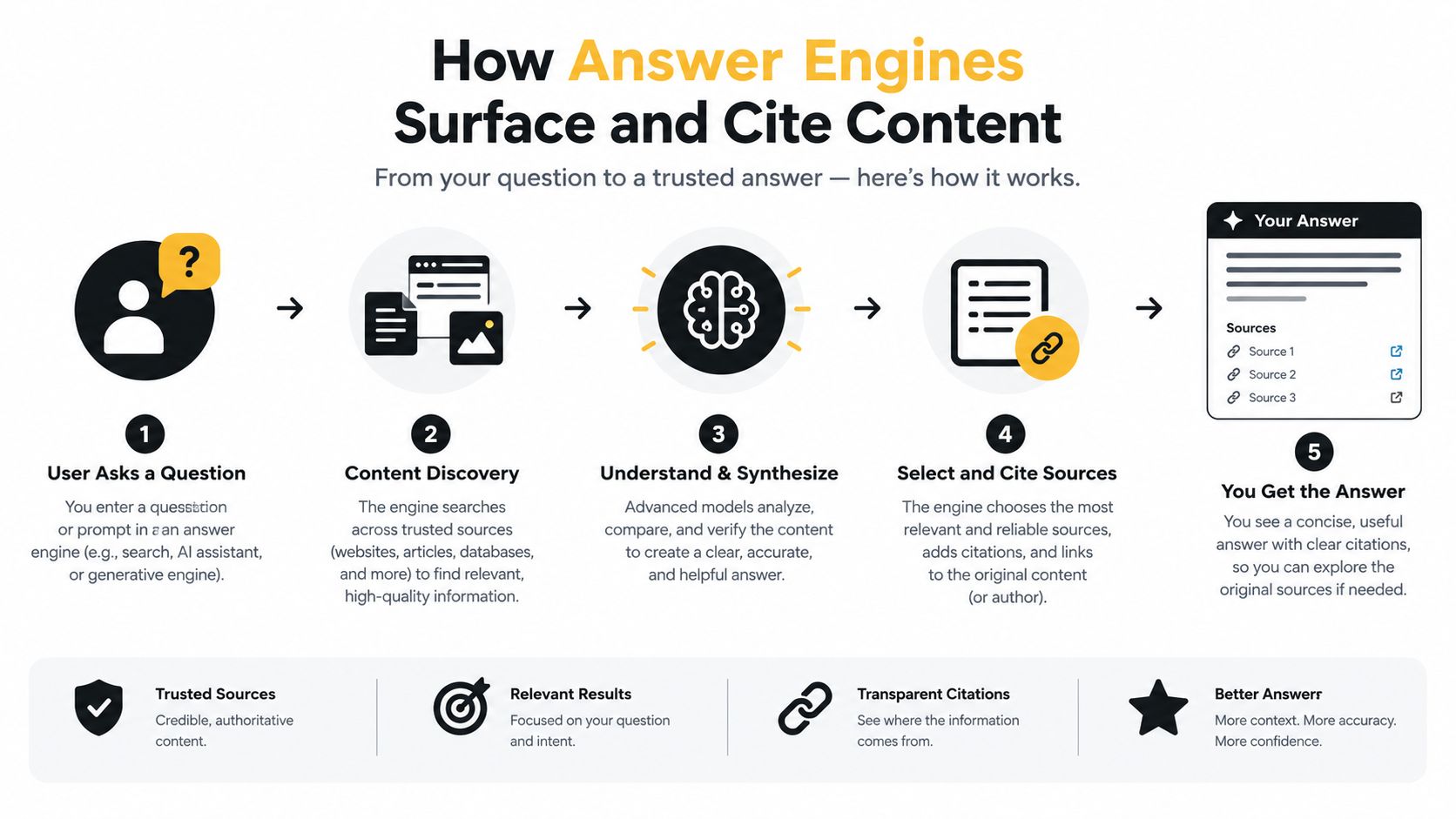
Answer engines give us visible mechanics to work with, even if their internal scoring stays hidden. Perplexity's Help Center says every answer includes numbered citations linking to the original sources, and users can click those citations to verify the information or explore further (Perplexity Help Center on citations). That makes citation analysis possible without guessing at the unseen system behind it.
A second user-facing control matters just as much. Perplexity says users can choose sources in the search bar, including Web, Org Files, Web + Org Files, or None, and that Web means it will only use sources from the internet to generate answers (Perplexity Help Center on internal knowledge search). For visibility work, that boundary matters because it defines the observable source pool.
The right mental model is not “how does the model think.” It's “what evidence is visible in the answer.” That means marketers should inspect citation links, source types, and whether the surfaced pages are theirs or a competitor's. Internal speculation about training data doesn't help here. What users see does.
The process is easier to audit when it's treated like a sequence, not a mystery.
What teams should look for
- The cited URL. The visible source is the first signal worth logging.
- The page type. Product page, article, FAQ, or video transcript, each tells a different story.
- The query intent. Informational and purchase-style prompts often surface different source patterns.
- The answer format. Lists, summaries, and direct recommendations can change what gets surfaced.
- The source boundary. Whether the system pulls from web sources only, internal files, or a mixed pool affects interpretation.
The internal link below covers this topic from a different angle and fits the same visible-source logic: how ChatGPT gets its information.
What matters here is not theory. It's traceability. If a source can be clicked in the answer, it can be counted, compared, and audited.
The Weak Link Between Organic Rankings and AI Citations
Classic rankings still matter, but they don't guarantee AI visibility. Ahrefs reported a Spearman correlation of 0.347 between ranking in Google's top 10 and being cited in the top 3 AI Overview results, using 1 million keywords and 1.9 million citation links (Ahrefs on Google rankings and AI Overview citations). That is a real relationship, but it's not a one-to-one mapping.
The citation gap is wider than many teams assume
A later Ahrefs analysis found that only 38% of AI Overview citations came from pages also ranking in Google's top 10, while 31.2% came from positions 11–100 and 31.0% came from beyond the top 100 (Ahrefs on AI Overview citations beyond the top 10). Those numbers matter because they show that answer engines are not just replaying the top organic set. They're drawing from a broader corpus.
| Organic Ranking Tier | Share of AI Citations |
|---|---|
| Top 10 | 38% |
| Positions 11–100 | 31.2% |
| Beyond Top 100 | 31.0% |
That table should change how teams interpret “good SEO.” Ranking well can help, but it doesn't settle the citation question. A page can be visible in organic search and still fail to be cited. Another page can sit outside the top 10 and still appear in an answer because the content is more extractable, more specific, or more useful for the prompt.
The takeaway is not that rankings stopped mattering. It's that answerability now sits beside ranking as a separate optimization target. Passage-level clarity, source quality, and topical coverage matter because answer engines appear to select from material that can justify a response, not just from the highest-ranking page.
Working rule: if the content can't be quoted cleanly, it's harder to surface cleanly.
That's where much of traditional SEO advice breaks down. It explains how to compete for listings. It doesn't fully explain how to become a cited source inside a generated answer.
Why Established Brands Are Absent From AI Answers
Brand strength in traditional search doesn't guarantee presence in AI answers. One 2026 study found 89.8% of brands tested were largely absent from AI search across eight platforms, while another 2026 report said 88.1% of 1,700 businesses did not appear in ChatGPT recommendations (search engine journal coverage of AI visibility audits and mentions research). Those figures point to a simple problem. Many organizations assume visibility is automatic once they “rank well enough.” It isn't.
Absence is often a formatting problem, not just a ranking problem
A 2024 GEO paper found that adding citations, quotations, and statistics can increase source visibility by up to 40% (same cited coverage of the GEO paper). That doesn't mean every page needs more numbers. It does mean answer engines seem more comfortable surfacing content that carries explicit evidence and attribution.
The practical implication is uncomfortable for a lot of teams. AI visibility appears to depend on earned authority, third-party mentions, and evidence density inside the page, not just crawlability or backlink volume. If a page reads like a polished brand brochure, it may still be easy for a human to read and hard for an answer engine to justify citing.
The better question is not whether a brand is known. It's whether the content gives the system enough material to quote, verify, and reuse without strain. That's why reviews, references, and external corroboration matter more than many beginner guides admit.
Useful lens: if a paragraph contains no evidence, no attribution, and no specific claims, it gives the answer engine little reason to surface it.
The internal source below goes deeper on measuring those citations over time: AI citation tracking.
Platform-Specific Citation Behaviors and Source Preferences
A single playbook doesn't fit every AI surface. A 2026 analysis summarized by Conductor said Google AI Overviews, Perplexity, and Gemini all lead with YouTube across nearly every intent, and that for Purchase queries, YouTube was the top-cited domain every single month in the seven-month window analyzed (Conductor on how AI citations differ). That's not a universal rule for all topics, but it is enough to make one thing clear. Source behavior changes by platform and intent.
What that means for content planning
If one platform surfaces video heavily, a text-only strategy may miss part of the opportunity. If another platform cites a broader range of written sources, the page structure may matter more than the media format. The point is not to chase every channel with the same asset. The point is to map format to visible source behavior.
A platform-specific approach also avoids a common mistake. Teams often treat “AI search” as if it were one environment with one set of rules. The empirical evidence points the other way. Brand visibility varies across platforms, prompts, and time, which means reporting should not collapse everything into one blended score.
The practical response is to separate measurement by engine and by query class.
- Chat-style answers: inspect whether the brand is mentioned at all, then note the cited sources.
- Research-oriented queries: log which pages are surfaced and whether they are owned, earned, or third-party.
- Purchase prompts: watch for source formats that answer comparison and recommendation intent.
- Video-heavy topics: check whether YouTube or another media format is repeatedly surfaced.
The internal guide below fits this platform-by-platform view: SEO for AI answers.
The safest conclusion is blunt. What works in one answer engine may not transfer cleanly to another. Teams need separate playbooks, not a single universal checklist.
A Methodology for Testing and Measuring AI Visibility
AI visibility should be treated as a distribution, not a single snapshot. Research cited in the source brief says answers vary across runs, prompts, and time, and that visibility is unstable enough to require repeated sampling rather than one-off checks. That matters because a single prompt can overstate or understate presence.
Build the measurement around repeated sampling
The first step is to define a fixed query set by intent. Keep the prompts stable. Then sample each engine more than once, at different times, and record whether the brand appears, which sources are cited, and what format is surfaced. The point is not to chase a perfect score. The point is to understand variance.
A second step is to compare topics rather than blending them. Product queries, educational queries, and comparison queries can behave differently. If the reporting collapses them together, the result becomes decorative instead of useful.
A third step is to track source movement. When a brand appears, note whether it came from owned content, earned media, or a third party. That distinction often says more than the mention itself.
Measurement rule: one query, one run, one answer is not a dataset.
Use recurring checks to catch drift. If citations change over time, that change matters. If the same topic surfaces different sources across platforms, that matters too. The measurement system should be built to show instability, not hide it.
The linked internal reference below covers the tracking angle in more operational detail: AI citation tracking methodology.
What to log each time
- Query text. Keep the wording identical.
- Engine name. Do not blend platforms.
- Answer presence. Note whether the brand appears.
- Citation URLs. Save the visible sources.
- Content type surfaced. Article, video, product page, or discussion.
That framework is enough to stop teams from reading too much into a single response. It also creates a reporting layer that reflects how AI outputs behave.
Adapting Your Search Strategy for AI Retrieval
The strategy shift is straightforward, even if the execution isn't. Traditional SEO still forms the base, but AI retrieval adds a second requirement, citation-worthiness. That means clearer structure, more explicit evidence, and content that can be lifted into an answer without much interpretation.
A practical audit starts with three checks. First, look for current pages that already rank but never appear in AI answers. Second, inspect whether those pages contain enough evidence density to be cited. Third, sample the major AI surfaces separately, because the same page can show up in one and disappear in another.
The work should not stop at content edits. Teams also need a measurement loop. Re-run the same prompts, track source changes, and keep separate logs by platform. Without that, AI visibility becomes a guess dressed up as reporting.
The internal reference below is a useful companion for the tactical side of that shift: SEO for AI answers.
The next move is not to rewrite every page for robots. It's to make the strongest pages easier to cite, easier to verify, and easier to measure.
Start with the pages that already attract demand, then review them for explicit evidence, clear passage structure, and answer-ready language. After that, build a standing review cadence. Teams that do this consistently will learn more from the visible answer layer than from another generic SEO checklist.
If the goal is to appear in AI answers, the next step is simple. Audit one query set this week, record the cited sources across two or more AI surfaces, and compare those results with your top organic pages. The gap between the two is where the work begins.