

The counterintuitive finding is that being retrieved doesn't guarantee being cited. In a study of 1.4 million prompts, ChatGPT cited about 88.46% of URLs from the general search index, yet cited only about half of the URLs it retrieved. The result changes the practical question. Publishers shouldn't ask only whether a page can appear in search. They should ask whether the page is relevant, verifiable, and easy to select from the retrieved set, as documented in Ahrefs' analysis of why ChatGPT cites pages.
ChatGPT citations also belong to a product workflow that changes as web search and research features expand. OpenAI documents clickable citations in web search responses and source-linked reports in research features in its guidance on searching the web with ChatGPT. For SEO teams, that means citation work isn't a one-time formatting exercise. It combines index visibility, topical coverage, evidence quality, testing, and repeated measurement.
Understanding AI Citation Behavior
Retrieval is only the first gate in citation visibility. ChatGPT can produce sourced answers when web search or a research feature is active, and users can open the cited pages. That observable sequence provides a stronger basis for strategy than assumptions about an undisclosed ranking formula.
A page must first enter the web sources considered for a response. The 1.4 million-prompt analysis found that the majority of cited URLs came from the general search index. It also observed nearly equal numbers of cited and non-cited URLs retrieved per prompt. The Ahrefs study reported that only about half of retrieved URLs appeared in the final citations.
The practical problem is therefore a selection gap. A page may be discovered and reviewed, yet excluded from the answer. Content teams need two controls: broad web discoverability and page-level clarity that makes a claim easy to verify.
Practical rule: Treat retrieval as an entry point, not an outcome.
What publishers can observe
The analysis found a higher citation rate for the “search” source type than for news, Reddit, YouTube, or academic sources. Those formats can still appear, but the pattern makes ordinary web-search visibility a strong starting condition for ChatGPT citations.
Source behavior varies by answer system. Perplexity says its answers include clickable citations, while warning that search results and citations may be incomplete, outdated, or incorrect in its product documentation. A recent academic analysis describes Google AI Overviews as presenting embedded reference citations alongside generated content.
This variation creates a gatekeeper problem for publishers. A page must be discoverable in the relevant source ecosystem, then offer a clearly supported answer that can survive selection. The broader information path is outlined in this explanation of how ChatGPT gets its information.
The defensible questions are narrower than “what does the model secretly like?”:
- Did the page appear in the relevant source set?
- Did it match the exact topic and intent?
- Could the system extract a supported claim?
- Did the citation remain visible across repeated tests?
This framework turns citation work into a repeatable workflow. Teams can separate source distribution, page-level gatekeepers, and response volatility, then test each factor rather than treating citations as a generic SEO outcome.
Preparing Citable Content
A citable page reduces the work required to verify its claims. State one topic clearly, answer the main question early, and attach inspectable evidence to important statements. This page-level discipline addresses a different problem from source distribution: it helps a selected page remain useful after it enters an answer system's source set.
Start with a stable URL. Avoid unnecessary address changes. If a migration requires a redirect, preserve the old location and update internal references. A citation that leads to a missing page, a different subject, or a thin replacement creates friction during verification.
Define a narrow topic boundary. One page can answer a substantial question, but it should not combine unrelated intent. A page about ChatGPT citations may cover source selection, preparation, testing, and measurement. It should not become an unstructured guide to every AI search platform.
Make evidence concise. Put the claim first, then identify the source, date, method, or relevant qualification. Separate conclusions when their supporting evidence differs. This lets editors audit the page and gives retrieval systems clearer units of meaning.
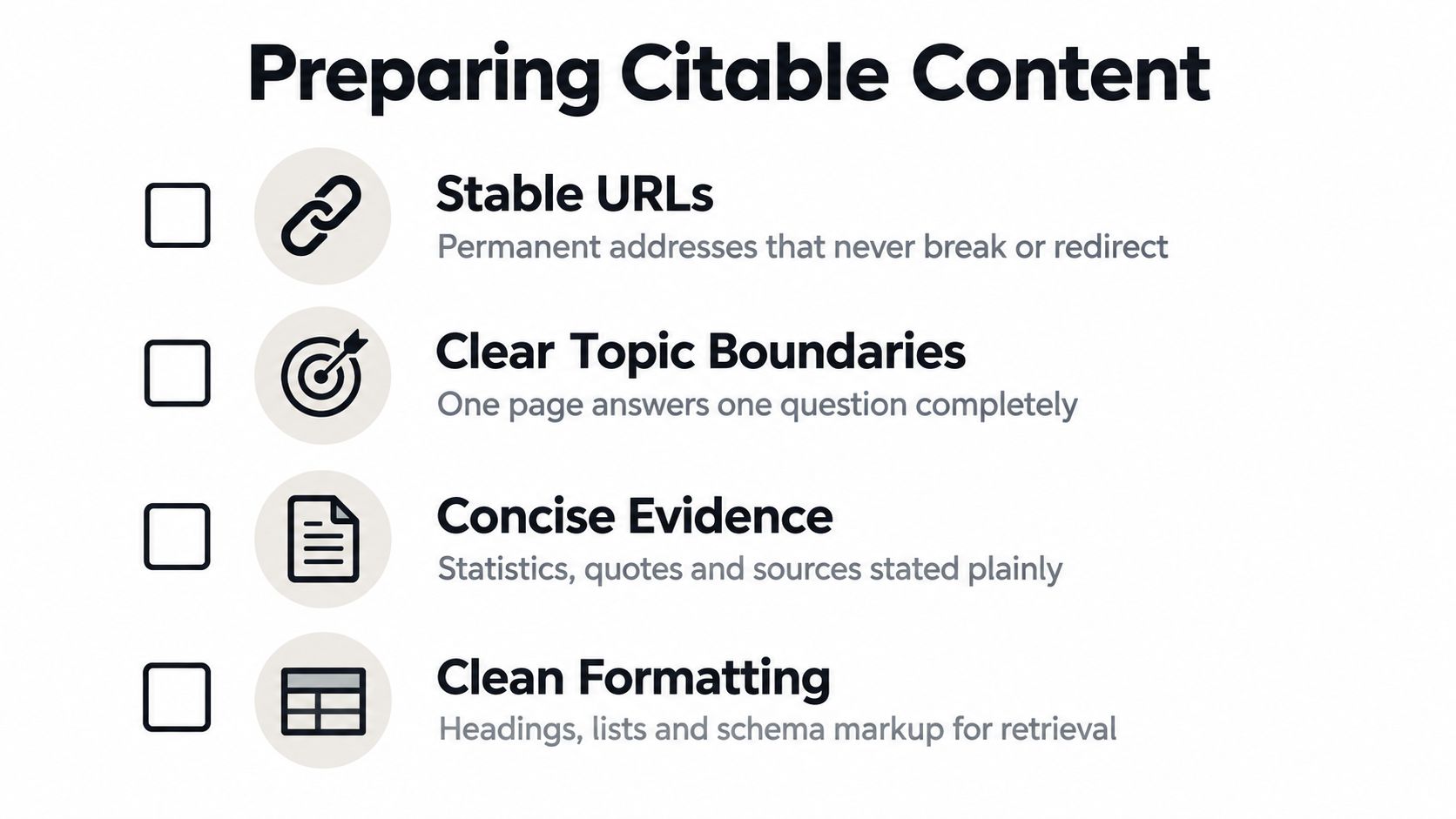
A practical page checklist
- Stable URLs: Keep the address permanent, and ensure the cited page resolves to the subject described in search results.
- Clear topic boundaries: Give each page one primary question. Place adjacent questions in separate sections or pages.
- Concise evidence: State statistics, quotations, dates, and source context plainly. Make the connection between evidence and claim explicit.
- Clean formatting: Use descriptive headings, short paragraphs, lists where appropriate, and tables only when they improve comprehension.
Clean formatting supports scanning and accessibility. A large controlled trial across six LLMs found that formatting had negligible impact compared with topic match and recency. The practical implication is limited but useful: keep the page easy to read, while prioritizing topical fit and current evidence over elaborate layout or schema.
Dates also require editorial control. Add a publication date and an update date when the page changes materially. Explain what changed. A visible date without substantive maintenance gives readers little information about reliability.
The wider workflow appears in this practical guide to SEO for AI answers. Publish one focused answer, expose the evidence behind it, and review the page after publication so its claims, links, and dates remain accurate.
Choosing Source Ecosystems That Appear in Citations
Most citation advice begins with a page. The harder question is where citation sources appear across a broader ecosystem. A large analysis of 6.8 million AI citations found that 86% came from sources marketers can directly manage or strongly influence, including brand websites, listings, and reviews, according to Yext's analysis of AI citations, user locations, and query context.
That distribution changes investment priorities. A brand shouldn't treat its blog, directory profiles, review pages, community posts, and editorial coverage as interchangeable. Each source type offers a different level of control and a different editorial purpose.
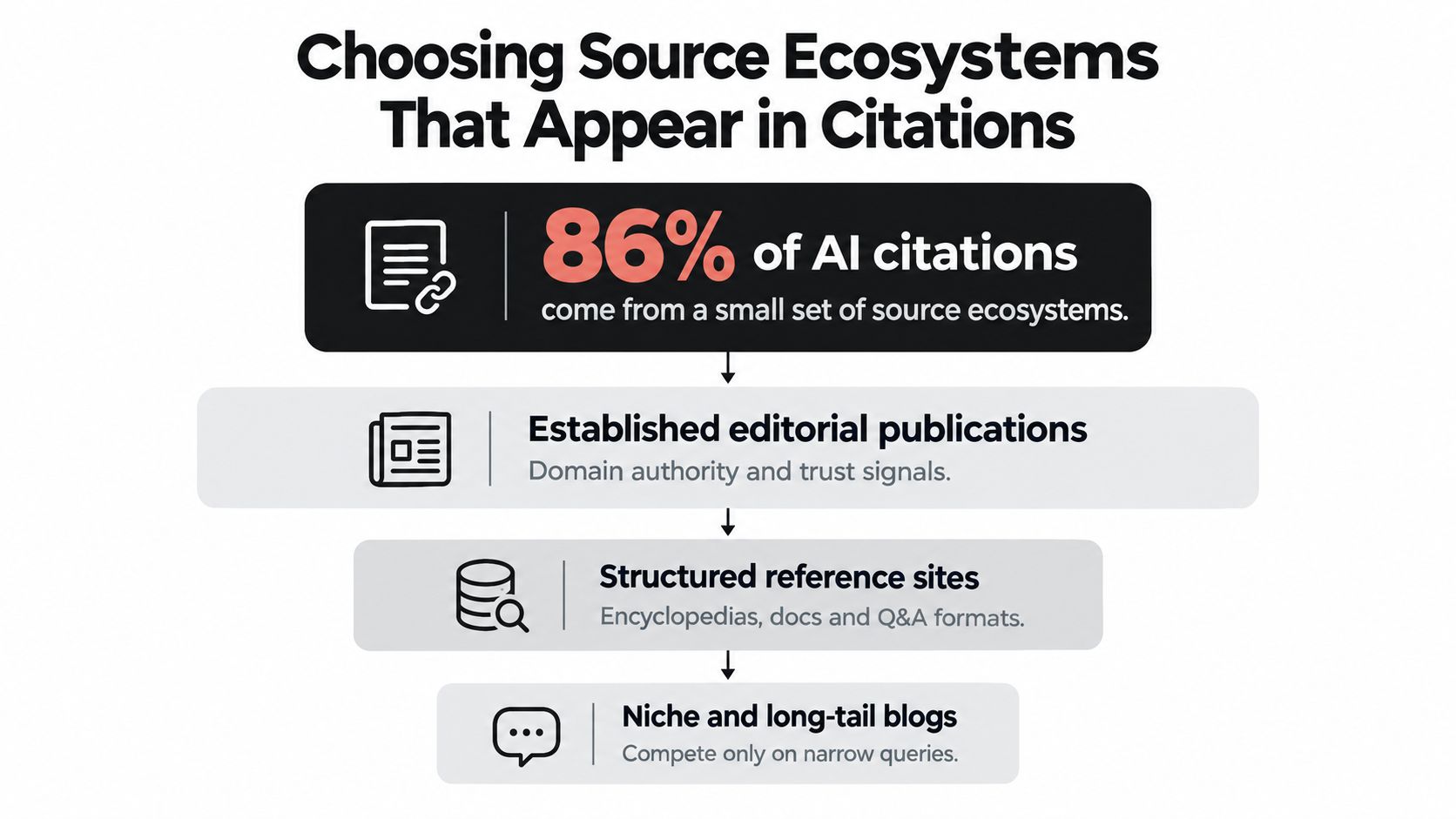
Compare the main source groups
| Source ecosystem | What the team controls | Useful publishing role |
|---|---|---|
| Brand website | High control over facts, dates, structure, and updates | Product explanations, documentation, research, and original analysis |
| Listings and profiles | Control over core business information | Consistent names, locations, services, and descriptions |
| Reviews | Partial control, with customer-generated content | Experience evidence and recurring customer language |
| Editorial publications | Low direct control | Independent context and third-party coverage |
| Community platforms | Limited control | Questions, discussions, and practical user perspectives |
| Academic and government sources | Very low control | Formal evidence, standards, and public information |
The finding doesn't prove that every brand should reduce investment in public relations, Reddit, or academic references. It does establish that controllable sources represented most of the measured citation set in that analysis. The operational conclusion is stronger than the usual “publish great content” advice: maintain a source ecosystem that can be corrected and kept consistent.
Owned content comes first because teams can revise it. Listings matter because conflicting business details create avoidable ambiguity. Reviews matter for experience-led queries, but a company can't script authentic customer testimony. Editorial and community sources remain valuable for independent context, even though the publisher can't fully manage their wording or permanence.
Build an evidence network
A sustainable source portfolio should connect, not duplicate. A product page can state the official specification. Documentation can explain implementation. A review profile can collect customer experience. An editorial article can provide outside context. Internal links and consistent naming help readers move between these roles, but each page should retain a distinct purpose.
Perplexity's source review process assigns domains one of three labels, Government, Academic, or Trusted, as described in its source-label documentation. Publishers can't assign those labels themselves. They can, however, make source quality and provenance visible through accurate authorship, dates, methodology, and references.
The best allocation is therefore not “owned versus earned.” It is owned for precision, earned for independence, and community sources for lived context. Teams should audit all three and record which source type appeared when their brand was cited.
Testing Prompts and Validating Citations
Prompt testing turns a citation strategy into an observation log. Use representative questions rather than branded prompts designed to produce favorable answers. The goal is to measure how source selection changes across realistic query conditions.
Build a query set that covers commercial, informational, comparison, local, and support intent where those categories fit the business. Keep wording stable during each testing cycle. For every response, record whether the brand was cited, mentioned without a citation, recommended, or omitted. Save the exact cited page, then check whether it supports the claim presented.
Isolate one variable at a time
Building on the trial summarized earlier, use its four gatekeeper variables as a test matrix: vary topic match while holding price, recency, and position as consistent as possible. The trial also reported secondary gains from completeness and trust cues. Treat these findings as experimental observations, not evidence of a hidden ranking process.
Define each variable before testing:
- Topic match: Compare a general page with one written specifically for the query.
- Price: Test queries where cost is part of the answer, while keeping other source details stable.
- Recency: Compare an older version with a materially updated version.
- Position: Record where each page appeared in the returned source set.
- Completeness and trust cues: Add a missing answer component, transparent authorship, methodology, or source context without changing the central claim.
Change one page attribute per test. Keep the query, competing source context, and page purpose consistent. Brand anonymization in matched A/B source pairs can reduce the risk that recognition affects the result. The cited trial used this approach to isolate individual variables.
Validate the citation, not just the appearance
A listed source is not enough. Review three properties:
- Support: Does the page substantiate the sentence attached to it?
- Scope: Did the response turn a qualified claim into an absolute one?
- Currency: Does the page still contain the relevant information?
A useful log records the query, date, platform, response text, citation URL, citation type, supported claim, and page version. Add the test variable and its control condition so later reviews can separate a change in source content from a change in query context.
Repeat each test across the planned query set. One response can reveal a useful discrepancy, but repeated patterns provide stronger evidence for editorial decisions. When a citation fails validation, revise the page or qualify the claim before treating the appearance as a success.
A citation is useful only when the linked page supports the answer readers were given.
Measuring Visibility and Resurfacing Rates
AI visibility is volatile enough to make snapshot reporting misleading. In a measurement study of live AI search responses, about 57% of brands that disappeared from one response resurfaced later, while only 30% stayed visible in back-to-back responses. Brands that earned both a citation and a mention were 40% more likely to resurface than brands with citations alone, according to the study of citation and mention visibility.
Those figures describe observed response behavior. They don't establish why a brand disappeared or returned. A change may reflect query variation, source availability, response composition, or product changes. Reporting should therefore describe movement rather than assign a causal explanation without testing.
Replace snapshots with a series
A practical dashboard separates four outcomes:
| Outcome | What to record |
|---|---|
| Citation | The brand page or external source was linked |
| Mention | The brand appeared without a linked citation |
| Recommendation | The response suggested the brand for the query |
| Omission | The brand wasn't present |
The distinction between citation and mention matters because the measurement study observed stronger resurfacing for brands receiving both. A brand can therefore lose a citation while retaining useful visibility through an unlinked mention. Combining both into one score hides that difference.
Retest the same query set on a regular schedule and preserve prior results. Add a small set of new queries only after the baseline remains stable. When a page disappears, check whether the cited source changed, whether the page still supports the answer, and whether the query wording remained identical.
This guide to AI citation tracking provides a framework for separating mentions from citations and preserving page-level records. The key reporting habit is to show appearance, disappearance, and resurfacing, not just the latest visible result.
The evidence supports planning for fluctuation. It doesn't support promising a fixed citation position or a permanent inclusion. A stable process is more valuable than a single favorable response.
Building a Sustainable Citation Strategy
The strongest workflow combines four activities, but it shouldn't collapse them into one score. Content preparation determines whether a page can be checked. Source-ecosystem management determines where consistent facts exist. Prompt testing reveals what appeared in actual responses. Measurement shows whether visibility persisted or changed.
Run the workflow as an editorial loop
Publish one answerable page. Give it a stable URL, a narrow subject, clear headings, concise evidence, visible dates, and references that support the exact claims. Keep the central answer understandable without requiring the reader to reconstruct it from several sections.
Maintain the surrounding sources. Review the brand website, listings, reviews, documentation, and relevant third-party coverage. Correct conflicting names, descriptions, prices, and service details. Don't create duplicate pages just to increase volume. Create a new source when it serves a distinct audience or question.
Test representative prompts. Use the same query set across each reporting cycle. Record citations and mentions separately. Keep the response text and page URL so editors can validate whether the source supports the answer.
Refresh based on evidence. Update a page when facts change, when a cited claim becomes stale, or when testing repeatedly shows a missing subtopic. Don't add statistics merely to make a page look data-rich. Unsupported precision makes verification harder.
Teams can use manual checks, platform-specific reporting, or a monitoring product. The AI Search Signals is one option that records brand mentions and cited sources across AI answer systems, based on its brand monitoring workflow. Any system should preserve the underlying prompt, response, citation URL, and timestamp rather than provide only an opaque visibility score.
Keep conclusions within the evidence
The current evidence supports several practical conclusions. Broad search visibility matters because most cited URLs in the large ChatGPT prompt study came from the general search index. Relevance, price, recency, and position appeared as gatekeeper factors in the controlled multi-LLM trial. Source ecosystems under marketer control accounted for most measured AI citations in the large Yext analysis. Visibility also fluctuated across repeated live responses.
The evidence doesn't establish a universal content template, a guaranteed citation rate, or a permanent advantage from schema, page length, or a particular platform. It also doesn't show that one source type wins for every query or market. Teams should test those questions instead of turning vendor guidance into a rule.
Sustainable citation work is measurement-led publishing, not a formatting trick.
A quarterly content audit can identify stale evidence and broken URLs. A recurring prompt panel can reveal changes in citation and mention patterns. A source inventory can show whether the brand's core facts remain consistent across owned and influenced properties. Together, these practices create a defensible operating system for AI visibility without claiming access to internal model behavior.
Build a pilot around a small set of high-value queries. Assign an editor to review the target pages, a marketer to audit the surrounding source ecosystem, and an analyst to log citations, mentions, omissions, and resurfacing. Recheck the same prompts on a fixed cadence, validate every linked claim, and update pages only when the evidence supports a change.