
Teams are measuring AI visibility the wrong way. They count how often a brand appears in an answer, then treat the total as a score. That mixes a simple mention with a linked source, a comparison entry, and a citation supporting a specific claim. Those events don't carry the same meaning.
AI citation tracking needs a stricter question: did the system cite the brand's page as evidence for what it said? That question matters because Google AI Overviews can show source panels, while traditional ranking tools don't expose that visibility. Google AI Overview source panels require separate checking, and ChatGPT displays citations when it browses the web and includes linked sources from that session. ChatGPT citation behavior is described here
Why Counting Mentions Misstates AI Visibility
A brand mention is not automatically a trustworthy attribution. An answer might name a company in a comparison, repeat a sourced fact, add a warning, or list alternatives without linking any of them. A dashboard that combines these events produces a precise-looking number while hiding the commercial context.
The difference matters when one response contains both a mention and a citation. “Brand A is an option” shows that the entity appeared. A linked product guide supporting a statement about Brand A shows where the answer's evidence came from. Record those as separate observations.
Measurement rule: A mention answers “was the entity present?” A citation answers “was a source attributed to support the answer?”
Citation tracking therefore belongs beside rank and click reporting. Google AI Overviews can cite several pages inside an answer panel, yet that source layer may not appear as a conventional organic position in SEO platforms. AI Overview visibility requires source-panel inspection rather than blue-link tracking
A 2026 analysis of 1,000 Google AI Overviews reported an average of 4.2 sources per overview, with 2 to 9 citations per response. It also found that only 38% of cited pages ranked in the top 10 organic results. Classic rankings therefore cannot substitute for citation measurement. The citation-pattern analysis reports these metrics
The practical issue is attribution quality. A brand may appear in the answer but not in the source panel. A page may be retrieved during generation but remain hidden from the reader. A cited URL may sit beside a claim it does not support. Current benchmarking still treats this as an unresolved technical problem. In the CiteME benchmark, CiteGuard reached 68.1% accuracy, compared with 69.2% human performance, after improving the prior baseline by 10 percentage points. The benchmark and its scope are documented in the ACL paper
Tool disagreement is an early diagnostic signal, not merely an inconvenience. If two trackers report different citation counts, compare their prompts, engines, collection times, source definitions, and claim matching before choosing the larger number.
The useful reporting unit is a verified citation event tied to a prompt, an answer, a URL, and the claim surrounding that URL.
What AI Citation Tracking Actually Means
AI citation tracking is the systematic capture and classification of sources shown in generative answers. The work records which prompt was run, which engine produced the response, which URLs appeared, and what each URL was attached to. Trending those events over time exposes patterns that a manual screenshot can't establish.
Rank tracking measures a page's position in a results list. Citation tracking measures whether a domain appears in the attribution layer, such as an inline link, footnote, or Google AI Overview source panel. The two can overlap, but they answer different questions.
A page can rank well and never appear in an AI answer. A page can also be cited while sitting outside the traditional top 10 results, as documented in the Google AI Overview citation analysis above. Treating these as one metric creates bad diagnosis. A ranking decline might not explain a citation decline, and a citation gain might not appear as an organic ranking gain.
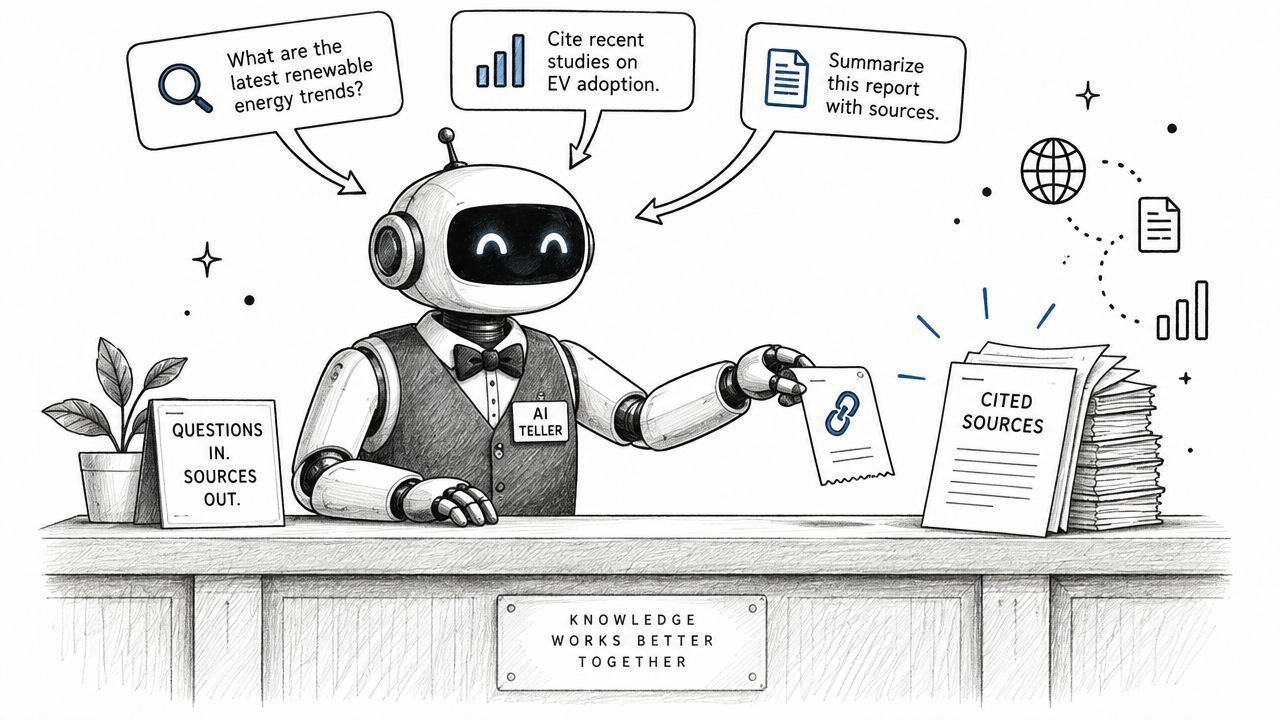
A bank-teller analogy makes the distinction easier. A teller can hand over money, which is retrieval. The customer still needs a receipt naming the branch and account reference to verify where the transaction came from. Retrieval tells the system which material was available to the response. A citation gives the reader an observable source connection.
A tracking record should therefore contain at least:
- Prompt identity: The exact question, not a shortened keyword label.
- Engine context: The product, locale, date context, and retrieval mode used.
- Full answer: The complete response, including wording around each source.
- Citation details: Every cited URL, its position, and the associated passage.
- Classification: Direct citation, text-only mention, unsupported attribution, or exclusion.
The methodology matters because one answer can contain several URLs. A rigorous system keeps the event grain fixed, so a single prompt with many links doesn't distort the result. The citation-tracking methodology separates answer-level rate, source share, and prompt coverage
A useful working definition appears in this explanation of why citations matter: citation tracking is not a screenshot exercise. It's a repeatable record of how answers reference sources.
The Three Layers of a Citation Metric
One number can't describe AI visibility. A useful measurement model separates answer-level citation rate, source citation share, and prompt coverage. Each layer uses a different denominator and answers a different business question.
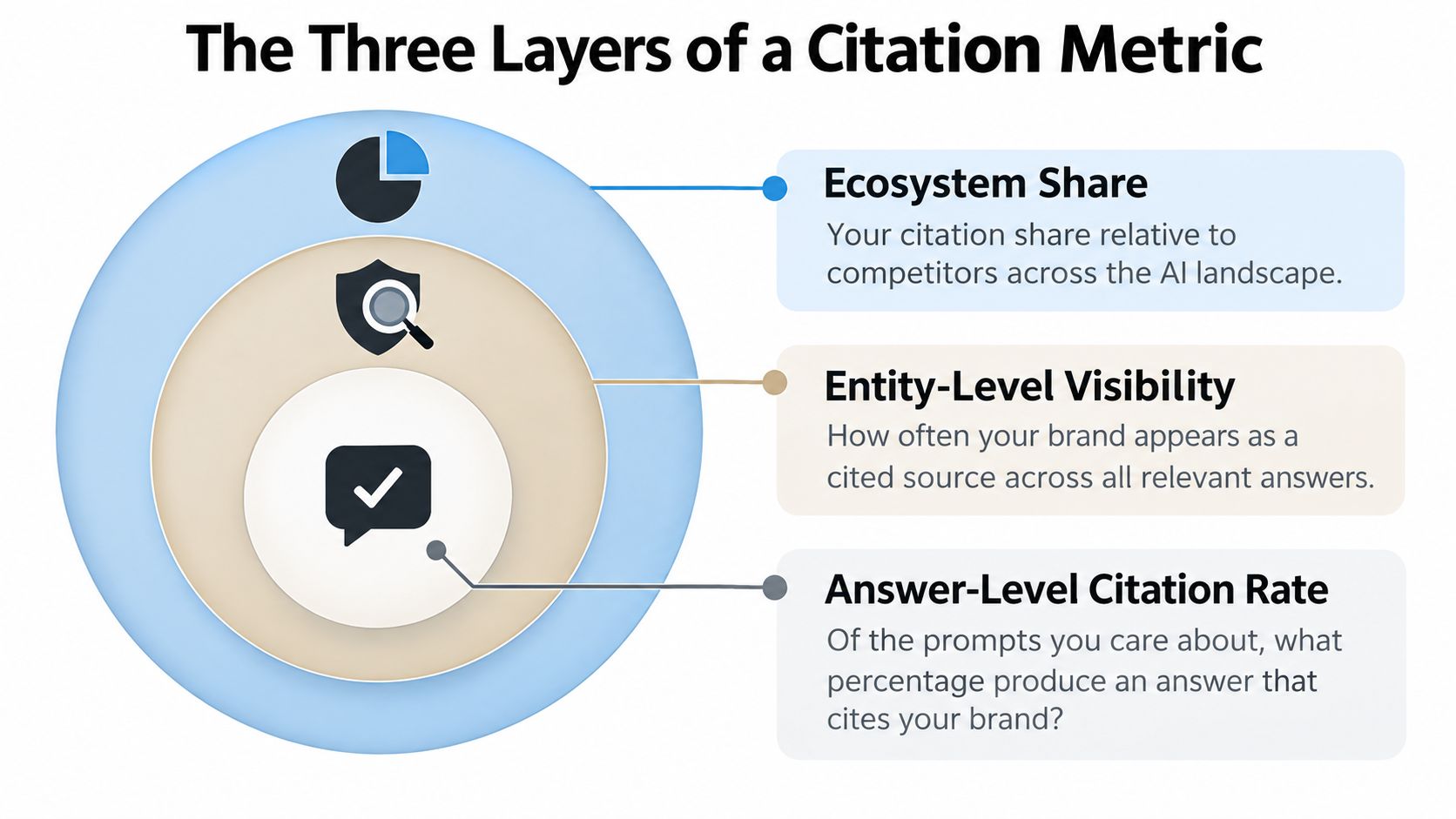
Answer-level citation rate
This asks: of the eligible prompts tested, how many produced an answer citing the domain at least once? It measures presence at the answer level. A response with one citation and a response with five citations both count as cited answers under this layer.
That makes the metric useful for a retrieval diagnosis. If high-intent prompts rarely produce an answer citing the domain, the content may not be entering the visible evidence set. The metric doesn't show whether the brand is winning against competitors, and it doesn't judge whether the citation supports the claim.
Source citation share
This asks: among all tracked source citations, what portion points to the target domain? It measures competition inside the same answer set. If an answer cites several domains, each source event can be classified by domain and compared with competing sources.
Source share is closer to share of voice than answer-level rate, but it must be reported with its denominator. A brand can appear in many answers while holding a small share of all source links. Another can appear less often but capture a larger portion of the cited-source set.
Prompt coverage
Prompt coverage asks whether the tracked library represents the territory the business wants to win. A domain can perform well on a narrow group of branded questions and still miss comparison, problem, category, or use-case prompts.
The three layers work together:
| Layer | Question answered | Main use |
|---|---|---|
| Answer-level citation rate | Did the domain appear in the answer's citation set? | Diagnose presence |
| Source citation share | How much of the cited-source set belongs to the domain? | Compare competitors |
| Prompt coverage | Which important prompt groups are represented or missing? | Find topical gaps |
A methodology that logs every eligible run, every cited URL, and every exclusion reason avoids denominator confusion. Repeated runs also matter because citation inclusion can change across engines and prompt variants. Single snapshots turn unstable output into false certainty.
A Repeatable Methodology for Citation Tracking
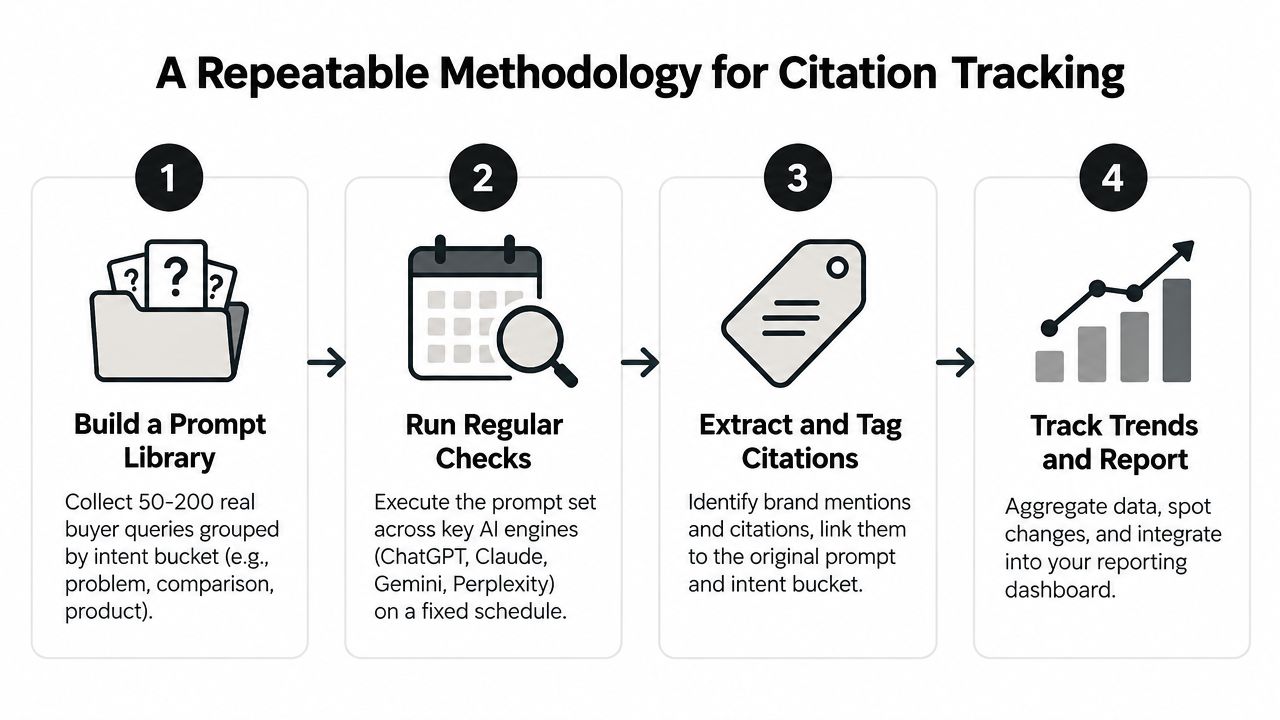
Ad-hoc checks produce anecdotes. A repeatable system produces comparable events. The strongest setup has four parts, and each part belongs in a runbook that another teammate can follow without guessing.
Build a prompt library
Start with real buyer questions grouped by intent. The required library in this workflow contains 50 to 200 queries, as specified by the operating plan, but the important property is not the range. It's realism.
Use questions a customer might type into an answer engine:
- Problem prompts: “How should a SaaS team monitor brand visibility in AI answers?”
- Comparison prompts: “Which platforms compare cited sources across answer engines?”
- Product prompts: “What should a buyer verify before choosing a citation tracker?”
- Category prompts: “What tools measure sources cited in Google AI Overviews?”
Keep the exact wording stable. Keyword mutations make it difficult to tell whether a visibility change came from the engine or from a rewritten prompt.
Standardize each run
Record the model or engine, version where available, locale, date context, retrieval mode, and any system-level settings exposed by the interface. Teams should also note whether browsing was active.
The purpose isn't to claim that every response can be reproduced perfectly. It's to make differences visible. If the environment changes, the log should show that a comparison isn't like for like.
Log each citation event
Each run should include a prompt ID, timestamp, engine, full response, cited URL, citation position, and surrounding snippet. Store the answer before applying classifications, because a later audit may find that a URL was present but attached to a different claim than first assumed.
A useful schema separates the source from the interpretation:
| Field | Example use |
|---|---|
| Prompt ID | Connects the event to an intent bucket |
| Response text | Preserves the observed answer |
| Cited URL | Identifies the attributed source |
| URL position | Records its order in the source set |
| Claim snippet | Shows what the source appears to support |
| Status | Verified, unsupported, ambiguous, or excluded |
Repeat on a fixed cadence
Run the same prompt set on a weekly or biweekly schedule. The first run is a calibration baseline, not a verdict. Repetition helps separate a durable pattern from a one-off answer.
The system should retain failed runs and exclusion reasons. A missing response, blocked source, changed prompt, or unavailable engine isn't the same as an answer that cited a competitor. Removing those events makes the final metric look healthier than the underlying observation.
Dedicated Tools Compared to DIY Prompt Logging
Dedicated platforms and DIY logging solve different measurement problems. A dedicated tool can automate recurring checks and normalize results. A DIY system makes the raw evidence easier to inspect and the method easier to change.
The named platforms in this comparison include Profound, Otterly, Peec AI, Scrunch, SimilarAI, and Writesonic GEO. Their actual coverage and output should be verified against published evaluation criteria before procurement. A dashboard label isn't proof that an engine was queried directly or that a citation supports the surrounding claim.
| Capability | Dedicated AI Visibility Tools | DIY Prompt Logging |
|---|---|---|
| Prompt volume | Built for larger monitored libraries | Limited by staff time, API usage, or spreadsheet discipline |
| Scheduled reruns | Usually available as an automated workflow, subject to vendor documentation | Must be scheduled and maintained by the team |
| Raw response access | Varies by export and plan | Full control when the run returns complete outputs |
| Citation normalization | Often converted into share and trend views | Defined by the team's own schema |
| Engine coverage | Depends on the engines and access method disclosed by the vendor | Limited to interfaces or APIs the team can access |
| Auditability | Depends on raw exports, logs, and reproducibility | Strong when every request and response is retained |
| Engineering effort | Lower at setup, higher when custom validation is needed | Higher at setup and maintenance |
| Cost control | Predictable only when query, engine, and refresh limits are clear | More direct control over usage and labor |
DIY logging can use APIs from OpenAI, Anthropic, and Perplexity, or a spreadsheet for manual checks. It gives the team exact prompt control and access to raw output. It also under-samples engines that aren't included in the chosen setup and can become difficult to maintain as prompt libraries expand.
Dedicated systems are useful for scheduled reruns, competitive comparisons, and source URL extraction. They can still hide the most important evidence if they provide only a final score. Before choosing one, teams should ask for the prompt list, engine coverage, refresh rules, raw responses, citation classification logic, and export fields. An AI search visibility checker illustrates the kinds of inputs and outputs teams should inspect.
Tool disagreement deserves attention rather than dismissal. A 2026 controlled comparison found an 8.2x gap between the lowest and highest citation counts across seven tracking tools for the same domain over 15 days. The comparison discusses the measurement disagreement and its implications
That gap may reflect prompt variance, retrieval differences, inclusion rules, or stale data. It doesn't prove that one platform is correct. The disagreement itself is the first audit signal.
How to Validate Any Tool Before You Trust the Number
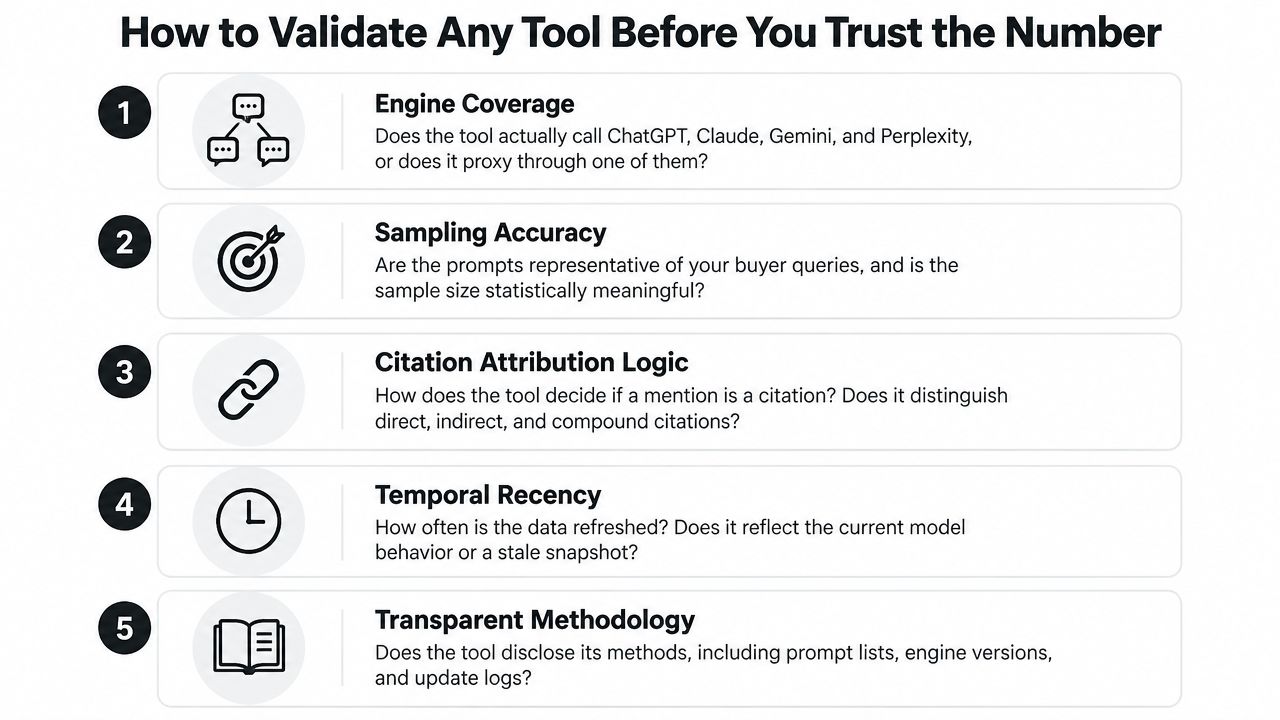
A citation-share figure shouldn't enter a stakeholder report until the measurement process has been inspected. Five checks expose most problems.
Check engine coverage
Confirm whether the platform queries ChatGPT, Claude, Gemini, and Perplexity, or whether it uses one provider and presents the result as multi-engine coverage. Google AI Overviews require a separate check because their source panel is distinct from ordinary result positions.
Ask for the engine name, access method, refresh schedule, locale handling, and retrieval settings. If the vendor can't answer, the coverage label isn't sufficiently auditable.
Audit cited URLs
Take a sample of cited pages and open them manually. Check that the URL exists, was shown in the response, and relates to the claim placed beside it.
This step catches false citations and weak attribution. A source can be real yet fail to support the statement. The benchmark evidence cited earlier shows why visible source presence and attribution quality should be measured separately.
Cross-check the output
Run overlapping prompts through a second tool and a manual workflow. The proposed operational threshold is 70 percent agreement across the overlapping observations, but that threshold belongs to the validation protocol, not to a verified industry benchmark. Agreement below it should trigger investigation into prompt variance or measurement error rather than an immediate visibility conclusion.
Keep the comparison event-level. “The tools agree on the brand” is too broad. Compare prompt, engine, cited URL, and citation status.
Inspect the prompt set
A prompt library dominated by branded questions flatters established brands. Review the mix by problem, category, comparison, product, and competitor intent. Coverage should reflect the questions that matter commercially, not only the questions that produce comfortable results.
Demand raw exports
The export should include every response, every cited URL, timestamps, prompt IDs, engine identifiers, and exclusion reasons. Without those fields, the team can't reproduce the number next quarter or explain why two reports differ.
Audit principle: A polished dashboard is an interpretation layer. The response log is the evidence.
Putting Citation Tracking Into Your Reporting Routine
Citation tracking works best as a monthly layer on an existing SEO dashboard. It shouldn't become a separate reporting island with different prompt definitions, dates, and competitive sets.
The monthly package can contain three artifacts:
- Citation-share trend chart: Plot source citation share beside organic visibility, while keeping the denominators separate.
- Prompt-coverage heatmap: Group prompts by intent and show where the domain earns citations, misses them, or receives ambiguous attribution.
- Validation narrative: Explain tool disagreements, changed engine conditions, unsupported URLs, and exclusions.
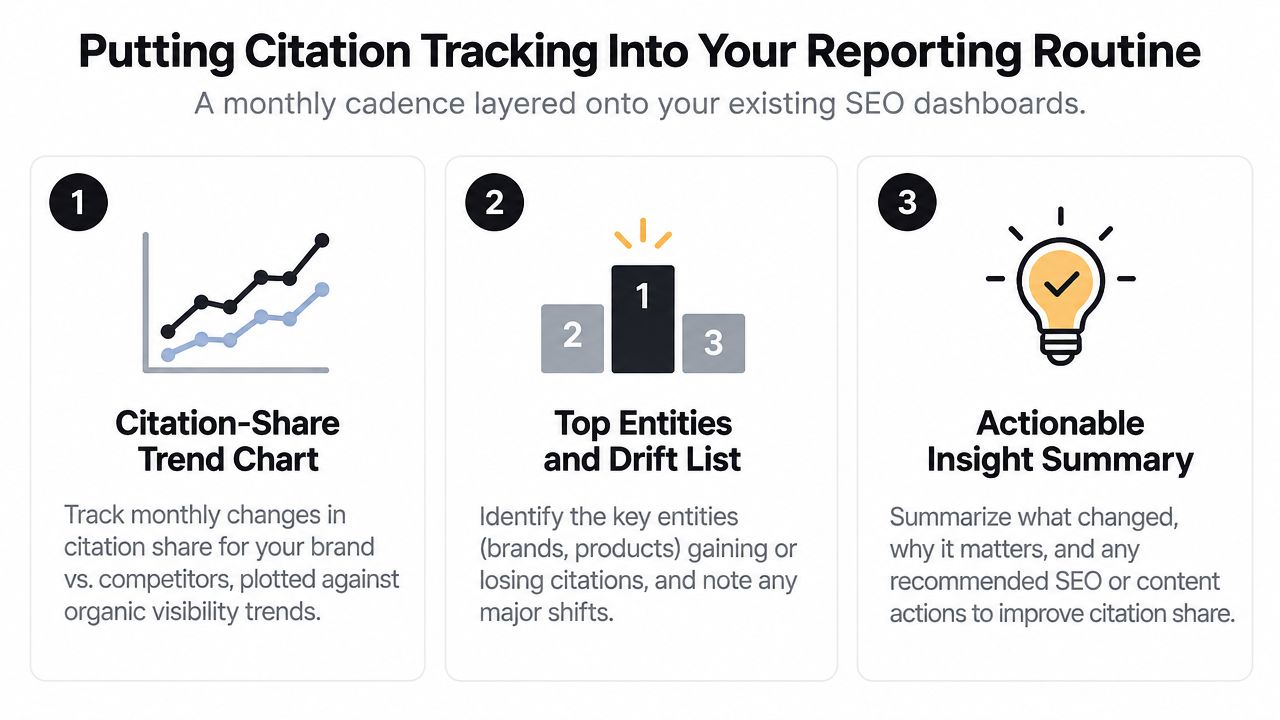
The first report should establish a baseline, not claim return on investment. Alerts belong to sharp changes in answer-level citation rate for priority topics or a newly observed competitor entering the citation set. Longer movements in source citation share and shifts in engine mix belong in a quarterly review.
A reporting layer such as AI traffic analytics can sit alongside referral and organic data, but referral visits still won't explain every AI-influenced interaction. Open questions remain around citation disclosure, multi-hop attribution, and whether source citation share will correlate cleanly with revenue.
Build the first measurement baseline with a fixed prompt library, a documented runbook, and raw response storage. Then audit a sample of cited URLs before presenting any citation-share number to leadership. This week, assign an owner, select the initial buyer prompts, and record the first comparable runs across the engines that matter to the business.