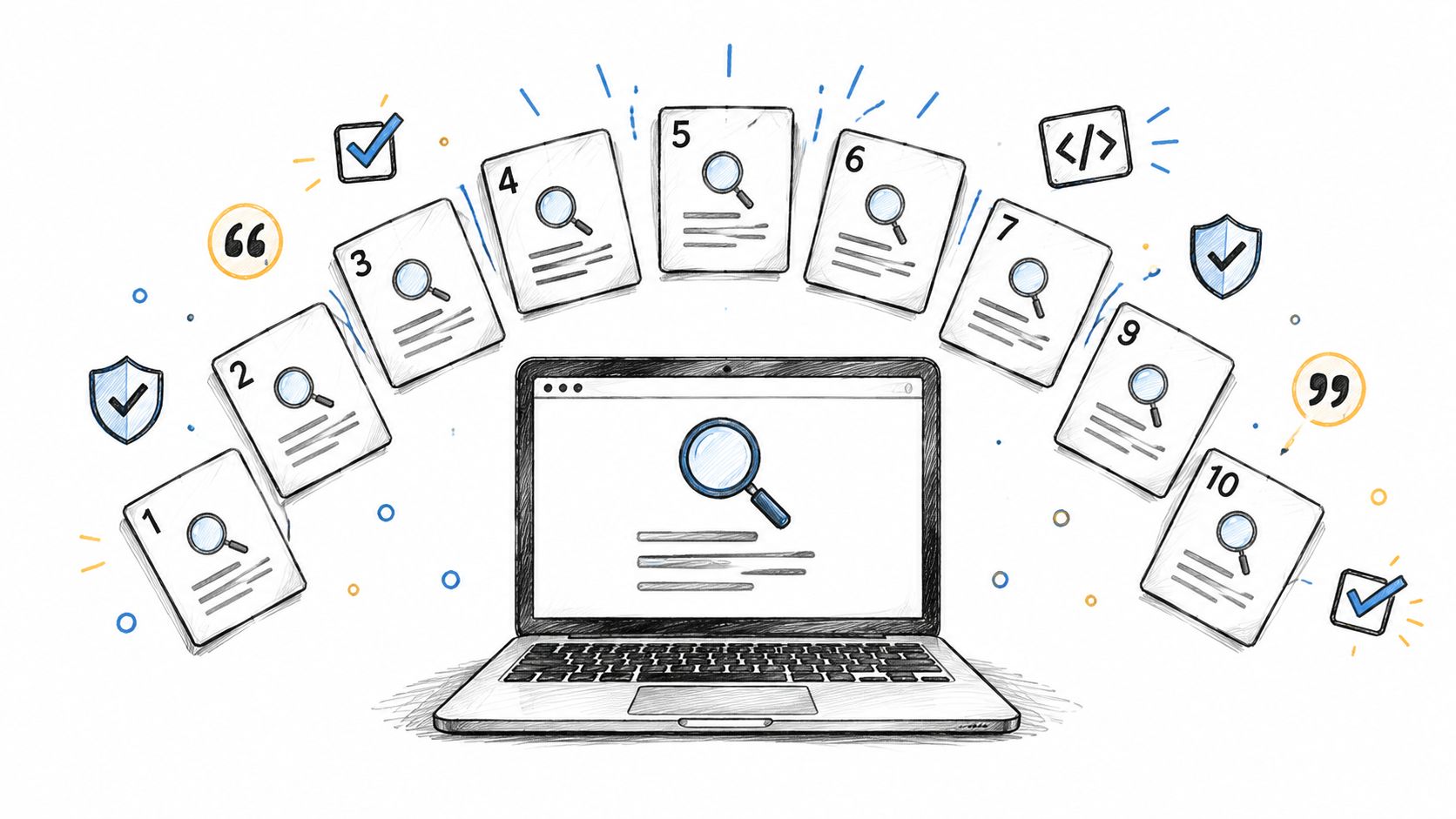
A marketer opens ChatGPT or Google AI Overviews and searches for a brand-relevant answer. Competitors appear in the response, while their company is absent. The answer looks polished and includes links, yet the missing brand exposes a key change in search: citations can influence whether a company becomes visible inside an AI-generated answer.
Traditional SEO trained teams to focus on blue links, titles, and rankings. Answer engines add another layer. A brand might be mentioned, cited, or surfaced as a source. Those outcomes differ. The practical questions are who gets cited, which page supports the answer, and whether the citation faithfully matches the claim.
Citations therefore serve as both a reader's verification path and a visibility signal within the answer experience. They show where information came from, give readers a way to check it, and connect a brand to a specific statement. University of Wisconsin Library citation guidance explains that citations help readers trace sources and evaluate the basis for an argument. University of Jordan library guidance on citations and source evaluation likewise connects source evaluation with judging whether information is credible and relevant.
AI systems can still select an unsuitable source or present a citation that does not support the wording around it. A visible link alone is not proof. Its value depends on the quality of the source and how closely it supports the answer.
For marketers, this reframes citations from simple attribution into an evidence and visibility mechanism. Clear, faithful citations can strengthen trust and place a brand beside a relevant answer. Weak, random, or misleading citations can make an answer look supported while leaving its evidence chain difficult to verify. Presence matters, but so do source quality and accuracy.
What Citations Mean in Traditional Search and AI Answers
In traditional academic writing, a citation has two parts. The in-text marker points to a source in the body of the work. The reference list gives the full source details used in the work (Paperpal on in-text citations and reference lists). That split is simple, and it teaches the core rule well. The reader needs a signpost and a source trail.
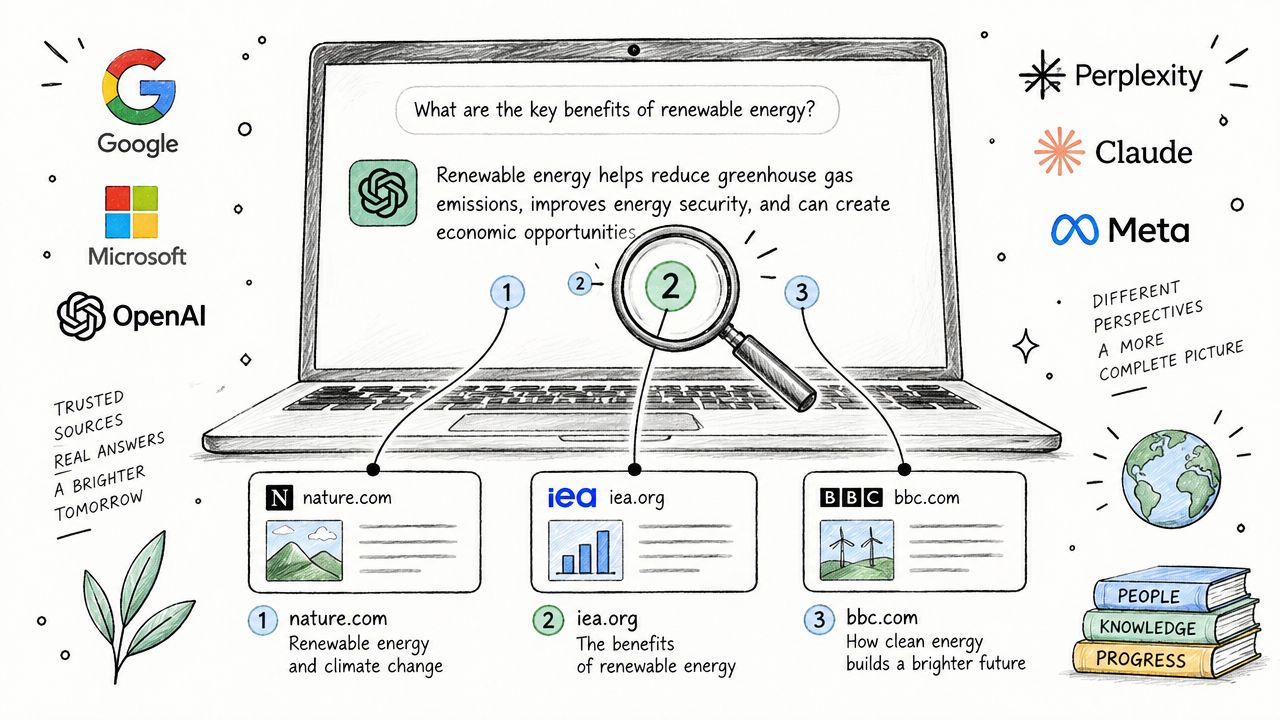
AI answers use a similar logic, but the setting changes. A description of generative search systems notes that they present a synthesized response with in-text citations to web URLs, which makes source links part of how the answer is substantiated (generative search systems and inline URL citations). The citation is no longer only a bibliographic detail. It sits inside the answer itself.
A simple way to think about it
A briefing memo with footnotes works in the same way. The memo can still read smoothly, but each important claim has a note attached. If a reader wants to challenge the statement, the note is already there. AI citations work the same way. They are not decoration. They are the proof trail that lets a reader ask, “Where did this come from?”
Practical rule: if a citation would not help a reader verify the exact claim, it is probably only giving the appearance of support.
For marketers, the shift is practical. A blue link asks a user to leave the page and inspect the source. An AI answer often places the source inside the answer itself. That changes where visibility happens. A brand may never earn the click in the old sense, yet still appear in the response as a cited source.
That is why checking rankings alone misses part of the picture. AI answer visibility is not just about being found. It is about being quotable, traceable, and easy for the response to substantiate.
How AI Answer Systems Surface Citations and Why It Matters
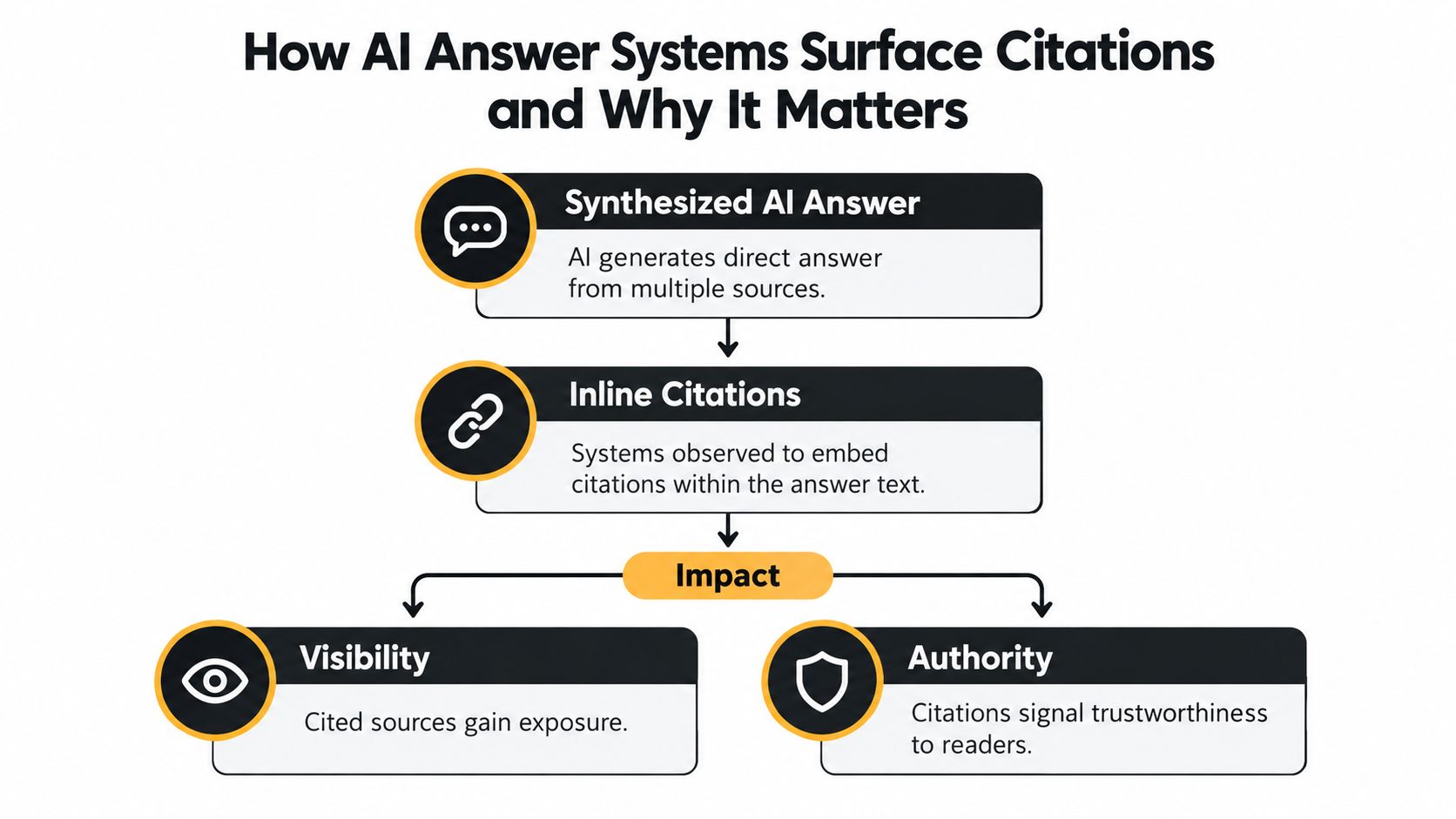
A marketer asks a question. The answer engine returns one response, not a page of blue links. Inside that response, it may place citations next to the claims it is using. That changes the job of the source. The source is no longer only something a user might click later. It is part of the answer itself.
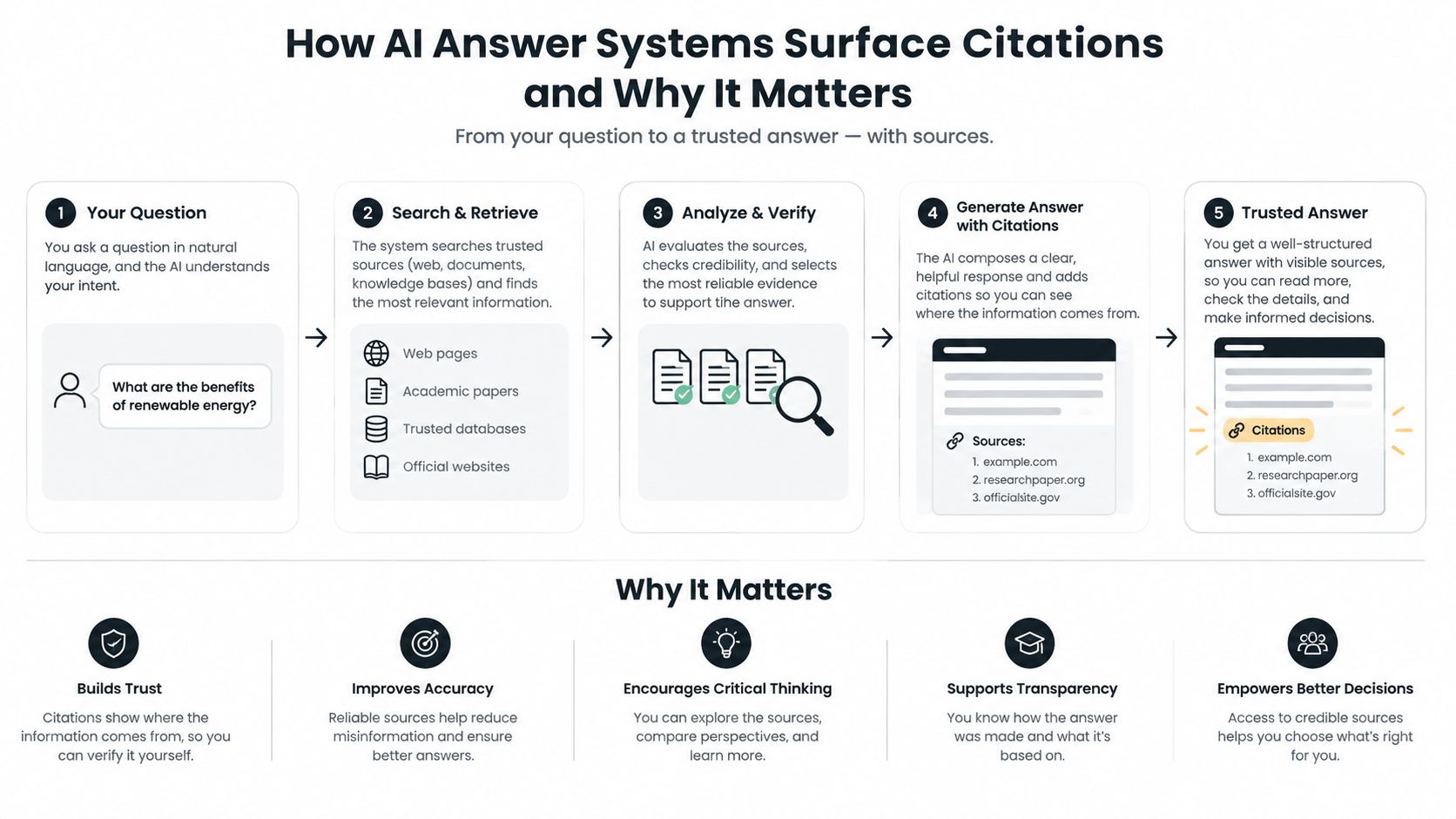
The practical difference is simple. In classic search, visibility usually means appearing in a results list. In answer engines, visibility can mean being named as support for a statement inside the reply. That is why how ChatGPT gets its information matters to SEO teams. The system is not showing a raw library of options. It is assembling a response and attaching sources that help the answer hold together.
A citation inside an AI answer works like a footnote inside a memo. It gives the reader a place to check the claim. It also tells the system, and the user, that this sentence is not just floating on its own. For marketers, that means the old question, “Did we rank?” is only part of the picture. The tighter question is, “Did the answer engine surface our source as usable evidence?”
Visibility is not the same as a ranking position
It is easy to read citation presence as if it were a new rank. That is too neat. A source may appear because it is easy to extract, because it matches the answer format, or because it helps support the statement being made. The internal logic is hidden, so measurement has to stay close to what can be observed.
One industry release from Yext AI citations release says its own system often cites brand and location-level data. That is their framing, so it should be treated carefully. Even so, the point is useful. Answer systems may surface specific source locations, not just broad brand reputation.
For teams used to Google, that changes how visibility works. A homepage can matter, but so can product pages, help articles, local pages, and other source pages that are easy to verify. A source that is clear, specific, and easy to quote has a better chance of being used as evidence than a vague page that says a lot without pinning down anything.
The measurement mindset changes too. Instead of only checking rankings, marketers need to ask whether the brand appears in cited answers, whether the citation fits the claim, and whether the source is the brand's own material or someone else's description of the brand. For a practical way to review that kind of appearance, see this AI visibility checker.
Why Citation Presence Changes Trust and Credibility
A buyer asks an AI tool whether a brand is suitable. The answer includes the brand and a source link. The link may make the recommendation feel supported before the buyer opens it. That first impression matters, but it is only the beginning.
A controlled 2025 study found that trust increased significantly when citations appeared, even when the citations were random. Trust fell when participants checked those citations. The result separates two effects: citation presence can create an initial credibility signal, while source quality determines whether that signal survives review (2025 controlled study on citations and trust in AI-generated answers).
Core point: citation presence can invite trust, but verification decides whether that trust survives.

What this means for brand credibility
For marketers, the effect reaches beyond CTR or impressions. A citation can place a brand inside an answer at the moment a reader is forming an opinion. It also makes the supporting page part of that experience. The brand name earns attention, while the source gives the reader a way to test the claim.
That creates two possible outcomes. A faithful, relevant citation can strengthen confidence and make the brand easier to trust. A weak or mismatched citation can make the mention look careless, even if the answer itself sounds polished. Readers may ask whether the source supports the statement, rather than noticing that the brand was named.
Citation volume cannot solve that problem. Several weak mentions provide little protection when a user checks the underlying pages. A smaller set of clear, relevant sources can do more for credibility because each one gives the reader a sensible verification path.
The practical standard is straightforward. Publish source material that remains credible when a human opens it. The page should be clear, current, and directly connected to the claim. It should support the answer, not merely sit near the topic. That combination helps citations function as both a trust signal and a way for users to verify what an AI answer says.
What Makes a Citation Count as Real Evidence
A citation earns its place by supporting the exact claim beside it. Research on retrieval-augmented generation separates citation faithfulness from citation correctness. A source may be relevant to the topic yet fail to support the statement attached to it (wallat 2025 on citation correctness). This is why a citation can look credible and still be weak. The problem is often a mismatch, not a fabricated source.
A 2025 study of 1.3 million citation sentence pairs found that citation fidelity was higher when authors cited newer papers and work that was intellectually close to the claim. Fidelity was lower as the cited paper's own citation count increased (2025 ACL study on citation fidelity). The study also found that citation importance was associated with recurring mentions, longer discussion, detailed treatment in method sections, and links to concepts, methods, or data. A brief reference can identify a source, while fuller engagement shows why it supports the point.
Strong citations versus weak ones
| Strong citation pattern | Weak citation pattern |
|---|---|
| Directly supports the specific claim | Only loosely related to the topic |
| Gives the reader a clear verification path | Looks plausible but leaves gaps |
| Appears in a meaningful context | Shows up as a quick passing reference |
| Explains enough detail to matter | Is mentioned once and never unpacked |
A useful citation has a clear job. It should support the precise statement in the AI answer, not appear on a page about the same subject. The reader should also be able to open the source, find the relevant passage, and judge the connection without guessing.
That standard changes how marketers should view AI visibility. Citation presence can put a brand in the answer, but citation quality affects whether that mention feels dependable. Faithful support gives the brand a stronger verification path. A loose citation may still create visibility, yet the mention becomes fragile if someone checks the source.
Use a simple test: can the source defend the claim as written? If the answer is no, the citation is decoration rather than evidence.
How to Improve Your Chances of Being Cited in AI Answers
Teams cannot control an answer engine's internal logic. They can control whether a page is easy to verify, extract, and cite without changing the meaning. That work begins with clear structure, identifiable sources, and consistent information about the business, service, or location.
A useful scenario is a reader checking an AI-generated answer. They open the cited page and need to find the supporting statement without searching through slogans or unrelated claims. Pages that separate definitions, process steps, and supporting details make that check easier. A page that is unclear to a human reader gives an answer system more opportunities to quote the wrong passage.
For a practical reference, see how to rank in Perplexity. The relevant lesson here is source readiness, not a promise about rankings. Specific wording, clean structure, and stable facts give citations a better chance of representing the page faithfully.
A compact checklist
- State the claim plainly. Place the main point near the top so readers can confirm it quickly.
- Separate facts from promotion. Show which statements are evidence and which are commentary or sales language.
- Use consistent names and locations. Keep business names, service names, and location pages aligned. Variants can split signals across several versions.
- Add traceable support. Link to documentation, source material, or an explanation that lets readers check the claim.
- Avoid vague superlatives. Polished phrases that communicate little are difficult to quote accurately.
- Watch for source drift. If a page changes meaning over time, its citation may become less faithful even when the URL remains unchanged.
Practical rule: the easier a human can verify a statement, the easier an answer system can cite it accurately.
The goal is not to guess which wording an answer engine will select. No honest SEO can guarantee that outcome. The better approach is to make important claims transparent, sourceable, and stable. Citation presence may improve visibility, while accurate support determines whether that visibility gives readers a dependable way to verify the brand.
Putting Citations to Work for Visibility and Verification
A citation does more than attribute a claim. It gives an AI answer a checkable evidence trail and can help a brand surface where readers are already seeking an answer. The citation itself is not proof of quality. Its value depends on whether the source is relevant, accurate, and faithful to the statement shown.
Teams measuring AI search should ask focused questions: Was the brand cited? Was the source relevant to the answer? Did it support the exact claim? Could a reader verify the connection without guessing? These checks reveal more than link counts because they examine both visibility and evidence.
Review each citation like a skeptical editor. Open the source, read the surrounding passage, and compare it with the wording in the answer. A strong match supports trust. A weak match can make the citation look authoritative while leaving the claim unverified.
For ongoing monitoring, teams can use this AI search visibility checker alongside manual review. A checker can help identify where a brand appears and which sources answer systems cite. Human review still determines whether the citation is appropriate and faithful.
The useful question is not only, “Did we rank?” Ask, “Did we become a verifiable source?” AI answers may change, and no outside observer can promise how an answer system selects or displays a citation. Teams can control the clarity, support, and stability of the pages they publish.
Start with one important page, one set of answer-engine queries, and one citation trail. Check whether the source supports the answer, revise pages that need clearer evidence, and measure brand presence together with verification.