
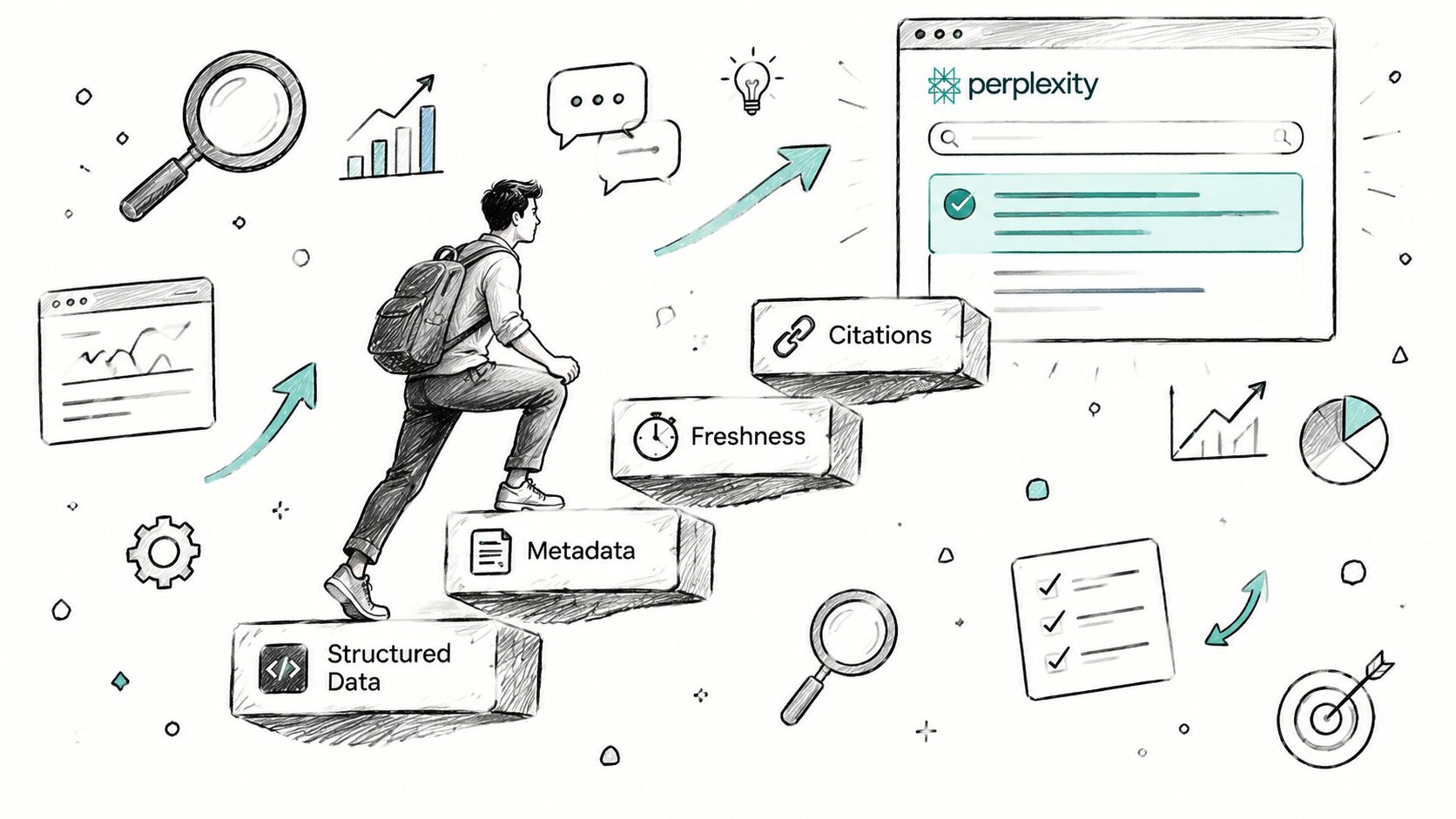
A team can do everything right in Google and still feel invisible in Perplexity. The page may be indexed, the title may match the query, and the brand may even appear in the generated answer, yet the referral never comes because the page wasn't surfaced as a source people could inspect. That split matters, because being mentioned and being cited are not the same outcome.
Perplexity's own product wording makes the distinction clear. Its documentation says, “Citations reveal exactly where every answer comes from”, which is why pages need clear claims, strong evidence, and text that can be verified quickly. For SEO teams, that means the work is less about chasing a generic visibility signal and more about making a page easy to quote, easy to trust, and easy to confirm.
What Showing Up in Perplexity Actually Means
The first job is getting the brand mentioned inside the answer text. That's the moment when Perplexity includes the company, product, or page as part of the generated response, which helps with awareness and can position the brand as part of the conversation. It does not automatically create a click.
The second job is getting the page listed as a cited source under the answer. That's the linkable outcome, the one users can inspect and click through, and the one Perplexity explicitly ties to its citation experience. Perplexity's help text on source labels also shows that some citations carry a shield icon for reviewed domains, including Government, Academic, and Trusted labels, which makes source quality visible in the interface itself. Perplexity's source label help page is useful here because it shows the system is presenting sources as a filterable trust layer, not just a list of URLs.

Practical rule: teams should decide whether they need brand presence, referral traffic, or both before changing a page. A page written for mentions can be broader and more narrative. A page written for citations needs tighter sourcing, cleaner formatting, and sharper attribution.
That difference shapes the rest of the workflow. If the goal is awareness, the content has to be recognizable in the answer itself. If the goal is traffic, the page has to survive the citation layer, where extractability and verification matter more than polish.
How Perplexity Picks Its Sources
Perplexity's public descriptions point to a multi-stage selection process. It starts with a broad candidate set, then reranks pages by topical match, entity relevance, source authority, freshness, crawl access, and prior citation quality before assembling an answer. SEOProfy's summary of Perplexity source selection is one of the clearest public explanations of that pattern, and the practical takeaway is the sequence, not any claim of internal certainty.
What can be influenced
The levers teams can shape are practical. Query coverage matters because pages that answer the same intent in cleaner language are easier to retrieve. Authority patterns matter because outside mentions and linked references help a page look like a source worth extracting from. Freshness matters on topics that change quickly, especially when the question is current or comparative.
For a deeper breakdown of how AI systems decide which brands to recommend, see our analysis of the AI recommendation engine.
AuthorityTech's analysis estimates roughly 3 to 4 cited sources out of about 10 pages reach the synthesis stage, though Perplexity has not confirmed those figures. AuthorityTech's 2026 analysis of Perplexity source selection still points to the same operational conclusion, a page has to survive more than one gate.
That is why short, answer-first pages tend to outperform long pages that bury the point. Schema and explicit headings help too. A source that reads like a well-labeled answer is easier to lift than a source that reads like a brochure.
What stays opaque
Perplexity does not publish the weights, thresholds, or prompts behind its selection logic. Teams should avoid language that implies certainty. A page can be associated with citation because it is structured well, current, and credible, but no one outside the system can guarantee inclusion.
The honest stance is to optimize for what can be observed. Make the page crawlable. Make the primary entity obvious early. Keep the copy fresh. Build external signals that make the page look verifiable. Then judge the result by whether the page was mentioned, cited, or ignored.
Building Pages Perplexity Can Cite
A citation-friendly page starts with a direct answer, not a soft intro. The first paragraph should say what the page is about in plain language, then the rest of the page can add detail, examples, and supporting context. That helps answer engines extract the point quickly, and it also helps human readers decide whether the page is worth their time.
Make the source details visible
Pages do better when they look like sources, not slogans. That means naming the author or publication entity, showing the date, and linking out to supporting references where relevant. It also means avoiding vague claims that float without attribution. If a page says something specific, the page should show where that specificity came from.
Freshness needs to be visible, not implied. A clearly displayed last updated date helps the page read as current, and current pages are easier to trust on topics that move quickly. That doesn't guarantee inclusion, but it removes one of the easiest reasons for a page to be skipped.
A helpful pattern is to combine a short answer with supporting blocks that are easy to parse:
- Direct answer first: one short paragraph that resolves the query immediately.
- Named attribution: author, organization, and publication date near the top.
- Outbound references: links to primary or well-supported sources inside the body.
- Clear section labels: headings that match the question people ask.
- Structured data: Article, Author, Organization, and FAQPage where they fit the page type.
Use schema to reduce ambiguity
Perplexity's own help center on source labels shows that source review and trust labeling are part of the interface. That makes unambiguous pages more valuable, because they're easier to classify and easier to verify. A page that clearly states who wrote it, what it covers, and when it was updated is less confusing for any retrieval system.
| Page Element | What It Does for Citation |
|---|---|
| Answer-first paragraph | Gives the system a clean extract near the top |
| Visible author and organization | Reduces ambiguity about who owns the claim |
| Last updated date | Signals freshness for current or changing topics |
| Outbound references | Shows that claims are grounded in supportable sources |
| Article schema | Helps the page read as a defined content object |
| FAQPage schema | Makes question-and-answer blocks easier to isolate |
The main mistake is writing for persuasion first and verification second. Perplexity-friendly pages do the opposite. They tell the reader the answer, show the evidence, and keep the structure simple enough that the source can be confirmed at a glance.
Do You Still Need to Rank in Google First
The overlap between Google and Perplexity is real, but it isn't the whole story. One 2026 analysis said about 60% of Perplexity citations overlap with Google's top 10 organic results, which suggests traditional SEO still matters for citation eligibility. Machine Relations' 2026 research on Perplexity source selection and citation mechanics is useful because it frames overlap as a practical filter, not as a universal rule.
That overlap means Google visibility still helps on pages where the query is competitive, commercial, or strongly navigational. If the page already earns trust in classic search, it's often easier for that page to appear as a viable citation candidate. But overlap is not destiny. Niche sources, recent updates, and pages with unusually clear structure can still surface even when they are not obvious winners in conventional search.
Where Google matters more
Google ranking matters most when the intent is to choose a vendor, compare products, or land on a specific brand page. In those cases, the page often needs broader authority signals, stronger internal linking, and enough external trust to be visible across search surfaces. Traditional SEO is still the long game.
Where structure matters more
Content structure matters more when the intent is informational or recency-dependent. Definitions, comparisons, and explainer pages can surface in Perplexity when they are written in a tight, answer-first format and are easy to verify. Freshness and source clarity can carry a page further there than they would in a generic search result list.
| Factor | Prioritize Google Ranking | Prioritize Content Structure |
|---|---|---|
| Navigational intent | Strong fit | Secondary |
| Commercial intent | Strong fit | Secondary |
| Informational intent | Helpful, but not enough on its own | Strong fit |
| Recent or changing topics | Useful, but freshness matters more | Strong fit |
| Brand pages | Often need traditional authority | Needs clear attribution and schema |
The clean decision rule is simple. If the query points toward a brand choice, invest in Google strength and site authority. If the query points toward an answer, invest in structure, clarity, and source quality first.
Crawl Access and API Visibility Checklist
A page can't be cited if it can't be fetched cleanly. That sounds basic, but it's where a lot of teams lose time because they assume a visibility problem is a content problem. Before changing the copy, confirm that the page is accessible, renderable, and machine-readable.
Confirm the page is fetchable
Start with the obvious checks. The page should return the expected HTML, the answer-first paragraph should appear in the raw response, and any schema should be present in the markup the crawler can see. If the page only becomes useful after heavy JavaScript execution, that's already a warning sign.
Teams should also review robots directives and edge-layer behavior. A legacy disallow rule, a challenge page from a security tool, or a blocking pattern inherited from an old template can keep a useful page from being verified quickly. The problem may not show up in a browser, but it can still interfere with machine access.
Pages that look fine in a browser can still fail in a crawler's first pass. If the source text, schema, or main answer is hidden behind rendering friction, the citation odds usually get worse.
A practical audit sequence is straightforward:
- Run a fetch check: confirm the page returns the expected HTML.
- Inspect the response: look for the answer-first paragraph near the top.
- Verify structured data: make sure Article or FAQPage markup is present where intended.
- Check logs: confirm the page has been hit recently by documented crawler signatures.
- Capture evidence: save a screenshot of the rendered page and the raw response for comparison.
The biggest misconfigurations are usually old ones. Stale disallow rules, protection layers that block headless requests, and JavaScript-only layouts often survive unnoticed because the site still works for humans. Perplexity-style visibility work starts by removing that friction before anyone blames the content.
Running a Citation Experiment You Can Trust
Perplexity changes often enough that teams need a repeatable test, not a one-off spot check. The cleanest setup separates what was mentioned from what was cited, and it keeps the logging tight enough that results can be compared later. Teams that skip that discipline tend to run into the same AI search measurement problems we covered previously, especially when they try to read too much into a single run.

Build the prompt set first
Start with branded prompts, category prompts, and comparison prompts. Keep the wording stable across reruns, because small phrasing changes can change what appears in the answer or source list. Each prompt needs an ID, a version number, and an intent tag so the team can compare like with like.
That matters more than early sample-size debates. A small prompt set can still show a real directional change if the wording stays fixed and the page edit is clear. Once the page is competing across a wider set of related queries, the team needs a larger prompt pool before making a call.
Log the right fields
The log should be plain and consistent:
- Prompt ID: stable identifier for the query.
- Version: exact wording used in the test.
- Date: when the response was captured.
- Intent tag: branded, category, comparison, or other.
- Mention status: whether the brand appeared in the answer text.
- Citation status: whether the brand appeared as a cited source.
- Source label: the label used in the result, if shown.
- Notes: anything unusual about the run.
The goal is to separate observation from interpretation. If the brand showed up in the answer, that is an observation. If the team believes a page change caused that result, that belongs in the interpretation notes until repeat checks support it.
A useful test also records variability. Identical prompts can return different responses, and that is normal enough that one spike should be treated as a signal, not proof. The same caution applies when the product changes during the test window. Keep a record of when the prompt set was last rerun, then compare runs over time instead of making one-day judgments.
Measure mention and citation separately
A page can move into the source list without entering the answer text, and that difference matters. Source-list placement can still support visibility, but it is not the same outcome as being named in the answer. If the team measures both, it can see whether a page is gaining authority, gaining inclusion, or doing a bit of both.
That split also keeps the review conversation honest. A citation lift may come from clearer topical coverage, stronger source cues, or better crawl access. A mention lift may come from phrasing that matches how people ask the question. The two often move together, but not always.
The cleanest experiments are the ones the team can repeat without debate. Stable prompts, clean logs, and a strict mention-versus-citation split make the result much easier to trust.
A Simple Reporting Template for AI Search Visibility
A reporting system only works if the team can maintain it without inventing meaning. The goal is to track what was observed in Perplexity, what changed on the page, and what that might have influenced. Everything else stays in the notes column until repeat checks support it.
Weekly snapshot
The weekly view should stay narrow. Track the fixed prompt set, whether the brand was mentioned, whether it was cited, the source domain, the source label, and any unusual response behavior. That gives the team a clean pulse check without pretending the data is broader than it is.
| Prompt | Date Sampled | Mention (Y/N) | Citation (Y/N) | Source Domain | Source Label | Notes |
|---|---|---|---|---|---|---|
| Prompt 1 | Date | Y/N | Y/N | Domain | Label | Notes |
| Prompt 2 | Date | Y/N | Y/N | Domain | Label | Notes |
| Prompt 3 | Date | Y/N | Y/N | Domain | Label | Notes |
For teams that want to connect this prompt-level data to actual site traffic, our guide to AI traffic analytics covers the measurement layer.
Per-change record
Every meaningful page edit deserves its own line. Record the exact change shipped, the date it went live, the prompts expected to move, and what happened one and two weeks later. That keeps the team honest about timing, because citation shifts rarely deserve credit if the change hasn't had time to show up.
This is also where teams often blur citation lift and mention lift. A page can move up in the source list without entering the answer text. That still matters, but it is a different outcome, and the report should call it out plainly.
Quarterly summary
The quarterly view should compare share of voice against a defined peer set on a defined topic list. The team does not need a grand narrative here. It needs a stable record of whether the brand is showing up more often, getting cited more often, and appearing under the right labels.
The labeling rule should stay strict:
- Observed: captured directly from a real Perplexity response.
- Interpreted: inferred from correlation, page edits, or traffic movement.
That separation makes the report harder to spin and easier to trust. It also helps prevent the most common mistake in AI search reporting, which is treating a small sample like a trend. A weekly spike can be useful, but it is not the same as a durable shift.