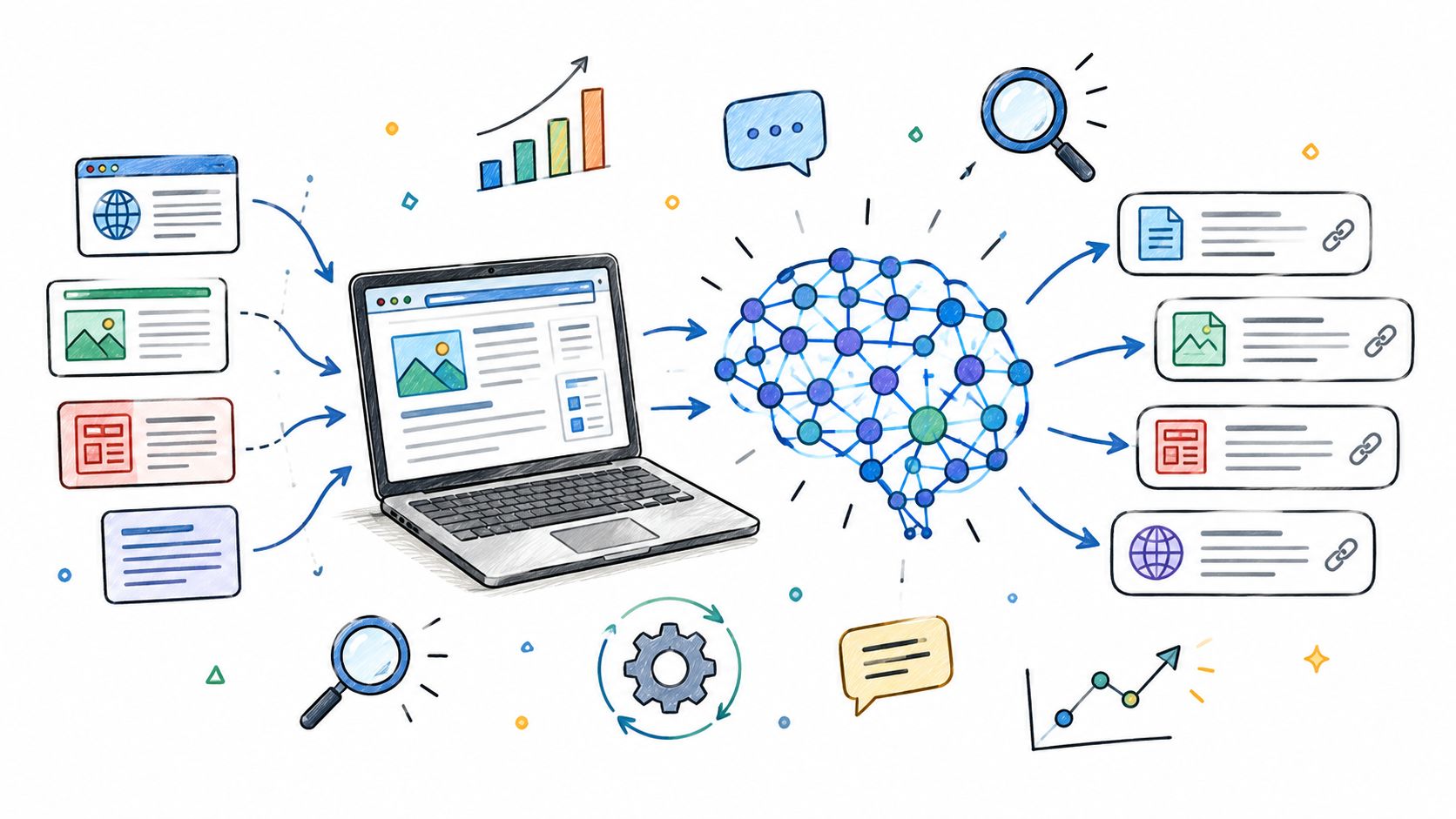

A brand can appear in a ChatGPT answer, receive a clear description in Perplexity, and still disappear when a buyer asks, “Which providers should we consider?” That gap is becoming familiar to SEO teams. Recognition isn't the same as recommendation.
Traditional search usually starts with an explicit query and returns pages or links. An AI answer can do something different in the tested response. It may describe a category, mention several vendors, cite supporting pages, and present a short set of options for a specific need. That changes the visibility question from “Does the brand appear?” to “Does the brand appear when the user is choosing?”
Recommendation engines have shaped digital discovery for years. Their roots reach back to the early 1990s, when collaborative filtering appeared in experimental systems at Xerox PARC and was applied to personal email and information filtering. Amazon's item-to-item collaborative filtering approach, published in 2003, became a major commercial milestone, and Netflix's 2006 Prize made recommender-system accuracy a central engineering challenge. The prize offered $1 million for at least a 10% improvement over Cinematch, while the winning BellKor's Pragmatic Chaos team achieved a 10.06% improvement, as documented in the historical review of recommender systems.
For marketers, the important shift is practical. An AI answer can understand what a company does without surfacing it in an open-ended product recommendation. Category language, comparison context, evidence, and the way a prompt is framed all matter to the observed result.
Introduction Why Recommendation Matters Now
A content lead checks a set of prompts before a product launch. For the named-brand question, the company's product appears accurately. The answer describes its audience, use case, and category. A competitor appears in the recommendation prompt, however, while the company's name is absent.
That outcome isn't contradictory. The two prompts test different jobs. A named-brand prompt asks whether the system can identify or describe an entity. A discovery prompt asks which options belong in a user's consideration set. The first can produce recognition. The second can produce recommendation. Treating them as one visibility metric hides the difference.
This distinction matters across shopping, media, and software. A retailer may be described correctly but omitted from a request for suitable products. A publisher may be cited in an explanation but not surfaced when a reader asks what to read next. A SaaS company may appear in a category summary yet fail to appear when a buyer asks for tools for a particular workflow.
The market context explains why this deserves attention. Independent estimates place the AI-based recommendation system market at $2.01 billion in 2023, $2.21 billion in 2024, and a projected $3.28 billion by 2028, according to the 2024 AI-based Recommendation System Global Research Report. Forecasts differ substantially by market definition, but they point in the same direction. Recommendation systems are becoming a significant software layer across commerce, content, and search.
Practical rule: Measure whether a brand is recognized and whether it is recommended as separate outcomes.
The rest of the subject becomes easier once the underlying mechanism is clear. The key questions are what an engine observes, how it turns those observations into a ranked shortlist, where different approaches fail, and how SEO teams can test recognition against recommendation without claiming knowledge of internal system behavior.
What an AI Recommendation Engine Actually Does
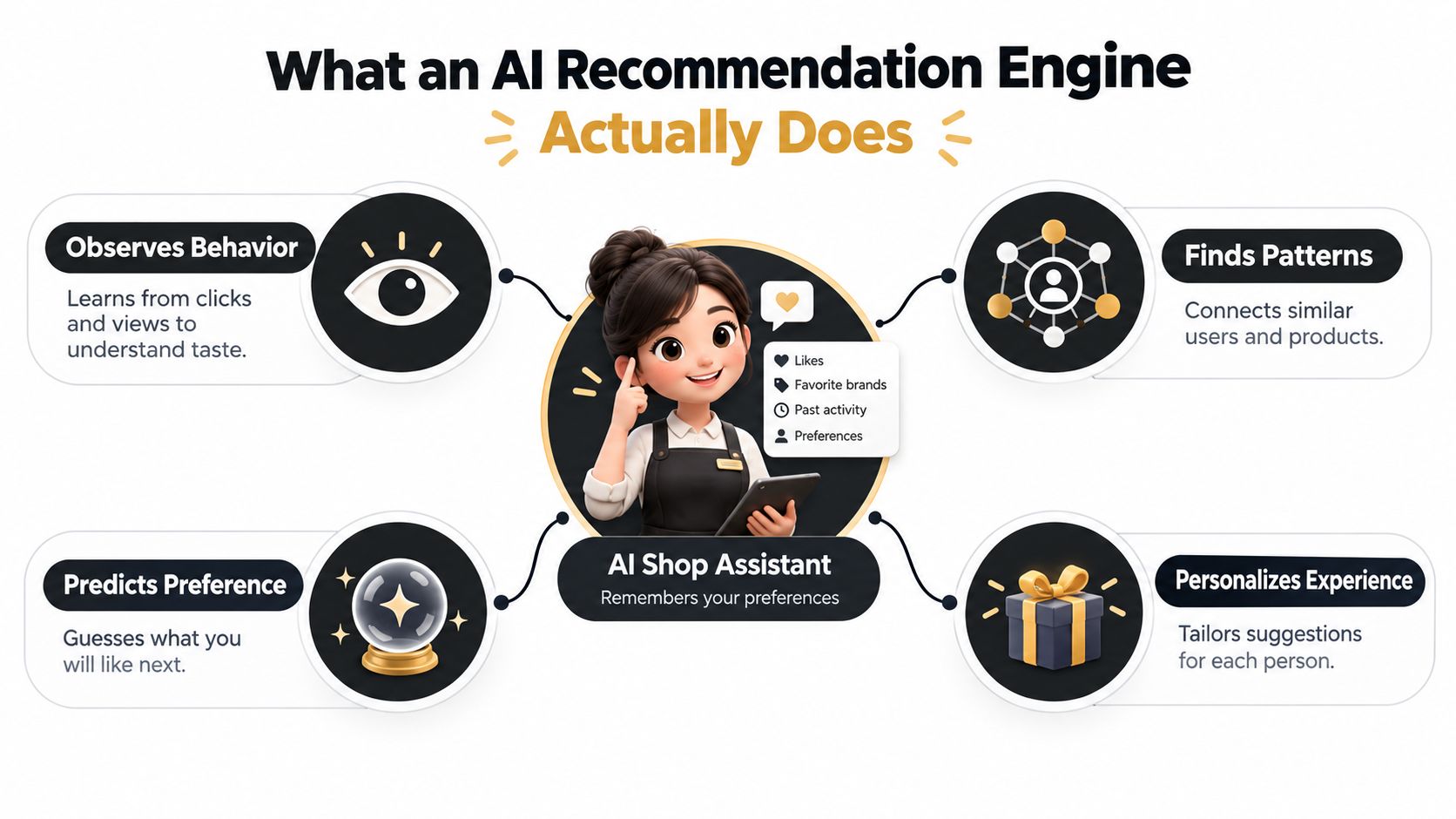
Think of an AI recommendation engine as a shop assistant serving a large catalog. A customer browses a few jackets, ignores formalwear, returns to lightweight products, and later opens a product page for travel bags. A useful assistant does not merely repeat the bestseller list. It combines the customer's actions with product information and the surrounding context, then presents a small set of plausible next choices.
The digital version performs a similar sequence.
It starts with observed actions
The engine receives interaction data. A click, view, purchase, save, skip, or completed watch can provide evidence about interest. A direct rating is clearer, but many systems operate mainly on implicit feedback, meaning the user's behavior implies a preference without stating one.
A click doesn't always mean satisfaction. It may reflect curiosity, a misleading title, or accidental selection. A purchase is stronger evidence of intent, but it can still reflect a gift, a business requirement, or a one-time need. The engine therefore works with signals that are useful but imperfect.
It turns many options into an ordered list
The engine doesn't need to predict an exact rating for every item. In many practical settings, it needs to decide which items belong near the top of the list. That makes recommendation a ranking problem.
The difference resembles a store employee choosing five products for a customer instead of assigning a precise score to every product in the building. The order matters because users often see only the first few suggestions. A technically plausible item that appears too late may have no practical effect.
A 2025 benchmark compared 13 collaborative filtering methods across four implicit-feedback datasets using MAP@10, NDCG@10, Precision@10, Recall@10, and MRR. The benchmark's unified evaluation protocol reflects an operational point for product and growth teams: recommendation quality should be judged by top-k ranking performance, with the metric selected for the business objective.
Search and recommendation solve different problems
Search waits for a request such as “best accounting software for a small agency.” Recommendation can appear before the user asks, or can answer a broader request such as “Which accounting tools should an agency consider?” Search retrieval and recommendation ranking can overlap, but the user task is different.
That difference explains why being understandable isn't sufficient. A brand must be legible as an entity and relevant to a category, use case, audience, and decision context. The tested response may mention a company in one setting and omit it in another. We don't know the internal reason unless the system provides one, so analysis should describe the observed prompt, result, and evidence rather than speculate about hidden preferences.
Signals That Power Modern Recommendations
Recommendation quality begins with the interaction record, not with the most complex model available. Teams should first identify the signals their product creates and decide what each signal can reasonably mean.
Behavioral signals show actions
Clicks, views, purchases, saves, skips, and dwell time can indicate interest. They don't all carry equal meaning. A product page viewed for a long time may reflect careful consideration or confusion. A short visit may mean the user found the answer quickly.
The distinction between explicit and implicit feedback is useful here. A rating tells the system what the user chose to state. A click or view provides a weaker behavioral clue. Modern evaluation work focuses on this second category because many products generate far more actions than explicit ratings.
A sparse signal set can still support useful ranking, but noisy signals require careful interpretation. A team evaluating content recommendations might separate a page opening from a completed read. An ecommerce team might distinguish an add-to-cart event from a completed purchase. The event taxonomy shapes the result before model selection enters the discussion.
Context changes the meaning
The same user can want different things in different circumstances. Device type, time, location, session context, and the current page can alter the relevance of an item. A commuter may want a short article, while the same person may choose a long tutorial during a planned research session.
Context should be treated as a qualification, not as proof of intent. A location can make a local option available, but it doesn't establish that the user wants that option. A device can suggest a screen constraint, but it doesn't reveal the user's full objective.
Profile and content signals fill the gaps
Past history, stated preferences, and profile attributes can help describe the user. Titles, descriptions, categories, authors, features, and other item metadata describe what is being recommended. Content signals become especially useful when an item has little interaction history, although the quality of the metadata determines what the system can match.
For SEO teams, discoverability work intersects with recommendation. Clear category language, consistent product attributes, and unambiguous descriptions make a catalog easier to interpret. The same principle appears in answer engine optimization, where structured, explicit information helps answer systems connect an entity with a user need.
A useful audit asks three questions:
- What happened: Which events are recorded, and which actions are missing?
- What it might mean: Does each event indicate interest, friction, or simple exposure?
- What gets measured: Is the team evaluating top-k relevance, business action, diversity, or user satisfaction?
The 2025 benchmark of collaborative filtering methods makes one caution clear. The evaluation protocol itself can change which model appears strongest. Teams should standardize the train and test split and metric choice before comparing lift.
How Recommendation Engines Work Under the Hood
Three families explain most recommendation discussions without requiring a technical build. Collaborative filtering uses interaction patterns. Content-based filtering uses item attributes and a user's previous interests. Hybrid systems combine approaches to cover their weaknesses.
Collaborative filtering can work without detailed product descriptions. If users interact with similar items, the engine can surface relationships among those items or among those users. Its weakness appears when interaction history is sparse, particularly for new users and new items.
Content-based filtering starts with the item itself. A product's category, specifications, title, or description can be matched with the attributes of items a user previously viewed or used. This can help with a new item that has no behavioral record, but it can also produce narrow suggestions that look too much like what the user already knows.
Hybrid methods combine signals and methods. They can use item content when interaction data is thin and behavioral relationships when a stronger interaction record exists. The trade-off is added complexity, because the team must maintain more components and decide how their outputs should be combined.
A practical comparison
| Approach | What It Uses | Best For | Limitation |
|---|---|---|---|
| Collaborative filtering | User-item interactions and relationships among users or items | Finding patterns from established behavior | Sparse history can weaken results |
| Content-based filtering | Item attributes and a user's prior item interests | Matching new or well-described items | Suggestions may become too similar |
| Hybrid recommendation | Behavioral, content, and contextual signals | Balancing cold-start and relevance needs | More design and maintenance complexity |
| LLM-augmented methods | Language-based item and query context alongside recommendation signals | Conversational discovery and richer explanations | Dynamic interests and real-time complexity remain production concerns |
The table describes system families, not a universal performance hierarchy. In a particular product, the strongest approach depends on the available interaction signal and the business objective. The 2025 implicit-feedback benchmark compared matrix factorization, pairwise ranking, autoencoders, graph neural networks, and probabilistic methods under one protocol, which is why technical teams should avoid choosing a model from a headline result alone.
For SEO practitioners, the useful questions are simple. What counts as a positive interaction? Is the objective a click, a completed watch, a purchase, or a broader measure of satisfaction? Does the evaluation reflect the position of the recommendation, or only whether an item appeared somewhere in the list?
That same discipline helps when explaining information in AI answers. A guide to how ChatGPT gets its information should not be treated as evidence about a hidden ranking formula. It can help clarify source and answer behavior, while observed prompts remain the proper basis for visibility reporting.
Real World Applications in Ecommerce Content and SaaS
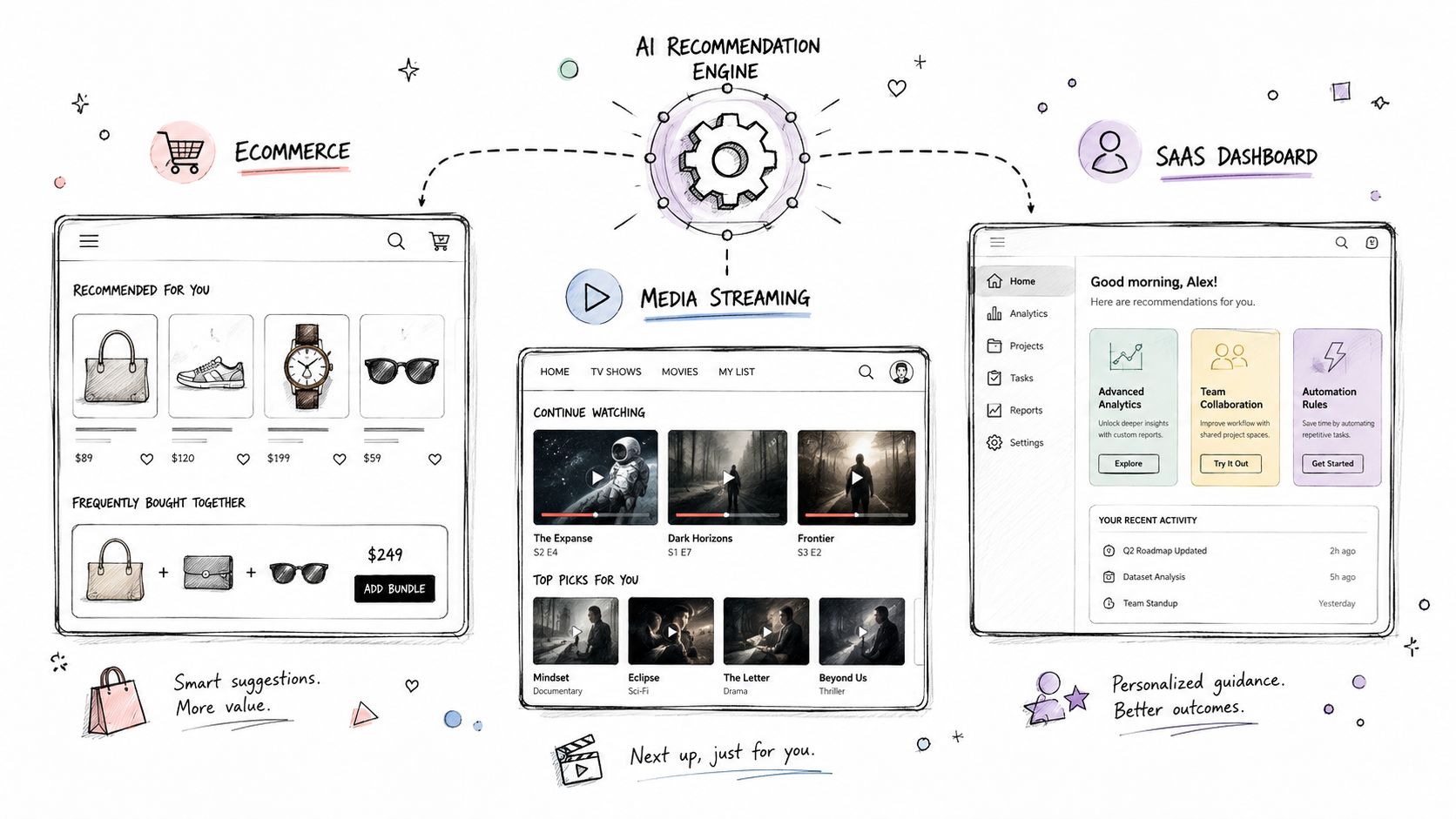
An ecommerce team can use an ai recommendation engine on a product page, in a cart, or after purchase. The recommendation may connect a viewed item with complementary products, similar products, or alternatives that fit the shopper's stated constraints. Each placement represents a different business question, so one generic “recommended” carousel can hide important differences.
A product-page module may support exploration. A cart module may support completion or bundling. A post-purchase module may support replenishment or a related use case. The team should label the placement, the user context, and the intended action before evaluating the result.
The value isn't limited to bestsellers. A structural analysis of Netflix viewing data found that replacing the incumbent recommender with matrix factorization would reduce engagement by 4%, while a popularity-based algorithm would reduce it by 12%. The Netflix viewing-data analysis also found that recommendation-driven consumption gains came mostly from better targeting, with the largest gains for mid-popularity content.
That finding has a direct merchandising implication. A catalog can create value when the system matches a shopper with a suitable mid-tail item, not only when it repeats the most visible product.
Media and publishing
A streaming service can recommend the next film, series, or song. A publisher can surface a related analysis after a reader finishes an article. The underlying task is similar, but the success signal changes. A watch completion, a return visit, a saved article, and a subscription action each describe a different outcome.
Content teams should map recommendation opportunities to editorial intent:
- Continuation: What should the reader or viewer consume next?
- Expansion: Which related topic adds useful depth?
- Discovery: Which less obvious item fits the current interest?
- Retention: What keeps the experience useful without making it repetitive?
This approach makes diversity part of product quality. A feed that surfaces only familiar subjects can produce a short-term interaction while reducing discovery. The Netflix analysis provides evidence for targeting mid-popularity content, but it doesn't establish that every catalog should use the same balance.
SaaS and knowledge products
A SaaS product can recommend templates, integrations, help articles, reports, or workflows based on the user's current task. A new account might see setup guidance. An experienced account might see an integration related to an existing workflow.
The best starting point is the user's moment of need. A help center can recommend troubleshooting content after an error page. A template library can suggest a starting point after a user selects an industry. A sales workspace can surface relevant enablement content beside an account record, provided the data use is appropriate and transparent.
Success should extend beyond clicks. Teams can examine whether the recommendation helped the user complete a task, find a relevant item, or return for another useful session. A click may be a starting event, not proof that the suggestion created value.
What AI Recommendation Engines Mean for SEO and Visibility
SEO teams need two scorecards. The first measures recognition. It asks whether an AI answer correctly identifies a named brand, product, category, audience, or use case. The second measures recommendation. It asks whether the brand appears when the prompt is open-ended and the user requests options.
A brand can pass the first test and fail the second. Recent reporting on the AI recommendation gap describes this observed pattern and argues that category context and query framing can matter more than simple brand authority. The analysis of recognition versus recommendation also cites Anthropic Economic Index data stating that recommending products and services ranked among the top work tasks in AI conversations, with 10.7% of AI outputs described as advice or recommendations.
The measurement design should reflect that difference.
Build two prompt families
Named-brand prompts might ask what a company offers, who uses it, or how its product differs from a defined category. Discovery prompts should remove the brand name and express the buyer's situation, constraints, and desired outcome.
A useful test record includes the exact prompt, system used, date, response text, recommendation position, cited pages, and whether the brand was named, described, or omitted. It should also distinguish a direct recommendation from a passing mention. Without that separation, a visibility report can make recognition look like buying consideration.
Measurement rule: A citation proves that a page was used or surfaced in the observed answer. It doesn't prove that the brand was recommended.
Google AI Overviews can cite pages that aren't the top organic result. One independent analysis reported that 55% of AI Overview citations came from the top 30% of a page, 24% from the middle 30% to 60%, and 21% from the bottom after the 60% mark, using the source's own page-position metric in the analysis of Google AI Overview citation sources. That observation makes page structure relevant, but it doesn't establish a causal rule for recommendation inclusion.
Perplexity presents numbered inline citations. Its help materials explain that users can select or hover over a source to view its label and a short explanation of why that domain received it, as described in the guide to viewing Perplexity sources. Independent interface guidance also describes a visible sources panel with the title, domain, and direct link in Perplexity's source panel guide.
For Google AI Overviews, the MLA advises clicking through to the source page and citing that page rather than citing the AI summary itself in its guidance on citing Google AI Overviews. For marketers, the same discipline applies. Record the answer, inspect the linked page, and report the observed relationship without claiming access to internal selection logic.
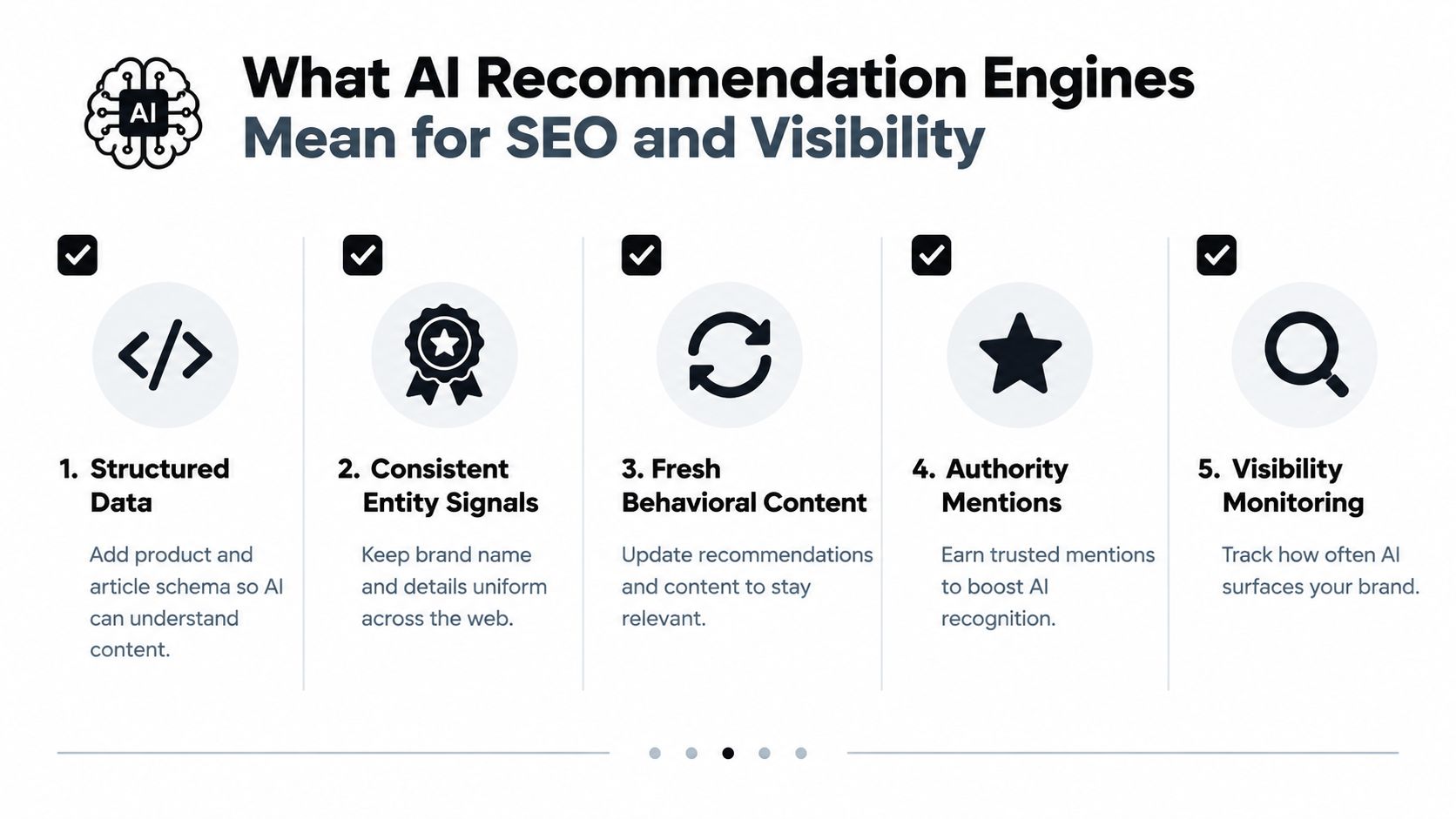
SEO work still supports this process through clear entity information, consistent category language, useful comparison pages, and evidence that matches the buyer's question. Those actions can improve how a brand is understood, but they don't guarantee recommendation. Performance reporting should remain grounded in the tested responses, with AI traffic analytics used alongside prompt-level visibility observations rather than as a substitute for them.
Trust Control and What to Do Next
A more accurate recommendation isn't automatically a better experience. Users may reject a suggestion that feels intrusive, difficult to correct, or impossible to understand. A system can surface a relevant item while still making the user feel watched.
Recent academic work on recommender systems found that explanations alone weren't enough to create a sense of agency. The 2025 study on transparency and user control reported that combining transparency with direct user controls significantly improved perceived agency. Another study using eye-tracking reported that explanation styles changed privacy concerns and trust.
That creates a useful product standard. A recommendation surface should explain enough to orient the user, while giving the user a meaningful way to correct, dismiss, reset, or limit personalization. The exact control depends on the product, and the user shouldn't have to infer what data shaped the suggestion.
A practical briefing checklist
- Define the decision: Specify whether the system supports discovery, continuation, cross-sell, task completion, or another outcome.
- Name the evidence: List the behavioral, contextual, profile, and content signals available, including gaps and ambiguous events.
- Separate evaluation: Compare top-k relevance with business outcomes, diversity, and user feedback rather than relying on one score.
- Protect agency: Include explanation, dismissal, correction, and privacy choices in the product brief.
- Report limits: State what was observed, what was tested, and what remains unknown.
SEO teams should apply the same care to AI answer visibility. Track recognition and recommendation separately. Preserve exact prompts and responses. Link citations to the underlying pages. Avoid statements about what ChatGPT, Claude, Gemini, Perplexity, or Google AI systems do internally when the evidence only shows what appeared in a tested response.
A focused next step is to create a prompt set with paired questions, one named-brand family and one open-ended recommendation family, then review the results across the brand's core categories. Record which answers mention the brand, which recommend it, which pages are cited, and where the evidence doesn't support a conclusion. That baseline gives the SEO team a defensible way to improve entity clarity and category relevance without confusing visibility with consideration.
Build the paired prompt set this week, test it across the AI answer systems your buyers use, and record recognition, recommendation, citations, and omissions in separate fields. That evidence will show where the brand is understood, where it enters the consideration set, and which content deserves the next SEO investment.