A marketing lead asks ChatGPT for the best CRM for a 50-person sales team. The answer comes back fast, with a vendor name that sounds plausible and confident, but there's no link, no citation, and no visible source trail. That's the moment many SEO and content teams realize ChatGPT isn't behaving like a normal search results page.
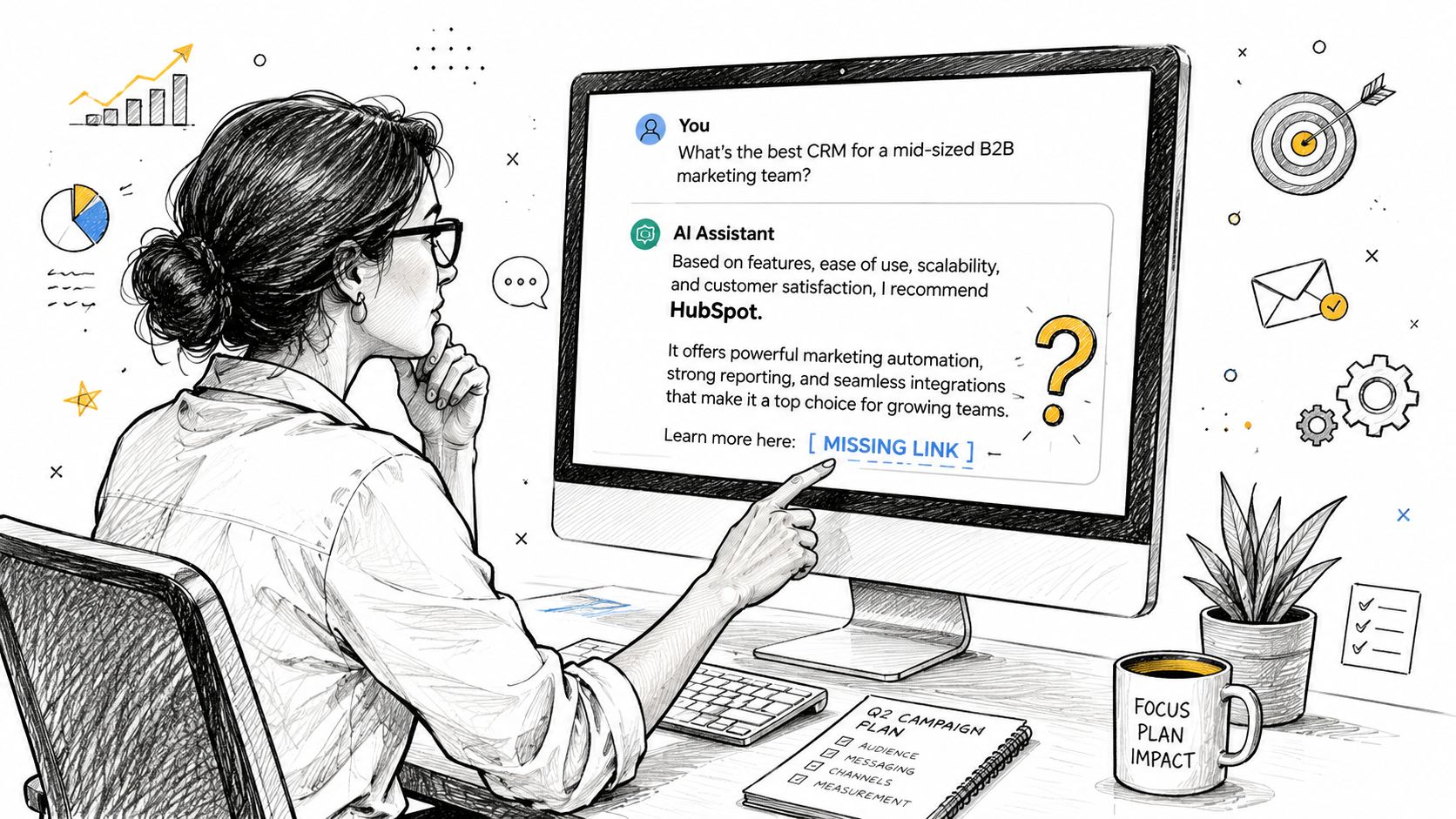
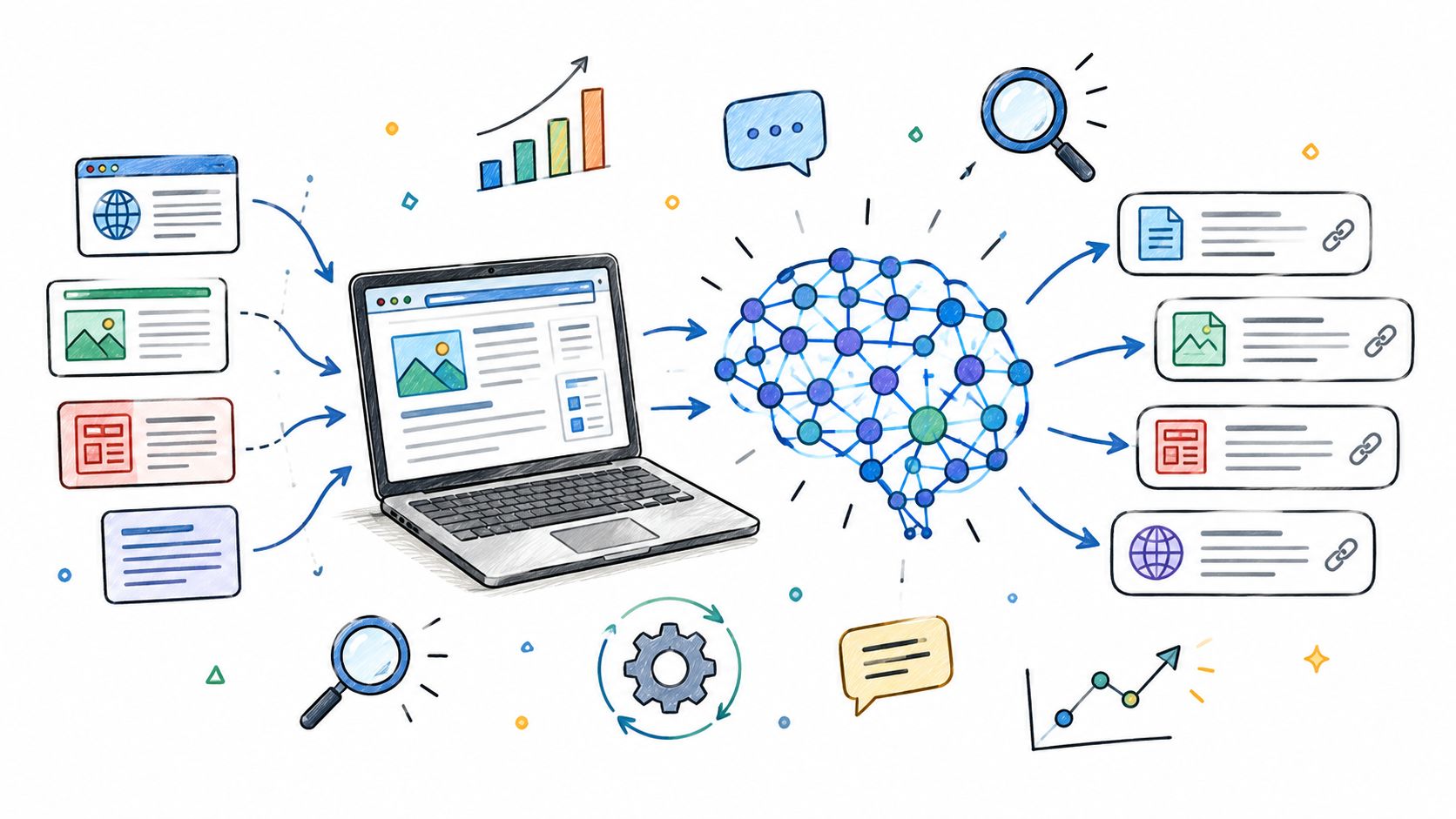
The same product can also answer a different query with a Sources area and clickable references. That split is the key story. OpenAI says ChatGPT's information base is built from publicly available internet content, licensed or third-party data, and information generated by users, trainers, and researchers, and it also says the model is not a live index by default. Freshness depends on whether retrieval is enabled in that session and whether current sources are reachable at answer time.OpenAI's development overview
For marketers, that means the useful question isn't only how does ChatGPT get its information. It's when does each path dominate. That timing decides whether a brand is mentioned, visibly cited, or absent from the answer entirely.
The Strange Moment a Brand Appears Without a Link
A brand can show up in a ChatGPT answer with no visible source trail. A team asks for a recommendation, sees a familiar vendor named with confidence, and still has no clear way to tell why that name surfaced.
That is the behavior of parametric memory. Dean Garland explains that ChatGPT's default responses come from statistical patterns stored in the model's weights, with no document lookup at answer time and no real-time citation unless a retrieval layer is active.Dean Garland on training data vs live retrieval In practical terms, the model is drawing on what it absorbed during training, like a compressed map of prior text, not on a fresh web search.
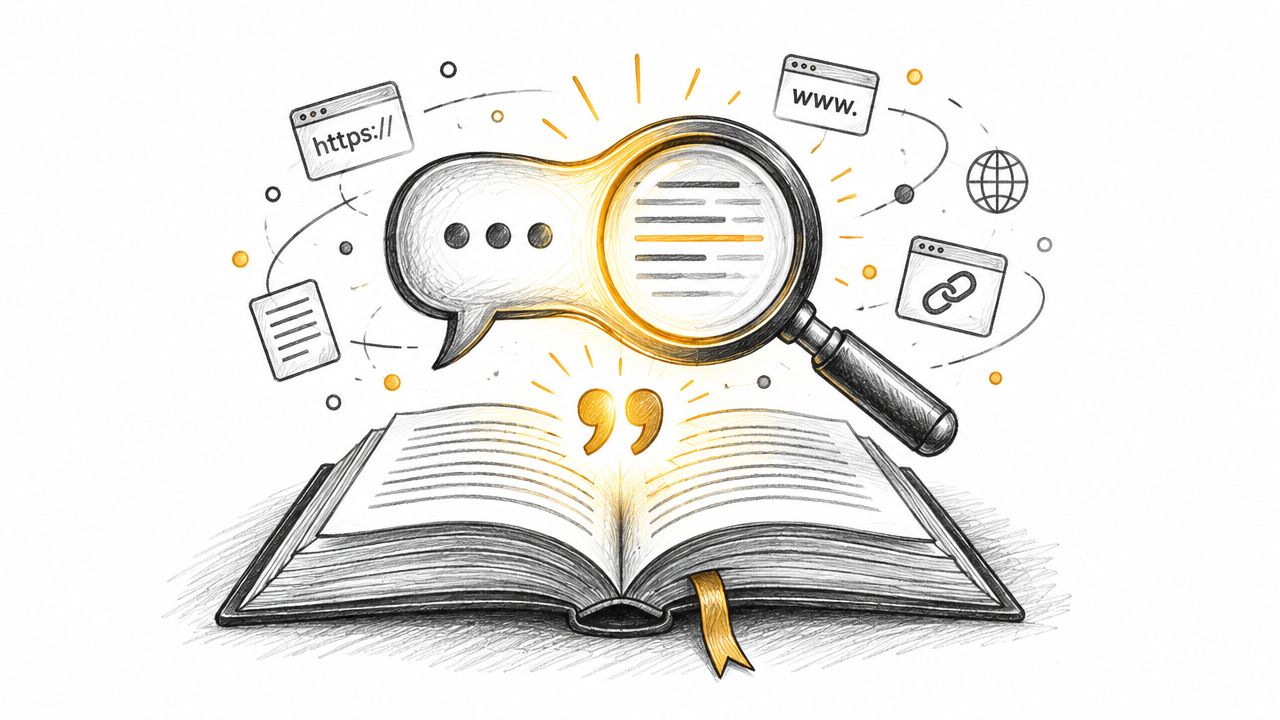
A different prompt can produce a different path. Ask for timely details, and ChatGPT Search can surface inline citations and a Sources area. OpenAI says users can hover citations on desktop to preview a source or click to open it, and if inline citations do not appear, they can select Sources beneath the response to see cited sources and other relevant links.OpenAI help on ChatGPT Search
Practical rule: a brand mention without a link is still a visibility event. It just comes from a different layer than a cited answer.
For marketers, that distinction changes how the output should be read. Some answers come from memory. Some come from live retrieval. Some combine both with the current conversation, which is why the same brand can appear in one answer and disappear in another. Once that clicks, the question becomes less mysterious and more operational. The useful question is not only how does chatgpt get its information, but which path was active when the answer was built.
Three Layers That Shape Every ChatGPT Answer
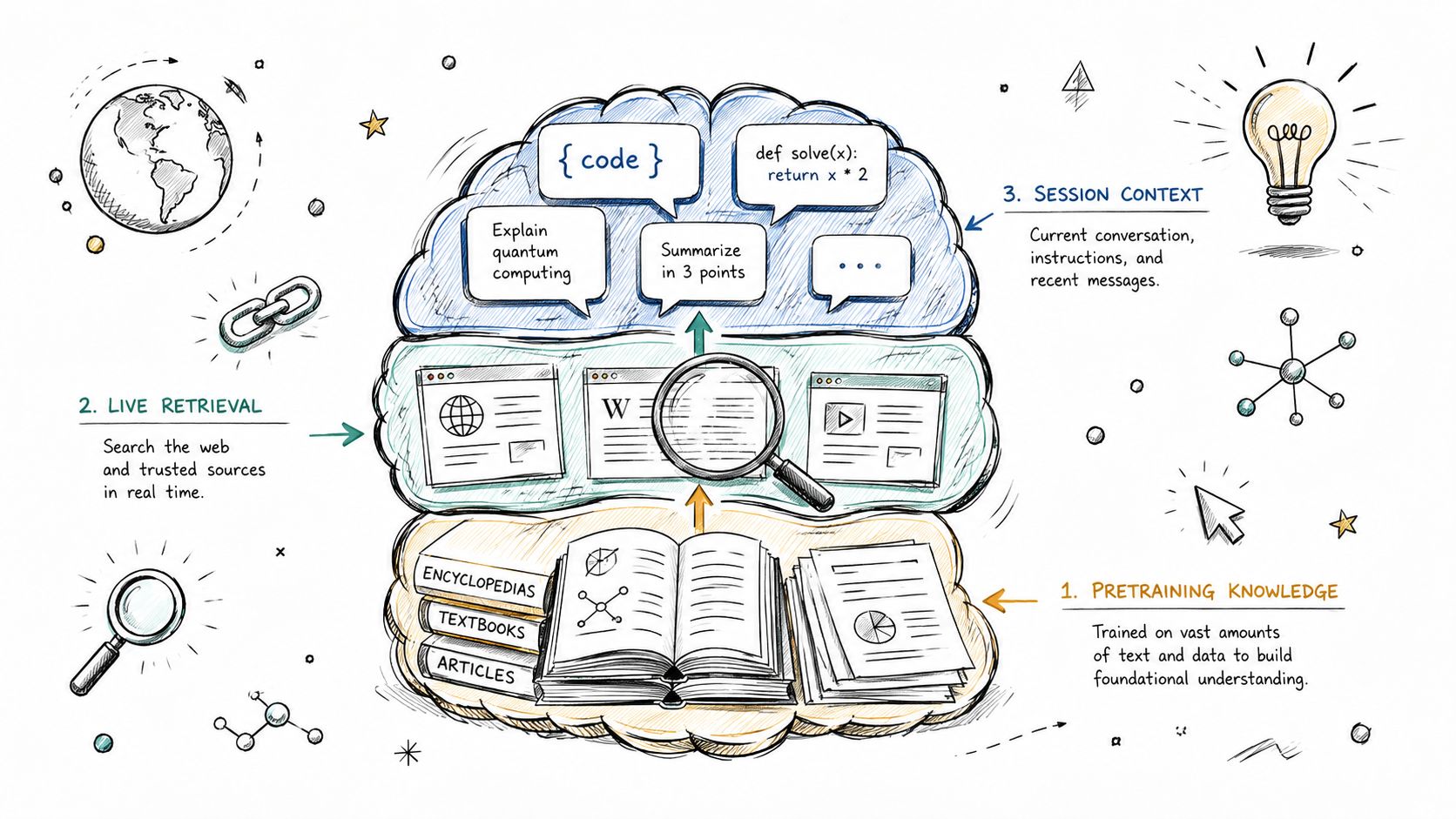
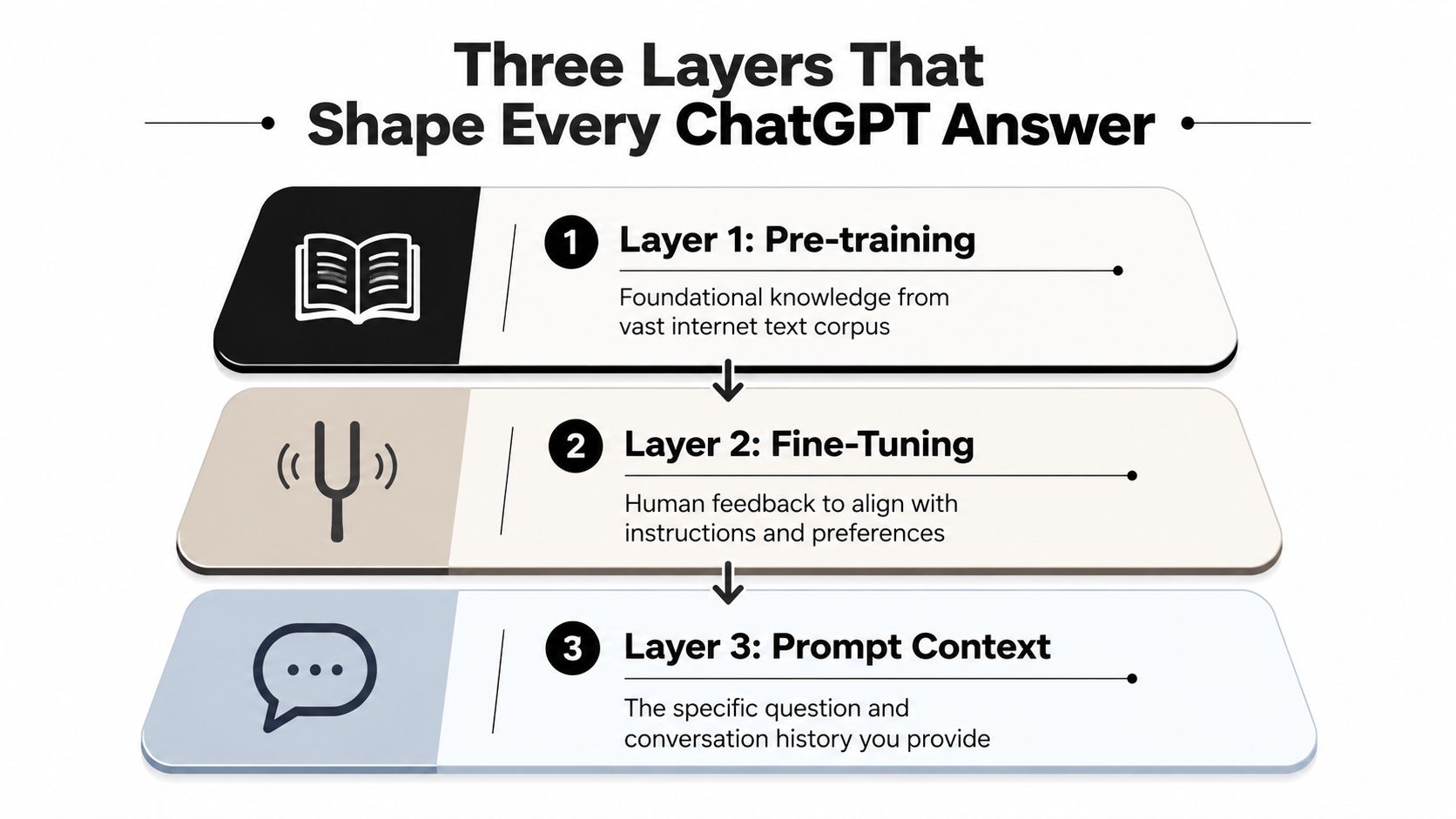
A ChatGPT answer usually comes from three layers working together. One layer holds broad trained knowledge, one layer can pull in live information, and one layer is the current chat, including your prompt, earlier turns, and any attached context.
Layer 1, pre-training knowledge
OpenAI says the web portion of training uses publicly accessible web content and does not intentionally collect paywalled material or the dark web. The model does not store a neat fact database. It learns compressed patterns from a mixed corpus, which is why a brand can show up from training alone before any search tool is involved.
Historical GPT-3 source mix helps make that scale more concrete. A filtered Common Crawl corpus accounted for roughly 410 billion byte-pair-encoded tokens, about 60% of its weighted pretraining dataset, alongside 19 billion tokens from WebText2, 12 billion from Books1, 55 billion from Books2, and 3 billion from Wikipedia.GPT-style source mix
Layer 2, live retrieval
OpenAI's search product changes the path the answer takes. It can pull timely information from the web and link to relevant sources.OpenAI's search announcement
When retrieval is active, the answer can show inline citations, preview cards, and a visible source list. That is the layer users notice when the response reads more like a cited research note than a memory-based reply. For marketers, this is the difference between being present in the model's general knowledge and being surfaced by a live search path.
Layer 3, session context
The current conversation also shapes the output. A prior message can narrow the topic, specify format, or constrain the answer. That context stays inside the chat and influences the final wording, even when the model is also drawing on broader knowledge or retrieved documents.
That is why the same brand can appear in one answer and vanish in another. The useful question is less about where ChatGPT got its information in the abstract, and more about which layer dominated when the answer was assembled.
What Goes Into the Training Data
A brand can show up in ChatGPT even when no live page is cited, because the model may be drawing from its frozen training knowledge. That makes the question less about one source and more about which path is doing the work at answer time. For marketers, that difference matters.
Training data is broad, but it helps to sort it into familiar buckets. Public web text from Common Crawl covers a large share of what the model sees. Cleaner reference material, such as Wikipedia, adds more standardized language. Books and long-form documents contribute depth, style, and context. The GPT-style source mix cited earlier shows how these parts sit alongside each other, with the web corpus still dominating by volume.
What the corpus usually looks like
| Data source | Approx. token share | What it means for brands |
|---|---|---|
| Filtered Common Crawl | 410 billion byte-pair-encoded tokens | Broad web coverage can expose a brand through many public mentions, not just one page. |
| WebText2 | 19 billion tokens | High-visibility web text can reinforce how a brand is discussed in public language. |
| Books1 | 12 billion tokens | Longer-form writing can shape descriptive and contextual language around a brand. |
| Books2 | 55 billion tokens | Extended narratives and reference material can support more nuanced responses. |
| Wikipedia | 3 billion tokens | Structured reference pages can anchor named entities and straightforward descriptions. |
The practical takeaway is straightforward. A brand that appears across multiple trusted public surfaces is easier for the model to represent than a brand that lives on one isolated page. Training data is usually filtered, deduplicated, and cleaned before it reaches the model, so repeated public context carries more weight than a single campaign asset.
Time sets the other boundary. If a fact appeared after the model's snapshot, it will not be part of this layer. That gap is one reason retrieval exists.
Parametric Memory vs Live Retrieval
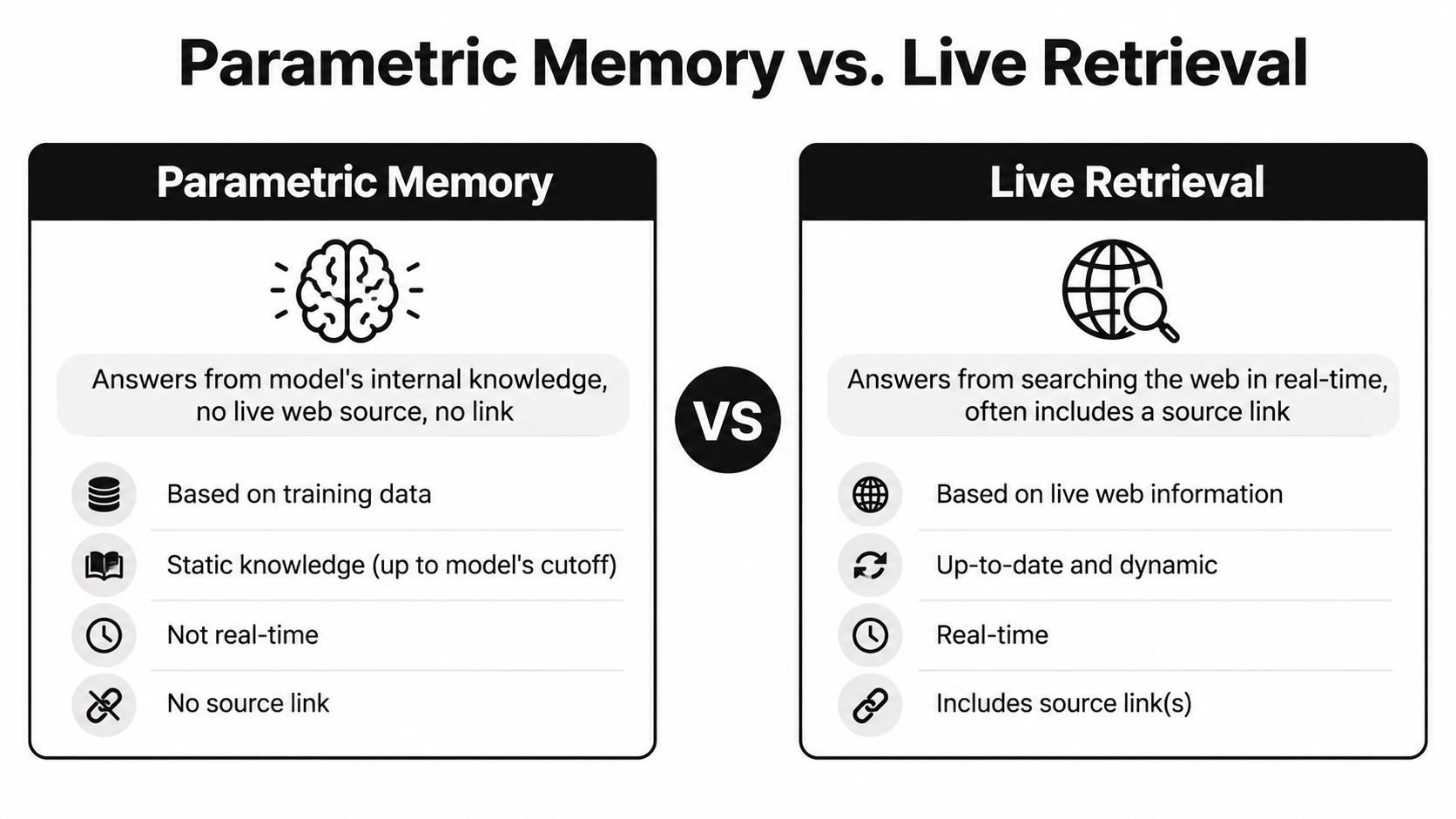
ChatGPT answers usually come from two paths, and the useful question is which one dominates in a given moment. One path draws from parametric memory, the model's stored patterns from training. The other uses live retrieval, which reaches out to current pages and can show where an answer came from.
Memory feels broad, but it stays silent about sources
Parametric memory can surface a brand name without revealing the page, article, or post that shaped it. That is why a vendor may appear in an answer even when no clickable proof is visible. It also explains why evergreen prompts, definitions, and conceptual questions often stay inside the model's stored patterns, the answer is generated from what it already learned rather than from a fresh lookup.
Retrieval brings source visibility into the response
Live retrieval works differently. OpenAI says ChatGPT search can include citations that open the source or show a preview on desktop web, and users can also open the Sources area to see references.OpenAI help on ChatGPT Search for Enterprise and Edu That visible layer matters because it lets users verify what the model used, and it gives SEO teams something concrete to inspect.
| Path | What it returns | What marketers can infer |
|---|---|---|
| Parametric memory | Fluent answer, sometimes with brand mentions, no live source link | The brand was represented in stored knowledge or chat context. |
| Live retrieval | Answer with links, snippets, and source references | The brand or topic was found in reachable pages at answer time. |
The strategic split is simple. One path rewards being remembered. The other rewards being cited. A brand can win one and miss the other, so visibility depends on which path ChatGPT uses for that query.
How Citations Appear in ChatGPT
Citations in ChatGPT are visible parts of a retrieved answer. The model is not dropping a hidden footnote at random. It is surfacing source markers when it grounds a response in live material, and users can then inspect those references inside the interface.
That visibility shows up in three places.
| Surface | What user sees | Optimisation focus |
|---|---|---|
| Inline citation | Small markers or linked references in the answer body | Clear, quoteable passages that answer one question cleanly |
| Hover preview | Title, URL, and snippet on desktop | Fast-loading pages with obvious relevance |
| Sources area | A list of references beneath the response | Pages that can be retrieved, read, and grounded easily |
For marketers, the useful point is that citation order is not classic search ranking. It depends on retrieval, the prompt, and the grounding step inside the answer. A page can be helpful without ranking first in Google, and a high-ranking page can still stay out of the response if it is not the best fit for that query.
A simple analogy helps. Training knowledge is the model's memory. Retrieval is the library desk that fetches a book at the moment of need. Citations appear when ChatGPT is using that desk, not when it is speaking from stored patterns alone.
SEO teams should therefore read the page itself with answer engines in mind. Clean headings help. Tight definitions help. Visible authorship helps. Schema can help machines understand what the page is about. Fast pages are easier to fetch, and plain-language explanations are easier to quote.
A page that answers one question crisply is easier for an answer engine to cite than a page that tries to cover several at once.
The Third Party Ecosystems Behind the Answers
A brand can appear in ChatGPT even when its own site is not the main signal. Listings, review pages, encyclopedic references, and public knowledge bases often act as the evidence layer behind an answer. That matters because answer engines often need a source they can verify quickly, not just a page that says the right thing on its own.
Structured ecosystems do a lot of the heavy lifting
Directories, map listings, and review platforms carry repeatable business data. Names, categories, locations, and attribute-style details usually live there in a form machines can parse without much guesswork. Encyclopedic and technical domains such as Wikipedia, Wikidata, GitHub, and Stack Exchange are also easy for systems to read because the structure is stable and the language is compact.
A release from Yext on AI citations says websites, listings, and reviews made up the vast majority of citations in AI answers, while other source types showed up far less often.Yext on AI citations It also says citation concentration is high across engines, with a small set of domains recurring in answers. The marketing lesson is straightforward. Brands need more than content volume. They need steady presence in the third-party ecosystems that answer engines can verify quickly.
Corroboration matters more than one polished page
A strong brand blog post can help, but it rarely stands alone. Public discussion on Reddit, transcripts from YouTube, and coverage from publisher networks can all provide corroborating passages that retrieval systems can use. A brand described the same way across many public surfaces often earns more confidence than a brand described only on its own site.
That is why AI visibility becomes practical when brands keep listings accurate, reviews current, and descriptions quotable in places the wider web already uses to define entities.
The AI Search Signals publication also reports on what sources AI answers cite and surface, which can help teams compare where a brand shows up across systems.AI Search Signals
What This Means for SEO and Marketing Teams
The question is not just where ChatGPT gets information. It is which path dominates in a given answer, because brand visibility changes depending on whether the model is drawing from frozen training knowledge, live retrieval, or an intermediary ecosystem of profiles, listings, and third-party pages.
A practical way to read that system is layer by layer. Memory-driven answers reward broad, repeated exposure across public sources that can be absorbed over time. Citation-driven answers reward pages that retrieval can read, understand, and quote without friction. Consistency depends on the brand's listings and third-party profiles telling the same story.
A practical quarterly workflow
- Audit the evidence layer: Check whether the brand's name, category, and description stay consistent across directories, reviews, and knowledge bases.
- Tighten quote-ready pages: Build pages that answer one question directly, with short definitions and clear entity signals.
- Fix surface-level confusion: Remove mismatched names, outdated categories, and stale descriptions in public listings.
- Watch the sources, not just the answer: Log which domains appear when ChatGPT cites something, then look for repeat patterns.
- Test the same prompt in different modes: Compare a memory-style answer with a retrieval-on answer, then note where the sources change.
The cleanest test is still the simplest one. Ask the same brand prompt in a few modes, record what appears, and see whether the same sources keep surfacing. Repeated gaps point to the parts of the brand presence that need attention.
This is not about tricking ChatGPT. It is about making the brand easy to read wherever the system looks, whether that is stored knowledge, a fresh web fetch, or the intermediary pages that sit between the two.
If the brand's mention pattern still feels unpredictable, run a small prompt audit across ChatGPT search and a few adjacent answer engines this week, then compare the sources that surface most often. The goal is to spot where the brand is already visible, where it is only remembered, and where a missing third-party trail is keeping it out of cited answers.