
The AI search visibility market is projected to reach USD 10.72 billion by 2031 from USD 3.71 billion in 2025, and that scale alone is a clue that one universal checker is the wrong expectation. The right AI search visibility checker depends on whether the job is Google-focused SERP tracking, cross-engine answer capture, scheduled monitoring, or a fast free spot check.
The popular advice says to buy one platform and watch everything from there. That's too simple. Visibility varies by engine, prompt set, citation evidence, and reporting workflow, so the tool has to match the question being asked, not the other way around. Some teams need Google AI Overview tracking inside an existing SEO stack. Others need exact answer text across multiple assistants. Others just need a defensible snapshot they can show to a client or stakeholder.
The market data also points to a split in maturity. North America accounted for 44.51% of revenue in 2025, while Asia-Pacific is projected to grow fastest at 20.12% CAGR through 2031 Frase's AI visibility market overview. That uneven geography matters because enterprise-ready features, such as multi-region tracking, prompt-set benchmarking, structured-content/entity analysis, and global reporting, become more valuable as teams compare more than one market.
The list below compares tools by the visibility question they answer, not by generic feature counts. We are separating documented capabilities from practical fit, because an ai search visibility checker is only useful when its evidence matches the workflow behind the report.
1. SISTRIX for AI Visibility and Prompt Monitoring
SISTRIX fits teams that want AI visibility inside a broader SEO system rather than in a standalone monitor. Its published AI module covers AI Visibility and Prompt Monitoring, which makes it useful when the reporting team already lives in an established SEO workflow. The strongest fit is not exploratory research. It is recurring monitoring for defined questions and branded prompts.
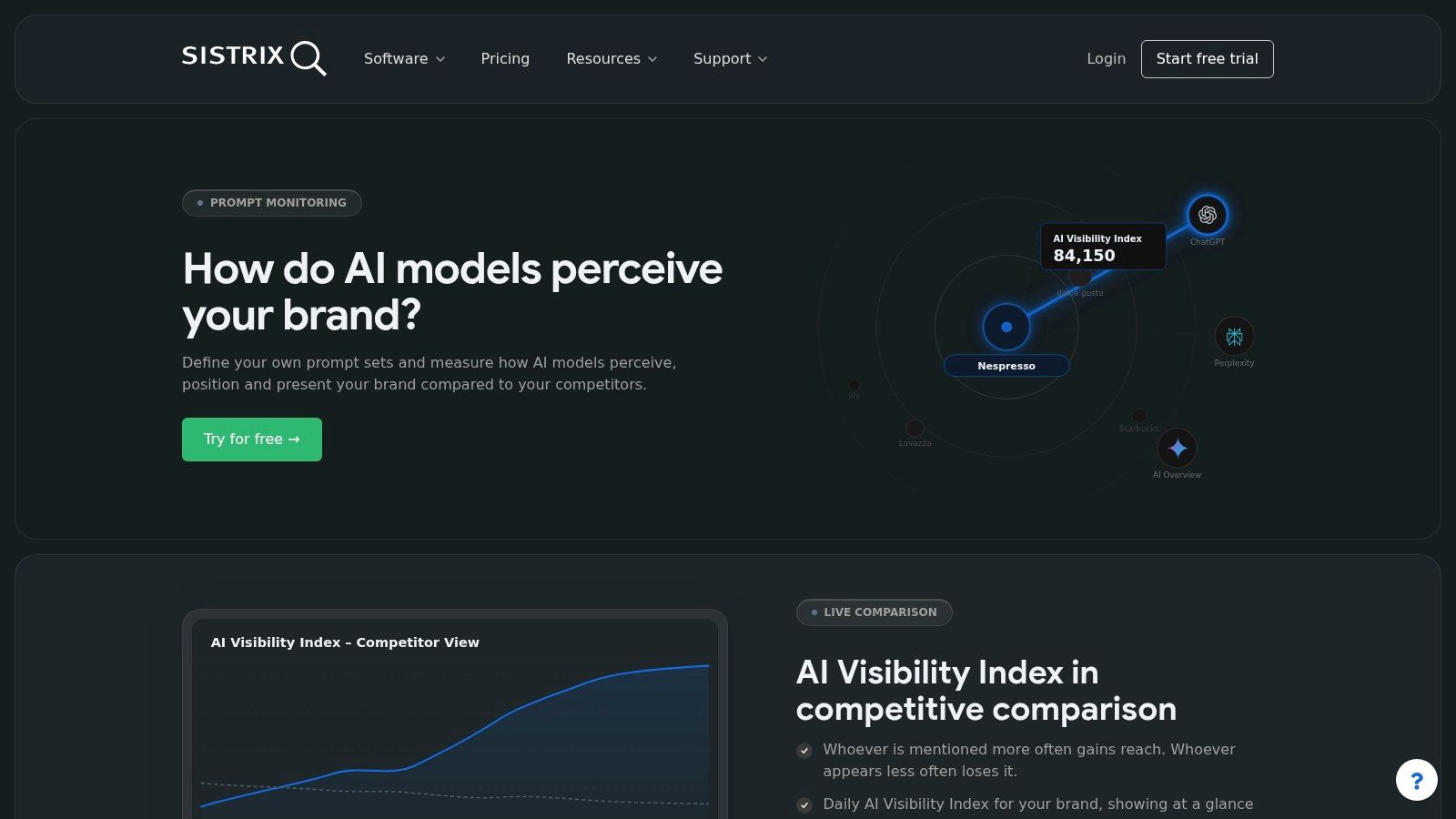
SISTRIX says the module tracks AI Overviews, AI Mode, ChatGPT, and Perplexity on the product page for AI Prompt Monitoring. That matters because the market is moving from single-surface checks toward multi-surface reporting, but not every team needs a separate stack for each surface. For organizations already paying for SISTRIX, the integration with traditional SEO reporting is the practical advantage.
Where it fits best
- Defined prompt sets. Good for teams that already know the questions they want to check.
- Competitive comparisons. Useful when the report needs to show how a brand appears versus named rivals.
- Source analysis. Helpful when the business cares about which URLs are being cited, not just whether a brand appeared.
- Exports and API use. Better for organizations that need reporting to flow into dashboards or client packs.
Practical rule: SISTRIX is strongest when the team wants AI monitoring tied to the rest of its SEO measurement, not when it needs forensic cross-engine capture.
The limitation is scope. SISTRIX is built around tracked prompts and known questions, so it is less suited to open-ended discovery. That is not a flaw. It is a workflow tradeoff. Teams should verify the published evaluation criteria on the product page before recommending it, because the right choice depends on whether the question is “Did we appear?” or “What exactly did the engine say, and on which source?”
2. Semrush for Google AI Overview Tracking
Semrush is the natural fit for teams that already use it for keyword research, Position Tracking, and competitor analysis. Its public AI visibility material focuses on Google AI Overviews, which makes it useful for organizations whose main concern is the Google SERP layer rather than broad answer-engine coverage. That scope is narrower than some newer monitors, but it aligns with how many SEO teams already operate.
Semrush's published guidance ties AI Overview visibility to familiar workflows such as Organic Rankings, Keyword tools, and Position Tracking Semrush AI Overview research. That is useful for teams that need AI tracking to sit beside existing keyword and competitor reporting, not beside a separate research tool. The operational advantage is obvious. Fewer handoffs, fewer dashboards, less translation from SEO language to AI search language.
What it answers well
- Where AI Overviews appear. Helpful for keyword lists already maintained by SEO teams.
- Whether a domain is cited. Useful for reporting brand presence in Google's AI layer.
- Trend tracking. Better for recurring operational review than for one-off checks.
- Competitor benchmarking. Suitable when the team wants a Google-centric comparison set.
The limitation is equally clear. Semrush's best-documented coverage is Google AI Overviews. Cross-engine LLM monitoring is still emerging, so teams should not assume it replaces a dedicated multi-engine answer capture tool. We also don't know how consistently every report distinguishes brand mentions from domain citations across all AI surfaces, so that should be checked in the vendor's published criteria before purchase.
3. seoClarity for Enterprise AI Overviews Monitoring
seoClarity is built for large keyword sets and enterprise reporting. Its AI Overviews monitoring is useful when the question is not just whether a page appeared, but how it compares visually and operationally across a huge search universe. The product is a strong fit for executive reporting where screenshots and visual context matter as much as line items in a dashboard.
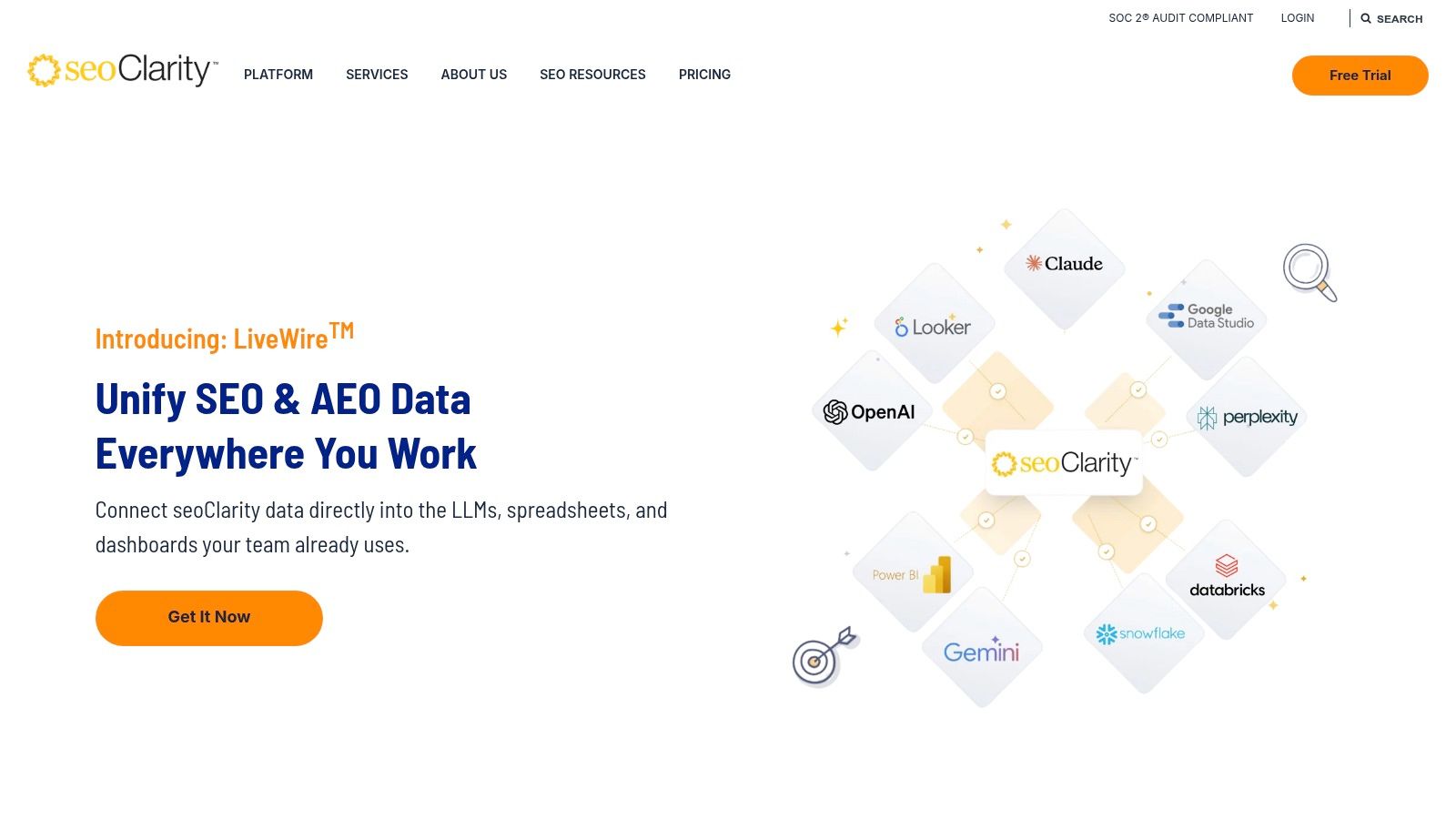
The documented workflow centers on AI Overviews detection, SERP previews, and reporting on whether a site or competitors are linked from the overview panel seoClarity homepage. That makes it especially relevant for teams that need to show Google AI visibility to stakeholders who are used to SERP screenshots rather than abstract metrics. The presence of stored visuals also helps when clients need proof, not just a score.
Why enterprise teams choose it
- Large-scale coverage. Better for broad keyword portfolios than for narrow spot checks.
- Visual reporting. Stronger stakeholder communication when screenshots are part of the proof.
- Filterable review. Useful for ad hoc checks across rank and SERP feature views.
- Competitive framing. Helpful when the report needs to show rival presence in the same AI panel.
The obvious limitation is that seoClarity is still mainly Google-centric. Multi-engine answer visibility is not its documented core. Pricing is quote-based, so budget planning needs a vendor conversation rather than a public rate card. Teams should also verify whether the report output matches the internal KPI definition before standardizing on it, because enterprise screenshots can be persuasive even when they do not answer the full visibility question.
4. BrightEdge for AI Overviews Through Generative Parser
BrightEdge is relevant when AI visibility needs to connect with research and content operations. Its Generative Parser focuses on Google AI Overviews and pairs visibility tracking with broader workflow integrations, which makes it a good fit for teams already invested in the BrightEdge ecosystem. This is less about isolated checking and more about moving from observation to editorial action.
BrightEdge's help content positions AI Overviews alongside research and content workflows such as Data Cube X and Copilot BrightEdge AI Overviews guidance. That is useful for teams that want analysis to flow into content planning without exporting every finding into another system. The best use case is operational: a content or SEO team sees a visibility gap, then turns it into a page update or a new asset inside the same stack.
What stands out
- Citation context. Useful when the team wants to understand presence, not just detection.
- Workflow integration. Helpful for teams already using BrightEdge content tooling.
- Research framing. Better for editorial planning than for free-form testing.
- Industry cut-downs. Relevant when enterprise teams need grouped reporting for internal reviews.
The limitation is the same one that appears in other Google-first tools. Cross-engine LLM mention tracking is limited compared with dedicated multi-engine monitors. That matters if the reporting goal includes ChatGPT, Perplexity, Claude, or Gemini side by side. Teams should read BrightEdge's published criteria carefully and check whether the workflow they want is evidence capture, content planning, or executive presentation, because those are not the same job.
5. Anymorph for Multi-Engine Evidence Capture
Anymorph is the right comparison point when exact answer capture matters more than a score. It uses virtual browsers rather than a simple API abstraction, which makes it better suited to forensic review and audit-style evidence. This is the tool class we would look at when a client asks, “What did the user see?”
The documented scope is broad. Anymorph says it can capture results across about 10 engines, including ChatGPT, Gemini, Claude, Perplexity, Google AI Overview/Mode, Grok, Copilot, and DeepSeek Anymorph Monitor. That is the kind of coverage a multi-region or multilingual audit team needs when the report must survive scrutiny. It is also where exact screen captures become more valuable than a summary score.
Why this category is different
A virtual-browser capture answers a different question than an API summary. It proves what was visible on screen.
Anymorph also stores full answer text, citations, and the engine's query fanout, which is important because the internal searches that an engine runs can change what appears in the final answer. That is one reason this tool belongs in the “evidence capture” bucket rather than the “simple monitoring” bucket. The tradeoff is operational complexity. Demo-led onboarding and enterprise-style engagement make sense here, but the depth can be overkill for a team that only wants a weekly check.
6. FoundGeo for Fast Multi-Engine GEO Snapshots
FoundGeo suits teams that want a quick, practical snapshot across several engines without starting with a heavy enterprise rollout. Its published answer engine insights focus on 9 engines, including ChatGPT, Claude, Gemini, Google AI Overviews, Perplexity, Grok, DeepSeek, Mistral, and Qwen/Llama FoundGeo answer engine insights. That breadth makes it a useful middle ground between a single-engine checker and a more complex forensic monitor.
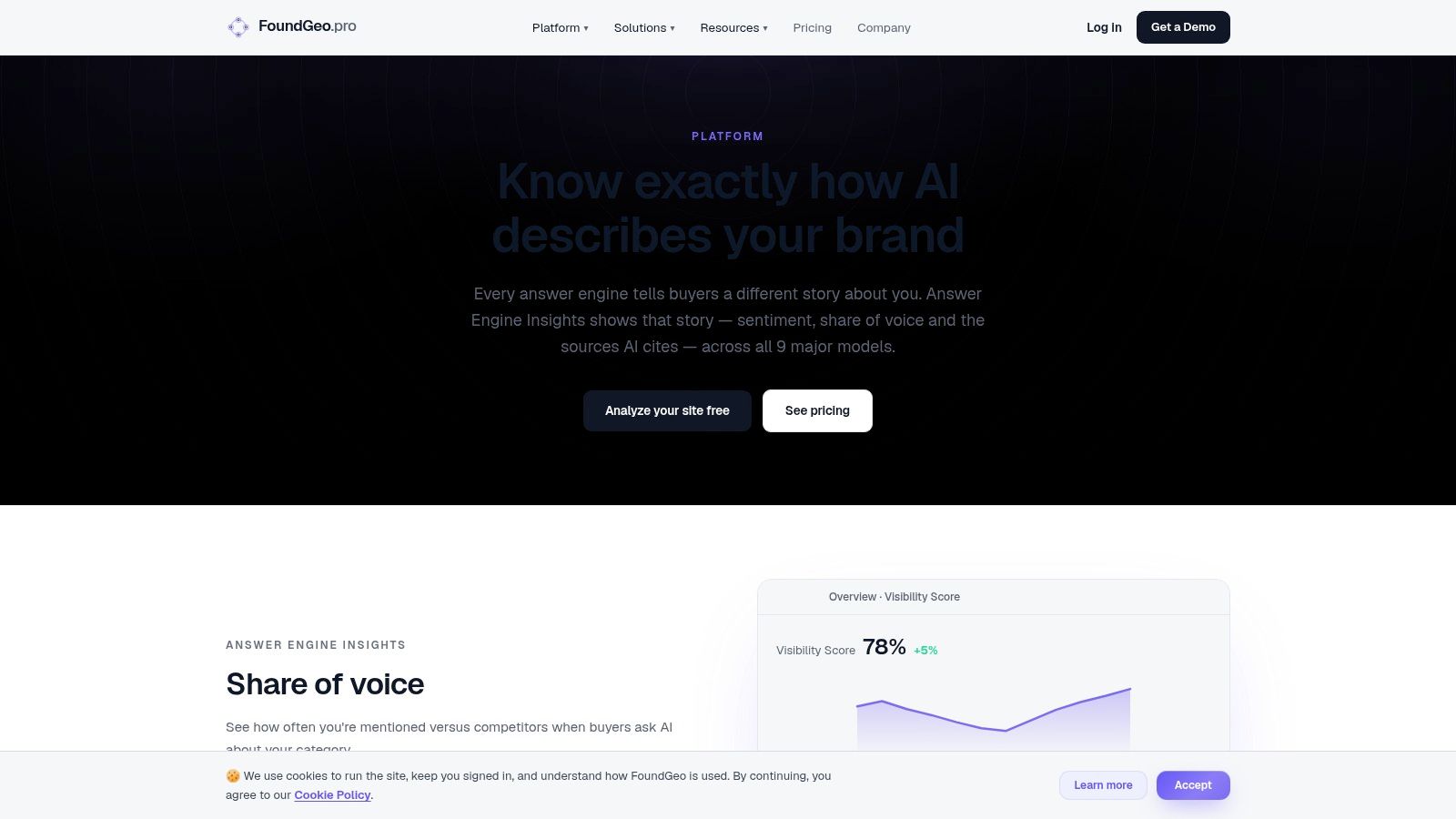
FoundGeo's workflow combines brand mention tracking, share of voice, sentiment, and cited source mapping. That matters because many teams still mistake a mention for proof of recommendation. FoundGeo's framing is better than that. It lets teams see the answer, the source pattern, and the brand context together, which makes the report more actionable than a simple yes or no check.
Best fit and limits
- Free snapshot entry point. Good for low-friction first checks.
- Multi-engine coverage. Better for market comparisons than for single-SERP focus.
- Source mapping. Useful when the source type matters more than raw mention count.
- Automation options. Helpful if the team wants recurring monitoring without building a custom setup.
The limitation is that the monitoring is sample-based, so it's directional rather than a full census. That is honest and useful, but it means teams shouldn't overread small movement as certainty. FoundGeo is a good place to start if the goal is fast multi-engine visibility, then decide whether a deeper audit tool is needed.
7. Elmo for Open-Source Control and Portability
Elmo is the strongest option on this list for teams that want transparency and control. It is open source, can be self-hosted for free, and also offers managed cloud plans Elmo homepage. That combination makes it unusual in a market that often pushes teams toward opaque dashboards and locked-in exports.
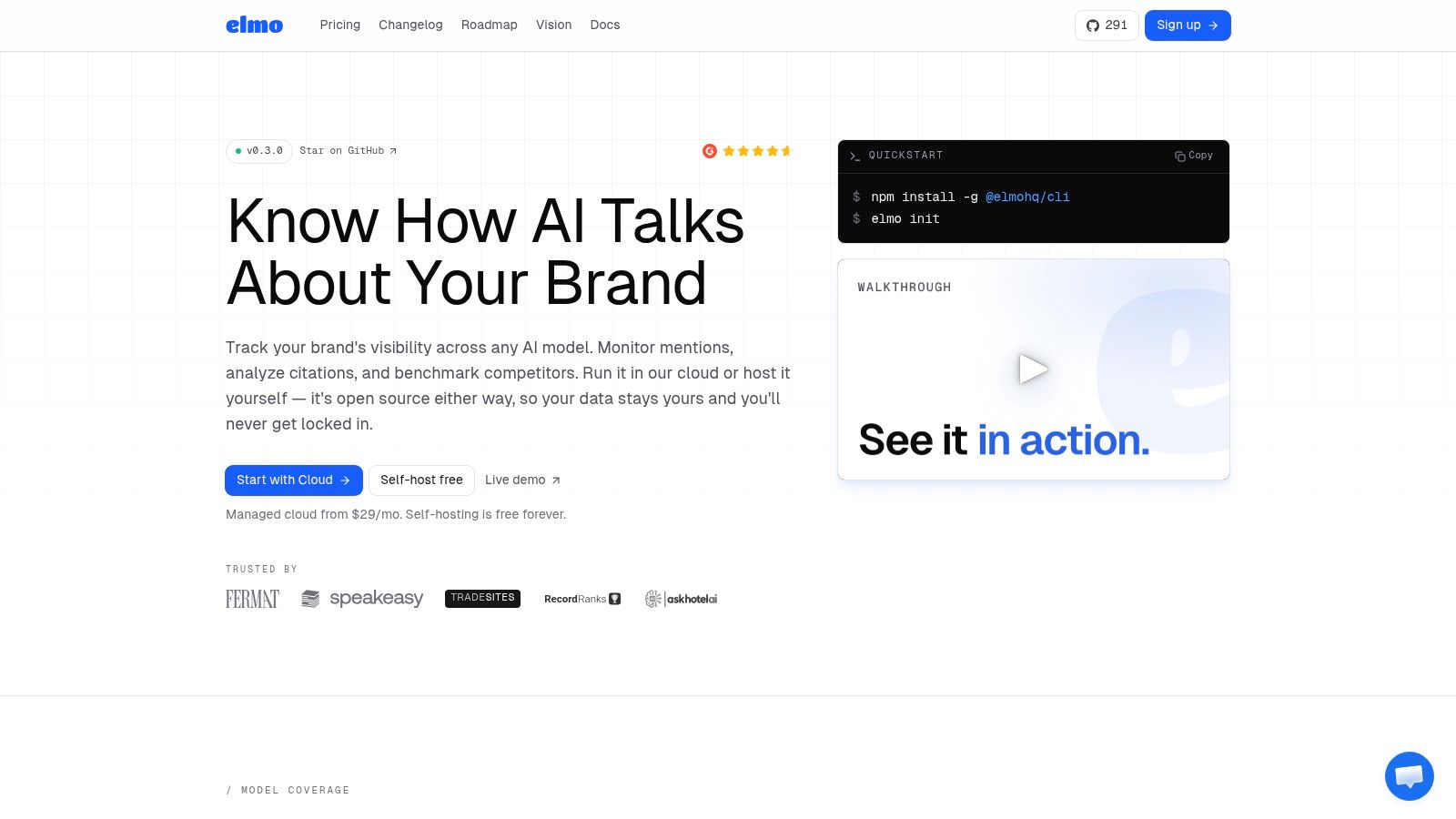
The published scope includes ChatGPT, Google AI Overviews/Mode, Perplexity, Gemini, Copilot, Grok, and LLM APIs, plus mentions, citations, share of voice, trends, prompt management, and query fan-out. That makes Elmo a strong choice when a team wants to own the monitoring stack or keep it portable across clients and internal environments.
Practical rule: Self-hosting only makes sense when engineering time is available. Free software is not free if the team has to maintain it.
The managed cloud side matters too. Elmo's published plan language shows that teams can avoid full self-hosting if they need a lighter path in. The main limitation is operational. Open-source control comes with setup and maintenance overhead, and enterprise SLAs require higher-touch engagement. This is the tool we would shortlist when budget control, auditability, or vendor independence matters more than convenience.
8. Koalr for Scheduled Brand Monitoring Across Seven Engines
Koalr is a pragmatic monitoring option for teams that want recurring brand tracking without building a large research workflow around it. Its published brand monitoring scope covers seven engines, including ChatGPT, Claude, Gemini, Perplexity, Copilot, Google AI Overviews, and AI Mode Koalr brand monitoring. That makes it a useful middle-layer tool for agencies and in-house teams who need regular reporting, not one-off curiosity checks.
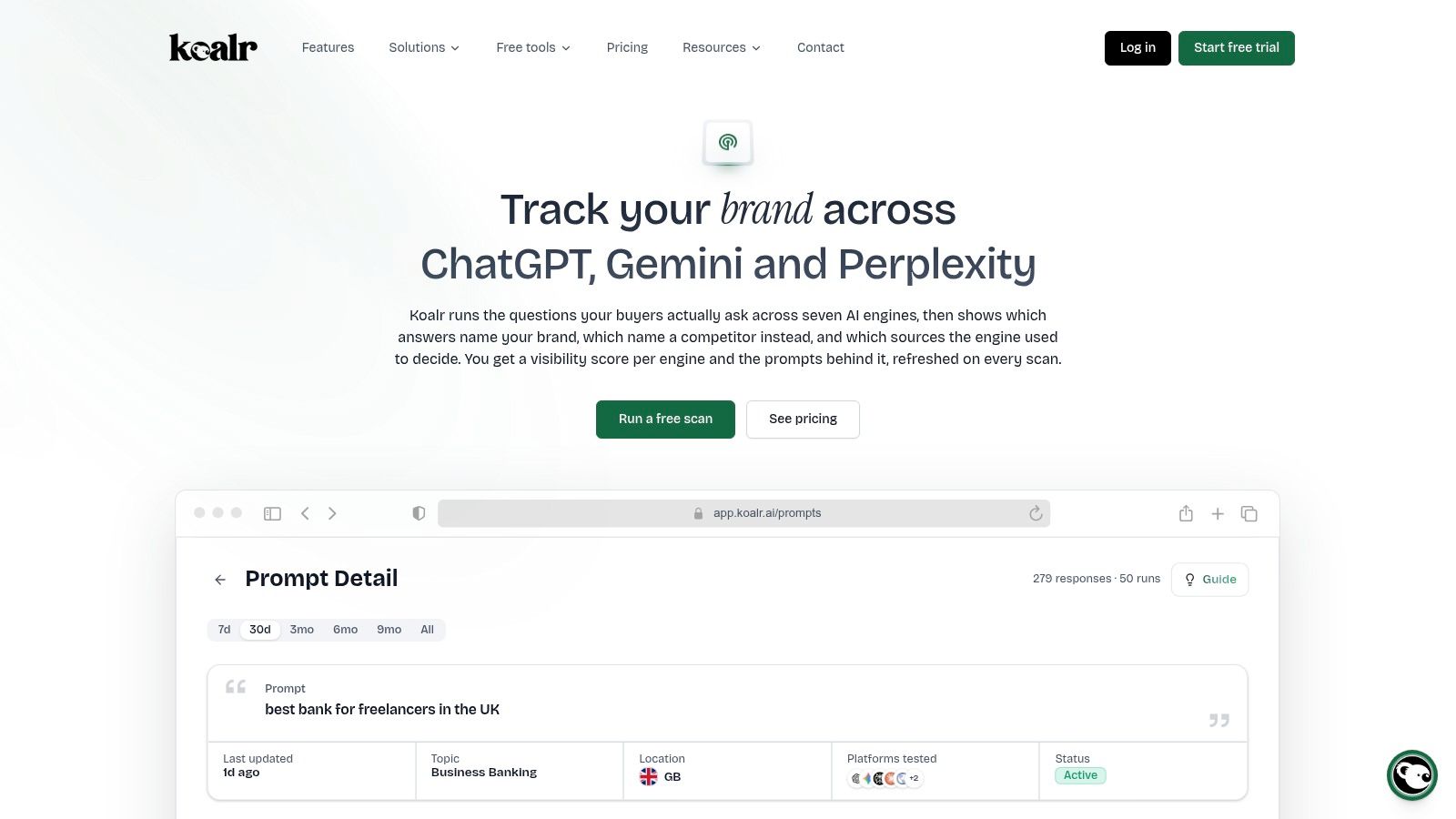
Koalr's published features include Prompt Explorer, scheduled monitoring, visibility/SOV scoring, sentiment, and citation rate per prompt. That is useful because the report can be shaped around a question set rather than a single brand mention. The output is designed to be client-friendly, which matters for agencies that need a clean summary without sacrificing the underlying evidence.
Where the workflow is strongest
- Buyer-style prompts. Useful for “best,” “comparison,” and “which one” questions.
- Scheduled tracking. Better for recurring visibility review than for isolated checks.
- Action lists. Helpful when the team needs next steps from the data.
- Free scan. Good for initial evaluation before a paid commitment.
The tradeoff is that some product messaging suggests the modules are still iterating. That doesn't make it weak, but it does mean buyers should verify the current published criteria and billing terms, especially because pricing is displayed in GBP. For US teams, that detail matters operationally even if the monitoring logic is sound.
9. Surva.ai for Prompt Tracking With Commercial Context
Surva.ai is useful when visibility needs to be read through commercial value, not just mention volume. Its prompt tracking covers ChatGPT, Perplexity, Claude, Gemini, and Google AI Overviews, then adds signals such as trend score, CPC, and ad count Surva.ai search prompt tracking. For teams choosing an AI search visibility checker, that mix helps separate high-value prompts from queries that are visible but unlikely to matter in reporting.
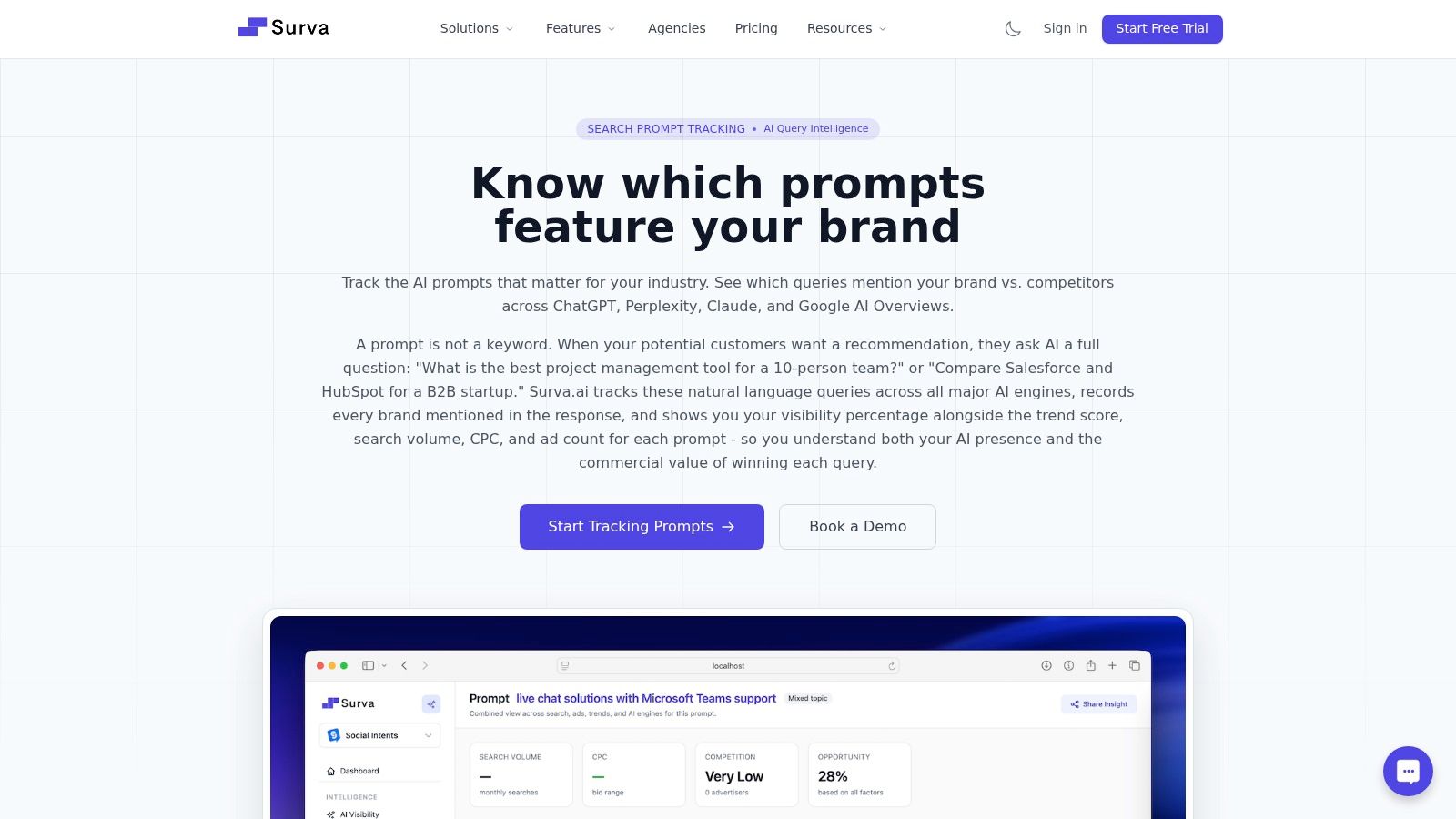
The workflow starts with prompt discovery, which can be driven by AI suggestions, competitor sources, or keyword-to-prompt mapping. Surva.ai then layers visibility and citation data onto that set, so the report reflects both exposure and business context. That matters for content strategists working with limited budget, because it supports prioritization instead of treating every query as equal.
What makes it useful
- Commercial context. Helpful when the team wants to rank prompts by market value.
- Daily checks. Fits recurring review of active prompt sets.
- Gap alerts. Useful when competitors appear and the brand does not.
- Full response text. Lets analysts review the answer, not only the summary.
The tradeoff is platform weight. Surva.ai bundles broader AI SEO and content optimization features, so it can feel heavier than a narrow checker. Verify whether Surva.ai's CPC and ad count signals are sourced directly or inferred from third-party datasets before using them in client reports. That distinction matters if the output will be treated as evidence rather than internal guidance.
10. CitedSpy for Free Spot Checks and Fast Benchmarking
CitedSpy is the easiest place to begin if the team wants a no-signup snapshot. Its free AI Answer Checker runs a question across ChatGPT, Perplexity, Gemini, Copilot, and Google AI Mode, then captures the brands named and the cited sources CitedSpy AI Answer Checker. For quick validation, that is enough to answer a basic visibility question without buying a full monitoring stack.
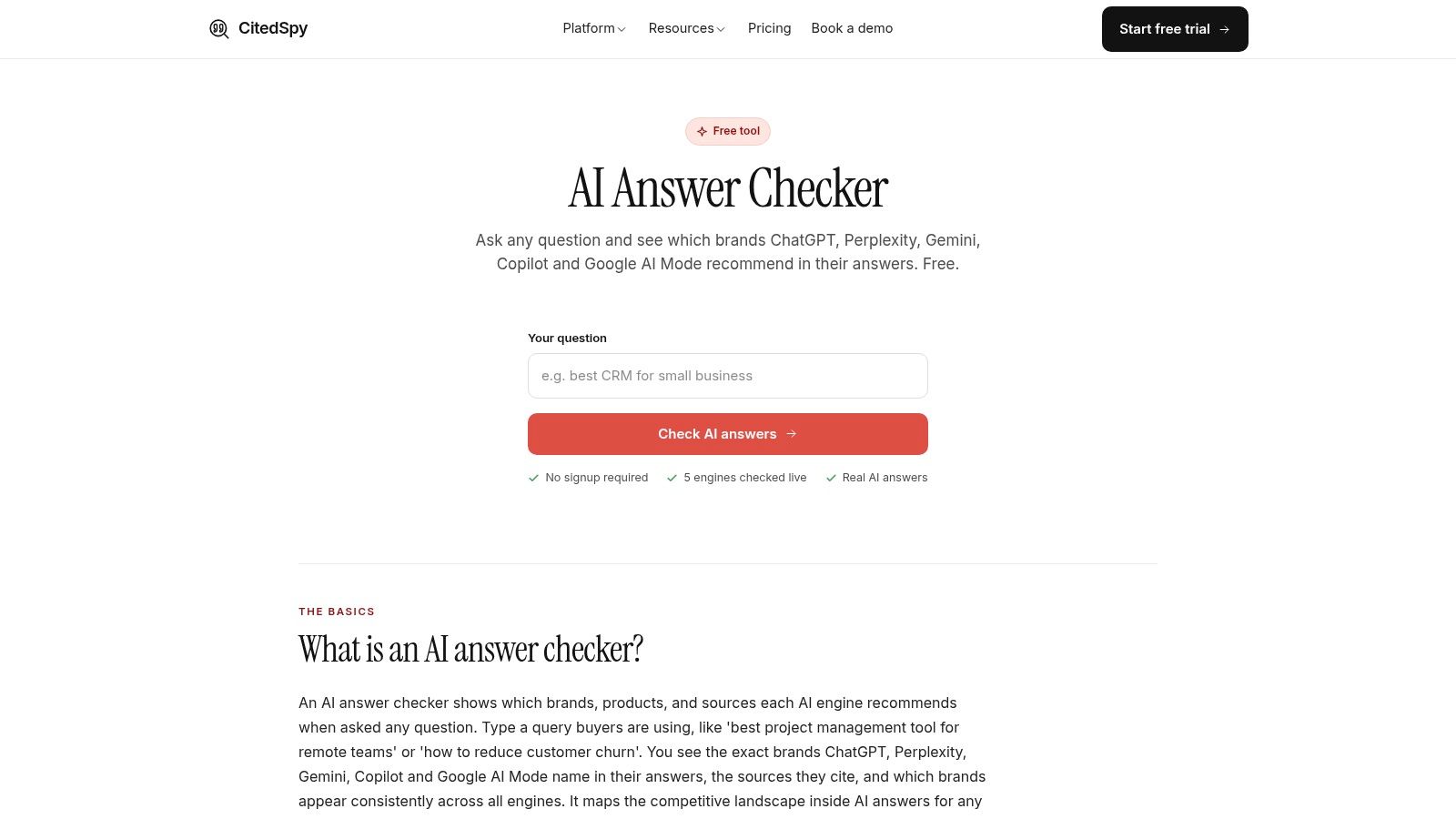
This is the tool we would use when a marketer wants to test real queries like “best X” or a comparison prompt before a budget discussion. The published summary view helps show consistency across engines, and the paid path adds scheduled monitoring, competitive tracking, and alerts. That makes the product fit neatly into the “fast spot check first, recurring monitoring later” category.
A snapshot is useful because it keeps the team honest about what appears right now. It is not the same thing as a longitudinal program.
The limitation is built into the free model. Snapshot-based checks do not equal sustained visibility measurement, and engine timeouts or rate limits can interrupt a run. That is why CitedSpy is best treated as a first read, not a final report. For teams comparing tools, the published methodology is part of the evaluation, and it should be reviewed before any recommendation is made.
Top 10 AI Search Visibility Checker Comparison
ProductEngine coverageCore featuresBest for / Target audienceKey strengths (USP)Pricing & accessSISTRIX – AI Visibility & Prompt MonitoringGoogle AI Overviews/Mode, ChatGPT, PerplexityDaily AI Visibility index, prompt monitoring, citation/source analysis, API & exportsSEO teams/agencies already on SISTRIX; integrated reportingIntegrates AI visibility into mature SEO suite; enterprise exportsIncluded in SISTRIX subscriptions (paid license)Semrush – AI Visibility Toolkit + AI Overview TrackingPrimarily Google AI Overviews (emerging cross‑engine)AI Overview filters, Position Tracking trends, AI Visibility score, guidesTeams already using Semrush for keyword & competitor workflowsStrong keyword/workflow integration and operational guidesPart of Semrush plans (paid)seoClarity – AI Overviews Monitoring (Enterprise)Google AI Overviews (Google‑centric)Overviews detection, SERP image captures, Visibility Share, visual SERP comparisonsLarge enterprises needing scale and executive reportingScales to very large datasets; visual reporting for stakeholdersEnterprise / quote-based pricingBrightEdge – BGP (Generative Parser)Google AI OverviewsAI Overview detection, correlation research, Data Cube X / Copilot integrations, playbooksBrands on BrightEdge (US focus), content ops teamsResearch‑driven playbooks; deep content pipeline integrationEnterprise / quote-based pricingAnymorph – Monitor (Multi‑Engine)~10 engines (ChatGPT, Gemini, Claude, Perplexity, Google AI Mode/Overviews, Grok, Copilot, etc.)Virtual‑browser captures, full answer text, citations, on‑screen screenshotsTeams needing forensic, cross‑engine captures and auditsHigh‑fidelity, on‑screen evidence vs API approximations; multi‑engineDemo / sales onboarding; pricing not publicFoundGeo – Answer Engine Insights (GEO)9 engines with GEO controls (incl. ChatGPT, Claude, Gemini, Perplexity, Grok)Brand SOV, sentiment, citation mapping, action queue, geo samplingLocal SEO, GEO specialists, small teams testing AI visibilityFree instant snapshots, transparent monthly tiers, GEO controlsFree snapshot; low‑friction monthly plansElmo – Open‑Source AI Visibility TrackerChatGPT, Google AI Overviews/Mode, Perplexity, Gemini, Copilot, Grok, LLM APIsVisibility/SOV dashboard, prompt management, query fan‑out, API, self‑host/cloudTeams wanting transparency, portability or budget controlOpen‑source + self‑host option; BYO keys; minimal vendor lock‑inSelf‑host free; managed cloud tiers (starter pricing)Koalr – Brand Monitoring7 engines (ChatGPT, Claude, Gemini, Perplexity, Copilot, Google AI Overviews/Mode)Prompt Explorer, scheduled multi‑engine checks, SOV & sentiment, gap analysisAgencies and consultancies; client reporting workflowsClient‑friendly dashboards & clear scoring; free scanFree scan; paid plans (pricing in GBP)Surva.ai – Search Prompt TrackingChatGPT, Perplexity, Claude, Gemini, Google AI OverviewsPrompt discovery, per‑prompt SOV/citation, daily checks, commercial signals (CPC, ad count)Marketers prioritizing commercial value of AI visibilityPrioritizes opportunities by commercial context; AI SEO audit featuresPaid multi‑module platformCitedSpy – AI Answer Checker (Free)ChatGPT, Perplexity, Gemini, Copilot, Google AI ModeLive multi‑engine question checks, brand extraction, source URLs, cross‑engine summaryQuick spot‑checks, beginners, fast benchmarkingFree no‑signup checker; plain‑English methodologyFree checker; paid upgrades for scheduled monitoring
Choose the Checker That Matches the Question
The best ai search visibility checker depends on the question being asked. Google-focused platforms make sense when the work is centered on AI Overviews and SERP reporting. Semrush, seoClarity, and BrightEdge fit that lane well because they sit close to existing SEO workflows and executive reporting. They are strongest when the team wants Google-specific proof and a clean operational path from observation to content action.
Multi-engine monitors answer a different question. Anymorph, FoundGeo, Elmo, Koalr, and Surva.ai are better when the report needs answer text, citation evidence, sentiment, and competitor context across several assistants. That is the right category when the team is comparing observed answers rather than just checking whether a domain showed up somewhere. If portability matters, Elmo stands out because self-hosting gives the team more control over the stack and the data.
For low-friction checks, FoundGeo and CitedSpy are the easiest entry points. They are useful when the team wants a quick read before deciding whether ongoing monitoring is worth the effort. CitedSpy is the fastest way to spot-check a query. FoundGeo is better when the team wants a broader multi-engine snapshot with sentiment and source mapping.
The most important part of the buying process is not the feature list. It is the evidence model. Before selecting a tool, the team should define the prompts, markets, engines, citation evidence, refresh cadence, exports, and the vendor's published evaluation criteria. That is the only way to keep the report defensible when a client asks why one platform showed a mention and another did not.
The safest operating rule is simple. Record the observed answers and cited URLs, then treat any score as a starting point, not a complete measure of visibility. A score can be useful, but the underlying answer text is what makes the report auditable. For SEO professionals and marketers new to AI search, that discipline matters more than picking the loudest dashboard.
If the next step is evaluating a checker for a live brand or client account, start with one Google-focused tool, one multi-engine monitor, and one free spot-checker, then compare the same prompts across all three. That will show where the tools agree, where they don't, and which reporting format supports decisions.