Teams are seeing the same pattern right now. Pages still rank. Impressions still exist. Traffic doesn't follow in the same way. The missing piece is often simple. The answer happened before the click.
That's why SEO for AI answers has become a separate operating discipline inside search. The job isn't only to rank beneath a result page. It's to be cited, surfaced, or recommended inside the response layer users read.
This changes how content gets planned, how sources get chosen, and how success gets measured. It also changes the standard of proof. We can describe what appeared in ChatGPT, Perplexity, and Google AI Overviews. We can describe what was cited and what wasn't. We can compare outputs across prompts. We can't claim internal mechanics we can't observe.
That distinction matters, because a lot of bad advice in this space starts by pretending certainty where there isn't any. Good teams are doing the opposite. They're testing prompts, tightening extractable answers, and tracking citation presence separately from rank.
Why SEO for AI Answers Starts Inside the Answer
The old mental model was straightforward. Rank high enough, earn the click, improve the page, repeat. That still matters. It just doesn't describe the whole search experience anymore.
When an answer layer appears, user behavior changes. In a Pew Research Center study reported by Semrush, users clicked a standard search result in only 8% of visits when an AI summary appeared, compared with 15% when no AI summary appeared. The same writeup says clicks on links inside the AI summary itself were just 1% of visits, and users ended their browsing session after an AI-summary page 26% of the time versus 16% without one.
For SEO teams, that forces a new question. Not "did the page rank?" but "did the brand appear inside the answer the user consumed?"
Visibility now has two layers
Traditional search visibility still exists. So does answer visibility. They are related, but they aren't the same thing.
A page can rank and still contribute less traffic when an answer absorbs the informational need. A page can also be cited inside an answer and still produce fewer visits than expected. That's why answer inclusion needs its own workflow, not just a few AI buzzwords added to an SEO dashboard.
Practical rule: Treat rank, citation presence, and click yield as separate signals. They describe different parts of the same search journey.
Many teams lose time. They audit rankings, maybe featured snippets, maybe brand mentions. But they never build a clean record of what was surfaced in ChatGPT, Perplexity, Gemini, Claude, or Google AI Overviews for the prompts that matter.
What changes in practice
The working target becomes narrower and more concrete:
- Prompt coverage: Which real questions trigger answer-style responses.
- Answer inclusion: Whether the page, brand, or source was cited or mentioned.
- Demand capture: Whether users later search the brand directly or return through another path.
- Answer-level measurement: Whether performance changed when the answer layer appeared.
The strongest evidence for the traffic impact comes from large keyword analysis too. Ahrefs reported across 300,000 keywords that the presence of a Google AI Overview correlated with a 34.5% lower average CTR for the top-ranking page. That's enough to end the idea that position alone explains outcome on answer-heavy results.
SEO for AI answers starts with a simpler assumption. The answer is often the first page users consume. If a team wants visibility there, it has to design for citation, sourceability, and prompt testing from the beginning.
How AI Answer Systems Surface and Cite Content
The visible layer is where the analysis should start. Not with theories. With the response itself.
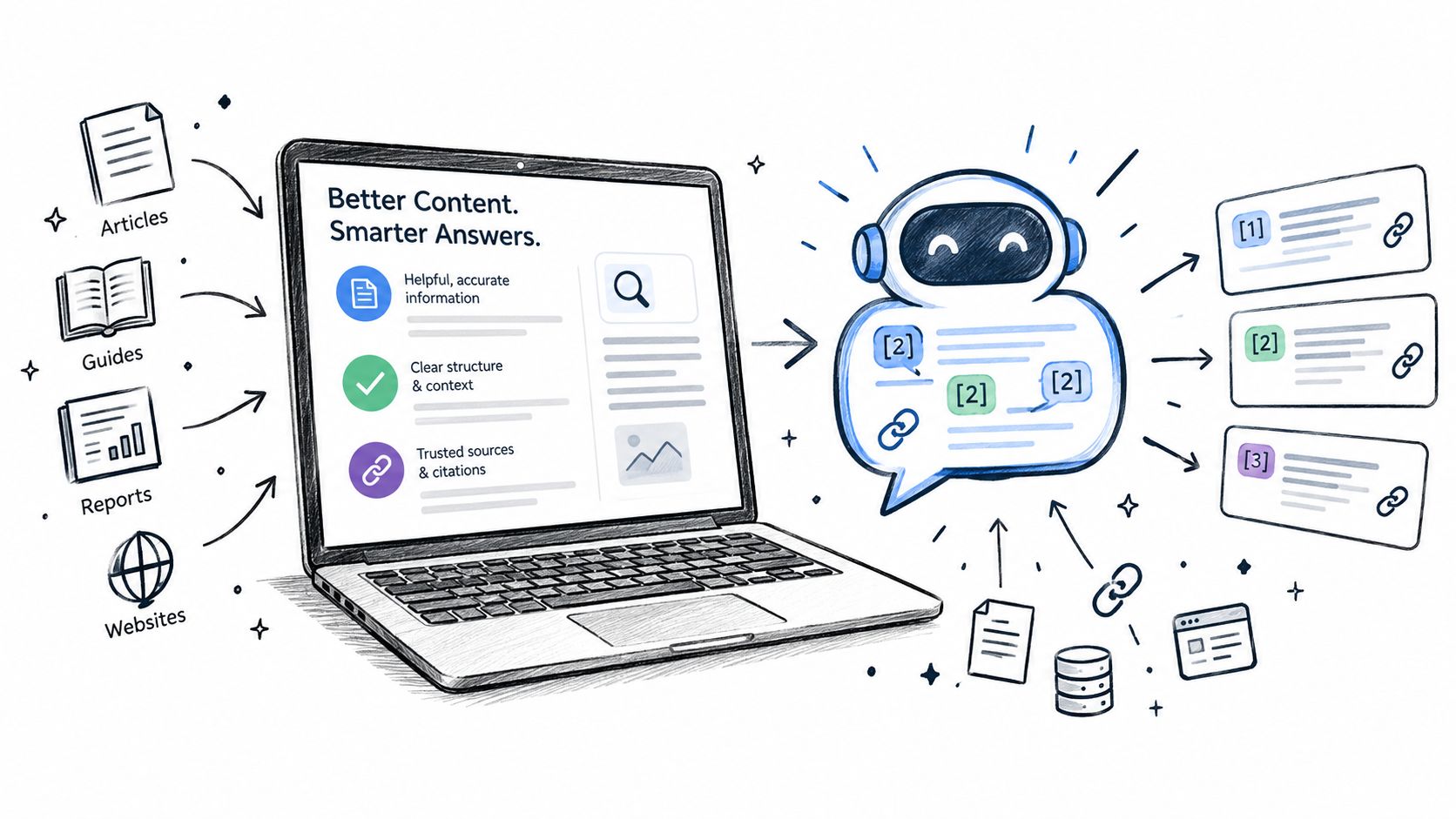
Google AI Overviews, ChatGPT with web search, and Perplexity all show users some form of linked source experience. That's what can be audited. It's also what can be compared across engines without pretending to know internal scoring.
A 2026 arXiv paper summarized here states that each AI Overview is accompanied by embedded reference citations presented to the user as the evidentiary basis for the generated content, and that these citations are structural rather than incidental. That description is useful because it focuses on the thing users can see.
What can be observed in live outputs
In practice, teams should inspect every answer with the same questions:
- Which domains were cited
- Which claims were linked to those domains
- Which brands were mentioned without citation
- Which pages were surfaced but not described
- Which source types appeared, such as product pages, documentation, editorial pages, directories, or reviews
ChatGPT's web search feature has been documented as producing current answers with links users can open, and those responses may include citations users can inspect, as described in this summary of source-linked web search behavior. Perplexity also documents source labels through a review process and shows labels such as Government, Academic, or Trusted in its help-center behavior cited here.
That's enough to build a practical reading method. Look at the answer. Log what appeared. Separate citation from mention. Separate mention from recommendation.
A simple checklist for reading any AI answer
This is the checklist we use when reviewing tested responses across engines:
- Read the answer before the links. The wording shows what need was satisfied on-platform.
- Open every cited source. Confirm whether the cited page supports the claim.
- Note source type. A documentation page behaves differently from a listicle.
- Compare by prompt phrasing. A minor wording change can surface different pages.
- Log omission. If a strong page wasn't surfaced, that absence matters.
A lot of teams still import old SERP habits here. They assume appearance in the answer layer will behave like a normal ranking win. It often doesn't. That's why a separate review routine matters, especially when comparing answer behavior against broader recommendation patterns such as those discussed in this piece on AI recommendation engines.
The useful question isn't "who ranked first?" It's "what did the user read, and which sources made that answer possible?"
Designing Prompt Aware Content That Gets Surfaced
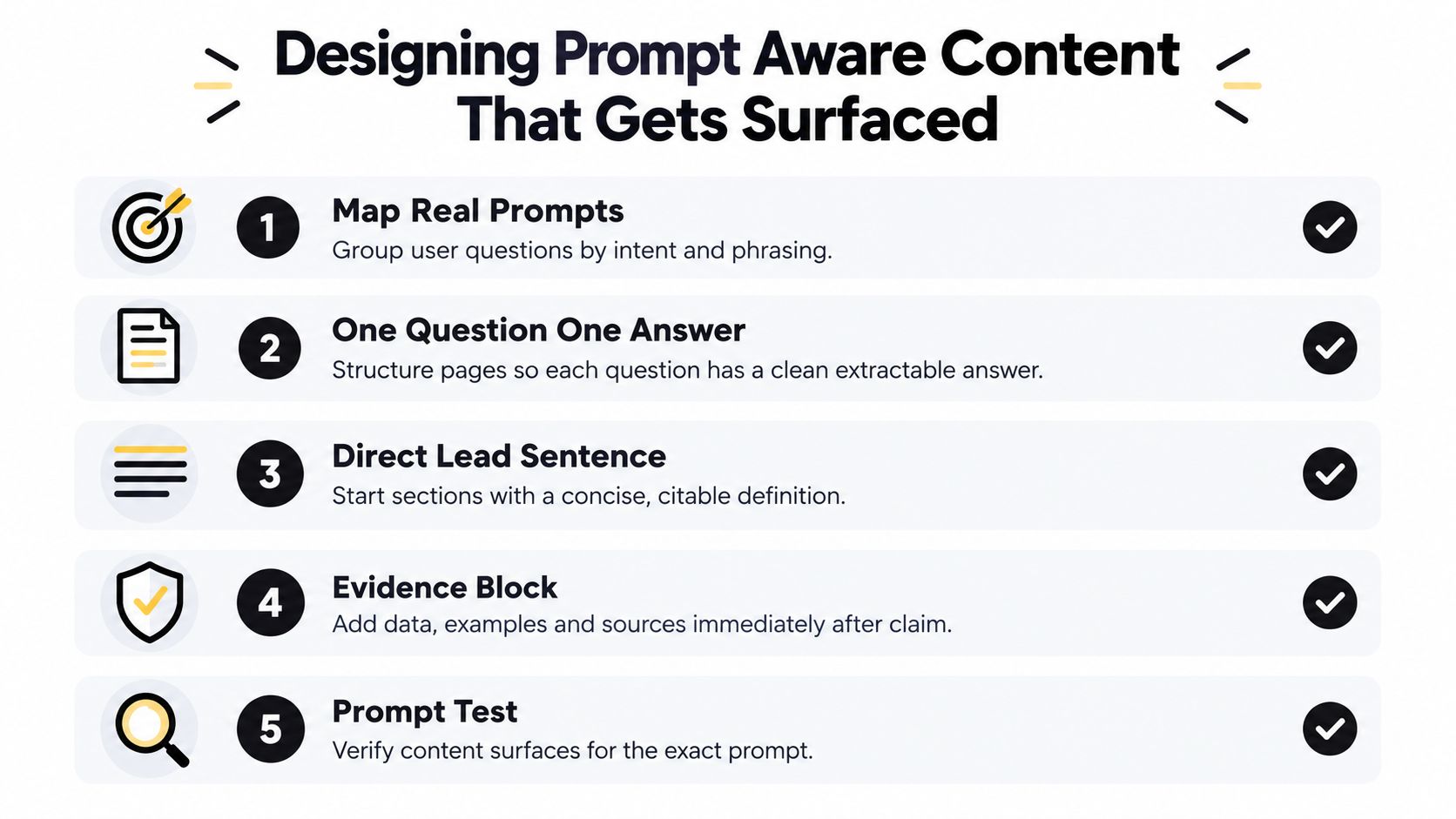
Most generic advice stops at "write authoritative content." That isn't enough. Teams need content blocks that can answer a real prompt cleanly, in plain language, without forcing an engine to piece together the point from five scattered paragraphs.
That starts with prompt mapping. Not keywords first. Prompts first.
Map the prompt before editing the page
Take one topic and collect the variants people ask.
A SaaS team might map prompts like:
- best CRM for small sales teams
- HubSpot alternatives for B2B SaaS
- CRM with simple setup and reporting
- compare Pipedrive and HubSpot for a startup
An ecommerce team might map:
- best running shoes for flat feet
- waterproof hiking boots for winter travel
- carry on suitcase for frequent business trips
These aren't just keyword variations. They imply different answer shapes. Comparison. recommendation. definition. shortlist. buying criteria.
Build one question, one answer blocks
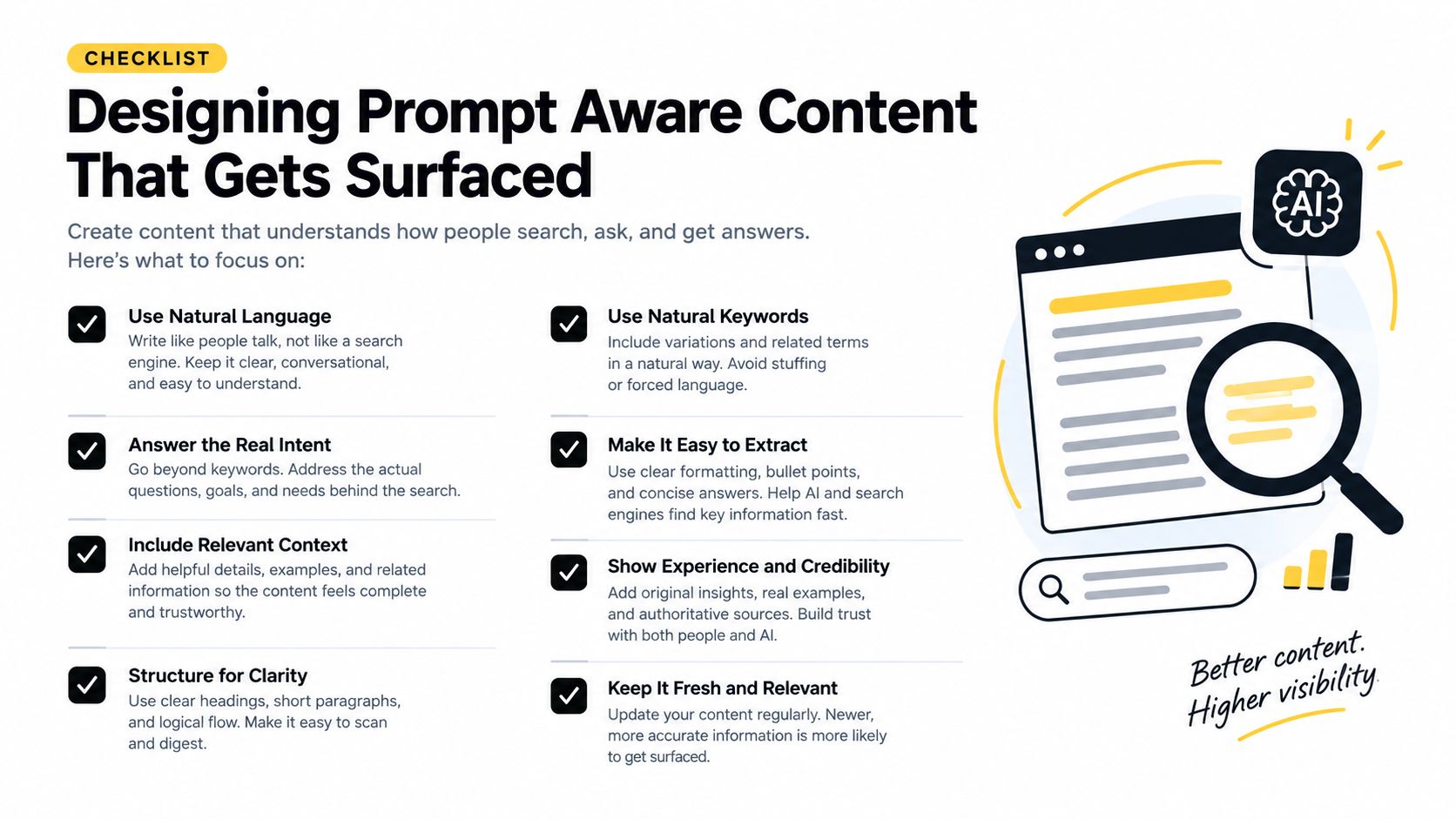
A strong page gives each likely prompt a clean extraction point. The easiest way to do that is to make each section self-contained.
Weak version:
Our platform supports teams with a range of workflow and reporting features that can adapt to different business sizes and industries, making it a flexible solution for modern organizations.
Stronger version:
For small B2B sales teams, this CRM is a fit when the main need is fast setup, basic pipeline visibility, and lightweight reporting without a complex admin layer.
The second version does three things better. It names the audience. It states the use case directly. It can stand alone if surfaced outside the page context.
Structure choices that make pages easier to cite
The most reliable edits are often boring. That's usually a good sign.
- Lead with the answer: Start the section with the direct response, not the scene-setting.
- Use headings that mirror prompts: "Best CRM for small B2B sales teams" is clearer than "Choosing the right platform."
- Keep claims adjacent to evidence: Put the supporting proof immediately after the claim, not six scrolls later.
- Write definitions in one sentence: If a term needs context, give a concise definition first, then expand.
- Make comparison criteria explicit: Price model, fit, trade-offs, onboarding, support, integrations.
Here's where many pages still fail. They bury the answer under brand voice, throat-clearing, or generic intros. That style can work for a human skimmer who's committed to reading. It breaks down when the response layer needs a compact, attributable unit of meaning.
For teams working across engines, this becomes especially important when testing prompt phrasing in platforms like Perplexity, where query wording can surface very different source sets. This guide on how to rank in Perplexity is useful for understanding the practical side of that testing.
Two fast rewrites
SaaS before
"Choosing project management software depends on your business goals, collaboration style, and future growth plans."
SaaS after
"Project management software for remote product teams needs three basics first: task visibility, permission control, and a clean handoff between planning and delivery."
Ecommerce before
"Our skincare range includes options for every skin type with advanced ingredients designed for visible results."
Ecommerce after
"For sensitive skin with redness, this moisturizer is best used when the priority is barrier support and low-irritation hydration rather than active exfoliation."
Editing test: If a paragraph is copied into a spreadsheet with no page title attached, it should still make sense.
That is the standard. Not cleverness. Not volume. Clean, prompt-shaped answer blocks with evidence close by.
Source Engineering and Citation Stability Across Engines
On-page structure helps a page become usable. It doesn't solve the sourcing problem.
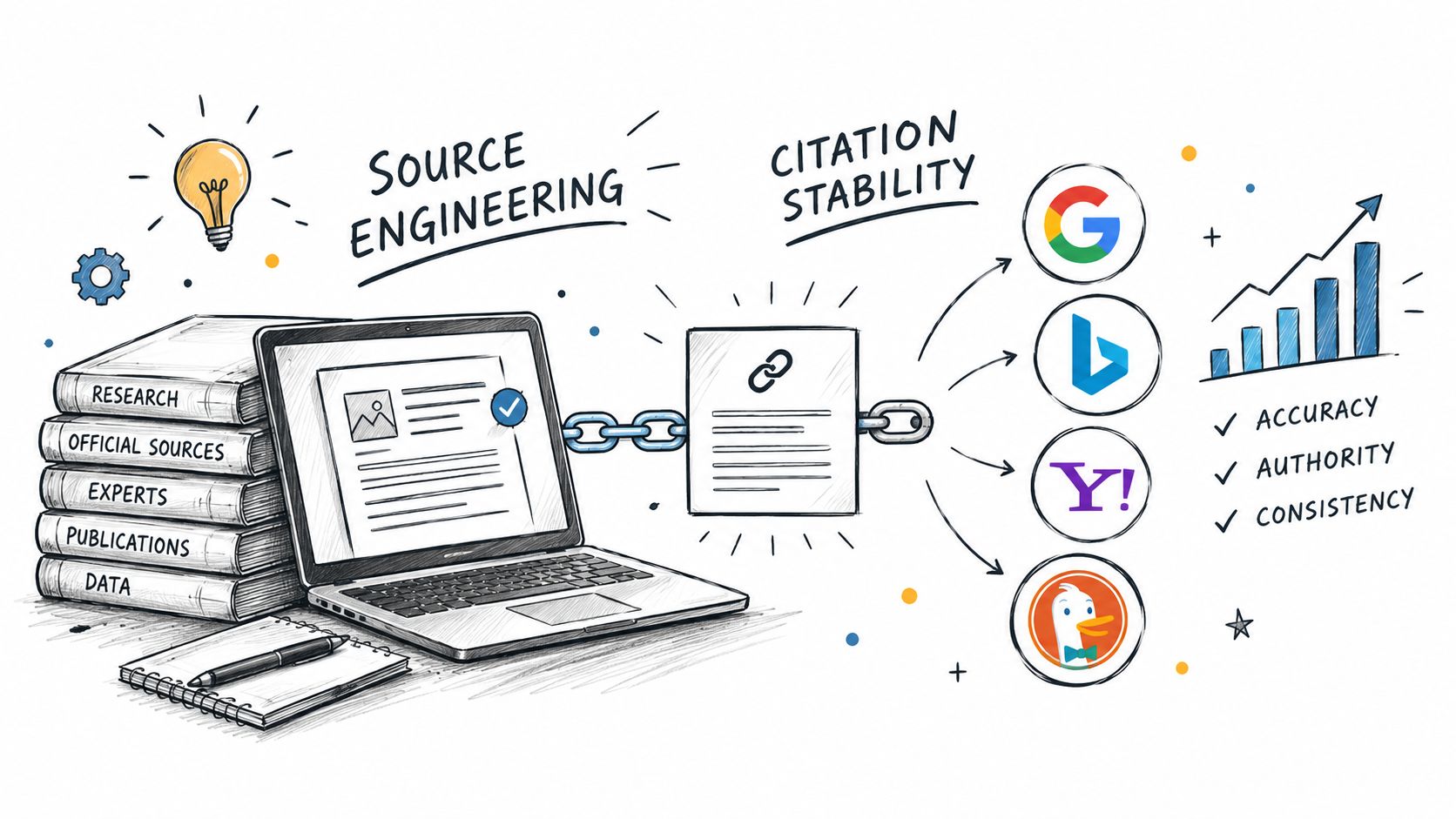
Citation engineering is the work of deciding which pages should carry factual claims, where third-party support is needed, and how to reduce dependence on a single source type. It matters because answer systems don't surface the same mix of sources for every query, market, or engine.
Recent research summarized in this AlphaXiv entry on generative engine optimization argues for machine-scannable content, earned media, and language-aware strategies, and it explicitly notes an inherent big-brand bias against niche players. The same summary also points to variation across engines and rewriting methods, which is the practical reason no single playbook stays stable everywhere.
What source engineering actually means
For most SEO teams, it comes down to four source jobs:
- Primary factual pages: Product docs, pricing explainers, methodology pages, policy pages, location pages.
- Comparative pages: Alternatives, use-case pages, category comparison content.
- Third-party corroboration: Reviews, editorial coverage, partner references, industry listings.
- Entity consistency: Clear naming, ownership, product labels, and topic alignment across the web.
This isn't about inventing authority. It's about reducing ambiguity.
A page can be well written and still lose visibility in tested responses because its claims are hard to verify, its brand naming is inconsistent, or the best supporting information sits in a PDF, image, or fragmented UI component.
Stability comes from source mix, not one perfect page
A common mistake is to expect one polished article to hold answer visibility by itself. That's fragile.
A better approach is to audit the citation neighborhood around a prompt. If tested responses cite review platforms, product docs, editorial explainers, and category pages, then the source plan should reflect that observed mix. If the engine repeatedly surfaces directories or marketplace pages for local or supplier-style prompts, that source type has to be part of the operating map whether the team likes it or not.
Niche brands usually can't out-scale bigger brands on sheer presence. They can reduce confusion, publish cleaner evidence, and close source gaps faster.
A practical audit for source gaps
Run a prompt set across ChatGPT, Perplexity, Gemini, Claude, and Google AI Overviews. Then sort every cited URL into a source category. The categories matter more than the individual winner.
Look for questions like these:
| Source question | What to check |
|---|---|
| Is the engine citing docs or editorial pages? | Decide whether the factual claim belongs on product documentation or content marketing pages |
| Are third-party pages appearing more than owned pages? | Strengthen the owned page and build corroboration where the answer layer keeps pulling from outside sources |
| Are citations stable across prompt variants? | If not, narrow the page focus and rewrite for one use case per section |
| Is the brand named consistently everywhere? | Fix naming drift across site copy, listings, and earned mentions |
What doesn't work is treating citation wins as permanent. They aren't. Engine behavior changes. Query wording changes. Competitor pages change. A stable program uses repeatable source patterns and checks them often.
Testing What Gets Cited and Measuring What Matters
Testing has to be boring enough to repeat. If the workflow is too clever, the team won't keep doing it.
The goal is simple. Build a prompt set, run it regularly across engines, and log what was cited, what was surfaced, and what changed. SEO for AI answers stops being theory and becomes an operating rhythm.
Segment prompts by intent first
Don't mix everything into one giant list. Prompt behavior changes too much by intent.
A workable split looks like this:
- Informational prompts: definitions, explanations, how-it-works questions
- Commercial investigation prompts: comparisons, alternatives, shortlist questions
- Recommendation prompts: best tools, best products, top options for a use case
- Local prompts: nearby providers, city-specific services, "who should I hire" wording
- Support prompts: pricing, setup, compatibility, returns, policy questions
This structure matters because answer systems often surface different source types for each group. A product page may appear for one prompt. A review site or publisher comparison may appear for another.
Use the same logging rules every week
The sheet doesn't need to be fancy. It needs to stay consistent.
| Prompt | Engine | Was Cited | Was Surfaced | Notes |
|---|---|---|---|---|
| best CRM for startup sales team | ChatGPT | Yes | Yes | Docs page cited, comparison article mentioned |
| HubSpot alternatives for B2B SaaS | Perplexity | No | Yes | Brand named in list, competitor pages cited |
| best moisturizer for redness | Google AI Overviews | Yes | Yes | Category page cited for ingredient explanation |
| plumber near downtown Austin | Google AI | No | No | Directory-style sources appeared instead |
The sheet should record the exact prompt, the engine, whether the brand or page was cited, whether it was surfaced without citation, and any notes about source type or answer framing. Teams that want a more formal process can use a dedicated tracker such as this guide on AI citation tracking, but a spreadsheet is enough to start.
Separate answer visibility from click metrics
This is the part many teams still muddle.
Citation presence is not traffic. Mention is not traffic. Surfacing is not traffic. Those are answer-visibility signals. They need to be logged beside click performance, not mistaken for it.
The strongest large-scale warning comes from a later Ahrefs update on AI Overviews and CTR, which reported that when an AI Overview was present, the average clickthrough rate for the top-ranking page was 34.5% lower than for similar informational keywords without an AI Overview. That study also reported the average position-one CTR fell from 7.3% in March 2024 to 2.6% in March 2025 on AI Overview keywords, and a later update reported an even larger 58% lower average CTR for position one content.
That doesn't mean every citation program failed. It means a rank report can look healthy while click yield changes underneath it.
Measurement rule: Log citation status, organic CTR, and paid CTR separately. They answer different questions.
A weekly routine that holds up
A good weekly review usually includes:
- Run the same prompt set across the same engines and modes.
- Capture the response output with date and prompt wording.
- Log source type for every cited page.
- Mark new appearances and drops without assuming a cause.
- Revise one page class at a time, such as comparison pages or help docs.
- Retest the exact prompt, not a paraphrase, after changes are live.
What doesn't work is over-reading a single test. One response can shift for reasons the team can't verify. Patterns across repeated prompts are far more useful than one screenshot.
That's also why citation counts alone aren't enough. A page might be cited and still produce weak click recovery. Another page might never be linked directly but still strengthen branded demand. When evidence is missing, the honest note is simple. We don't know yet.
Putting SEO for AI Answers Into Practice
The workflow changes by business type, even when the principles stay the same.
A SaaS team targeting "project management software for remote agencies" should usually build a compact comparison and use-case structure. That means a direct fit statement near the top, a clear section for team size and workflow complexity, and supporting proof close to the claim. If tested responses keep citing review sites instead of owned pages, the source plan needs third-party corroboration, not just a rewritten landing page.
An ecommerce team working on "best trail shoes for wide feet" needs a different shape. The useful page isn't broad lifestyle copy. It's a page that states fit, terrain, cushioning trade-offs, and sizing constraints in clean blocks. If answer responses keep surfacing editorial roundups, the brand should check whether its own category and product pages explain those buying criteria in extractable language.
Local service prompts are different again. A query like "best family dentist in Bristol" often depends on source types the business doesn't fully control. The local team should tighten service pages, clarify specialties, keep naming consistent, and audit which directory, review, or local pages were repeatedly surfaced in tested responses. That work is less glamorous than writing a trend piece. It usually matters more.
A short decision checklist
Use this when choosing the next prompt set to target:
- Start where answer behavior is already visible: If prompts already produce AI-style answers, they deserve review first.
- Choose prompts with clear business value: Comparison, recommendation, and local hiring prompts often reveal the biggest source gaps.
- Fix one page type at a time: Don't rewrite docs, blog posts, product pages, and local pages all at once.
- Audit what is already cited: Build from observed source patterns, not assumptions.
- Write "we don't know" when needed: If a team can't verify why a page was or wasn't surfaced, it shouldn't pretend otherwise.
The near-term win is clarity. Better prompt mapping. Better answer blocks. Better source design. Better logging.
The longer-term advantage is discipline. Teams that separate rank from answer inclusion will learn faster than teams that treat AI search as a branding myth or a traffic apocalypse. It's neither. It's a visible answer layer with its own rules of observation, and it rewards teams that test what appears.