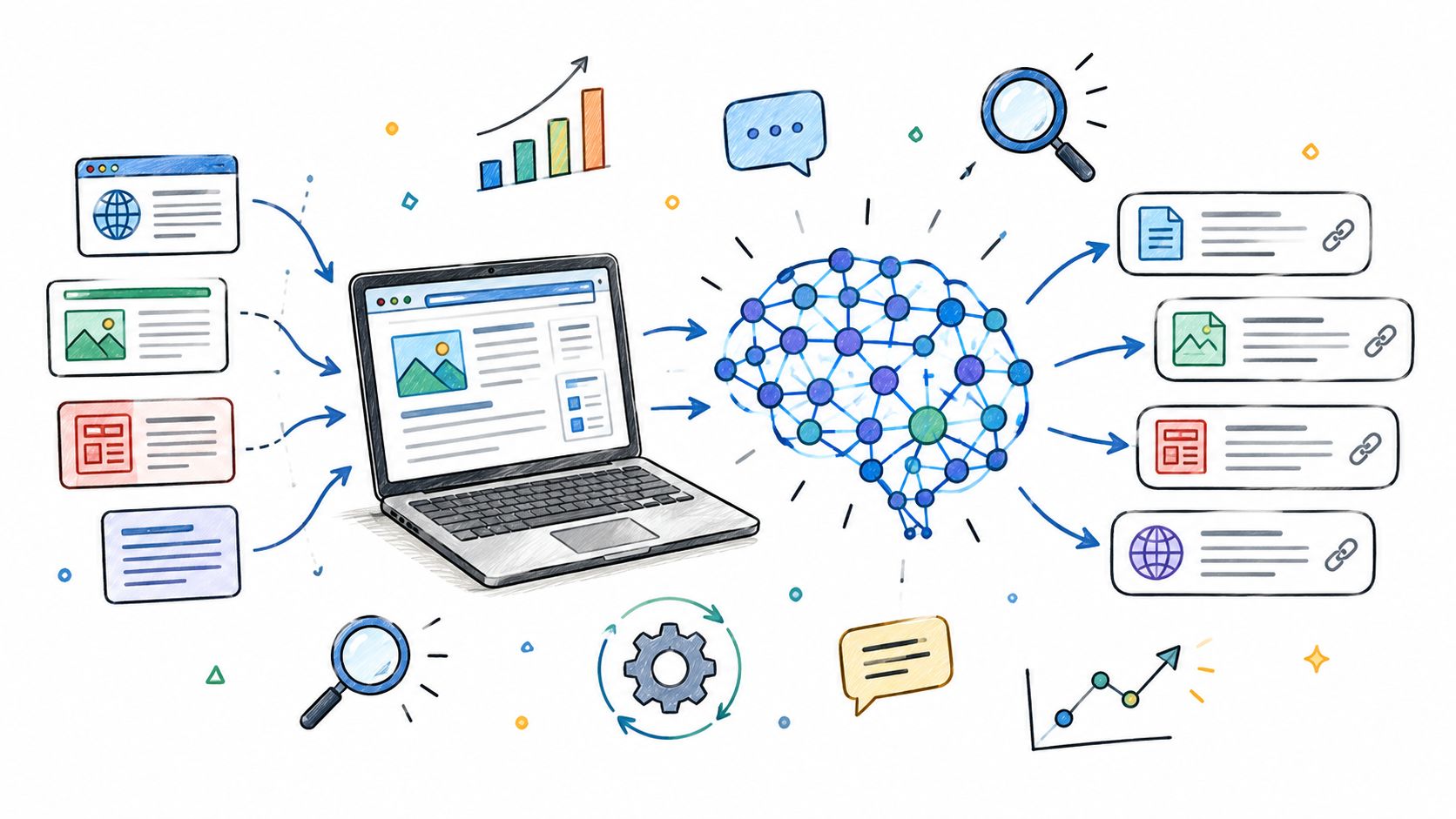

Popular advice says to pick one AI visibility tool and make it the source of truth. That sounds tidy, but it breaks as soon as a team needs to compare brand mentions, citations, Google AI Overviews, AI referrals, and content workflows in the same reporting stack. The better question is what a team needs to measure, because AI answer visibility, market intelligence, and SEO execution are not the same job.
That distinction matters because the category is expanding fast. One market estimate puts the global AI visibility tool market at $20.4 billion in 2024 and projects $82.2 billion by 2030, a rise that implies a 24.8% CAGR over the period, which suggests the category is moving from a niche add-on to a mainstream measurement layer for discovery across ChatGPT, Perplexity, Gemini, Google AI Overviews, and Claude Amicited market overview. We also need to separate what the tool sees from what the answer engine shows. A citation is not always a mention, and a mention is not always a citation.
For that reason, no single product should be treated as universally best. We're comparing tools by engine coverage, front-end versus API data, prompt controls, reporting, integrations, pricing transparency, and known limits. We're also flagging where a second measurement source may be prudent, especially when teams need confidence around AI answer coverage rather than just a clean dashboard.
1. Profound
Profound is built for teams that want answer-engine visibility first, not classic SEO with an AI layer bolted on. Its website positions the product around how AI systems mention brands, which sources they cite, and how that changes over time across major AI surfaces. That makes it a strong fit when the main question is whether a brand is appearing in the answers at all.
Why it stands out
The strongest case for Profound is its focus on prompt-level tracking and enterprise workflows. It is designed around the reality that teams need to compare prompts, competitors, and source patterns over time, not just glance at a score. The category context also helps here. A 2026 software review describes AI visibility tools as products that track how often systems like ChatGPT, Perplexity, Claude, and Gemini mention or cite a brand in their answers, and Profound sits squarely in that model Frase software review.
Practical rule: Use Profound when the reporting question is about answer presence and cited sources, not just search rank movement.
The platform's positioning also matters for agencies and larger in-house teams. It emphasizes daily tracking, competitor benchmarking, and analytics that help separate a one-off answer from a repeatable pattern. For teams that report upward, that kind of structure is often more useful than a loose collection of screenshots.
Where we'd be cautious
Pricing isn't fully public, so procurement will likely be sales-led. That makes it harder for smaller teams to compare quickly. Coverage can also vary by plan, so buyers should verify which engines are included before treating it as their only monitoring layer.
Profound is strongest when the goal is share of voice in AI answers, but we'd still want a second source if the team needs coverage beyond the engines included in the chosen tier. That is especially true for brands that operate in multiple regions or need a broader audit trail for stakeholder review.
2. Ahrefs
Ahrefs is the clearest example of a broader SEO suite adding AI visibility without abandoning its core workflow. That matters because many teams already live inside Ahrefs for keyword research, backlinks, and organic tracking. When AI visibility is added to that environment, it becomes easier to connect answer visibility with the rest of the SEO program.
Why it stands out
Ahrefs has documented AI Overviews tracking, Brand Radar, and Bot Analytics, which gives it a practical place in the comparison for teams that need AI visibility without adopting a separate specialist stack. The product's research posture also helps. In one 2026 analysis of Google AI Overviews citation patterns, major publishers and media made up 28% of citations, review and comparison platforms 22%, brand and product sites 19%, educational and reference sources 14%, community and forums 9%, and other sources 8% Presenc.ai citation patterns. That kind of source mix is useful context for Ahrefs users who already think in terms of pages, domains, and content types.
The other advantage is fit. Ahrefs is often the easiest path for SEO teams that want AI visibility folded into a familiar platform rather than another dashboard to learn. It also makes it simpler to connect AI visibility to technical SEO and content decisions in the same system.
Where we'd be cautious
Some AI visibility features sit behind higher tiers, so smaller teams may not get full access at the lowest entry point. Ahrefs is also broader than a dedicated AEO platform, which means buyers should not assume it will replace an answer-engine specialist if the brief is heavy on prompt research or multi-engine mention tracking.
For teams already using Ahrefs, it is a practical first comparison point. For teams that need deeper cross-engine reporting, we'd treat it as one layer, not the entire measurement stack.
3. Semrush
Semrush is best for teams that want AI visibility inside a wider marketing suite. Its appeal is less about being the deepest answer-engine specialist and more about reducing tool sprawl. That can matter when stakeholders already expect SEO, reporting, and competitor tracking to live in one place.
Why it stands out
Semrush's AI visibility toolkit is designed to track brand mentions across ChatGPT, Google AI, Gemini, and Perplexity, while still tying into familiar SEO features such as Position Tracking and Sensor. The practical benefit is that the team can compare traditional search signals with answer-engine visibility without moving between unrelated systems. For workflows, that's valuable.
The market context also supports the case for broader monitoring. Independent industry commentary says 49% of marketers now actively monitor LLM impact on brand visibility, up from 22% in 2025, and 82% have it on their radar when those planning to monitor are included Topify market commentary. That doesn't prove Semrush is the right tool, but it does show why suites that can fold AI visibility into existing reporting are getting attention.
Practical rule: Semrush makes the most sense when the team wants one operational home for SEO and AI answer reporting.
Where we'd be cautious
The main tradeoff is precision versus convenience. Because Semrush is a large suite, buyers should validate the AI visibility module against a second source if exact mention and citation behavior is critical. Pricing and availability also vary by bundle, so the feature set should be checked on the current product pages before purchase.
Semrush is a sensible choice for teams that want coverage, familiar reporting, and broader workflow alignment. It's less obvious for buyers who only need a narrow AEO-focused system.
4. BrightEdge
BrightEdge fits enterprise teams that need Google AI Overview tracking with executive-ready reporting. It is less about lightweight experimentation and more about structured visibility programs that already involve multiple stakeholders.
Why it stands out
BrightEdge is one of the more natural options for large organizations because it pairs AI search reporting with the kind of documentation and communication style enterprise teams expect. That matters when search leadership needs to explain why a page appears in AI answers on one query and not another. It also matters because Google AI Overviews are not a static surface.
Google AI Overviews citations are not confined to the top of a page. In one 2026 study, 55% of citations came from the first 30% of a page, 24% came from the middle section, and 21% came from the bottom 40% CXL citation source study. That makes BrightEdge relevant for teams that want to connect page structure with AI Overview presence and content placement decisions.
Where we'd be cautious
BrightEdge is enterprise-oriented and sales-led, so smaller teams may find it more than they need. It also appears best suited to organizations that already have the internal process to act on the reporting, since the value is highest when multiple teams can use the insights.
For large brands, BrightEdge is a strong fit when the question is how Google AI Overviews interact with existing organic content. For smaller teams, the overhead may be more than the benefit.
5. SISTRIX
SISTRIX is a useful middle ground for teams that want published pricing, trial access, and growing AI visibility coverage inside an established SEO platform. It isn't the deepest AEO-only system, but it offers a clearer purchase path than many enterprise-first vendors.
Why it stands out
SISTRIX has added prompt tracking for engines including ChatGPT, Perplexity, Google AI Mode, and AI Overviews, plus country coverage and an API for AI visibility data. That makes it attractive for teams that need structured reporting without committing to a large custom contract. The public pricing angle matters because many AI visibility buyers still struggle to compare tools on transparent terms.
The broader market is also shifting toward multi-platform monitoring. A separate industry review notes that modern AI visibility tools now benchmark competitors and detect where brands are overlooked across multiple platforms, not just classic search results Frase software review. SISTRIX fits that trend, but in a more traditional SEO package.
Where we'd be cautious
SISTRIX's AI features sit alongside the core SEO stack, so they may not go as deep as an AEO-specialist platform. Teams with heavy cross-LLM reporting needs may still want a second tool for broader coverage. That is especially true if the team wants to compare mention behavior across more than one answer engine in the same workflow.
SISTRIX is a sensible shortlist option when buyers want a known SEO environment, published access terms, and enough AI visibility to support practical monitoring.
6. Similarweb
Similarweb belongs in a different bucket. It's a market intelligence suite first, and that gives it value when the problem is not only “Did we show up?” but also “What is happening to AI-driven traffic and referral context?”
Why it stands out
Its Gen AI Intelligence positioning makes it relevant for teams that want brand mentions, citations, prompts, and sentiment in the context of broader traffic intelligence. That's useful because AI visibility doesn't live in isolation. Microsoft's October 2025 note on AI search says AI referrals to top websites spiked 357% year-over-year in June 2025, reaching 1.13 billion Microsoft AI search guidance. That kind of traffic context is exactly where Similarweb adds value.
Practical rule: Choose Similarweb when leadership wants market-level context, not just a brand dashboard.
The platform is also strong for enterprise integrations. If reporting needs to feed BI tools, dashboards, or broader traffic analysis, Similarweb is one of the more logical choices in the group.
Where we'd be cautious
It's sales-led and enterprise-oriented, so it won't feel lightweight. The full Gen AI Intelligence package is not a casual self-serve purchase. Teams should also be clear whether they need AI traffic analysis, answer visibility, or both, because those are related but different requirements.
Similarweb is strongest for marketers who need visibility data alongside macro traffic intelligence. It is less obvious as a pure AEO specialist.
7. AccuRanker
AccuRanker is the practical pick for teams that care most about Google AI Overviews inside a fast rank-tracking workflow. It's a good fit for agencies and SEO teams that want speed, clarity, and clean reporting around a narrower use case.
Why it stands out
AccuRanker's appeal is its focus. It has explicit Google AI Overview monitoring and newer AI-related fields, but it still behaves like a rank tracker at heart. That makes it easier to use when the team's main job is SERP monitoring with AI visibility added on top. It also helps that the vendor positions the product with transparent, tiered access rather than hiding everything behind a long sales process.
The category itself supports this need. One independent benchmark roundup notes that entry-level AI visibility tools can start with access to multiple AI platforms and prompt sets, while more enterprise-oriented products emphasize broader governance and reporting Frase software review. AccuRanker sits closer to the fast-moving, agency-friendly end of that spectrum.
Where we'd be cautious
Its AI visibility outside Google is more limited than specialist AEO platforms. That makes it a partial answer, not a complete one, for teams who need ChatGPT, Perplexity, Gemini, and Claude coverage in the same place. Buyers should also confirm whether the reporting depth is enough for internal stakeholders before using it as the only source.
AccuRanker makes sense when the team needs a fast Google AI Overview lens and already has other systems for broader answer-engine monitoring.
8. Nozzle
Nozzle is best understood as a granular data source for teams that like custom reporting. It's less about polished AI visibility storytelling and more about SERP detail, scheduling control, and flexible outputs.
Why it stands out
Nozzle's strength is that it can behave like a data pipe for power users. For teams building custom dashboards or comparing AI Overview behavior across segmented keyword sets, that flexibility can matter more than a flashy interface. It's a sensible option when the analyst wants the raw material, not a pre-baked interpretation.
That's especially useful because AI visibility measurements are unstable by nature. A 2026 research summary reported that identical prompts on the same day overlapped only 32% to 42% of the time on cited sources, and recommended repeated sampling because a single citation-share figure can hide wide error bars Zero Click Labs measurement research. A tool like Nozzle can support that repeated, segmented approach.
Where we'd be cautious
Nozzle is not the best fit for teams looking for native LLM answer-brand-mention tracking. It's closer to a customizable rank and SERP layer than an AEO-first platform. Buyers who need user-visible answer monitoring across multiple engines should likely pair it with another source.
Nozzle is strongest for technical SEO teams and analysts who want granular data and are comfortable shaping their own reporting environment.
9. thruuu
thruuu is the most content-forward option in this list. It fits teams that want to connect Google AI Overview monitoring with content briefs, draft support, and page-level execution.
Why it stands out
The product's appeal is practical. It monitors AI Overview content and citations, and it also supports an LLM API for multi-engine prompt runs. That means a content team can move from visibility insight to page work without changing tools immediately. For editors and SEO managers, that workflow can save a lot of back-and-forth.
The content angle matters because AI answer systems are sensitive to structure. Microsoft's guidance on AI search says content that is fresh, authoritative, structured, and semantically clear is central to inclusion in AI answers Microsoft AI search guidance. thruuu is a good fit when teams want a platform that connects that principle to real content workflows.
Practical rule: thruuu works best when the same team owns research, briefing, and page updates.
Where we'd be cautious
Its center of gravity is still Google AI Overview and content work, not broad enterprise reporting. Teams looking for wide cross-engine governance or deep stakeholder dashboards may need something larger. It is also best suited to content-led programs rather than pure monitoring operations.
thruuu belongs on the shortlist for teams that need a cost-conscious bridge between AIO monitoring and content production.
10. LLM Pulse
LLM Pulse is a focused AEO and reputation platform for teams that want visibility score, mention rate, citation sources, and sentiment in one place, with more technical access than some competitors. It's a strong fit for smaller teams that still want programmatic reporting.
Why it stands out
The product is interesting because it combines self-serve access with CLI and API options. That gives analysts and developers a way to move beyond the dashboard when needed. It also makes the tool useful for agencies that want to automate reporting or feed AI visibility data into other systems.
We'd also keep the measurement caution in mind here. AI reporting can be distorted by the difference between a citation and an actual brand mention. In one 2026 vendor-summarized dataset, ghost citations accounted for 61.7% of appearances, mentions with no citation took 25.1%, and both happened together 13.2% of the time measurement dataset summary. That's exactly why a tool with structured citation and mention fields can be useful.
Where we'd be cautious
Coverage on lower tiers may not include every engine, so plan verification matters. Buyers should confirm what's included before relying on it as the only source of truth. Advanced capabilities may also be limited to higher tiers or enterprise plans.
LLM Pulse is a good fit when a team wants an AEO-focused system with developer-friendly reporting and a clear path from pilot to broader rollout.
Top 10 AI Visibility Tools, Feature Comparison
| Product | Core focus (coverage) | Top features | Audience & workflows | Price & availability |
|---|---|---|---|---|
| Profound | AEO-first AI search visibility across ChatGPT, Perplexity, Claude/Copilot/Gemini, Google AI Overviews | Daily prompt-level tracking; Visibility Score; Share of Voice; front-end answer tracking; enterprise workflows | Enterprise teams, agencies, in-house SEO; prompt research & reporting workflows | Sales-led enterprise pricing; not fully public; plan-dependent LLM coverage |
| Ahrefs | Traditional SEO suite extended with AI Overviews & Brand Radar | AI Overviews tracker; Brand Radar; Bot Analytics; published research/methodology | SEO teams and agencies integrating AI visibility into core SEO workflows | Tiered plans; some AI features gated to higher tiers |
| Semrush | Broad SEO + AI Visibility Toolkit (ChatGPT, Google AI, Gemini, Perplexity) | AI Visibility (mentions, prompts, sentiment); integrated with Position Tracking & Sensor | Marketing teams and agencies seeking all-in-one SEO + AIO reporting | Bundled pricing (Semrush One/toolkits); feature availability varies by plan |
| BrightEdge | Enterprise SEO with Google AI Overviews & AIO behavior tracking | AIO presence & citation overlap; optimization guidance; Data Cube & SERP integration; research/webinars | Large enterprise SEO teams and stakeholders needing executive reporting | Sales-led enterprise pricing; typically high |
| SISTRIX | SEO platform with published AI modules, prompt & AIO tracking | Prompt tracking (ChatGPT, Perplexity, Google AI Mode); country AIO tracking; API & Looker Studio connector | SEO teams that value clear pricing, documentation and trial access | Published packages; 14-day free trial |
| Similarweb | Market intelligence + Gen AI Intelligence (clickstream + AI visibility) | Brand mentions/citations; AIO-aware Rank Tracker; AI Traffic API with country filters | Market analysts, enterprise product & marketing teams | Enterprise sales-led pricing; limited free functionality |
| AccuRanker | Fast rank tracker with explicit Google AI Overview features | Google AIO monitoring; AccuLLM filters (mentions, sentiment); MCP/hooks; white-label & APIs | Agencies and rapid-response SEO teams needing fast deltas & clean reporting | Transparent tiered pricing; trial-friendly onboarding |
| Nozzle | Flexible rank tracker with detailed SERP/AIO feature extraction | AI Overview detection; granular SERP features; customizable cadence & outputs | Power users and teams building custom dashboards and integrations | Tiered pricing; some plans require vendor contact |
| thruuu | Content optimization plus Google AIO monitoring and multi-LLM API | Google AIO scraping for summaries/citations; LLM API for multi-engine prompt runs; content briefs | Content teams and writers wanting content-first AIO workflows | Usage-based published pricing; cost-effective vs enterprise tools |
| LLM Pulse | Focused AEO visibility & reputation platform with developer interfaces | Visibility score; mention/citation/sentiment tracking; CLI/API; GEO content execution add-ons | SMBs, agencies, developers; proof-of-concept to enterprise rollouts | Tiered self-serve and enterprise plans; confirm engine coverage per plan |
Choose the Measurement Layer Your Team Can Use
The right purchase starts with the question the team needs answered. If the goal is answer visibility, a dedicated AEO-first platform usually makes the most sense. If the goal is enterprise reporting and governance, a broader suite may be easier to adopt. If the team mainly needs Google AI Overview monitoring, a rank tracker with explicit AIO support can be enough. If the goal is traffic context and market intelligence, a market intelligence suite is more appropriate. If the goal is content execution, a content-led platform will usually be the better fit.
Before buying, we'd check five things. First, define the AI surfaces and prompts that matter to the business. Second, confirm whether the product measures visible answers or relies on APIs or modeled outputs. Third, review how it handles citations, mentions, and competitor comparisons, because those are not interchangeable. Fourth, verify plan-level coverage for each engine the team cares about. Fifth, test exports and integrations before committing, especially if the reporting has to land in BI tools, Looker Studio, GA4, or a client-facing dashboard.
That same caution applies to any second-source strategy. The case for a second measurement source is strongest when the first tool is broad but not deep, or deep but narrow. It's also sensible when the team sees unstable result sets, because identical prompts can vary across runs, and a single snapshot can hide that variability Zero Click Labs measurement research.
A practical buying pattern is to match the tool to the workflow instead of the feature count. Profound and LLM Pulse suit answer visibility. BrightEdge, Ahrefs, and Semrush suit teams that want AI visibility inside a larger SEO operating system. AccuRanker and Nozzle suit Google AI Overview work and granular SERP analysis. Similarweb suits market intelligence. thruuu suits content execution. SISTRIX is a strong middle-ground option when published pricing and a traditional SEO environment matter.
Before purchase, verify the current published evaluation criteria, engine coverage, and pricing on each vendor's site. If the team is comparing against The AI Search Signals' own reporting or any other independent publication, use those evaluations as context, not as a substitute for hands-on validation. The best software for AI visibility enhancement is the one that matches the measurement job, the reporting model, and the team's ability to act on what it sees.