
Monday morning starts the same way for a lot of SEO teams now. A weekly log is open, a prompt library is half-finished, and a competitor's product name has started showing up in ChatGPT answers where it wasn't being checked before. The problem isn't just that the brand is missing in some places, it's that no one can tell whether that absence is temporary, systematic, or tied to a source issue that needs fixing.
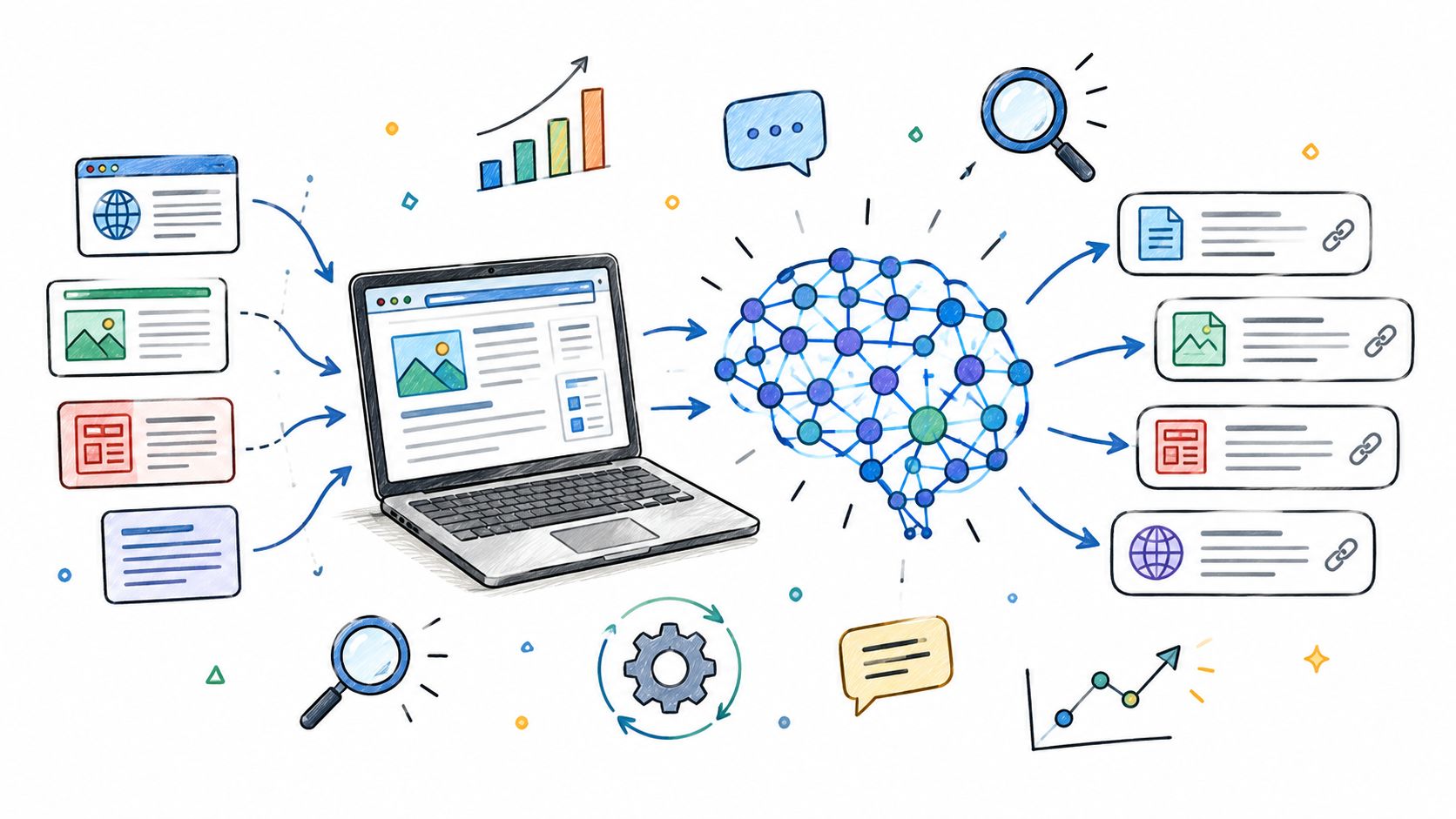
Brand monitoring for AI results has to start from that reality. Traditional rank tracking gave a clear position, but AI answers give a moving set of mentions and citations that can change by engine, prompt, and day. Semrush's 2026 benchmark analyzed more than 126 million U.S. AI search prompts from January through April 2026 across ChatGPT, Gemini, Google AI Mode, and Google AI Overviews, and found that only 36 brands maintained top-100 visibility on all four platforms in every month of the study. The same source also shows why mentions and citations have to be tracked separately: on Gemini, the overlap between brands mentioned and domains cited can be as low as 30%. Semrush's 2026 AI visibility index benchmark shows why a weekly workflow matters more than a snapshot.
Table of Contents
Why AI Brand Monitoring Feels Different From Traditional Rank Tracking
The first mistake is treating AI answers like another SERP column. A classic rank report gives a stable page and position, then the next crawl updates the numbers. AI answers don't behave like that. The same prompt can surface different brands, different citations, and different wording, even when the underlying content hasn't changed.
A useful mental model is that AI monitoring tracks appearance, not position. That means the question is not only whether a brand was named, but whether it was named in a response that was shown to a real user, and whether the cited source was owned, third-party, or something else entirely. In practice, the citation graph often mixes brand pages, review sites, directories, and explainers, so a clean “we ranked well” report doesn't tell the full story.

Why one-off checks fail
One-off checks create false confidence. A brand can appear in a prompt on Monday, disappear on Wednesday, and reappear on Friday with a different citation pattern. Search Engine Land reported that brands were mentioned in Google AI Overviews 43% of the time in one July 2025 study and that week-to-week volatility was 30x higher there, which is a strong reminder that ad hoc checks miss the shape of the trend. Search Engine Land's report on AI Overviews volatility makes the point clearly.
Practical rule: if the same prompt isn't run the same way every week, the result isn't monitoring, it's a screenshot collection.
That's why the workflow needs to look more like instrumentation than reporting. The team needs recurring prompts, consistent logging, and a way to tell noise from pattern. Otherwise, a single positive or negative result gets overread, and no one can say whether the change matters.
Building a Fixed Prompt Library and Recording Two Signals
The prompt library is the foundation. Without it, every engine comparison becomes a different test, which means every result is arguable. The best structure is simple and based on intent, not keywords.
Organize prompts by intent
A prompt library works when it reflects how buyers ask. Discovery prompts should sound like early-stage research, comparison prompts should force head-to-head answers, validation prompts should test trust and fit, and feature-specific prompts should check a known capability or use case.
- Discovery: “best project management software for remote agencies”
- Comparison: “Notion vs Asana for content teams”
- Validation: “is Asana worth it for small marketing teams”
- Feature-specific: “which project management tools support approval workflows”
Those prompts need to stay identical week over week, including punctuation and casing, so diffs are real. If the prompt changes, the result changes for reasons that have nothing to do with visibility.
Log mentions and citations separately
A second rule matters just as much. Record mentions and citations in separate columns. A brand can be named without a citation, and a source can be cited without the brand name appearing in the visible answer. That distinction isn't academic. BuzzStream's study found that only 23.1% of brand mentions were backed by a citation in the same response, so a rising mention count can hide a falling citation share. BuzzStream's mention versus citation study is the clearest warning against collapsing the two signals.
Prompt IDIntent CategoryExample PromptEngineMention (Y/N)Citation URLPM-001Discoverybest project management software for remote agenciesChatGPTY/NURLPM-002ComparisonNotion vs Asana for content teamsGeminiY/NURLPM-003Validationis Asana worth it for small marketing teamsPerplexityY/NURLPM-004Feature-specificwhich project management tools support approval workflowsGoogle AI ModeY/NURL
A bare-minimum spreadsheet can hold the whole system together if it stays disciplined. Prompt ID, intent, engine, mention, citation URL, and notes are enough to start. Anything more complicated should earn its place later.
Choosing a Monitoring Stack Without Picking a Winner Yet
A team that starts AI brand monitoring usually wants one clean answer. The setup is rarely that neat. The choice is between dedicated AI visibility platforms, rank trackers with AI modules, scrapers adapted for AI Overviews, and DIY runners built on APIs or browser automation. Each one answers a different question, and each one leaves something out. We are currently running trials of several AI visibility platforms and will publish comparisons once our evaluation criteria are public.
Dedicated platforms are good at putting mentions, citations, and share-of-voice style views in one place. SEO suites with AI modules keep the familiar reporting flow, which matters when the team already works out of one dashboard. Scraper-based setups help when prompt control and export format matter more than polish, but they can break as engines change. DIY systems give the most flexibility, and they also shift more QA onto the team.
What each category still leaves to humans
Source verification is the part no stack removes. Most tools can show that a brand appeared, but not all of them make it easy to classify whether the cited URL was owned, a listing, a review site, a forum, or a competitor page. That context changes how the result should be read.
Tool CategoryWhat It SurfacesWhat You Still Check ManuallyMain LimitationDedicated AI visibility platformMentions, citations, source lists, basic trendsSource quality, competitor displacement, prompt driftCoverage varies by engineSEO suite with AI moduleFamiliar reporting, some AI visibility viewsPrompt-level source inspectionAI features can be shallowExtended scraperRaw responses, excerpts, URLsClassification, consistency, exception handlingMaintenance burdenDIY prompt runnerExact prompts, custom loggingEverything beyond raw captureSlow to scale
Teams that want reporting and measurement around how brands appear in answer systems should evaluate options against their own prompt coverage, workflow needs, and verification standards.
Operational constraint: no single vendor currently removes the need to open cited URLs by hand and check what the response said.
That limitation gets clearer when an engine delays updates or exposes inconsistent APIs. A sensible evaluation period uses more than one tool category at once, then compares what each one catches and what each one misses.
Scheduling, Tracking Sheets, and Alerts That Actually Fire
A weekly routine works better than a dashboard built too early. The core setup is boring on purpose. Every prompt in the library runs on the same day, results land in one sheet, and the team reviews only the rows that changed.
Keep the sheet simple
One tab per engine is enough. One row per prompt keeps the comparison clean. The columns should stay fixed so the team doesn't invent new logic every week.
DateEnginePrompt IDMention (Y/N)Citation (Y/N)Cited URLSentimentNotes
Google Sheets, Airtable, or n8n can handle the orchestration. A lightweight Slack or webhook alert should fire when a row flips from present to absent, or from absent to present. That alert should go to the person who owns the prompt set, not a generic channel that gets ignored by noon.
Make the alert useful
The alert doesn't need to explain the whole situation. It only needs to say what changed and where. A good alert flags the prompt ID, the engine, the old state, the new state, and whether the citation URL changed too.
A second watch should sit on branded search queries and the top prompt terms. That catches a sudden drop before the next weekly review. The point is not to build a giant reporting stack. The point is to make sure a real change gets noticed while it can still be traced back to the prompt, the page, or the citation source.
When teams overbuild this layer, they usually end up checking the dashboard less often. A clean sheet and a reliable alert beat a complex report nobody opens.
Verifying What AI Systems Say About You
A mention is not a win by itself. The next step is to verify what the engine did with the brand, because the answer can be technically present and still be wrong, stale, or poorly sourced.
Check the source mix first
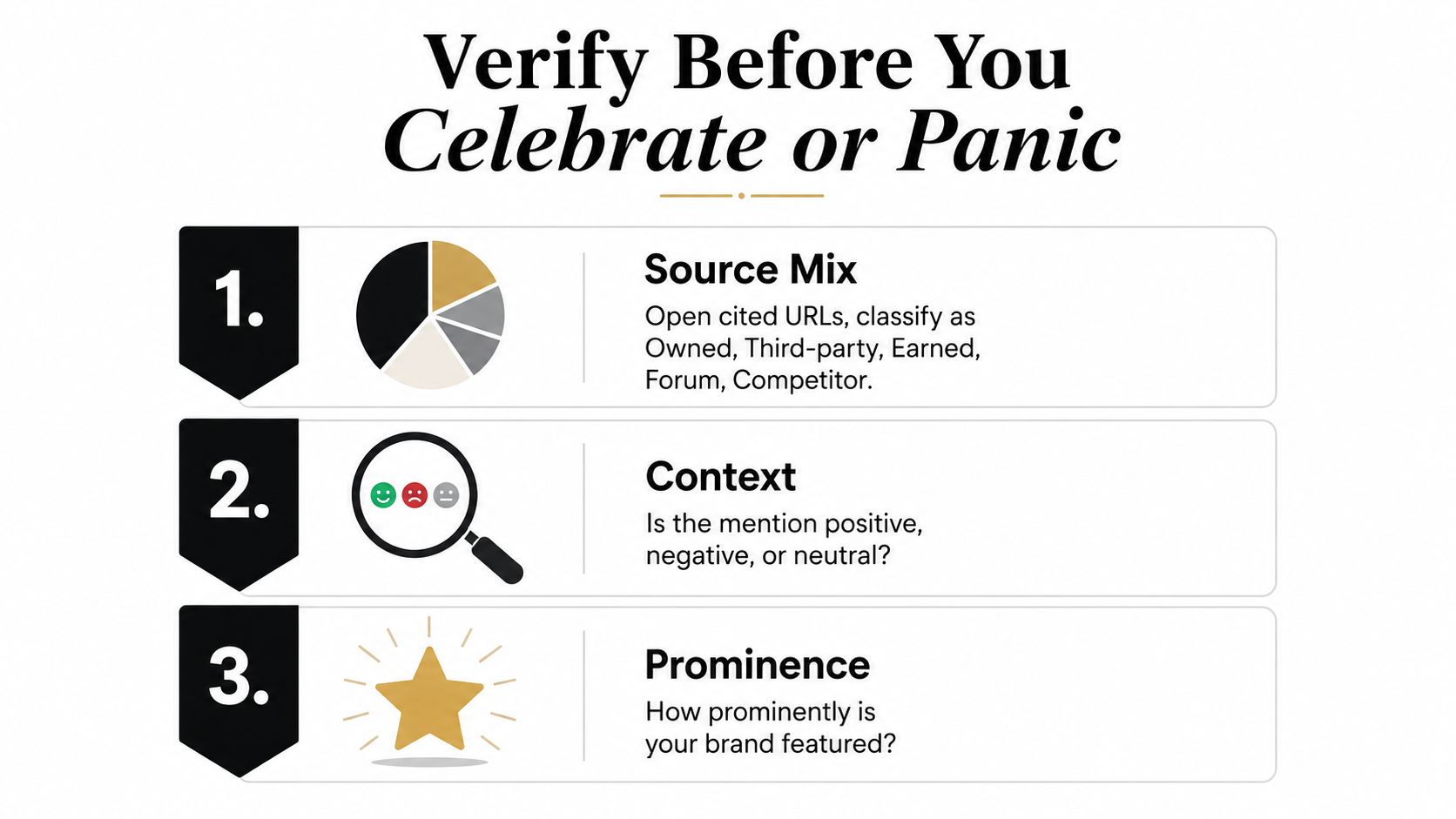
Open every cited URL and classify it. Owned pages, third-party explainers, earned media, forums, and competitor pages each point to a different source stack. A citation from a page the brand controls is useful, but a citation from a review site or forum often means the engine is leaning on inventory the team does not manage.
Yext's AI citations release notes that cited sources often come from assets brands already control, such as websites, listings, reviews, and social profiles. That makes source mix a monitoring issue, not just a visibility issue. Yext's AI citations release is a useful reminder to review the source stack, not just the answer text.
Check the accuracy of the claim
The second pass takes more work. Open the cited page and compare it with the answer. Does the page support the claim, or did the engine combine two separate ideas and present them as one? The Tow Center found that AI search engines often failed to retrieve the right information in more than 60% of 1,600 test queries. That is enough reason to keep this check in the workflow.
Check who gets cited instead
Competitor displacement matters most when a different brand keeps showing up on the same prompt set. If that other brand is a true peer, the finding is competitive. If it is not, the citation points to a source gap, not a market-share gap.
A one-week disappearance is usually noise. Two consecutive weeks across two engines is a pattern worth documenting with screenshots and the exact prompt text. That gives the content, listings, or PR owner enough context to act without guessing.
Turning Findings Into Actions Across Content, Listings, and PR
The value only appears when the monitoring feed reaches the right team. A brand that gets mentioned but not cited needs a different fix from a brand that gets cited from the wrong page or a competitor profile. The cleanest way to handle it is to route findings into three queues.
Content queue
When a prompt mentions the brand but doesn't cite it, the content team owns the repair. The target page should answer the exact question and place a short, quotable response near the top. That means the H2 often mirrors the prompt, and the first 80 words should give the answer before the page expands into detail.
That page doesn't need to be bloated. It needs to be explicit, easy to quote, and structurally obvious enough for an answer engine to reuse. If the prompt is a comparison query, the content should compare the categories directly instead of burying the answer in a long intro.
Listings queue
When AI answers cite a directory, review site, or profile instead of the brand's own page, the listings owner should check the profile inventory first. Names, categories, descriptions, and schema often drift. The fix is usually updating the source the engine is already using, then tracking whether the citation mix changes on the next run.
PR queue
When the cited source is wrong, outdated, or a competitor page keeps replacing the brand, comms needs to know. That can lead to digital PR, a correction request, or outreach to the source owner. The key is not to launch all three responses at once. The prompt type and the source type should decide the next move.
Rule of thumb: if two engines change in the same direction after a content or listing update, the source is usually the more likely cause than the model.
Every fix should be re-tested the following week. The sheet needs a status tag for each row, so the team can see whether the change moved the prompt, only affected one engine, or did nothing at all. That closes the loop and keeps the work from turning into a pile of unconfirmed edits.
A Simple Weekly Routine and the Questions We Still Cannot Answer
A weekly run keeps the work grounded. On Monday, pull the fixed prompt library, run the same queries across ChatGPT, Claude, Gemini, Perplexity, Google AI Overviews, and Google AI Mode, then log mentions and citations as separate fields. Review the week-over-week shifts, and spend time only on the outliers. With a clean sheet and a tight prompt set, one SEO lead can usually get through the pass in a couple of focused hours.

The routine in plain language
- Pull the prompts.
- Run them across the engines.
- Log mention and citation states.
- Flag abnormal shifts.
- Hand the outliers to the right owner.
That cadence keeps attention on change that matters. It also makes the difference between a true shift in the answer set and a one-off screenshot artifact easier to see.
The open questions
A few questions still do not have clean answers. It is still unclear whether AI citations move pipeline in a measurable way or track with branded search interest. Identical prompts can also return different sources on consecutive days, and the field still cannot say with confidence how much of that comes from fresh retrieval, caching, content edits, or off-page signals.
That is why this work has to stay operational. The goal is not to crown a winner after one pass. It is to keep a repeatable record of how the brand appears, where it gets cited, and which source changes deserve action.