
A page can rank on Google's first page, answer the query well, and still never appear as a cited source in an AI Overview. That situation is becoming familiar to SEO teams. Traditional rankings remain useful, but they no longer describe the whole visibility problem. AI Overview optimization is about making a page easy to extract, clear to attribute, and strong enough to verify, while protecting the clicks and branded demand that still matter to the business.
What AI Overview Optimization Actually Means
AI Overviews appear above traditional organic results for eligible searches. They summarize information from multiple pages and present source links alongside or around the generated answer. A cited page can therefore gain exposure without holding the top organic position, while a highly ranked page can remain absent from the summary.
That distinction changes the operating model for SEO. Traditional optimization often treats ranking as the main outcome. AI Overview optimization treats citation selection as a separate visibility outcome. The page needs to answer the question directly, identify its subject precisely, and make important claims easy for readers and search systems to verify.
Google's May 2025 product update says AI Overviews are available to all users in more than 200 countries and territories and in more than 40 languages. Availability is still gated by country, territory, and language, as described on Google's AI Overviews availability page. An international SEO program therefore can't assume that the same query produces the same search experience everywhere.
Ranking and citation are different checks
A ranking report answers one question: where did the page appear in conventional results? A citation review answers another: did the page appear as a linked source in the AI Overview?
A useful operating dashboard keeps these fields separate:
- Organic position: The page's conventional search result position.
- Overview presence: Whether an AI Overview appeared for the tested query.
- Citation status: Whether the page was linked as a source.
- Answer accuracy: Whether the summary represented the page correctly.
- Click outcome: Whether users continued to the site after exposure.
This approach is consistent with the broader distinction between conventional search and answer-led experiences described in this explanation of AI search versus traditional search. It prevents teams from treating every appearance as a ranking win or every citation as a traffic win.
Practical rule: A page should be optimized for two audiences at once. People need a useful answer. Search systems need a clean, attributable passage they can use without ambiguity.
The practical job is not to write for an invisible formula. It's to make the page extractable, attributable, and verifiable. That means a clear answer near the relevant heading, visible evidence for factual statements, recognizable entities, and page structure that separates definitions, instructions, comparisons, and caveats.
The language used in reporting matters too. Teams should record what appeared, what was cited, and what changed during testing. They shouldn't claim that a rewrite caused a citation unless the test design supports that conclusion.
Where AI Overviews Appear Most and How to Prioritize Pages
A team with limited editorial capacity should not begin with a sitewide template change. Start with the queries most likely to trigger an Overview, then connect that exposure to business value and citation potential.
A large study of 2.37M U.S. queries found AI Overviews on 25.8% of queries overall, 54.7% of 7+ word searches, and 51.6% of healthcare queries. Location or brand modifiers reduced prevalence to 9.1% for long modified queries, according to WebFX's analysis of AI Overview statistics. These figures describe query prevalence. They do not predict traffic or guarantee that a specific page will be cited.
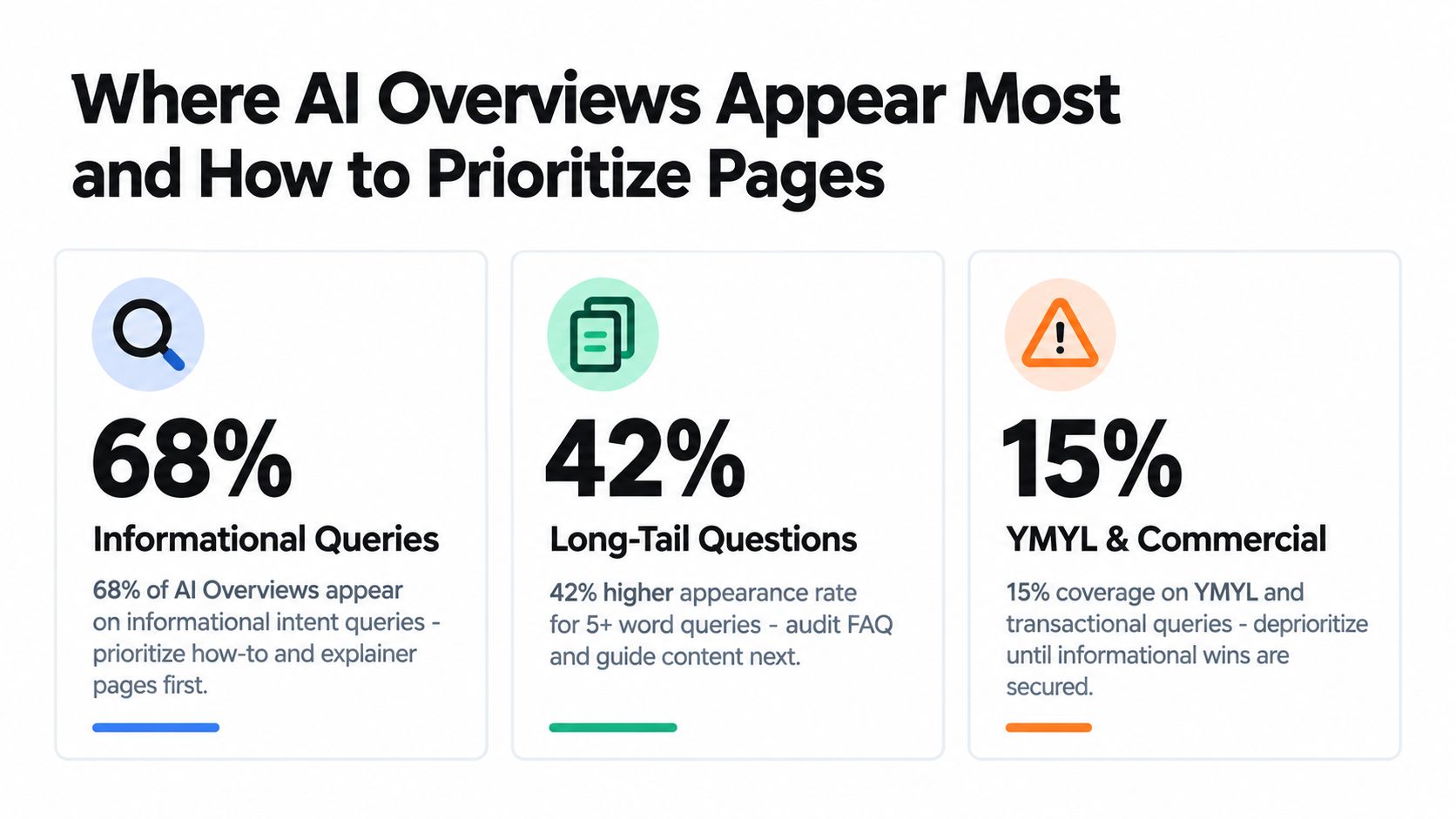
Informational, question-led, longer-tail content is a sensible starting point. Branded and heavily local-modified queries can still carry strong commercial value, but they deserve a separate benchmark because their Overview prevalence differs. Teams comparing AI search versus traditional search should track citation selection and clicks separately. A cited page may receive little traffic if the Overview resolves the question on the results page.
Build a page priority list
A useful audit combines query intent, business value, existing visibility, and the page's ability to supply a clear source passage.
Find question-led pages. Begin with guides, explainers, troubleshooting content, comparison pages, and healthcare education. These formats usually answer an information need rather than a checkout request.
Separate modified demand. Label queries with brand or location modifiers. Keep those pages in the program, but score them against comparable queries instead of combining every intent in one queue.
Check the live result. Search each query manually in the relevant market and language. Record whether an Overview appears, which pages receive citations, how prominently the source is shown, and whether the answer leaves a material gap.
Score rewrite readiness. Prioritize pages that contain useful information but bury the answer, combine multiple intents, rely on vague headings, or make factual claims without clear sourcing. These pages may offer a faster citation test than pages requiring a complete rebuild.
Protect commercial value. A page with strong purchase intent may justify work even when Overview exposure is less common. Measure qualified visits, product consideration, and branded demand alongside citation status. Citation count alone can reward visibility that produces no useful visit.
Keep the list small enough for a real editorial sprint. A SaaS team might start with integration explainers and implementation questions. An ecommerce team might review product education, care instructions, and category comparisons. A healthcare publisher should audit condition and treatment explainers with strict source and accuracy checks.
Start with pages where a concise, trustworthy answer can become materially clearer. Do not rewrite every title, template, or FAQ at once.
Search intent needs a precise label. “Best software” calls for comparison criteria and commercial context. “How does software work” calls for a definition, process, limits, and evidence. Citation-ready optimization begins when the expected answer type is clear, then tests whether the page is selected and whether that selection protects a valuable click.
Structuring Content So Answers Can Be Extracted
A product page can earn a citation and still lose the click if its answer is buried below general background. Put the direct answer first, then give readers a reason to continue with evidence, examples, limits, and practical detail. This structure improves extraction while preserving the page's commercial context.
A 100-page citation study found 55% of AI Overview citations came from the top 30% of page content, 24% from the middle 30–60%, and only 21% from the bottom 40%, as reported by WebFX. This describes where citations appeared. It does not prove that moving a paragraph upward will earn one. It does justify reviewing the opening sections first, especially the blocks intended to answer the query.
Use an answer-first page pattern
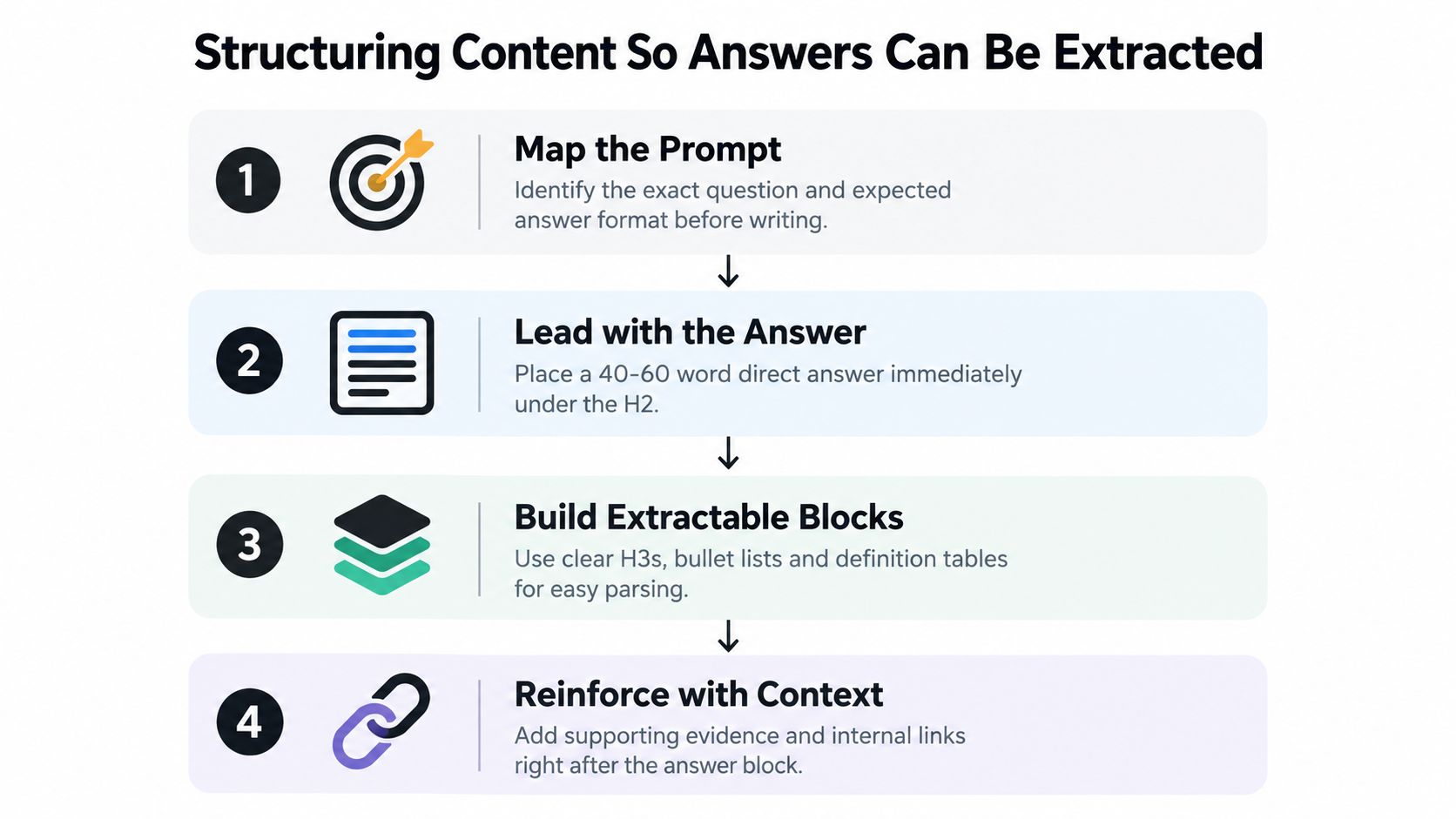
Under each important H2, place a compact response that can stand alone. Follow it with reasoning, examples, exceptions, and supporting evidence. The opening block should satisfy the immediate question, while the remaining content earns the reader's next action.
For an ecommerce page, a weak opening might say:
Choosing a rain jacket depends on several factors, including fabric construction, intended use, climate, fit, and care requirements.
That sentence introduces the topic without resolving a specific question. A stronger block would say:
A waterproof rain jacket uses a membrane or coated fabric that prevents liquid water from passing through. Breathability, seam construction, hood design, and intended activity determine how comfortable it feels during extended use.
The second version defines the product and identifies the decision criteria. The surrounding section can explain ratings, materials, and care. Readers get the answer quickly, while buyers who need more detail have a clear path to continue.
For a SaaS page, replace a vague paragraph such as “Integrations help teams connect their tools and improve workflows” with a direct answer:
A CRM integration connects customer records and activity between the CRM and another business system. Teams use it to reduce duplicate entry, keep account data aligned, and trigger actions across tools.
This wording gives an extraction system a clear subject, function, and use case. It also gives a potential buyer enough context to decide whether the following implementation details are relevant.
Make each block do one job
Use headings that mirror real questions, not internal editorial labels. Keep the content beneath each heading focused.
- Definitions: State what the term means and distinguish it from nearby concepts.
- Processes: Present the sequence in numbered steps, with one action per step.
- Comparisons: Use consistent criteria across options, followed by a plain-language conclusion.
- Eligibility and limits: Put exclusions close to the answer instead of hiding them at the end.
- Evidence: Link the claim or name the source immediately after the relevant statement.
Tables work when every row answers the same type of question. They become a liability when they store vague marketing language. FAQs can support related intent, but repeating one keyword across several near-identical questions adds noise.
A strong page has a short opening answer, logically nested headings, compact paragraphs, lists where sequence matters, and supporting links beside the claims they substantiate. Measure two outcomes separately: whether the page is cited, and whether the citation leads to a qualified click. The detailed material still matters. Place it after the answer so it supports selection without blocking the visit.
Strengthening Structured Signals and Authoritative Sourcing
Clear prose isn't enough when a page contains ambiguous entities, unsupported claims, or unclear authorship. The supporting layer should help readers understand what the page is, who stands behind it, and where its factual statements came from.
A study of 405,576 searches found that AI Overviews average 5 cited sources per query, with 90% listing 8 or fewer, and that 52% of cited sources also rank in Google's top 10, according to Surfer's AI Overviews study. The study also shows why page-one rankings shouldn't be treated as a citation guarantee. Organic visibility and source inclusion overlap, but they aren't identical outcomes.
Run a structured quality check
Schema can clarify page type and content relationships when it accurately matches the visible page. It shouldn't be added as decorative code or used to describe information users can't find.
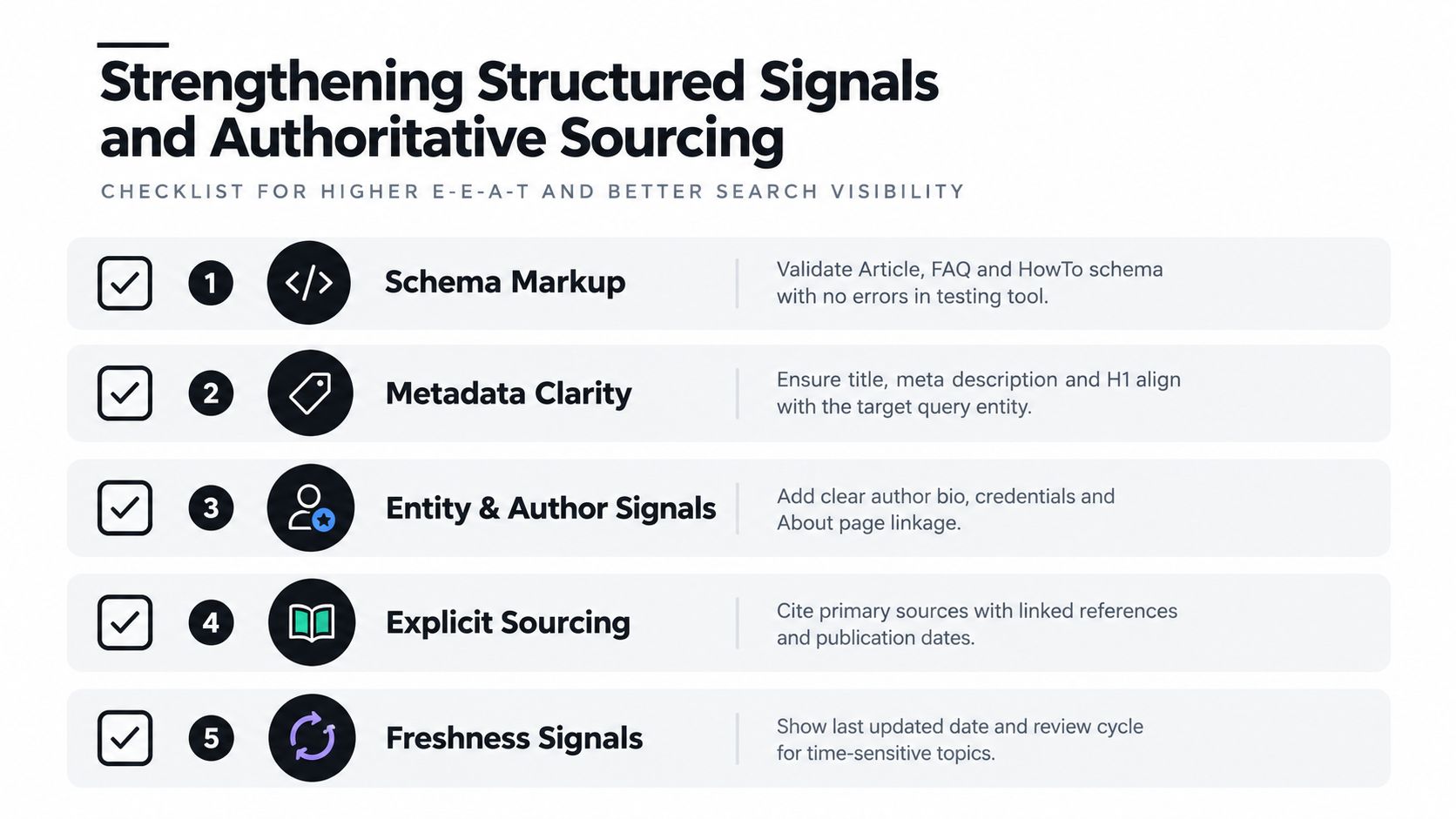
A practical review covers:
- Schema markup: Validate relevant Article, FAQ, or HowTo markup and remove fields that don't match the page.
- Metadata clarity: Align the title, main heading, and description with the page's actual subject and search intent.
- Entity signals: Use consistent names for products, organizations, services, conditions, and authors across the page.
- Author information: Add a visible byline, a useful author biography, and a connected About page where appropriate.
- Source presentation: Link primary references and show publication or update dates when they matter to the claim.
- Freshness information: Display the last updated date only when the page has been reviewed or changed.
Explicit sourcing is especially important for health, finance, legal, product safety, and technical specifications. A sentence such as “This treatment is safe” is too broad. A responsible page should state what the source supports, identify the limits, and distinguish general information from professional advice.
Don't confuse authority with a ranking shortcut
A page can rank well because it matches the query and satisfies conventional search requirements. That doesn't mean every paragraph is suitable for an AI-generated summary. The citation evidence above supports a more careful workflow: preserve traditional SEO fundamentals, then improve clarity, attribution, and verifiability.
The same principle applies to author credentials. A biography should explain relevant expertise, not make unsupported claims about influence. A company page should describe the organization consistently across its site and public references. Editors should remove anonymous claims, unexplained statistics, and unattributed quotations before asking whether a page is “optimized.”
Source hygiene is part of technical SEO for AI visibility. If a reviewer can't verify a claim quickly, an editor shouldn't expect a summary system to represent it accurately.
A final QA pass should inspect the rendered page, not only the source code. Confirm that schema reflects visible content, links work, dates are meaningful, and important answer blocks aren't buried below unrelated promotional material.
Testing Monitoring and Measuring What Matters
Visibility inside an AI Overview and traffic from that Overview are different outcomes. A team that reports only citations can miss a decline in organic visits. A team that reports only clicks can miss increased exposure for research-stage queries where users may not need to visit immediately.
A 2026 randomized field experiment found that when an AI Overview was shown, outbound organic clicks fell by 39.8% and zero-click searches rose by 34.5%, while sponsored clicks stayed flat, according to the report on the experiment. The result makes click protection a measurement requirement, not an optional reporting detail.
Separate the outcomes
A testing log should record the exact query, market, language, date, device context where available, Overview presence, cited URLs, answer wording, and the page's organic position. Repeating the same prompt over time can show whether the result changed, but it can't by itself establish why it changed.
A useful reporting model distinguishes:
| Intent Type | Primary Goal | How to Measure |
|---|---|---|
| Informational | Be cited accurately | Track citation presence, answer coverage, and referral visits |
| Problem solving | Earn a qualified follow-up visit | Track cited exposure, assisted sessions, and engagement with supporting content |
| Commercial comparison | Protect consideration and brand visibility | Track citations, branded searches, comparison-page visits, and assisted conversions |
| Branded | Protect demand and control accuracy | Track answer accuracy, source presence, branded organic behavior, and customer feedback |
| Transactional | Preserve direct conversion paths | Track product or service visits, conversion activity, and any change in organic click volume |
The table is a decision framework, not a universal reporting template. Different businesses will assign different weights to exposure, clicks, and conversions. The important point is to avoid treating all queries as if they have the same value.
Test for citation and click protection together
For an informational page, citation may be the primary objective because the user is seeking a quick explanation. For a comparison page, citation without a click may still matter, but the page should make the next step obvious through useful criteria, evidence, and internal navigation. For a product page, direct traffic and conversion activity deserve greater weight.
Teams can use a practical guide to AI citation tracking to define what gets logged and how citation checks fit into a wider measurement process. Manual testing remains valuable because the wording and source set can vary by query context.
A sound report uses cautious language:
- “The page was cited for the tested query.”
- “Organic clicks declined during periods when the Overview was shown.”
- “The answer included the brand, but no source link was visible.”
- “The page moved from uncited to cited after the content update.”
It shouldn't say that a specific formatting change caused the result unless controlled testing supports that conclusion.
Putting AI Overview Optimization Into Practice
A workable program doesn't start with a sitewide rewrite. It starts with a small set of pages, clear query classes, and a record of what appeared before and after each change.
The first pass should identify informational and question-led opportunities, then separate branded, local, commercial, and transactional queries. Pages with a clear information gap and a realistic chance of improvement belong at the front of the queue. Pages that already answer the query well may need sourcing or entity clarification rather than more text.
Use a repeatable editorial loop
A weekly workflow can stay lightweight:
- Audit the query set. Check which target searches display an AI Overview and record the current cited sources.
- Select a limited page group. Choose pages where the answer is buried, the intent is mixed, or claims lack visible support.
- Rewrite the opening. Put a direct answer beneath the relevant heading, then add context, qualifications, examples, and links.
- Review structured signals. Check schema, metadata, author information, entity naming, references, and update dates.
- Test the live result. Record whether the page appeared, was cited, or was represented accurately.
- Measure the business outcome. Compare citation exposure with organic clicks, branded behavior, assisted visits, and conversions by intent.
- Document uncertainty. Note what changed without claiming more causality than the evidence supports.
Common mistakes are easy to spot. Ranking alone is treated as success. Long introductions push the answer down the page. FAQs repeat existing copy. Schema describes content that isn't visible. Sources are linked in a general reference list instead of beside the claims they support. Editors add unverified statistics to make a page sound authoritative.
The strongest approach combines conventional SEO with citation-aware publishing. Pages still need accessibility, crawlability, relevant internal links, and useful content. They also need answer blocks that stand alone, source details that readers can check, and measurement that distinguishes exposure from action.
The result isn't a promise of inclusion. No public checklist guarantees citation. It's a disciplined way to improve the qualities that make a page useful in an answer-led search result while keeping the business's traffic and demand goals visible.
Start with ten high-value queries, document the current Overview results, and audit the pages that answer them. Move the clearest answers upward, verify every important claim, and track citations and clicks separately. After the next review cycle, keep the changes that improved the observed outcome and revise the ones that didn't.