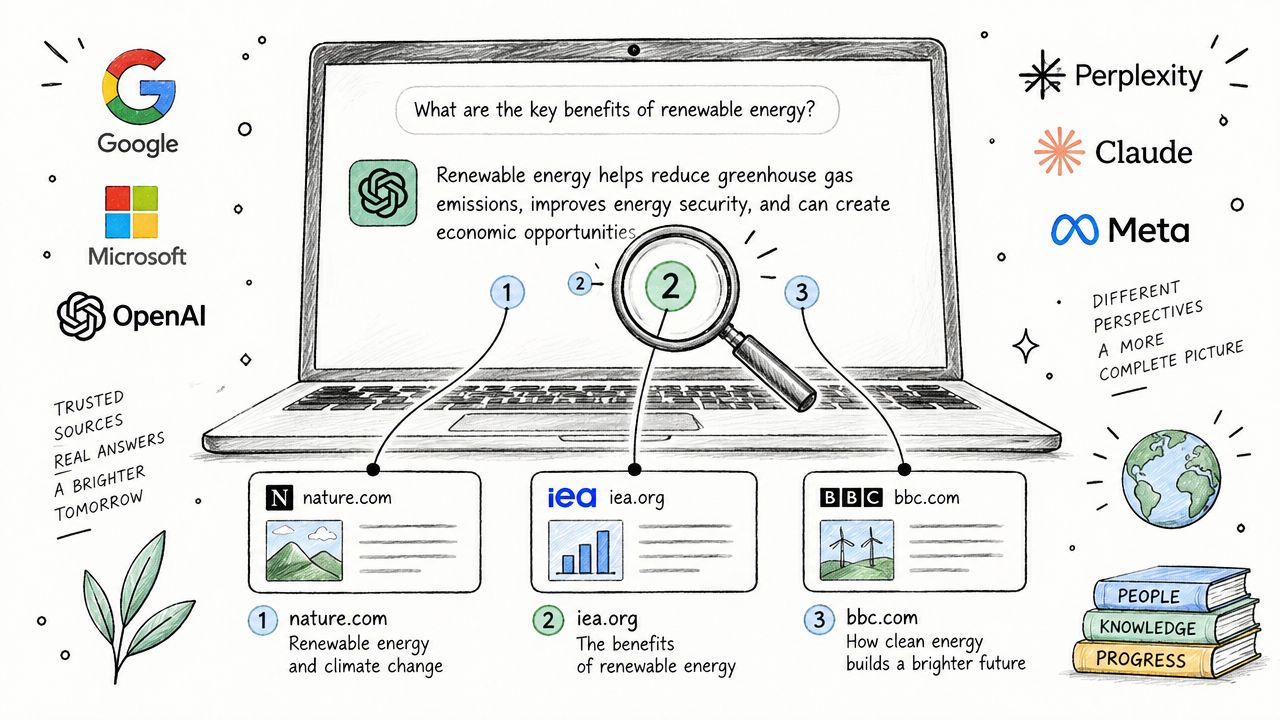
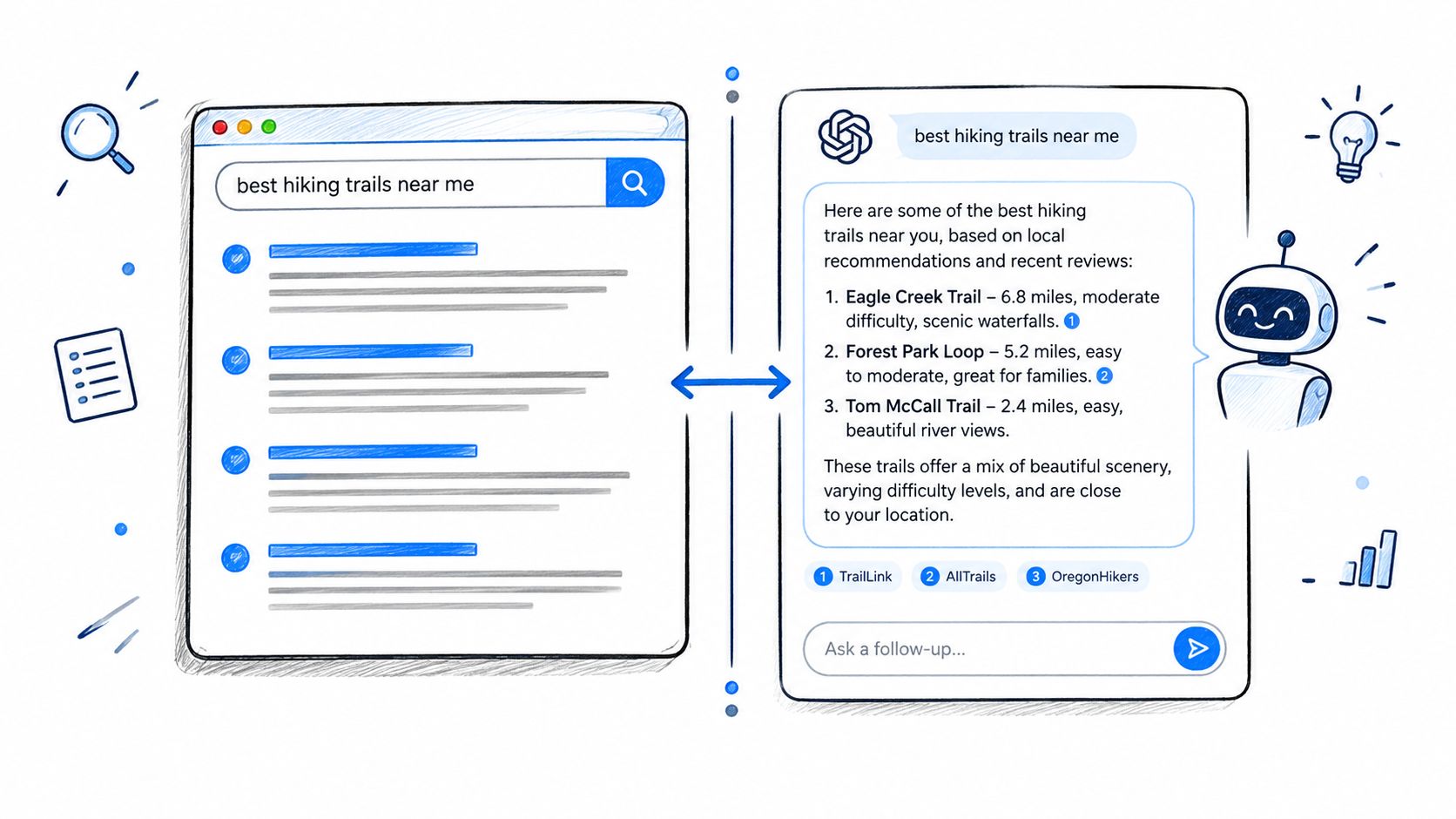
A marketer checks the same product query in Google and Perplexity. Google returns a familiar list of pages, ads, videos, and other result features. Perplexity provides a written recommendation with numbered links beside the answer. The brand ranks on Google, but a competitor appears in the AI response.
That difference changes the SEO question. Traditional search asks whether a page earns a position and a click. AI search asks whether a brand appears in the answer and receives a citation. Sometimes both outcomes matter. Sometimes a citation can preserve value even when fewer users visit the site.
This comparison uses an evidence-led standard. It separates observed search behavior from assumptions about how AI systems work internally. The practical question is not whether AI search replaces traditional search. It is when marketers should optimize for rankings, when they should optimize for citations, and when they need both.
Introduction Why This Comparison Matters Now
A buyer searches for a software category, reads Google's results, and then asks an AI system which option fits. The brand may rank on the results page, while a competitor appears in the generated recommendation. For marketers, that creates two separate visibility questions: who earns the position, and who gets named in the answer?
Generative AI use has moved beyond isolated testing. Similarweb reported that average monthly web visits across generative AI platforms worldwide reached 9.5 billion between June 2025 and May 2026, a 70% year-over-year increase, while unique visitors rose 57% to 655 million. Similarweb's generative AI statistics supports treating AI search as an information discovery layer that can influence consideration before a site visit occurs.
Google has also placed AI summaries within established search journeys. Deloitte forecast that in 2026 about 29% of adults in developed markets will start one or more searches each day with results that include a generative AI summary. The first visible interaction may therefore be a synthesized answer rather than a page title and snippet, even when the user begins with Google.
The commercial effect depends on what the citation contributes. A brand can receive fewer clicks yet gain recognition, inclusion in a recommendation, or a place in the user's shortlist. It can also rank well in conventional results and remain absent from the generated response. Ranking and citation are separate visibility events.
Practical rule: Treat a ranking as a route to a webpage. Treat a citation as inclusion in the answer layer. Measure both before judging performance.
Use two reporting layers:
- Result visibility: The page appears in a conventional search result and can earn a click.
- Answer visibility: The brand, page, or source appears inside a generated response, citation list, or source panel.
The comparison that follows should therefore focus on trade-offs, not a simple traffic-loss narrative. The key test is when citation value offsets fewer visits, and when ranking remains the stronger route to demand.
How AI Search and Traditional Search Work for Users
A buyer comparing software may begin with a conventional query, scan several pages, and verify details across visits. The same buyer could enter a detailed prompt into an AI system and receive a synthesized recommendation with supporting citations. The two experiences differ in where evaluation starts.
Traditional search presents a set of links. Each result usually includes a title, URL, and supporting text, while the page itself remains for the user to inspect. The user compares options, opens sources, checks evidence, and forms a conclusion across visits.
AI search places more of that synthesis in the first interaction. A response may provide an explanation, recommendation, source links, numbered citations, or a source panel. The user can still visit the original pages, but the brand may first appear as evidence inside an answer rather than as a result to click.
Google has added this answer layer to familiar search journeys. Google's documentation on original, high-quality content in Search explains that AI Overviews and AI Mode can surface links from selected sources. For marketers, the observable distinction is clear: a page can be cited inside the generated response, not only listed among conventional results.
Generative AI platforms also support search-like discovery at broad scale, according to Similarweb's reported worldwide visit figures. Traditional search remains dominant, but discovery paths now overlap. A user may search in Google, read an AI Overview, open a cited page, and return to the results list during one research journey.
The two-layer visibility model
Traditional search fits browsing, verification, page comparison, and website actions. AI search fits prompts that ask for a combined explanation or recommendation based on several constraints.
The business implication is a shift in entry point. A conventional ranking introduces a page that can earn a visit. A citation introduces a brand as support for the answer. These are separate visibility events, so fewer clicks do not automatically mean zero exposure, while strong rankings do not guarantee inclusion in an AI response.
Report both layers:
- Result visibility: The page appears in a conventional result and can earn a click.
- Answer visibility: The brand, page, or source appears in a generated response, citation list, or source panel.
Readers seeking a narrower explanation of information access can review how ChatGPT gets its information. Use observational language when testing these systems: a source appeared, a page was cited, or a brand was mentioned. Visible output supports those statements, not assumptions about hidden internal processes.
SERP vs Answer Behavior Side by Side
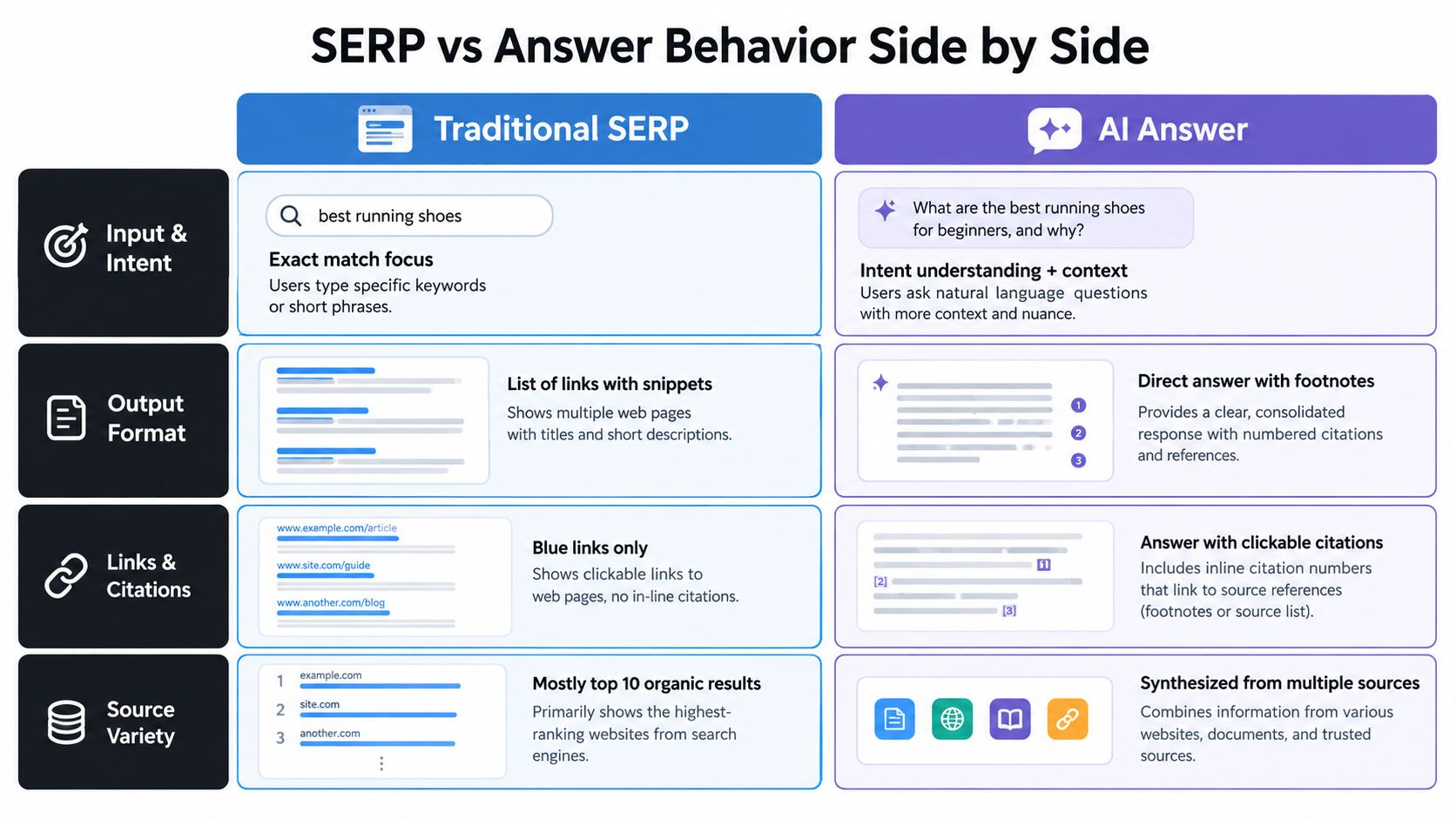
A marketer comparing the same topic in Google and Perplexity can see two different visibility events. Traditional search displays pages that compete for position and clicks. AI search presents a synthesized conclusion, where a brand may appear through a mention or citation even when the user does not visit its site.
Input and intent
Traditional queries often reduce a need to a short label. Broad wording can produce several interpretations, so the user opens pages, compares them, and decides which result fits.
AI prompts can include context, constraints, and several questions at once. The response may combine those conditions into one explanation and attach citations to the material used. The experience resembles a guided research step rather than a directory of pages.
This distinction changes how teams diagnose performance. A page can support one part of a complex prompt without ranking for the complete wording. A page with strong conventional visibility may also be absent from the answer's citations. Ranking relevance and citation relevance overlap, but they are not interchangeable.
Output format and source transparency
Google AI Overviews and AI Mode can place source links within the answer layer. Perplexity answers use numbered citation links that open the original webpage, and its source panel lists the material used, according to this explanation of viewing Perplexity citations.
Perplexity can also apply labels such as Government, Academic, or Trusted after its source review process, as described in Perplexity's source-label guidance. Traditional results show domain and page information, but these answer-layer labels provide extra context about how a source is presented.
| Dimension | Traditional Search | AI Search |
|---|---|---|
| User input | Short query or phrase | Natural-language question with context |
| Main output | Ranked links and snippets | Generated answer with possible citations |
| Visibility event | Page position and impression | Mention, inclusion, or citation in the answer |
| User action | Opens and compares pages | Reads the answer, then may open sources |
| Source inspection | Result pages and website content | Inline citations and source panels |
| Measurement focus | Rankings, impressions, CTR, sessions | Citation presence, answer inclusion, source clicks |
The interface does not determine the business outcome. A citation can reinforce a brand without generating a visit. A ranking can generate a session without placing the brand inside the user's final consideration set. Reporting should separate selection visibility from answer visibility, then examine whether citations offset lost clicks through assisted attention or later action.
Why source concentration matters
Citations are not distributed evenly across publishers. An Ahrefs dataset reported YouTube at 22.9% of citations and Reddit at 18.5% in Google AI Overviews, as detailed in Ahrefs' cited-domain analysis.
That pattern changes the audit. A technically strong brand site can still miss answer visibility when the relevant discussion occurs on a large public platform. The audit should ask two questions: which page ranks for the query, and which source types are cited in the answer? The gap between those answers shows whether the brand needs stronger first-party content, broader public representation, or both.
Clicks Satisfaction and Where Citation Changes the Story
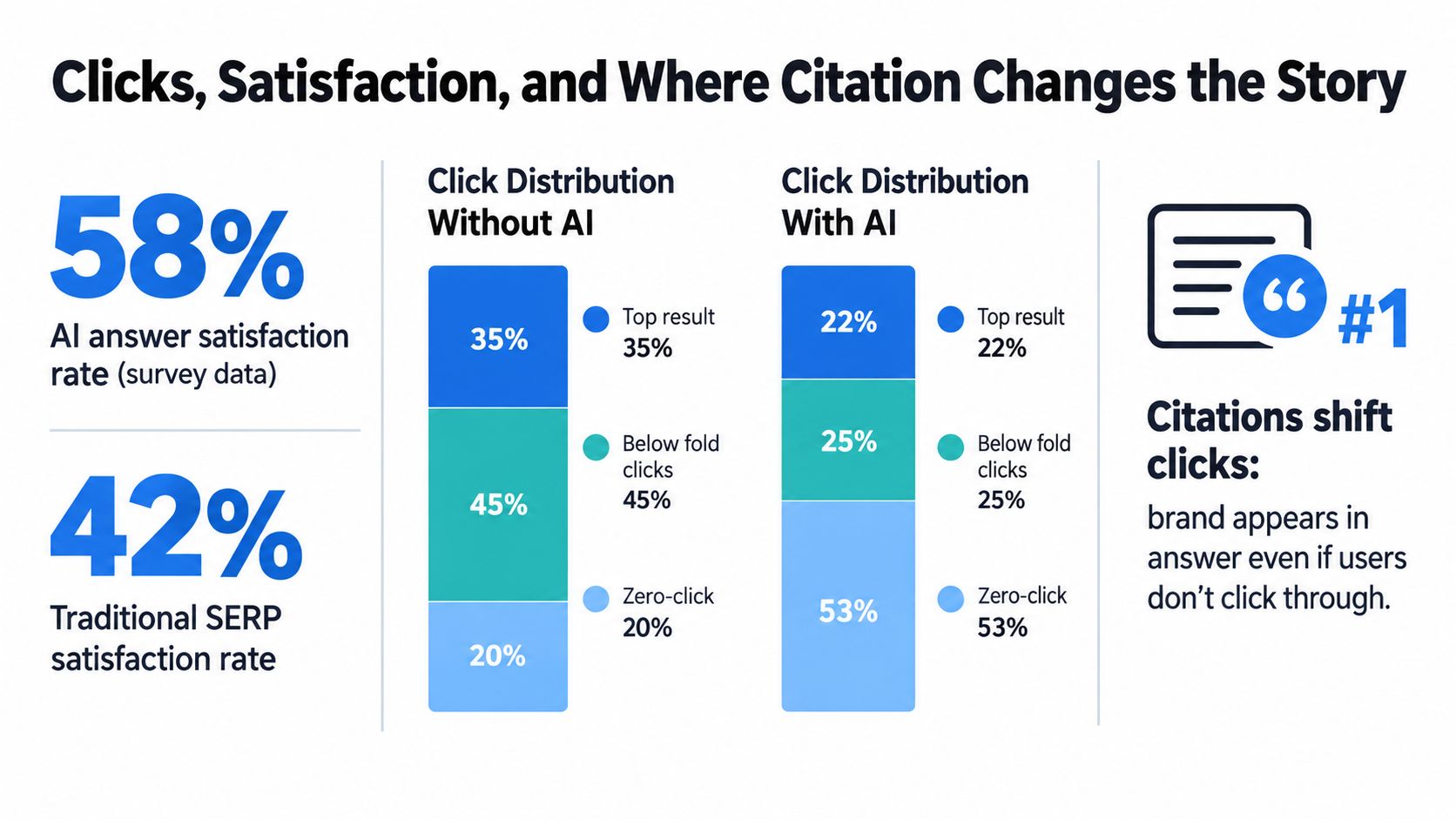
A user may read an AI answer, accept its explanation, and stop browsing. That changes click behavior, but it does not show that interest disappeared. The relevant question is whether the brand was absent, mentioned, or cited when the answer shaped the user's decision.
A 2026 analysis reported that 93% of Google AI Mode sessions ended without a click, more than triple the zero-click rate for traditional organic results. It also reported a 61% drop in organic CTR for informational queries when AI Overviews appeared, while one dataset showed 1.66% conversion from AI search versus 0.15% from organic search, an 11x difference. Mentionova's comparison of AI and traditional search statistics presents these figures together.
The figures describe different stages of the journey. Fewer users may click, while the users who do click convert at a higher rate. A lower page CTR can also coexist with citation visibility that places the brand in the answer before the user chooses a next step.
The citation split
Seer Interactive found organic CTR on AI Overview queries was 0.61% versus 1.62% on queries without one. Among cited pages, CTR was 2.1% versus 0.9% for uncited pages, according to Search Engine Land's report on citation and CTR behavior.
These comparisons cover different populations. The first measures queries where an AI summary appeared. The second compares cited pages with pages that were not cited. Aggregate CTR can therefore show reduced traffic while hiding a meaningful difference between being referenced in the answer and being left out of it.
Pew's March 2025 panel found that users clicked a traditional result in 8% of visits with an AI summary versus 15% without one. Users were also more likely to end the session on the results page when a summary appeared, as reported in the cited Search Engine Land analysis. This demonstrates changed session behavior, not equivalent value for every cited brand.
The important distinction: Traffic loss measures what happened after the result appeared. Citation visibility measures whether the brand entered the answer before the user decided what to do next.
A randomized field experiment found that outbound organic clicks fell from 0.38 to 0.61 per search after AI Overviews were removed, implying a 38% reduction in organic clicks on triggered queries. Zero-click sessions rose from 54% to 72%, according to Search Engine Journal's report on the field study. Those results describe the experiment's comparison, not a universal traffic forecast for every site.
For marketers, the practical test is simple: Was the page absent, present but uncited, or cited inside the answer? Ranking reports cannot distinguish those states.
The broader case for tracking this distinction appears in why citations are important in AI search. A citation does not erase click loss. It can change what that loss means by giving the brand answer-level visibility, even when the search session produces no visit.
What to Measure in Each System
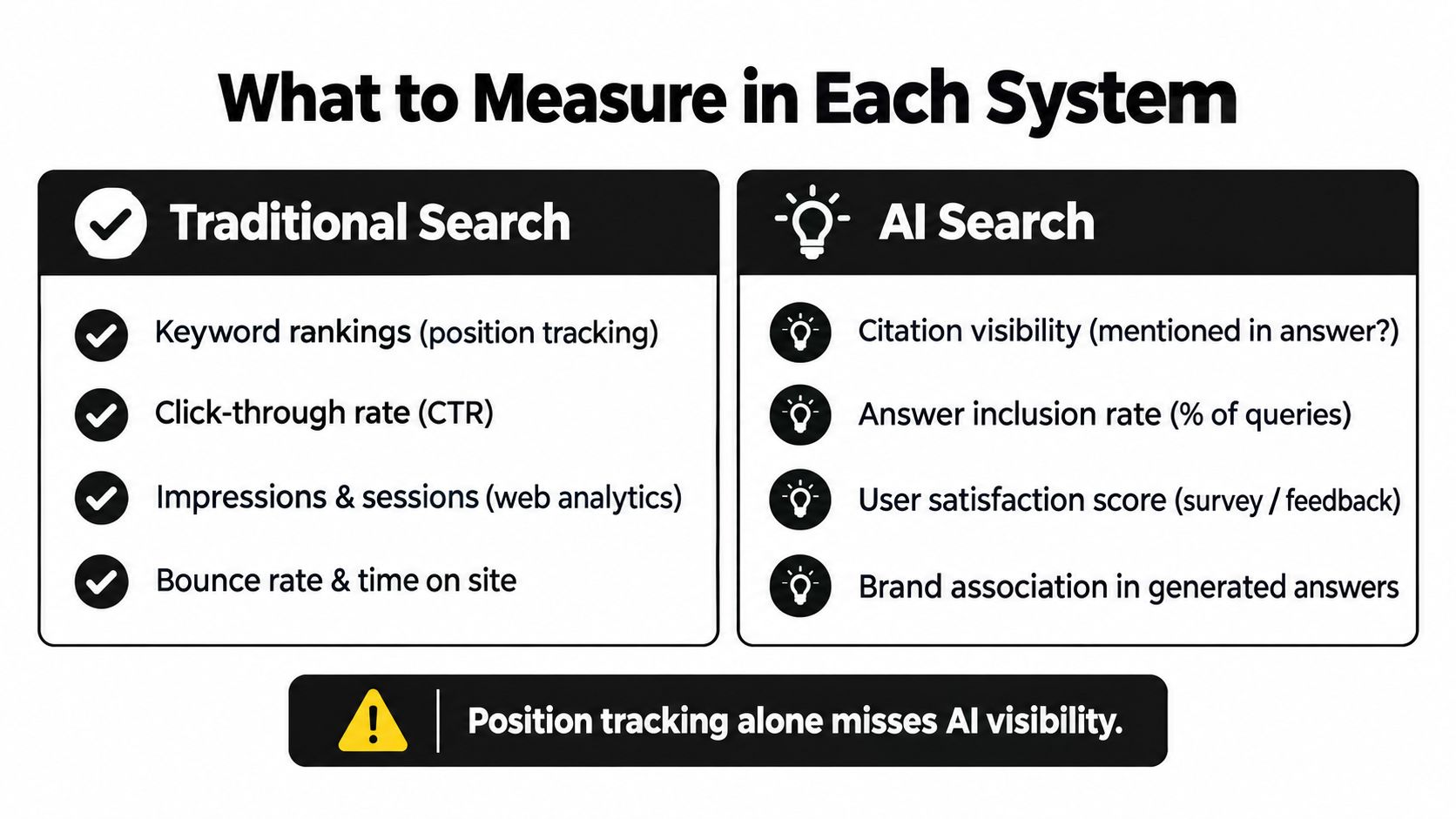
A conventional search report follows the path from query to page. Teams can track rankings, impressions, organic CTR, landing-page sessions, and conversions because the result normally offers a route to the website. Those measures still describe how efficiently a page attracts and converts visits.
AI search requires a separate visibility record. For each response, note whether the brand was mentioned, whether a page was cited, which competitors appeared, and whether the answer gave a recommendation or only general context. A ranking report cannot distinguish between being absent, being mentioned without support, and being cited as evidence.
Use separate fields for four questions:
- Traditional search: Record ranking position, impressions, organic CTR, landing-page sessions, and conversion paths.
- AI answer visibility: Record brand mentions, citation presence, answer inclusion, source type, and competitor presence.
- Demand quality: Compare assisted behavior, branded follow-up searches, direct visits, and conversions when the analytics setup can identify them.
- Query context: Segment informational, comparison, commercial, local, and navigational prompts rather than combining them into one average.
Query-level records matter because averages conceal different outcomes. An informational query may receive a complete answer without a click. A comparison prompt may mention several vendors while citing only some. A local request may show a business name without producing a measurable session. Citation status therefore belongs beside traffic, not underneath it as an assumed proxy.
A practical audit record
For every tested prompt, store the exact wording, date, platform, response text, cited URLs, brand mentions, competitor mentions, and whether someone opened a link. Record the answer type too. Definitions, product comparisons, recommendations, and troubleshooting responses create different opportunities for mention and citation.
The record shows what appeared, not why the system selected it. Keeping that boundary prevents unsupported conclusions about hidden ranking or retrieval behavior.
| Measurement question | Traditional search field | AI search field |
|---|---|---|
| Did the brand appear? | Result impression | Answer mention |
| Was the brand supported? | Page snippet and URL | Inline citation or source panel |
| Did a user visit? | Organic session | Citation click, where identifiable |
| Did competitors appear? | Competing result pages | Competing mentions and citations |
| Did demand stop on the surface? | Zero-click session | Answer completion or no external click |
The publisher's AI traffic analytics guidance helps separate referral traffic from broader answer visibility. A missing session does not prove that the brand had no influence. Without a citation record or an identifiable user path, we don't know how much value the answer created.
Use Cases When Each Search Type Matters More
The query reveals which surface deserves priority. A person ready to compare prices or contact a provider needs a destination. Someone asking for a shortlist may accept a synthesized answer, making citation and brand inclusion more relevant than an immediate visit.
Ecommerce product discovery
Traditional search carries more weight when shoppers need prices, product pages, availability, images, reviews, or a direct transaction. Those tasks depend on a destination, so product and category pages must remain accessible, clear, and competitive in conventional results.
AI search matters when the prompt adds constraints, such as a particular use case, budget, material, or feature. Test whether the brand appears in the recommendation and whether the answer cites a product or category page. A citation can support consideration even when it does not produce a session.
For ecommerce: Protect product-page rankings for transactional demand, then test recommendation prompts where product fit is the central question.
SaaS comparisons
SaaS buyers may want a shortlist before visiting any vendor site. An AI answer can summarize alternatives, integration requirements, limitations, and apparent fit. Conventional results remain useful for documentation, pricing checks, security information, and branded verification.
The strongest source material is specific and inspectable. State what the product supports, where it does not fit, and which buyer profile it serves. Compare vendor mentions with cited sources across the same prompts. A brand mention without a citation signals awareness, while a citation gives the buyer a path to verify the claim.
Local services
Local search is tied to location, hours, contact details, reviews, and directions. A conventional result can lead directly to a call or visit. An AI response may first name a shortlist or summarize service suitability, after which the customer verifies the details.
Local teams should monitor both surfaces. Accurate business information supports direct discovery, while a consistent public presence supports answer-based recommendations. Keep the wording factual. A business can be mentioned without receiving a click, and a click can occur without an AI citation, so those outcomes should be recorded separately.
Informational publishing
Informational pages face the clearest exposure to direct-answer behavior. If a generated summary resolves the basic question, the page may receive less traffic even when its information appears in the response.
Original analysis, first-hand detail, careful comparisons, and material that requires inspection create a different opportunity. These pages can provide evidence for an answer and remain destinations for readers who need depth. Track whether they are cited alongside their rankings and visits.
Decision rule: Prioritize rankings when the user needs a destination. Prioritize citations when the user needs a synthesized answer. Use both measures when the journey includes discovery, verification, and action.
Recommendation How to Adapt Your SEO Strategy
A page can rank well in Google yet remain absent from an AI-generated answer. It can also be cited in that answer without earning a visit. SEO reporting should therefore separate ranking visibility and citation visibility, then test when citation exposure offsets lost clicks.
Traditional SEO still sets the foundation: clear information, accessible content, relevant titles, useful internal linking, and a credible reason to visit. Add AI visibility as a separate reporting and content discipline rather than replacing those practices.
Use a practical audit process:
- Keep measuring rankings and clicks. These metrics describe conventional discovery and website demand.
- Test identical prompts side by side. Compare Google results, Google AI Overviews, Google AI Mode, and answer engines such as Perplexity where the audience uses them.
- Separate citations from mentions. A brand name in an answer is different from a linked source.
- Make evidence easy to inspect. Provide precise product details, clear comparisons, documented limitations, and pages that support specific claims.
- Segment by intent. Informational zero-click behavior should not be combined with commercial or navigational demand.
- Record unknowns. Without citation or referral data, a team cannot claim that AI search produced or lost a conversion.
The AI Search Signals is one option for reviewing brand visibility, citations, and AI-search reporting across platforms including ChatGPT, Claude, Gemini, Perplexity, Google AI Overviews, and Google AI Mode.
The next audit should use important queries across relevant surfaces. Record where the brand appeared, which page was cited, whether a site path existed, and how rankings, mentions, citations, and clicks differed. A query-level report can show whether the business needs stronger rankings, more citable evidence, or both.
Build that report using commercial, informational, local, and comparison prompts. Use the observations to assign the next content and measurement effort.