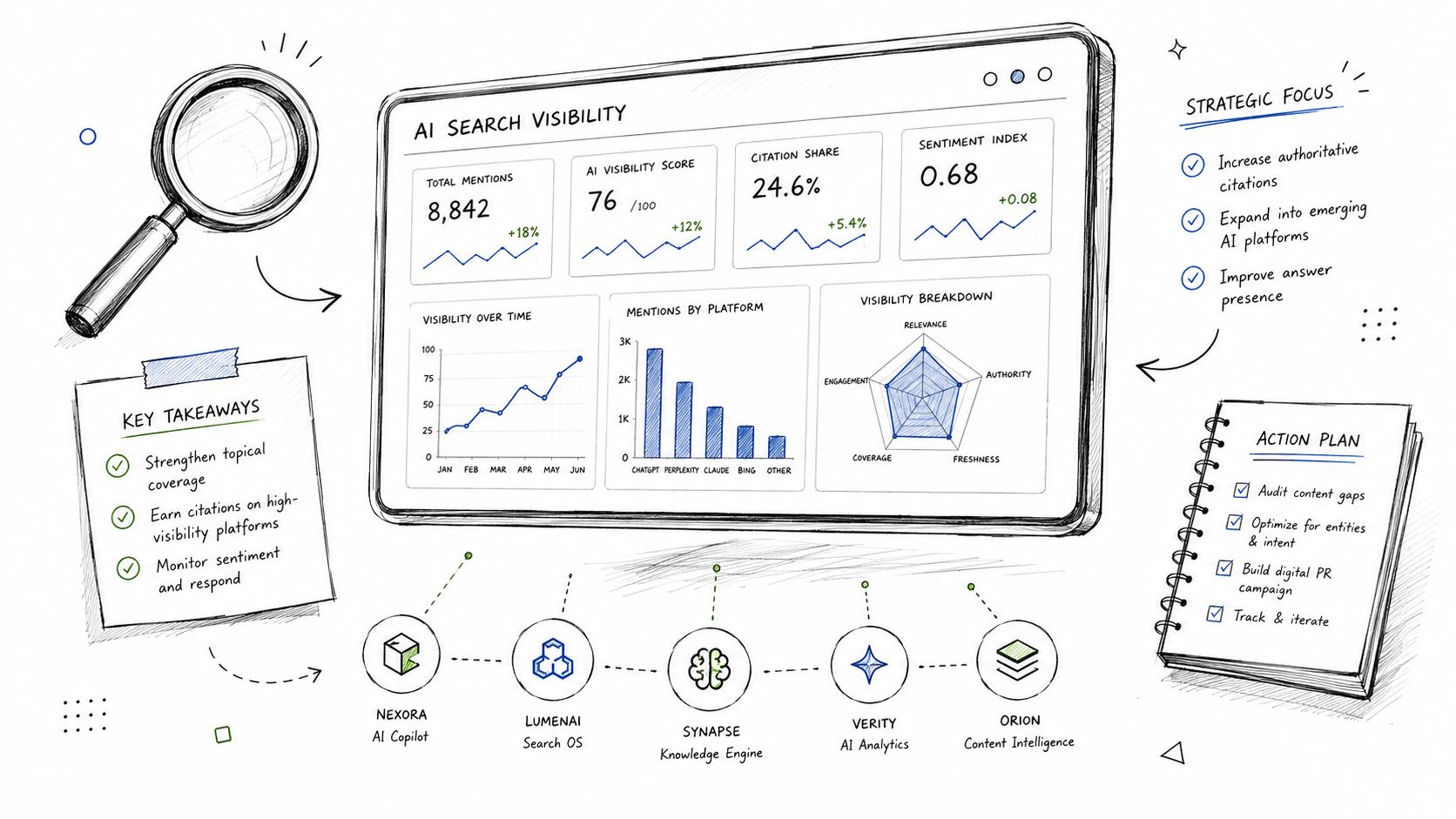
The most surprising thing in AI search measurement is that visibility isn't one metric. In the latest benchmark data, the same brand can look strong in one surface and weak in another, and the gap can widen as the company matures. That's why ai search optimization startups with top visibility metrics should be compared by the measurement problem they solve, not by a single score that sounds neat on a dashboard.
For SEO and content teams, the useful question is narrower. Which platform shows where the brand was mentioned, which one shows what was cited, which one ties that to Google AI Overviews, and which one gives a clean enough signal to defend in reporting. We should also separate what was observed from what is only interpreted. Unsupported performance claims don't belong here, and coverage, prompt scope, and citation visibility are the trade-offs.
1. Semrush, AI Visibility Toolkit
Semrush is the clearest choice when a team wants traditional SEO and AI visibility in one place. Its AI Visibility Toolkit reports an AI Visibility Score and a per-engine Visibility Overview across surfaces such as ChatGPT, Gemini, and Google AI Overviews or AI Mode, and its published research frames visibility as the frequency with which a brand name appears in an AI answer in a prompt database of more than 126 million US AI search prompts, which is helpful for share-of-voice tracking at scale (Semrush AI Visibility case study template).
The practical value is consolidation. Teams can compare tracked prompts, citation occurrences, and competitive benchmarks without splitting reporting across multiple tools, which makes Semrush easier to defend in stakeholder meetings than a patchwork of screenshots. The free AI search visibility checker also lowers the friction for first-pass validation, then the paid toolkit handles deeper monitoring.
Practical rule: use Semrush when the reporting question is, “How visible are we across engines and prompts, and can we explain that to leadership without a separate analytics stack?”
What to watch
Semrush's advanced AI visibility work is more comfortable for enterprise budgets than for small teams, and coverage varies by engine. That matters because a broad dashboard can still hide uneven data collection. The strongest use case is not “we need another score,” it's “we need one place to compare AI visibility with our existing SEO motion.” The toolkit page lives on Semrush's website, and the comparison lens used here is summarized in this editorial overview of AI visibility software.
2. Ahrefs, AI Visibility Index and AI Overviews tools
Ahrefs is the strongest fit when the team cares about data provenance and quick validation before committing to a bigger workflow. Its AI visibility layer includes a free checker, an AI Overviews tracker, and a research-led AI Visibility Index that covers brand mentions and citations across ChatGPT, Gemini, Copilot or AI Mode, Perplexity, and Google AI Overviews. That combination matters because it gives analysts both a low-friction scan and a way to compare tracked surfaces without starting from scratch.
The main advantage is baselining. Ahrefs is useful when a marketer wants to know whether a brand appears at all, which sources are being cited, and how that differs by engine. Because the toolset is attached to a broader SEO platform, it also fits teams already using Ahrefs for content and backlink work, which reduces workflow friction.
Where Ahrefs is useful
The free checker is the easiest entry point for marketers who need a quick read before a deeper audit. The AI Overviews tracker adds more structure by logging appearances and sources, which helps teams separate “we were mentioned” from “we were cited.” For ongoing scheduled tracking, though, the paid layer matters more, because the depth of monitoring is not meant to stay casual forever.
Useful distinction: mention checks tell us whether a brand showed up. Citation checks tell us whether the engine surfaced a source worth auditing.
Ahrefs also pairs well with the measurement gap described in its AI visibility checker overview. If the question is “Can we establish a reliable baseline fast, then inspect sources later?” this is one of the cleaner options.
3. SE Ranking, AI Results Tracker
SE Ranking is a good fit for teams that want AI visibility inside an existing rank-tracking workflow. Its AI Results layer looks at AI Overviews or AI Mode presence, brand citations, and prompt-level tracking across ChatGPT, Gemini, and Perplexity, while also cross-referencing Google's AI sources with organic rankings. That matters because it gives analysts context, not just a yes-or-no mention.
The product is especially useful for reporting teams. API access and add-ons make it easier to push AI visibility into dashboards, client reports, or internal BI layers. That reduces the risk of treating AI answer presence as a separate vanity metric that never reaches the people making content decisions.
Why agencies may like it
SE Ranking's reporting workflow is the practical draw. Agencies can include AI visibility alongside keyword, site audit, and backlink reporting without rebuilding their entire stack. The platform is also more legible for mixed-skill teams, since the output is easier to explain than many GEO-specific tools.
A simple way to evaluate it is to ask whether the AI layer answers the same brief as the SEO layer. If a client needs one report that links organic positioning with AI inclusion, SE Ranking helps. If the team needs deeper engine-specific diagnostics, the product may feel narrower than a dedicated conversational visibility platform.
Its website is SE Ranking, and the reporting use case aligns with the tool-comparison pattern in this broader software review.
4. Authoritas, AI Overviews Tracking
Authoritas is built for teams that already think in SERPs, keywords, and daily change tracking. Its AI Overviews layer identifies which tracked keywords trigger AIOs and whether a brand is referenced, then compares SERP states day by day. That makes it especially useful for analysts who need a clean before-and-after view instead of a broad brand dashboard.
The platform's strength is data access. Its granular SERPs API and integrations with BigQuery and Looker templates make it suitable for teams that want to build their own reporting rather than rely on a fixed interface. This is the kind of setup that supports custom dashboards, internal governance, and more exact measurement definitions.
The trade-off
Authoritas is strongest on Google surfaces. That's not a flaw if the decision is specifically about AI Overviews, but it does limit the product's usefulness for teams that want broad conversational engine coverage. It also means the buyer needs more operational patience, because the platform's tier details and implementation shape usually require a conversation with sales or support.
Best for: analysts who want raw data, not just summaries.
The platform site is Authoritas. For teams comparing reporting depth, the question is whether Google-centric AIO monitoring is enough, or whether the workflow also needs cross-engine conversational visibility.
5. seoClarity, AI Overviews monitoring and research
seoClarity addresses the scale problem. It monitors AI Overviews inside a large rank and feature system, shows which brands or URLs are cited, and helps teams compare AIO coverage with organic results. For large sites, the question is not only whether a brand appears, but how that pattern shifts across a wide keyword set.
The research layer adds context for teams that need to explain what the monitoring means. Large organizations often need that internal framing before strategy changes move, and seoClarity gives them material on rollout behavior, feature overlap, and content implications. For multi-stakeholder teams, that can matter as much as the tracker itself.
Why scale changes the evaluation
At enterprise scale, the issue is not finding more data. It is deciding which signals are stable enough to act on. seoClarity fits teams that need breadth, alerts, and a way to organize findings across a large site portfolio. Smaller groups that want a lighter daily read may find it heavier than they need.
The sales-led model is part of the trade-off. It usually means more implementation effort, but it also places the product for organizations that want a serious monitoring layer rather than a quick self-serve scan. The official site is seoClarity, and its ArcAI add-on extends the platform for teams already inside that stack.
6. SEOmonitor, Daily AI Overview insights
SEOmonitor is the most straightforward option for day-to-day AIO monitoring. It detects AI Overviews for tracked queries and separates brand mentions and citations inside those overviews, which gives agencies a clean signal they can fold into recurring client reporting. That separation matters, because a brand can be mentioned without being meaningfully cited, and the report needs to show the difference.
The appeal here is operational simplicity. SEOmonitor already serves reporting-heavy teams, so the AI layer doesn't feel bolted on. For agencies, that makes it easier to update a client deck or monthly review without building a custom pipeline.
A lightweight reporting choice
SEOmonitor is a strong fit when the goal is routine observation rather than multi-engine research. It's not trying to be a broad conversational intelligence platform, and that restraint is useful. If the team mainly needs Google AI Overviews as part of a client-visible KPI set, this is one of the least complicated paths.
The trade-off is scope. Teams that need deeper ChatGPT, Gemini, or Perplexity analysis will probably outgrow it. But for agencies that want something simple, repeatable, and legible, the daily signal can be enough.
The platform is SEOmonitor. Because this item is oriented around routine reporting, it pairs well with the measurement caveats in this analysis of AI visibility tracking, especially the warning that no single tool tells the full story.
7. BrightEdge, Data Cube X and Generative Parser
BrightEdge is the enterprise pick for teams that want Google-centric forecasting and strategy support. Its Data Cube X and Generative Parser are designed to help users identify when AI Overviews are likely to appear, understand how they differ from classic SERPs, and correlate AIOs with other SERP elements. That makes it useful before content changes, not just after they happen.
The platform's value is less about raw novelty and more about process. BrightEdge gives large organizations a way to turn AIO monitoring into planning, especially when they need education and internal alignment. The research materials help teams explain why AI surfaces matter and where content updates should focus.
Where BrightEdge fits
BrightEdge fits enterprises that care about forecastable workflows. It is not the best choice for broad conversational engine coverage, and it is not trying to be the lightest reporting tool. It is better for organizations that want AIO guidance integrated into a larger SEO operation.
For evaluation, we should ask whether the platform helps the team make a content decision that would not happen otherwise. If it only repeats what a SERP report already shows, the value is limited. If it helps predict where AIOs will show up and how a page should be adjusted, the signal is stronger.
The official site is BrightEdge, and the companion article on AI traffic analytics is useful for teams trying to connect visibility data to downstream reporting without overstating attribution.
Top 7 AI Search Optimization Platforms, Visibility Metrics Comparison
| Tool | Implementation complexity | Resource requirements | Expected outcomes | Ideal use cases | Key advantages |
|---|---|---|---|---|---|
| Semrush, AI Visibility Toolkit | Moderate, integrated platform; enterprise features | Paid subscription; enterprise tier for full features | Consolidated SEO + AI-visibility metrics and audits | Teams wanting unified SEO and AI visibility | Combines SEO signals with enterprise research |
| Ahrefs, AI Visibility Index & AI Overviews | Low–Moderate, simple checkers + research tools | Free checks; paid for scheduled tracking and depth | Research-backed visibility baselines and provenance | Quick validation and research-driven benchmarking | Strong data provenance; low-friction free tools |
| SE Ranking, AI Results Tracker | Moderate, add-ons and API integration | Core plan + usage-based add-ons; API access | Prompt-level, multi-engine tracking and dashboards | Mid-market and agencies integrating into reports | Maps AIO to organic SERPs; API/add-ons for scale |
| Authoritas, AI Overviews Tracking | Moderate–High, analyst-focused integrations | Paid plan; analyst resources and integrations (BigQuery) | Granular SERP/AIO data for custom dashboards | Teams needing raw SERP data and analyst workflows | Granular SERPs API and flexible reporting integrations |
| seoClarity, AI Overviews monitoring | High, enterprise-scale deployment | Enterprise pricing; large keyword ingestion | Large-scale AIO monitoring, alerts and strategy signals | Very large sites and enterprise SEO programs | Enterprise-scale coverage and stakeholder research |
| SEOmonitor, Daily AI Overview insights | Low, included in standard workflow | Standard subscription; agency reporting workflows | Day-to-day AIO presence and citation signals | Agencies and teams needing routine client reports | Lightweight, easy to include in reporting |
| BrightEdge, Data Cube X & Generative Parser | High, enterprise workflows and forecasting | Enterprise pricing; implementation support | Forecasts of AIO appearance and SERP correlation | Enterprises preparing content strategy for AIOs | Research-backed forecasting and educational tools |
Choose the Signal That Matches the Decision
The cleanest way to compare these platforms is by the decision they support. Semrush and Ahrefs are better for cross-engine visibility and citation baselines, because they combine multiple surfaces with broader SEO context. SE Ranking, Authoritas, and SEOmonitor are better when the team needs Google AI Overview monitoring folded into an existing reporting motion. seoClarity and BrightEdge make more sense when enterprise-scale coverage and internal education matter more than speed of setup.
For API-led custom reporting, Authoritas is the clearest fit in this list because it gives analysts rawer building blocks. For day-to-day agency reporting, SEOmonitor and SE Ranking are easier to operationalize. That difference matters because a platform can look strong in a demo and still fail the actual reporting task if the output can't be used without rework.
The evaluation checklist should stay simple. Confirm the supported engines and locales. Define the prompt set before comparing tools. Separate mentions from citations. Inspect the cited URLs, not just the score. Record the collection frequency, because daily and scheduled tracking answer different questions. Then test whether the output supports a real reporting, content, or stakeholder decision.
The benchmark data at the top of this piece shows that visibility can rise with company maturity, and that citation and entity signals move unevenly even inside the same market. That means the best tool isn't the one with the biggest score. It's the one that shows what changed, where it changed, and what we should do next.
For ongoing analysis of observed visibility patterns and measurement limits, The AI Search Signals is a useful publication to follow. The right next step is to pick one platform, run a fixed prompt set, and compare mention, citation, and source data for a single category. That gives the team a defensible baseline before any bigger investment.