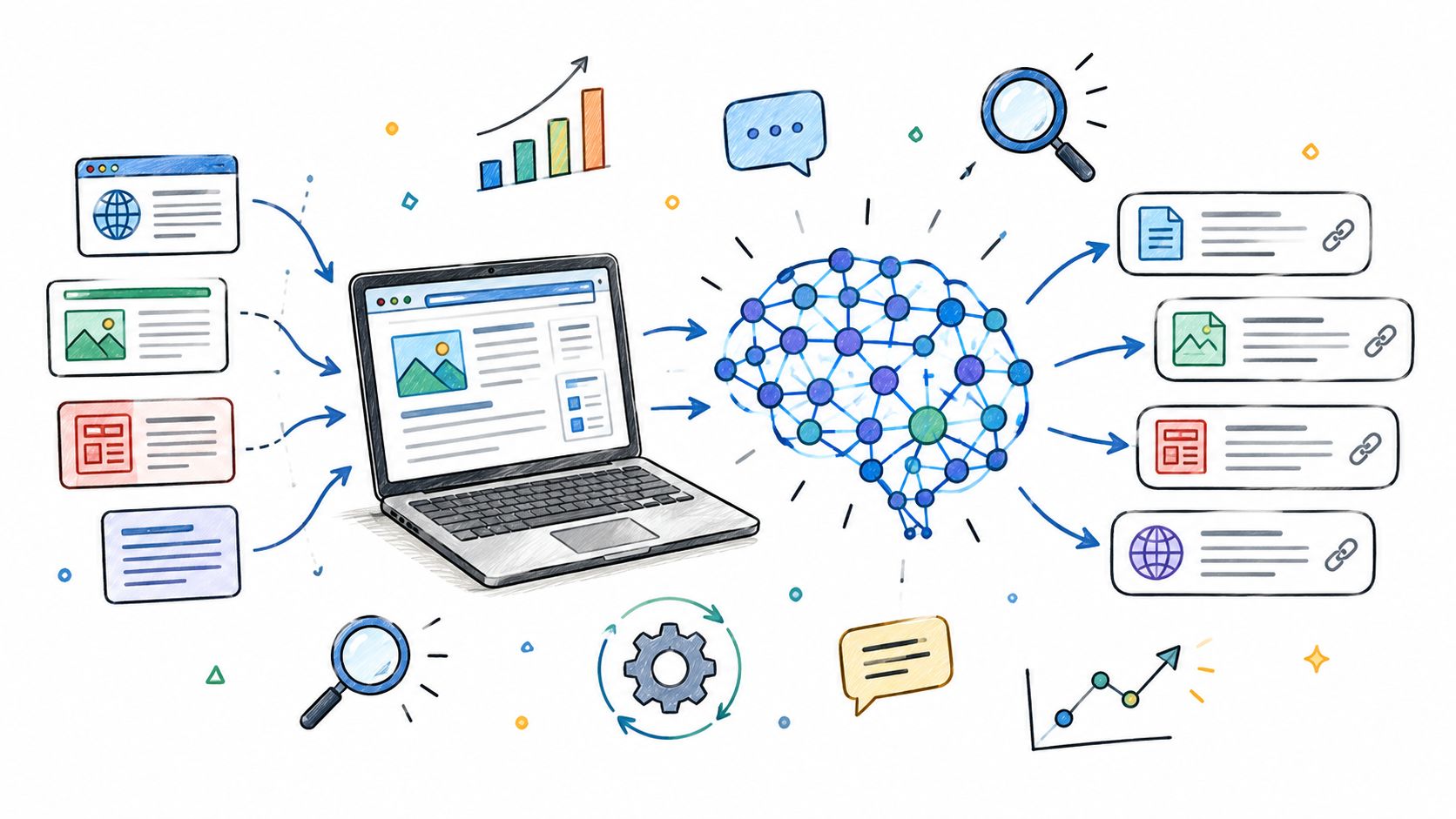
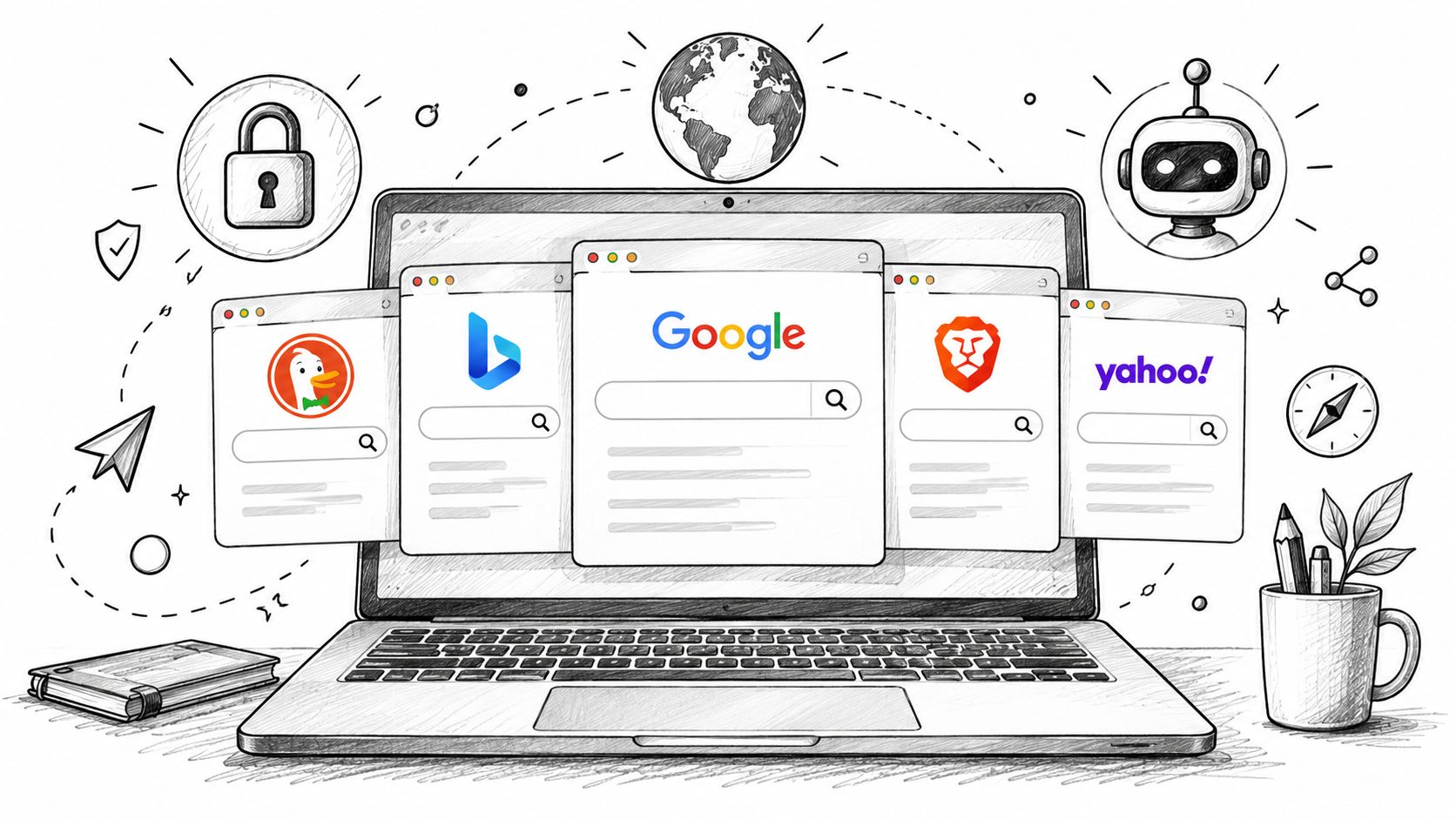
Alternative search engines aren't one category, and treating them as interchangeable produces weak testing. Some maintain independent web indexes. Others act as privacy layers over established providers. A third group returns synthesized answers with citations instead of a conventional results page.
That difference changes what SEO teams can learn. A page surfaced by an independent crawler answers a different visibility question from a page cited by an AI answer system. Privacy posture also matters, but it doesn't automatically improve local relevance, shopping coverage, multilingual results, or research depth.
The practical comparison is therefore query-led. Teams should record which pages appeared, whether the tool returned a SERP or an answer, how citations were presented, what regional context was applied, and what limitations affected the result. They should also separate direct observations from interpretations about AI systems. Google Search Central states that a page must be indexed before it can appear as a supporting link in AI Overviews or AI Mode, so indexing remains a hard prerequisite for Google's AI surfaces (Google's AI features guidance).
The ten tools below are organized by the test each resource supports: privacy-preserving search, independent indexes, mainstream vertical coverage, and cited AI answers.
1. DuckDuckGo
DuckDuckGo is the simplest test for privacy-sensitive general search. Its central user proposition is straightforward, and its interface resembles a conventional SERP rather than a chat workspace. That makes it useful when a marketing team wants to compare everyday discovery without relying on a personal search history.
The DuckDuckGo search engine also supports “!bangs”, which send a query directly to a selected site. For SEO testing, that creates a practical split. A broad search can show what DuckDuckGo surfaces, while a site-specific shortcut can help verify whether a known publisher, marketplace, or competitor page is discoverable through a targeted route.
What the workflow can reveal
DuckDuckGo is best treated as a test of low-personalization discovery. Teams can run the same informational, commercial, and branded queries in a clean browser session, then record result order, snippets, local modules, images, and partner-dependent features. The output remains a SERP, so the analyst can inspect more than the first answer and identify competing pages that may be absent from another engine.
Its privacy posture doesn't mean every vertical behaves identically. Maps and some specialized results depend on partner services, so local and vertical observations should be labeled separately from general web observations.
Practical rule: Use DuckDuckGo to test whether a page remains visible when the search experience is less connected to an individual's profile, not to assume that one result represents every market.
The main limitation is depth on highly niche queries. A brand that performs well in broad web search may still encounter thinner coverage for specialized topics. The useful conclusion is comparative: DuckDuckGo can expose a privacy-oriented audience and a different result environment, but it shouldn't replace country, device, and query segmentation.
2. Brave Search
Brave Search supports a stronger independence test than a privacy wrapper. Brave positions Brave Search around its own web index, while its results interface retains the familiar structure of links, snippets, and search refinements. That combination lets teams compare independent-index visibility without forcing every query into an AI chat format.
The search page also includes Ask Brave, an AI-assisted answer experience, and Discussions, which surfaces relevant community threads. These formats matter for visibility analysis because a brand can appear as a conventional result, a referenced source in an answer, or a discussion destination. Those are separate observations and should be logged separately.
A practical independent-index test
Run exact-match brand searches, category queries, and long-tail questions across Brave Search and a partner-backed engine. Record URLs rather than only domains. A result-domain match can conceal a different page selection, while a URL-level comparison shows whether the same article, product page, or documentation page was surfaced.
Brave's independent positioning creates differentiation, but it also creates a limitation. Long-tail coverage can be less complete than on the largest indexes, especially when the query depends on narrow local or specialist information. That isn't evidence of poor quality in every case. It shows why independent indexes should be evaluated for coverage and result diversity, not judged only by whether they reproduce a familiar SERP.
An independent index changes the test itself. A missing page may reflect coverage, crawl discovery, or ranking differences, and those possibilities shouldn't be collapsed into one explanation.
For AI visibility, teams can repeat the same prompt in Ask Brave and compare the cited or surfaced pages with the classic results. The important record is what appeared in the tested response. No claim about an internal ranking process is needed.
3. Kagi
Kagi is a paid, ad-free search environment aimed at users who want control over result noise and personalization. The Kagi search engine offers tools such as site downranking, site boosting, and Lenses, which allow a user to shape the search set around selected regions, domains, keywords, or file types.
That makes Kagi useful for a different SEO test. Instead of asking only whether a page appears in a default SERP, teams can examine how visibility changes when the searcher applies explicit source controls. This is especially relevant for research workflows where analysts want to isolate a small web, a particular geography, or a defined group of publications.
Why control changes the interpretation
Kagi's ad-free presentation can make result inspection easier because the analyst spends less time separating paid placements from organic links. Its integrated Kagi Assistant adds an answer layer, but the classic search experience remains central to the product. Teams should therefore preserve both outputs in their records, including the query configuration and any Lens applied.
The trade-off is access. A paid model can deter casual testers, and AI usage limits may vary by tier. Current pricing should be checked on Kagi's published plans, as of September 2026, rather than copied from third-party summaries.
Kagi is particularly relevant to teams evaluating visibility for publishers, specialist SaaS content, and independent websites. A page that appears only after a user applies a Lens has a different discovery status from a page surfaced in a default search. That distinction prevents analysts from overstating reach.
For a broader measurement framework, the AI search optimization analysis for startups with top visibility metrics provides a relevant editorial reference point. The practical lesson is narrow: Kagi can test user-controlled discovery, not universal search performance.
4. Startpage
Startpage is a useful control for separating privacy from index ownership. The Startpage search engine presents a familiar search experience while proxying queries to partner engines and removing identifying information from that exchange. Its Anonymous View option extends the privacy layer when a user opens a result through the service.
For SEO professionals, that creates a clean comparison with independent crawlers. If Startpage and another partner-backed engine surface similar pages, the result may reflect shared index coverage rather than a distinct web corpus. If Startpage differs, the analyst still needs to distinguish query handling, interface presentation, regional settings, and partner result treatment before assigning a cause.
The right visibility question
Startpage answers: Can a privacy-conscious user receive mainstream-style results without directly exposing the query to the partner provider? It doesn't answer whether a page is discoverable in an independent index.
That limitation is central, not incidental. A privacy proxy can reduce direct data exposure while remaining dependent on the underlying provider's index and result systems. Startpage's simpler interface also means some advanced partner features won't appear in exactly the same form.
A repeatable test should include generic category queries, branded searches, and local-intent searches. For each, record the visible result URLs, advertisements, map treatment, regional setting, and whether Anonymous View changes the destination experience. Analysts should avoid treating a privacy layer as evidence of a different ranking environment.
Startpage is therefore a strong tool for a privacy-versus-index comparison. It can help determine whether the visibility problem is associated with exposure to a search provider or with the page's discoverability in the shared underlying result ecosystem. Those are different technical and editorial questions.
5. Qwant
Qwant offers a European privacy-centered alternative with a hybrid model. The Qwant search engine combines its own crawling with partner supplementation across web, images, news, and maps. That makes it useful for testing how a privacy-forward product behaves when independent coverage and external vertical data coexist.
Its regional identity also matters for interpretation. A result set produced for a European audience shouldn't automatically be used as a proxy for United States local search. Qwant may be less so for US-local queries than engines built around US-centric coverage, while some verticals depend on partner providers.
A regional and vertical test
Qwant is best used with a query set divided by geography and format. Teams can test a European service query, a US-local query, a news topic, an image search, and a branded query. The record should identify the vertical, location settings, surfaced domains, and whether the result appears to come from a web index or a partner-supported module.
Qwant also offers mobile access and Qwant Junior, its child-focused variant. Those products create additional audience contexts, but they shouldn't be treated as interchangeable search environments. A page's presence in general web results says little about how it performs in a child-focused product or a mobile interface unless that specific experience is tested.
The main analytical value lies in its mixed architecture. A page may appear in one vertical and not another because the coverage source differs. That is more informative than a broad label such as “private search,” which hides the difference between web discovery and partner-supported maps or news.
For marketers, Qwant can test whether a privacy-oriented European audience encounters the brand in a way that differs from US-focused mainstream search. The result shouldn't be generalized globally. Country and device segmentation remains necessary, particularly because DuckDuckGo's adoption is materially stronger in the United States than worldwide according to summaries citing StatCounter (DuckDuckGo market-share context).
6. Ecosia
Ecosia combines a privacy-minded search experience with a sustainability-focused business model. The Ecosia search engine states that advertising revenue funds verified tree-planting projects, and it uses a multi-provider approach for search results. Browser and mobile integrations make it a practical default-switch test for teams studying adoption beyond Google.
The important SEO question isn't whether the mission sounds attractive. It is whether the same page remains visible when the provider blend and audience context differ. Because Ecosia's results can vary with that blend, analysts should avoid describing one observed SERP as a permanent Ecosia-wide pattern.
Test the provider blend, not the brand promise
A useful workflow compares identical queries across Ecosia and an independent index. Record the result URLs, snippets, ads, images, news modules, and location context. If Ecosia surfaces a page also found through a partner-backed engine, that may indicate shared coverage. If Mojeek or Brave surfaces a different page, the contrast becomes a test of index diversity.
Ecosia is simpler than Google for everyday switching, but it offers fewer advanced operators and features. That limitation affects research teams that depend on tightly constrained searches. A marketer should therefore use Ecosia for broad discoverability and audience-context testing, not as the only environment for technical investigation.
The social mission also changes the business question. A brand targeting environmentally conscious users may care about appearance in Ecosia even when global volume is limited. That is a qualitative audience decision, not a claim that Ecosia has broad market reach.
The strongest output is a segmented observation: which pages appeared, under which query type, and in which vertical. Ecosia helps test whether a brand's visibility survives a multi-provider search experience connected to a clear user value proposition.
7. Mojeek
Mojeek is a direct test of independent crawling. The Mojeek search engine operates its own web index and crawler, with a strict privacy stance and a classic keyword-first interface. Its Search API also gives developers a route for programmatic experiments, although API output should still be evaluated against the visible product experience.
This independence changes the interpretation of absence. If a page appears on Google or Bing but not on Mojeek, the observation doesn't prove that the page is low quality. It may indicate different crawl discovery, index coverage, matching behavior, or result selection.
A clean index-diversity workflow
Use Mojeek for exact brand names, distinctive product phrases, specialist questions, and publisher URLs. Compare the first visible results with Brave Search, which also positions itself around an independent index, and with Startpage, which uses partner-backed results. The test should preserve the full URL, title, snippet, and query wording.
Mojeek's keyword-first behavior can feel more literal than the semantic interpretation available in larger mainstream systems. That is valuable for SEO teams because it exposes whether a page's discoverability depends on exact language or remains visible for related wording.
Independent coverage is a separate measurement dimension from ranking position. A page can be prominent in one corpus and absent from another without either observation explaining why by itself.
The limitation is long-tail depth. Smaller independent indexes can have thinner coverage for obscure pages and local information. That makes Mojeek a poor universal replacement for every search task, but a strong diagnostic tool for index ownership and resilience.
For AI-search workflows, Mojeek can supply a control group. Analysts can compare the pages it surfaces with the sources cited by answer engines, then ask whether AI responses draw from pages that independent crawlers also discover. The comparison remains observational. It doesn't establish an internal relationship between the systems.
8. You.com
You.com is designed around AI-assisted search and answers rather than a purely traditional SERP. The You.com platform combines live web results with language-model responses, provides citations in its answer experience, and offers Web Search and Contents APIs for teams building applications.
That makes it practical for two related tests. A marketer can inspect what a user sees in a conversational answer, while a product team can evaluate how retrieved web content might feed an internal workflow through developer tools. Those should remain separate test tracks because an API response and a consumer interface aren't identical evidence.
Observe the answer, then inspect the sources
For each prompt, record the wording, answer format, cited URLs, follow-up behavior, and whether the response includes a direct link to the brand. A page can be surfaced as a citation without receiving a conventional SERP position. Another page may be mentioned in prose but not linked. Those outcomes need distinct labels.
You.com is useful for exploratory research and coding-related questions, where a conversational response can reduce the time needed to assemble an initial source set. Quality can vary by query type, and the product's consumer and API features evolve quickly. Teams should capture the date and interface used whenever they repeat a test.
The commercial model also requires care. Usage-based API pricing, individual plans, and enterprise options should be checked in You.com's developer documentation and current product pages rather than inferred from reviews.
For AI visibility, You.com supports a source-citation audit. The analyst asks whether the brand's documentation, research, product pages, or third-party coverage appears in the cited source set. The output is not a claim about internal preference. It is a record of what appeared in the tested response.
9. Perplexity
Perplexity is an answer engine for research-style prompts. The Perplexity product page describes citations as part of the answer experience, with links that let users inspect where an answer comes from and verify its evidence. That makes citation auditing more direct than in a conventional SERP.
The useful test is not whether a brand is named. It is whether the answer cites a relevant page, whether the cited page supports the surrounding statement, and whether follow-up prompts continue to surface credible sources. Perplexity's Projects and workspaces also support organized research, while Pro and Max tiers add features and higher limits. Current plan details should be checked on Perplexity's official plans page.
A citation-led visibility audit
Teams should use a fixed prompt set covering brand comparisons, category questions, product research, and source discovery. For every response, record the answer text, inline citations, cited URLs, publication dates where visible, and any regional assumptions. A source can be relevant without being favorable, and a favorable mention can still lack adequate evidence.
Perplexity's documentation specifies that sourced information should carry inline bracketed citations immediately after the sentence using it, with separate references rather than a combined citation format (Perplexity citation documentation). That format makes sentence-level source review possible.
The limitation is scope. An answer engine isn't a replacement for exhaustive SERP exploration, and usage limits can apply even on paid plans. Researchers should therefore use Perplexity for synthesis and source discovery, then open the cited pages and validate the claims directly.
For teams learning how to measure this channel, this guide to ranking in Perplexity is a relevant internal reference. The practical conclusion remains modest: Perplexity helps test citation presence, source quality, and answer framing.
10. Microsoft Bing
Microsoft Bing is the useful contrarian test in this list: broad visibility does not equal uniform visibility. The Bing search engine combines web search with images, video, maps, news, shopping, and visual search. Its results also include Copilot-assisted answers, allowing marketers to examine classic rankings and answer-format exposure within one mainstream ecosystem.
That range makes Bing valuable for commercial, image, and local-intent queries. A product page can surface in web results, an image module, shopping listings, or an AI-assisted summary. These placements represent different user paths, so they should be recorded separately rather than combined into one visibility score.
Test the full search surface
Run a fixed query set across web, images, shopping, maps, and news when each vertical fits the intent. Record the result type, URL, title, snippet, product or business information, and whether Copilot shows a cited or linked source. Document sign-in status, location, and personalization settings because Microsoft account configuration can change the observed results.
Bing's index and interface also provide a comparison point for privacy-focused engines. Advertising may be more prominent, while Microsoft account settings can influence personalization. A privacy-sensitive discovery test should therefore treat Bing as a distinct control, not as an equivalent to DuckDuckGo or Startpage.
The AI layer requires a separate interpretation. Google guidance, summarized by Google AI Overview guidance summary, indicates that AI Overviews do not rely on a separate AI index and may use content already eligible for regular Search. That supports an indexing-first workflow for Google, but it does not prove that Bing's Copilot responses follow the same process.
Use Bing to test mainstream vertical coverage plus AI-assisted SERP behavior. Evaluate whether a page is discoverable across the relevant result surfaces, then inspect how Copilot selects, cites, and frames sources. For limitations and open questions in AI search measurement, this analysis of AI search problems provides a relevant perspective.
Top 10 Alternative Search Engines Comparison
| Engine | Core features | AI / Answers & citations | Privacy & Indexing | Best for | Price & USP |
|---|---|---|---|---|---|
| DuckDuckGo | Private search, "!bangs", tracker-blocking apps | Minimal AI; classic SERP, few inline answers | Strong privacy (no profiling), minimal personalization; some verticals via partners | Everyday private web search | Free, USP: privacy-first, easy switch |
| Brave Search | Own web index, "Ask Brave" AI, Discussions | AI summaries integrated into results with source links | Independent index, privacy-minded | Users wanting independent index + optional AI help | Free, USP: independent index + built-in AI |
| Kagi | Ad-free paid engine, personalization controls, "Lenses" | Integrated "Kagi Assistant", multi-model on higher tiers | No ads/no tracking; quality-over-quantity ranking | Power users, researchers, professionals | Paid subscription, USP: ad-free control and high signal-to-noise |
| Startpage | Proxy queries to partners, "Anonymous View" | Uses partner engine results (Google/Bing); not AI-centric | Privacy proxy strips identifiers; dependent on partners | Users wanting Google-like relevance privately | Free, USP: Google-level relevance with privacy layer |
| Qwant | EU-focused policies, own crawl + partners, Qwant Junior | Standard SERP; not primarily AI-driven | EU privacy compliance (CNIL-aligned); mixed index | EU users and families seeking privacy-conscious search | Free, USP: EU privacy posture and child-friendly option |
| Ecosia | Multi-provider results, browser/mobile integrations, impact reporting | Not AI-focused; relevance varies by provider mix | Privacy-minded, uses partners for results | Users who want search that funds tree-planting | Free, USP: sustainability mission (ad revenue funds trees) |
| Mojeek | Own crawler & index, keyword-first search, developer API | Classic keyword matching; little semantic AI | True independence from major indexes; strict no-tracking | Users needing independent, non-personalized rankings | Free, USP: independent UK crawler and predictable results |
| You.com | Conversational answers, real-time web grounding, APIs | LLM-driven answers with citations and grounding | Blends live web + LLMs; feature set evolving | Developers, teams, exploratory research & coding help | Freemium / Pro, USP: developer-friendly APIs + grounded AI |
| Perplexity | Cited synthesized answers, projects/workspaces, tiers | Strong cited answers for research, follow-ups supported | Live web search + synthesis; usage limits on tiers | Researchers, content teams, quick briefs & source discovery | Freemium / Pro, USP: fast, citation-focused answer engine |
| Microsoft Bing | Full web index, images/videos/maps/shopping, Copilot | Copilot AI summaries integrated into SERP, mixed citations | Deep index; personalization tied to Microsoft account | Commercial, image/local intents, Windows/default users | Free, USP: broad vertical coverage + Copilot integration |
Build a Small, Repeatable Search Test Set
A useful alternative-search evaluation starts with query groups, not tool ratings. Build a compact set covering branded searches, category discovery, informational questions, commercial comparisons, local intent, image needs, news needs, and specialist long-tail topics. The exact wording should remain fixed between runs. Small wording changes can produce different pages, different citations, or a different answer format.
Run each query across a selected group rather than all ten every time. Mojeek and Brave Search can test independent-index discovery. Startpage and DuckDuckGo can test privacy-oriented experiences. Bing can test mainstream verticals. Perplexity and You.com can test cited answers. Kagi can test controlled discovery, while Qwant and Ecosia can add regional, audience, or provider-blend context.
Record observations in separate fields:
- Query and intent: Preserve the exact wording and classify the task.
- Environment: Note country, device, browser, sign-in state, and location settings.
- Output format: Mark whether the tool returned links, vertical modules, an AI answer, or a mixed SERP.
- Surfaced pages: Save the exact URLs, titles, snippets, and visible source labels.
- Citations: For answer systems, record every cited page and the sentence or claim it supports.
- Date and time: Search results change, so each observation needs a timestamp.
- Interpretation: Keep explanations separate from what was directly visible.
This separation prevents a common analytical error. If a page wasn't cited, the record can say that it wasn't cited in the tested response. It shouldn't claim that the system ignored, disliked, or deprioritized the page internally. Similarly, if an independent index didn't surface a URL, the observation is absence from that tested result set, not proof of a broader ranking failure.
Google Search Central's guidance makes one operational point especially clear: indexing is required for a page to be eligible as a supporting link in AI Overviews or AI Mode (Google Search Central documentation). That gives SEO teams a concrete first check before interpreting AI visibility. It doesn't remove the need to inspect citations, answer wording, freshness, and regional context.
There isn't one universal winner. The right tool depends on the question. Use an independent index when result diversity matters. Use a privacy layer when exposure to partner providers is the concern. Use Bing for vertical breadth. Use Perplexity or You.com when source-cited synthesis is the workflow. Use Kagi when analysts need explicit control over the search set.
Teams that need ongoing visibility measurement can evaluate AI Search Signals as one relevant option for tracking how brands appear in AI-powered search and answer systems, including ChatGPT, Claude, Gemini, Perplexity, Google AI Overviews, and Google AI Mode. The next step is practical: select a defined query set, run the first baseline across the tools that match the business's priorities, and preserve the pages and citations that appeared.
Choose five representative queries today, test them in an independent index, a privacy-oriented engine, Bing, and one cited answer system, then save the results with country, device, and date. Repeat that same test on a fixed schedule and review changes as observations first, interpretations second.