A familiar SEO problem is showing up in more teams now. A brand appears in a ChatGPT answer, but there's no link. Then a slightly different prompt produces the same brand with a citation attached. That difference changes how the answer can be audited, reported, and defended internally.
A mention without a citation is hard to trace. A mention with a citation gives the team something concrete to inspect. The page title can be checked. The claim can be matched against the source. The domain can be logged. For anyone trying to measure AI visibility, that's a big operational difference.
ChatGPT citations are not the same thing as rankings in Google, and they also aren't a clean vote of page quality. They are a visible output from a process where external pages were surfaced, some were used, and some were left out. That sounds simple. In practice, it's where many reporting mistakes start.
SEO teams also run into a second problem. The citation itself may look solid, but the underlying reference can still be wrong. In some cases, the page exists but doesn't support the claim. In others, the citation text is plausible-looking output that still needs checking.
Working rule: treat every AI citation as something to verify, not something to trust on sight.
That skeptical stance helps with two jobs at once. It keeps editorial teams from reusing shaky references. It also keeps visibility reporting from turning into guesswork.
Introduction What ChatGPT Citations Mean for SEO Teams
Teams encountering AI answers for the first time often try to map them directly onto familiar search habits, which usually breaks quickly. In Google Search, a visible link list is the product. In ChatGPT, the answer is the product, and citations may or may not appear alongside it.
That creates confusion in status reviews. Someone asks whether the brand is “showing up in ChatGPT.” One analyst counts mentions. Another counts linked citations only. A third exports screenshots because the interface changed between runs. All three may be looking at real signals, but they aren't measuring the same thing.
Why the link changes the conversation
A non-cited mention can still matter for awareness. But it's difficult to audit. The team can't easily say which page was surfaced, whether the answer relied on current web retrieval, or whether the model responded without any visible attribution.
A cited mention is different. It gives the team an artifact. That artifact can be checked against the source page and added to a repeatable workflow.
A practical example helps:
- Version one: “Which project management tools are good for remote software teams?” A brand appears in the answer text, but no source is shown.
- Version two: The same prompt is asked in a mode that uses web retrieval, and the answer includes numbered citations and linked source cards.
The brand mention is the visible outcome in both cases. Only the second version gives the team a traceable source path.
What tends to confuse experienced SEOs
The usual mistake is assuming that a cited page was “best” in the way a search result might be discussed in Google SEO. We don't know that. What we observed is narrower. A page was retrieved, selected for use in the answer, and then attributed in the interface.
That distinction matters because a page can be excellent and still not appear. A page can also be mentioned without becoming a visible citation. If the team skips that nuance, reporting gets sloppy fast.
A citation is evidence that a page was used and attributed in that response. It is not proof of broad authority, universal visibility, or factual correctness.
The rest of the workflow starts from there. First, understand when citations appear. Then inspect where cited material often sits on a page. Then verify every citation before using it in content work or brand measurement.
How ChatGPT Citations Are Generated
The simplest mental model is a retrieval-then-selection pipeline. That phrase sounds technical, but the idea is plain enough for any SEO team.
Some ChatGPT answers include citations. Some don't. A neutral explanation of ChatGPT source behavior says citations appear when a browse or external-retrieval step is used, and the cited items reflect what that retrieval step pulled rather than what the model can say from memory, as explained in this note on ChatGPT citation sources.
A simple analogy that holds up
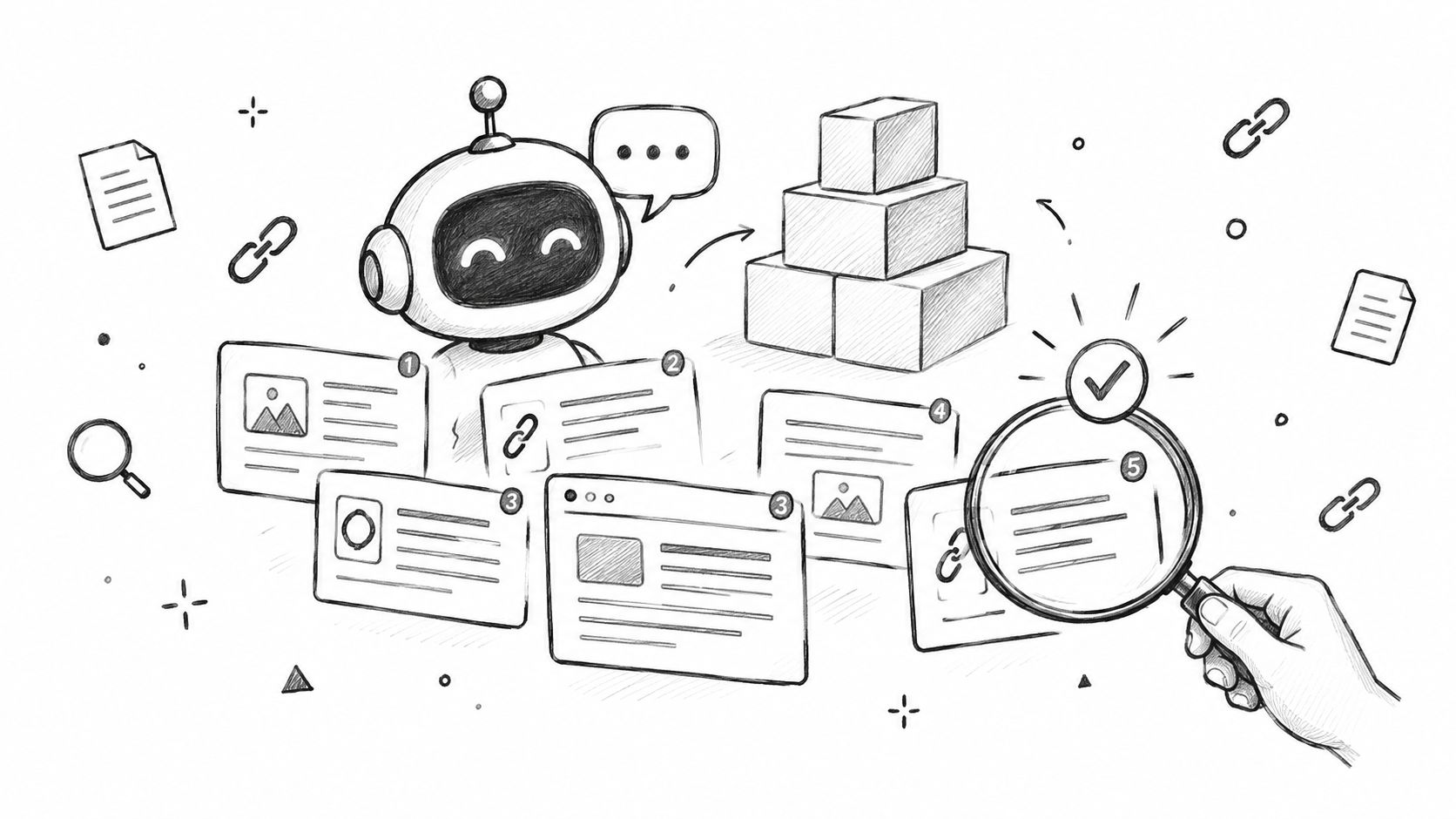
Think of the answer process like a researcher pulling a stack of documents onto a desk.
First, documents are brought into view.
Then, some of those documents are used.
Then, some of the used material is shown back to the reader as visible citations.
That doesn't tell us how the system works internally. It gives us a practical way to diagnose outcomes.
Another independent write-up says that in ChatGPT's browsing flow, a page must first be retrieved, then selected, and then attributed. If a page isn't indexed or isn't among the retrieved candidates, it can't become a citation in the final answer, according to this explanation of cited-source flow.
What this means when a page was not cited
If a page didn't appear as a citation, several different things may have happened.
It may not have been retrieved at all.
No retrieval means no path to citation in that response.It may have been retrieved but not cited.
Retrieval and citation are related, but they aren't identical steps.It may have informed the answer without visible attribution.
That's frustrating for measurement, but it's a real reporting edge case.
This is why teams need to separate three questions:
| Question | What it asks |
|---|---|
| Was the brand mentioned | Did the answer text include the brand at all |
| Was a page surfaced | Did the interface show a linked source or source card |
| Was that page actually usable evidence | Does the cited page support the claim being made |
That separation fixes a lot of confusion in prompt testing.
For teams that want a broader plain-language explainer on retrieval and answer behavior, this walkthrough on how ChatGPT gets its information is a useful companion.
Where Citations Tend to Come From on a Page
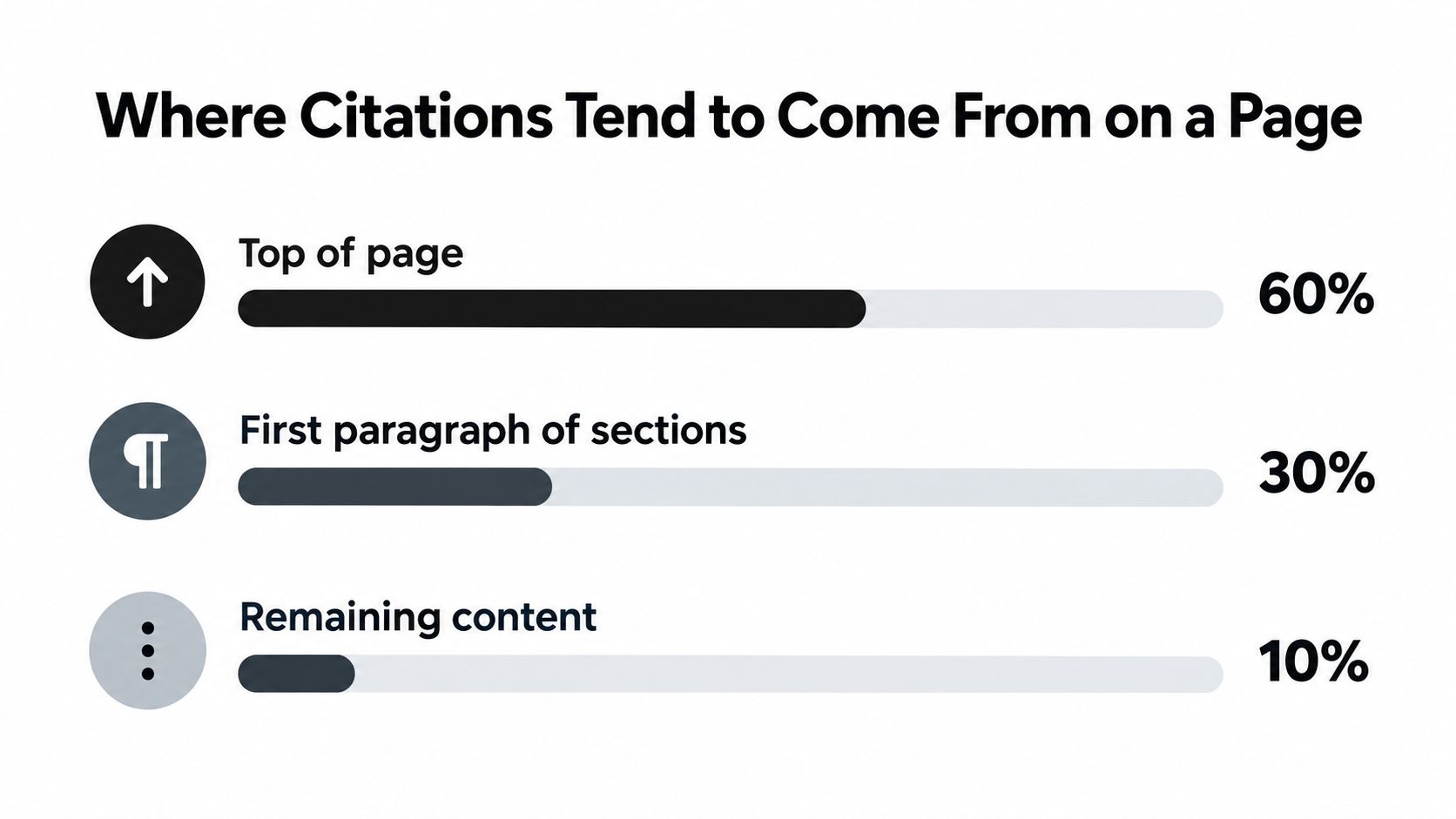
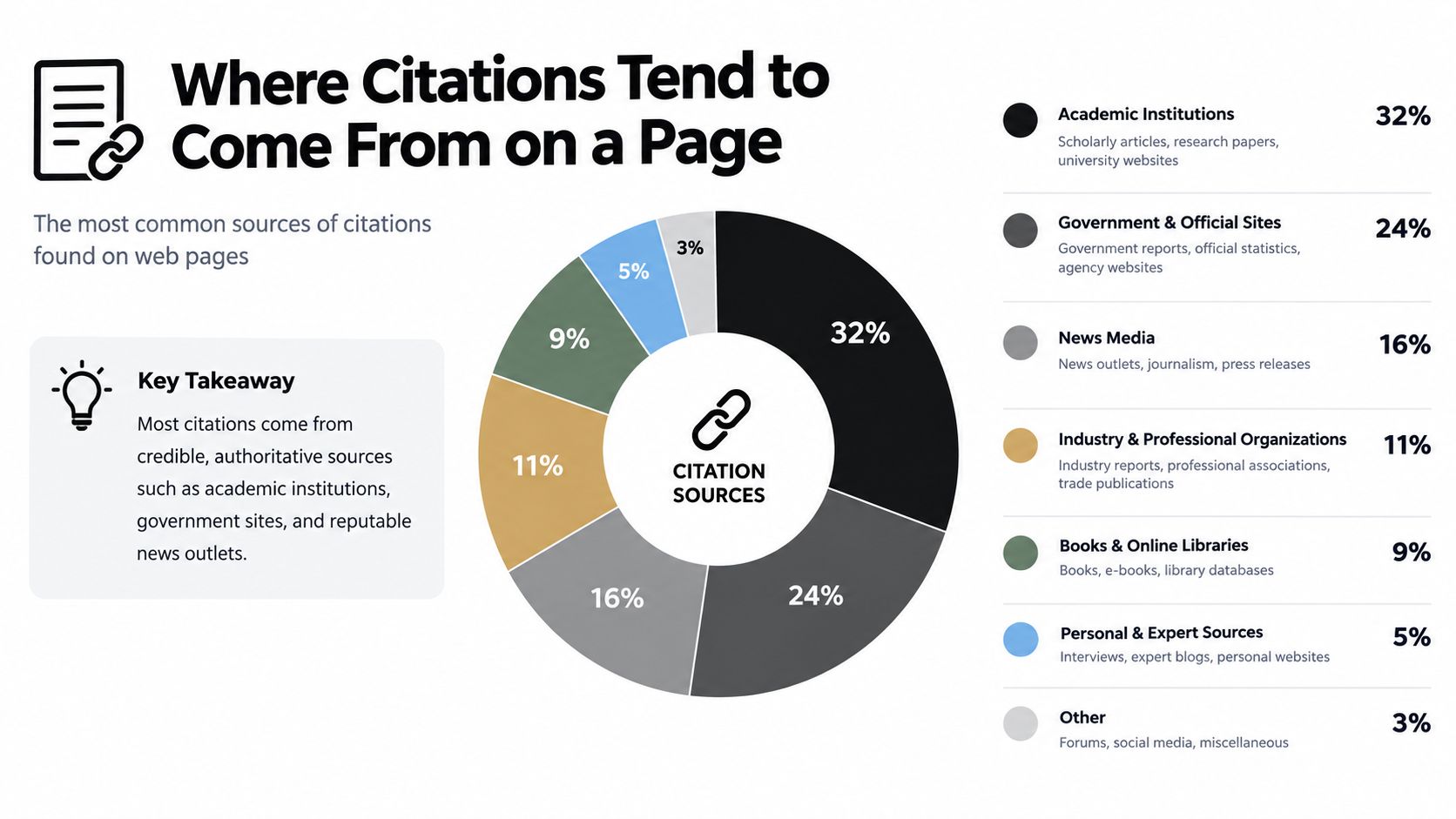
Citation-worthy material doesn't appear to be spread evenly across a page. Placement matters as an observed pattern, even if it shouldn't be framed as a guaranteed tactic.
A 2026 content-analysis study reported that 44.2% of citations came from the first 30% of a page, 31.1% from the middle 30–70%, and 24.7% from the final third, with a sharp drop near the footer, as reported in Search Engine Land's summary of the citation content study. The same research found 53% of citations came from the middle of paragraphs, 24.5% from first sentences, and 22.5% from last sentences, which gives content teams a much more specific editing lens than “put important stuff near the top.”
What to inspect on your own pages
This doesn't mean teams should stuff every key point into the first paragraph. It does mean the page should expose distinct claims early and clearly.
A useful audit starts with three page elements:
- Definitions near the top: If the page contains a strong explanation of a term, check whether that explanation is buried after long scene-setting copy.
- Distinct claims in paragraph bodies: The study's paragraph finding matters because the central sentence often carries the actual usable claim.
- Late-page evidence blocks: If the only concrete support lives near the bottom, the page may still be valuable to a reader while being less visible in cited snippets.
A before-and-after content edit
Consider a SaaS page explaining customer data platforms.
In the weaker version, the page opens with broad category talk, then jumps into company messaging, and only later defines the product and names the implementation tradeoffs. In the stronger version, the definition appears early, the common use cases sit close to that definition, and the tradeoff sentence is placed in the middle of a compact paragraph rather than hidden in a long closing section.
That doesn't prove placement caused citation. It does give editors something observable to test.
Editorial test: move the cleanest definition, the clearest comparison, and the most supportable claim higher on the page. Then check later whether those passages were the ones cited.
A simple review table can help.
| Page element | Weak version | Stronger version |
|---|---|---|
| Definition | Buried below brand intro | Near top of page |
| Key distinction | Split across multiple sections | Stated plainly in one paragraph |
| Supportable claim | Tucked into closing copy | Positioned in the middle of a body paragraph |
For SEOs, the main shift is structural. Many pages were built to satisfy a crawler and a skimming human. AI citation checks add a third audience condition. The exact sentence carrying the useful claim needs to be easy to surface and easy to attribute.
How Reliable ChatGPT Citations Really Are
The presence of a citation doesn't mean the citation is trustworthy. That's the part many teams underestimate.
One risk is fabricated bibliographic detail. A study of GPT-3.5 and GPT-4 outputs covering cited works found that ChatGPT can generate bibliographic citations that look plausible but are often fabricated, including cited items that were not real publications and, in some cases, invented parent journals, books, or publishers, as described in this Scientific Reports paper on fabricated references.
Failure mode one is fake-looking realness
This is what catches busy teams. The citation has an author name. It has a title. It has a year. The journal name sounds plausible. The format looks clean enough to paste into a slide or draft.
That is exactly why it needs checking.
For editorial workflows, the safe rule is simple. If ChatGPT outputs a reference list, every item should be treated as unverified until a person confirms it in a publisher record, source index, or the original page.
Failure mode two is uneven accuracy by task
Reliability also changes by domain and prompt type. A JMIR study of generated citations and references for natural-science and humanities prompts found that 74.5% were verified as real, while also noting discipline differences. The same source summarizes related economics research where GPT-3.5 produced false citations at above 30%, while GPT-4 still exceeded 20%, which is why specialized prompts deserve closer review, as outlined in the JMIR analysis of ChatGPT-generated references.
That doesn't mean all citation use is unsafe. It means confidence should scale with verification, not with formatting.
A practical distinction helps here:
- Inline web citation to a current page: usually easier to inspect because the page can be opened directly.
- Bibliographic citation to a paper or book: higher risk if the team assumes the formatted reference is real without checking.
- Specialized or niche-domain claim: deserves more scrutiny because plausible-looking errors are harder for non-specialists to spot.
If a claim matters enough to publish, it matters enough to verify line by line.
For SEO and content teams, this changes process more than strategy. Analysts should log the cited URL, the on-page claim, and whether the source supports that claim. Without that step, dashboards can fill up with citations that look precise and still fail basic review.
How to Prompt for and Verify Citations in Practice
The easiest way to improve citation checks is to make the request and the review process more explicit.
If the goal is source-auditable output, ask for sources directly. Ask for linked citations. Ask the model to use current web sources when available. That won't guarantee a perfect result, but it makes the output easier to inspect.
What to look for in the interface
A separate independent source states that ChatGPT Search presents inline numbered superscripts next to claims and shows source cards below the response, typically 3 to 8, each with a page title, domain, favicon, and clickable link, according to this write-up on ChatGPT citation source displays.
Perplexity gives users another visible cue. The Perplexity Help Center says that when Perplexity cites a source, some citations carry a small shield icon, as noted in this summary of Perplexity citation indicators.
A short verification routine that teams can reuse
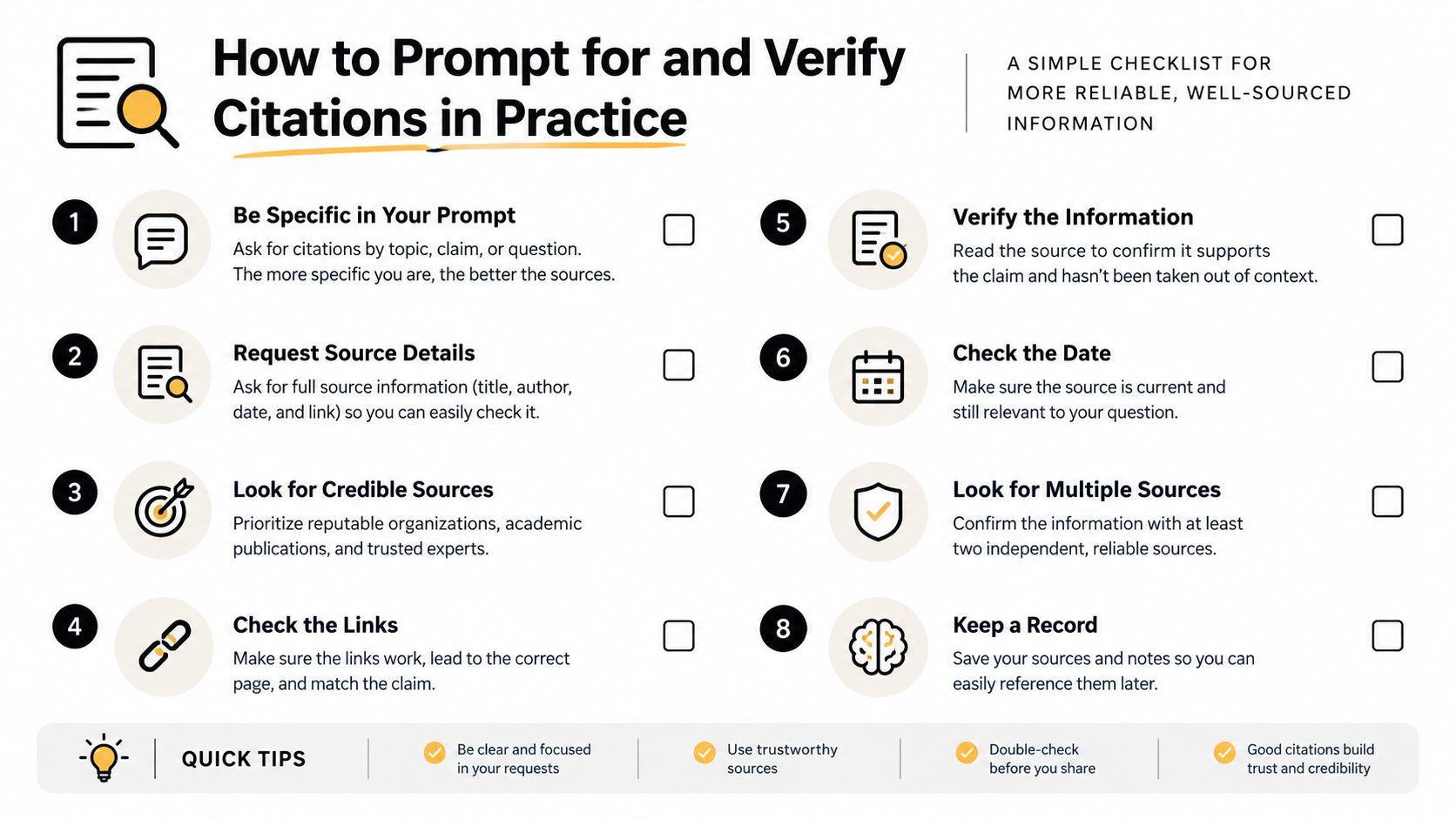
Use a checklist, not memory.
Ask clearly for sources
A prompt like “Use current web sources and include linked citations for each substantive claim” gives the reviewer something concrete to inspect.Open every cited page
Don't stop at the source card. Visit the page and confirm it exists, loads, and matches the title shown.Match claim to passage
Check whether the source supports the sentence it was attached to. A real page can still be a weak or misleading citation.Check publication date and freshness
If the answer makes a time-sensitive claim, verify that the source date fits the statement.Log domain and page type
Teams often learn more from the source mix than from a single citation event.
A short tracking template helps:
| Check | Pass condition |
|---|---|
| Page exists | URL resolves to a real page |
| Claim support | Source text matches the answer claim |
| Date fit | Publication timing makes sense |
| Attribution clarity | It's obvious why this page was cited |
For teams building ongoing workflows, there are several ways to record this. Manual spreadsheets work for small prompt sets. Prompt testing platforms can help with larger audits. This guide to brand monitoring for AI results outlines one way to structure that kind of review process across repeated prompts.
What Citations Mean for Brand Visibility and Measurement
For reporting, the key mistake is treating citation presence as the whole visibility story. It isn't. Citation data is useful because it is inspectable. It is not the same thing as total brand presence in answers.
A 2026 analysis of 1.4 million ChatGPT prompts found that ChatGPT cited about 49.98% of the URLs it retrieved, and the same study reported sharp source-type differences. Standard web search results were cited 88.46% of the time, while news content was cited 12.01%, Reddit 1.93%, YouTube 0.51%, and academic sources 0.40%. It also found that ChatGPT pulled an average of about 16.57 cited URLs and 16.58 non-cited URLs per prompt, which shows retrieval and citation are related but not identical steps, as reported in Ahrefs' analysis of why ChatGPT cites pages.
What to measure
That finding changes how teams should read citation logs.
A clean measurement set usually includes:
- Brand mentions: whether the brand appeared in the answer at all
- Cited appearances: whether a visible linked source was attached
- Source mix: what kinds of domains and page types were cited
- Prompt-level patterns: which prompt classes produced citations versus uncited mentions
That gives a more stable picture than a single “AI visibility” number.
What a citation can and can't tell you
A citation can show that a page was surfaced and attributed in a tested response. That's valuable. It can support content audits, competitive reviews, and prompt-set comparisons.
It can't, by itself, prove that the page is broadly visible across sessions, that the brand “won” a category, or that the cited source caused the mention. We don't know that.
For measurement, citations are best treated as auditable evidence points, not as a full theory of visibility.
Teams tracking these patterns over time often need a place to store prompts, outputs, citations, and brand mentions together. This overview of AI citation tracking is one example of how that reporting layer can be organized.
Practical Next Steps for SEO Teams Working With Citations
The strongest habit to build is simple. Separate mention, citation, and verification into three distinct checks. When those get blended together, reporting quality drops fast.
A workable operating routine
A short recurring process can serve as a starting point.
- Audit page structure: Move the clearest definition, comparison, and supportable claim into stronger on-page positions.
- Run prompt sets intentionally: Test informational, comparative, and transactional prompts separately rather than treating all prompts as one bucket.
- Verify every citation manually: Check the page, the claim match, and the date before adding any citation to a report.
- Log what was observed: Write that a page was cited, a domain was surfaced, or a brand was mentioned. If the mechanism behind that outcome is unclear, say we don't know.
What to skip
Skip claims that can't be defended with evidence. Skip broad statements about one model “favoring” a source type. Skip the assumption that a citation equals endorsement or accuracy.
Shortcuts are tempting here because the interface looks tidy. The underlying evidence often isn't.
A careful team can still get a lot of value from ChatGPT citations. They are useful for tracing visible source use, spotting structural content issues, and building more defensible AI visibility reporting. They just need to be handled like evidence under review, not like final truth.
That mindset is probably the most durable advantage available right now.