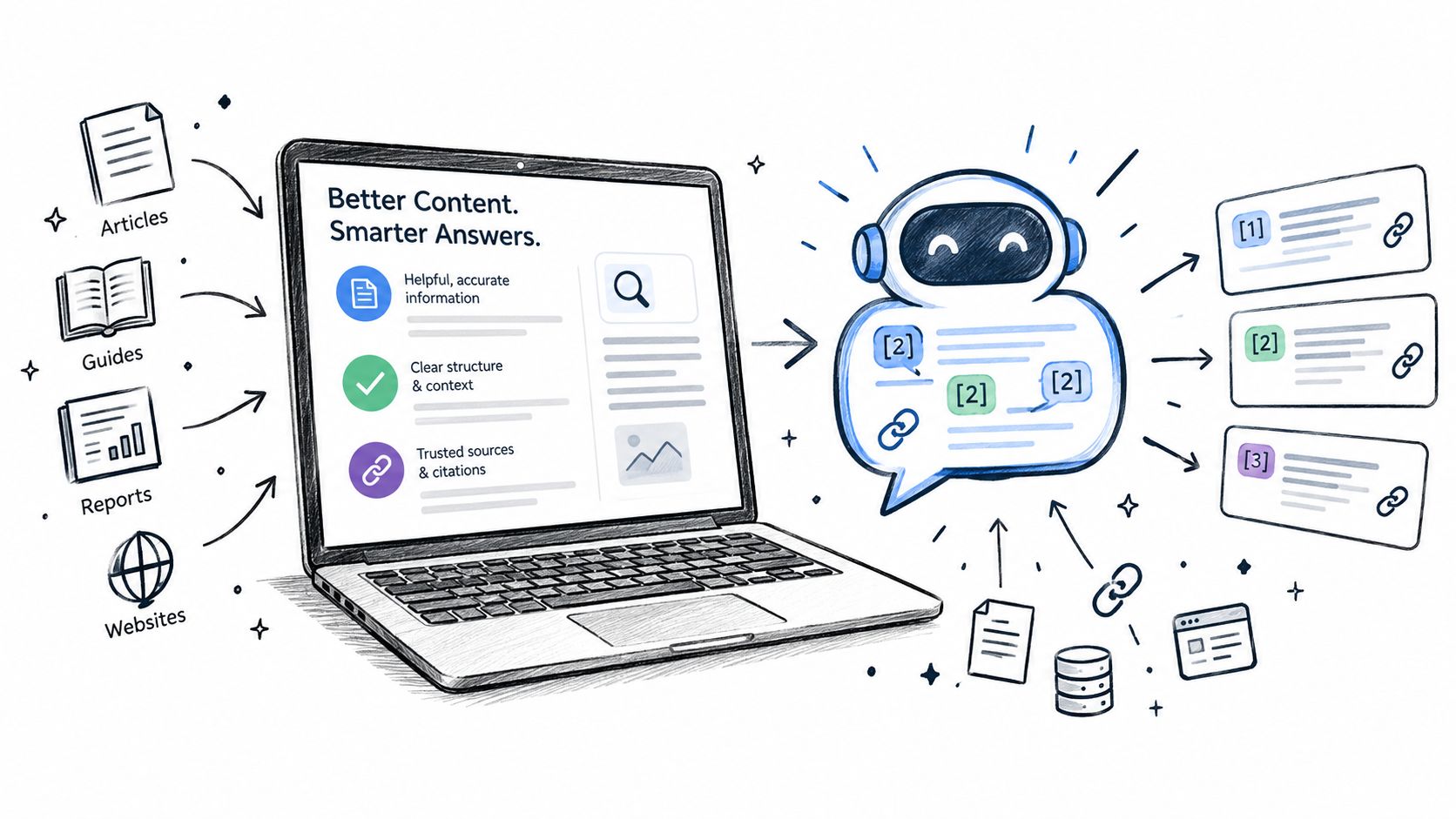
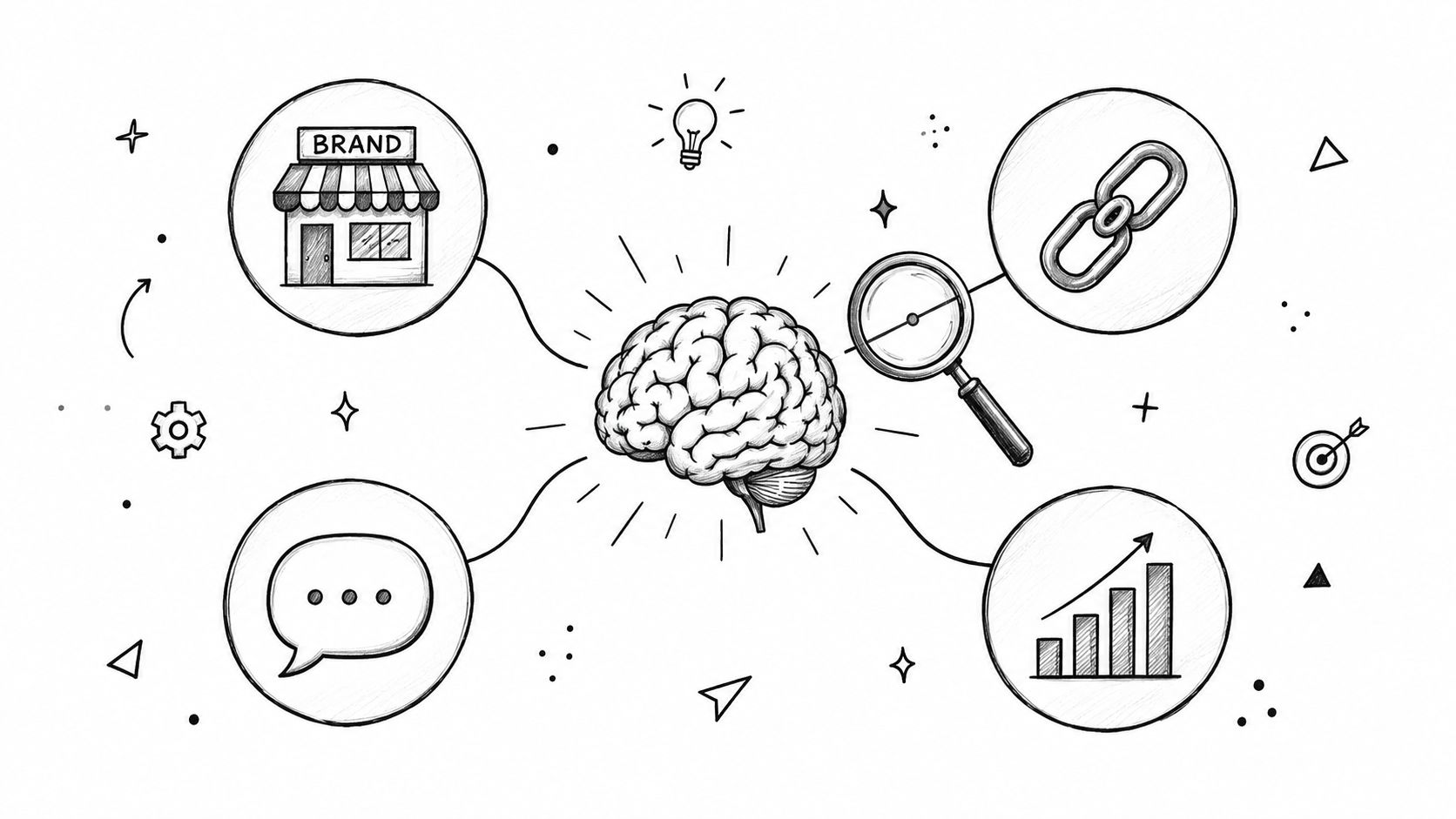
A marketer types the brand name into ChatGPT, Perplexity, or Google's AI Overviews and sees other companies instead. That moment feels personal, but it usually points to a broader problem. The brand may still rank in classic search, yet it is missing from the answers buyers read.
That gap matters because AI answer systems now surface at scale. One industry summary reports that AI Overviews appeared on approximately 48% to 50% of all U.S. Google Search queries, compared with 6.49% in January 2025. The same source says that in mixed-intent datasets, AI Overviews can appear on roughly 15% to 25% of searches, with much higher coverage in informational-heavy panels, which makes visibility in AI answers a separate measurement problem from traditional SEO. Originality.ai's visibility summary
The result is simple. A team can keep winning organic sessions and still lose the conversation inside AI-generated answers. That is why llm visibility has become its own discipline, not a side note inside keyword tracking.
Why Your Brand Disappeared from AI Answers
The first clue is usually a direct search. Someone on the team asks ChatGPT, Perplexity, or Google AI Overviews about the brand, and the answer names competitors, review sites, or category leaders instead. The brand is not absent from the market. It is absent from the answer.
The problem starts before the click
Traditional SEO was built around ranking pages and earning traffic. AI answers often compress that path. The user reads the summary, gets a shortlist, and never opens a tab. That means discovery can happen without a visit, and a visit is no longer the only sign that a brand was seen.
Practical rule: if the answer changes the buyer's shortlist, the brand has already entered the decision process, even if analytics show no click.
That shift creates confusion inside teams. Content leads check rankings, but the buyer is reading a generated answer. PR teams watch for coverage, but the AI answer may rely on a mix of sources that does not match the marketing calendar. SEO alone still matters, but it no longer tells the whole story.
The deeper issue is that AI answers create a new visibility layer. A page can be useful, relevant, and public, yet still fail to show up in the answer a buyer sees. That is why many brands feel like they vanished overnight. They didn't vanish from the web. They vanished from a different interface.
What the team is actually trying to recover
The goal is not to force every prompt into a win. The goal is to understand where the brand appears, how it is described, and when a competitor is being used instead. Once that is clear, the team can separate a content problem from a measurement problem.
When that separation is missing, the wrong fixes get prioritized. A team may rewrite a homepage that was never the issue, while the gap sits in third-party mentions, comparison pages, or answer-friendly product pages. The next sections turn that confusion into a working model.
What LLM Visibility Actually Means
LLM visibility is the prompt-level presence of a brand, page, or named source inside AI-generated answers. It is not the same as rankings, impressions, or click-through traffic. It is a measure of whether a brand is named, whether a URL is cited, and how often either one appears across a defined prompt set.
The three pieces that matter
A clean way to think about it is like a stage spotlight.
- Brand naming means the AI answer says the brand out loud.
- Citation presence means the answer points to a specific URL or source.
- Prompt coverage means the brand or source appears across enough relevant questions to be measurable.
These are related, but they are not interchangeable. A page can be cited without the brand being mentioned in the answer text. A brand can be named without its own URL being cited. Both can happen across a prompt set, which is why mention tracking and citation tracking need to be separate.
A cited page does not always create visible brand exposure. The brand still has to appear in the answer text for a human reader to connect the source to the company.
That distinction is why this topic is different from classic SEO language. Brand awareness describes whether people know the company. Share of search describes branded query demand. Organic share of voice describes how much visible space a site occupies in search results. LLM visibility sits beside those ideas, but it asks a different question. Does the brand show up inside the answer the user is reading right now?
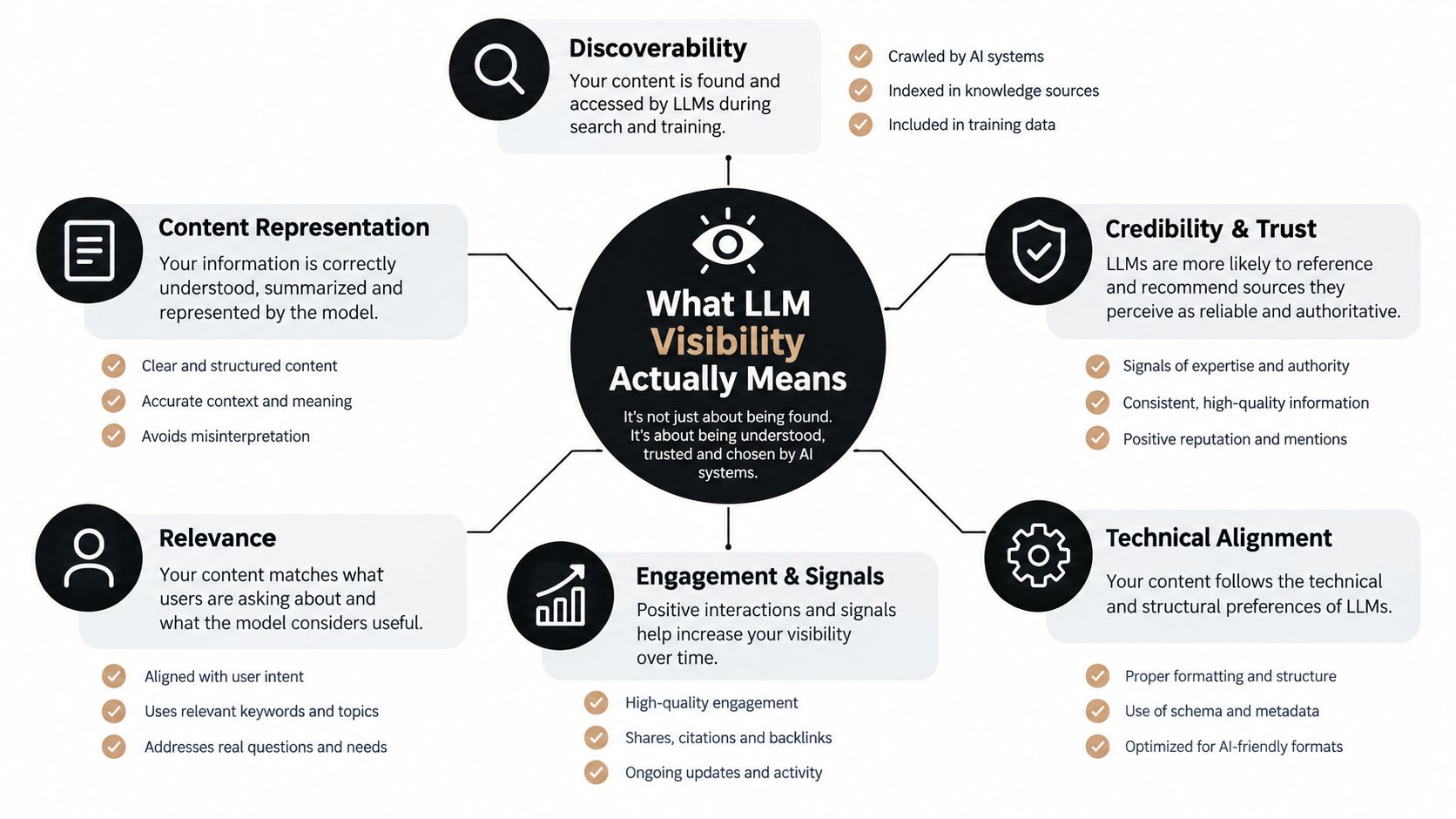
That makes the metric practical for stakeholder conversations. Instead of debating abstract “AI presence,” teams can ask which prompts name the brand, which URLs get cited, and where the answer still omits the company entirely. That is the version people can track without guessing.
LLM Visibility, AEO, and GEO Compared
These terms get mixed together because they overlap in practice. They are not the same thing. Each one measures a different layer of visibility, and each one tends to live with a different team.
The simplest way to separate them
SEO still measures ranked URLs and clicks. AEO focuses on direct answers and featured snippets. GEO looks at inclusion and citation inside generative responses. LLM visibility is broader at the brand level. It asks whether a brand or source is named or cited across a prompt set.
| Discipline | Primary Metric | Main Deliverable | Typical Owner | Key Influencing Signals |
|---|---|---|---|---|
| SEO | Ranked URLs and clicks | Organic traffic | SEO team | Content quality, internal linking, technical health |
| AEO | Direct answers and featured snippets | Answer box visibility | SEO or content team | Concise definitions, clear headings, structured content |
| GEO | Inclusion and citation in generative responses | Presence inside AI-generated answers | SEO, content, or digital PR | Source diversity, relevance, freshness, external mentions |
| LLM Visibility | Brand or source naming across prompts | Measurable brand presence in AI answers | SEO, content, PR, insights team | Mentions, citations, source mix, prompt coverage |
The same page can help more than one discipline. A concise definition paragraph can support a snippet, a generative citation, and a named answer. A strong comparison page can help a human buyer and an AI system at the same time. That overlap is useful, but the measurement still needs to stay separate.
Rule of thumb: if the question is “how many clicks did this page get,” the team is in SEO. If the question is “did the brand show up in the answer,” the team is in LLM visibility.
A practical starting point is capacity. If the team has limited time, fix the pages that already answer buyer questions clearly, then measure whether AI answers start naming those pages or the brand. The internal comparison guide at SEO vs GEO vs AEO is useful for sorting ownership, but the key decision is simpler. Start with the surface closest to buying intent, then expand measurement outward.
How AI Systems Cite Content in Practice
AI answers do not all present sources in the same way. Some show inline chips or numbered citations. Others mention a brand or URL in the prose and attach source links elsewhere. A few collapse several URLs into a footer block, which makes the answer easier to scan but harder to audit.
What readers can actually observe
Perplexity says some citations carry a small shield icon, and the icon marks a domain rated through its source review process, with labels for Government, Academic, or Trusted. That is a visible label, not an internal explanation, and it helps readers see that not every cited source is treated the same way in the interface. Perplexity's source label help page
Google AI Overviews also present reference citations as part of the answer. A 2026 arXiv paper on Google AI Overviews says each overview is accompanied by embedded reference citations presented as the evidentiary basis for the generated content, and that these citations are structural rather than incidental. The arXiv paper on Google AI Overviews citations
The visible pattern is messier than many marketers expect. Some answers cite review sites, some cite Wikipedia, some cite Reddit threads, and some lean on vendor docs or news outlets. The mix changes by engine and by prompt type. A product-comparison query often looks different from a “what is” query.
Cited and named are not the same thing
That gap matters. A source can be cited without the brand being named in the answer text. A brand can be named without its own page being the cited source. The answer can also cite one page and describe another entity more prominently.
The safest way to read that behavior is as two separate outcomes. One is source inclusion. The other is visible brand presence. The internal tracking guide at AI citation tracking is relevant here because teams need to log both, not just one. If they only count links, they miss the brand exposure problem. If they only count brand mentions, they miss the source footprint.
Measuring Brand Presence in AI Answers
The best measurement setup is a prompt set, not a vanity score. A team needs real questions from buyers, support logs, sales calls, and category research, then it needs to run those prompts across the major surfaces the brand cares about. The goal is to capture a repeatable baseline, not a perfect truth.
A workable prompt set
A practical starting set is 30 to 100 real customer questions grouped by intent. Some prompts should ask for comparisons. Some should ask for definitions. Some should ask for recommendations. That mix matters because AI answers vary with the question shape.
A simple logging sheet can capture the basics:
| Metric | Definition | Formula | What It Tells You |
|---|---|---|---|
| Mention rate | How often the brand appears at all | Brand mentions divided by prompts tested | Whether the brand shows up in the answer set |
| Citation rate | How often a brand-owned URL is referenced | Brand-owned citations divided by prompts tested | Whether the brand's own pages are used as sources |
| Share of voice | Brand mentions divided by total mentions in the prompt set | Brand mentions divided by all brand mentions in the set | How visible the brand is relative to peers in that sample |
| Ghost citation rate | How often a competitor's page is used to describe the brand | Competitor-owned citations used to describe the brand divided by prompts tested | Where the answer is borrowing someone else's framing |
The internal monitoring guide at brand monitoring for AI results fits naturally into this workflow. The important part is consistency. The same prompts need to be reused over time so the team can see movement.
Tools help, but the process matters more
Manual spreadsheets can work at the beginning. So can dedicated tools like Otterly, Profound, Peec, or Semrush's AI toolkit, as long as the team remembers that each product uses its own prompt library. The AI Search Signals publication also tracks brand mentions and citations in AI answers, so it can sit alongside other monitoring options rather than replacing them. A tool is only useful if the prompt set is stable and the logging is disciplined.
There is one honest limitation. No universal benchmark exists, so internal baselines matter more than borrowed averages. Teams should compare themselves against their own earlier captures, not a generic industry number. That keeps the metric grounded in the actual category the brand competes in.
Practical Actions to Improve AI Visibility
The fastest wins usually come from clarity, not trickery. AI answer systems need material they can quote cleanly, identify unambiguously, and connect to a known entity. That means the work sits in three places, on the page, off the site, and in the broader content ecosystem.
Page-level work that makes source use easier
Start with the pages already closest to buyer questions. Add a concise definition paragraph near the top. Include FAQ blocks where real objections show up. Use comparison tables where people are choosing between products. Tighten author bios, publication dates, and entity names so the page reads like a finished source, not a draft.
Structured data can help with clarity, but it is not magic on its own. A page that depends on JavaScript to render critical content is harder to read consistently. A page that buries the answer under marketing copy is also harder to use. The practical goal is simple. Make the main point legible without forcing the reader, or the model, to hunt for it.
Off-site work that shapes who gets cited
AI answers often pull from places people already trust in the category. That includes review sites, news outlets, Reddit threads, and in some cases Wikipedia entries where they are warranted and policy-appropriate. The point is not to flood the web with mentions. It is to appear in the places that already sit inside the answer ecosystem.
Distribution work that earns references
Original data helps because it gives other publishers a reason to cite the brand. Named frameworks help because they make the idea easier to repeat. Benchmarks help when they are clearly sourced and updated. Each of those assets can create more durable third-party references than another generic blog post.
Practical caution: tactics like llms.txt, schema-only optimization, and bulk Reddit posting are widely discussed, but the published evidence behind them is thin or inconsistent. Teams should treat them as experiments, not assumptions.
What Most LLM Visibility Coverage Gets Wrong
A lot of coverage still talks about AI visibility as if it were one surface with one playbook. That framing hides more than it reveals. Different engines show different source lists for the same prompt, and one static benchmark rarely describes the experience a buyer has across ChatGPT, Perplexity, Gemini, Claude, or Google AI surfaces.
The blind spots are bigger than the dashboard
The first blind spot is engine variation. A prompt can surface one set of sources in one product and a very different set in another. Any metric that blurs those together becomes less useful, not more.
The second blind spot sits outside public measurement. A 2026 analysis estimated that 8-14% of brand-relevant LLM queries in Q1 2026 occurred on local, on-prem, or air-gapped infrastructure that visibility platforms cannot see, and that the blind-spot share is growing faster than total LLM query volume. That means public-model reporting covers only part of the picture. Presence.ai's blind-spot analysis
The third blind spot is causation. A brand can appear more often after a Reddit push, but that observation alone does not prove the Reddit push caused the change. The same caution applies to dashboards that claim more than the underlying data can show. Correlation is useful. It is still not proof.
What a sane reading looks like
The strongest approach is cautious. Track what appeared, where it appeared, and what changed after a content or PR move. Do not assume the reason without evidence. Do not treat one engine as a proxy for all the others.
That caution matters because visibility work can get expensive fast. If the team overstates what the tools can see, it may optimize the wrong surface and call it strategy. If it stays grounded in observed answers, it can keep the work aligned with what buyers encounter.
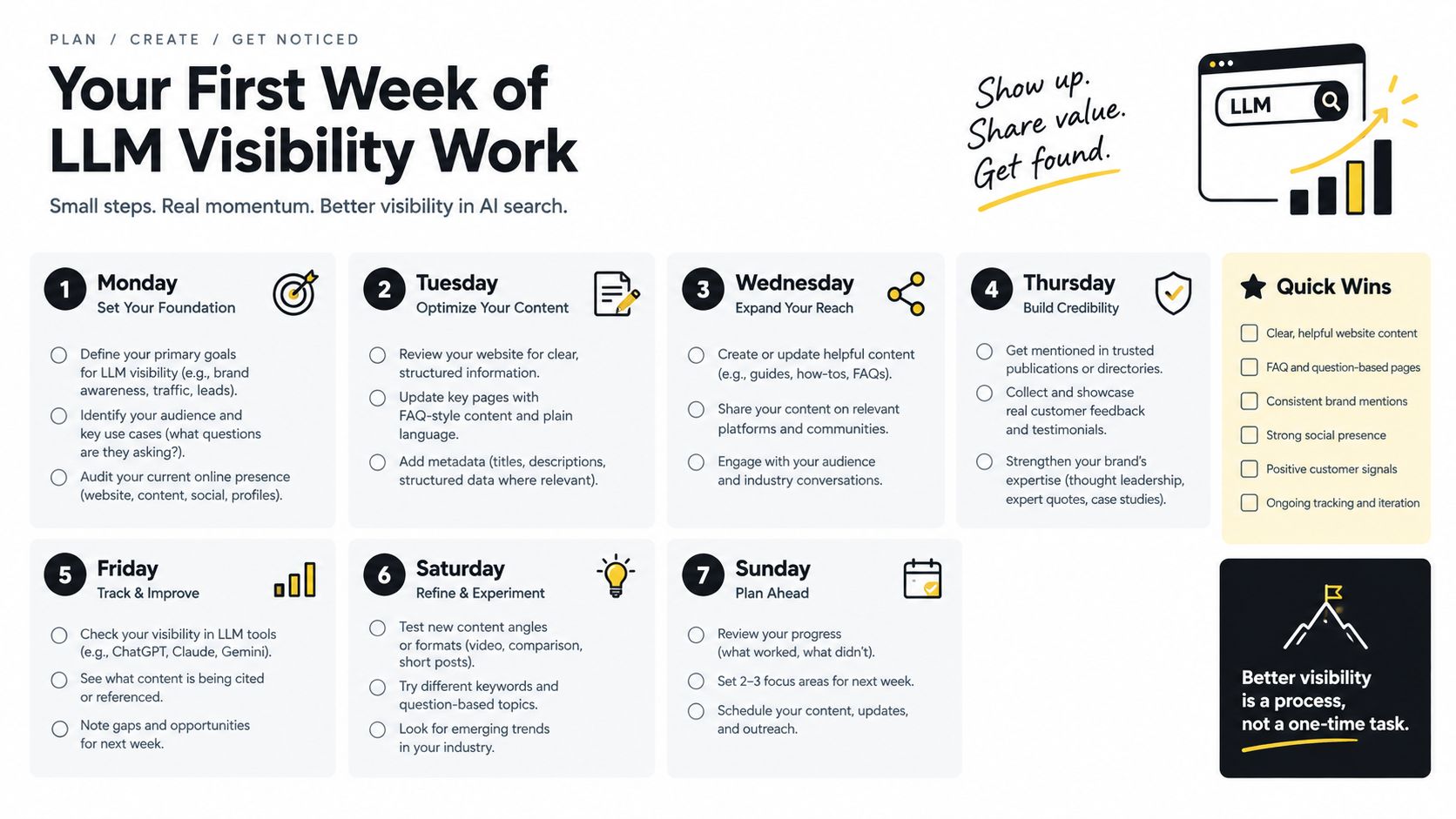
Your First Week of LLM Visibility Work
A single SEO practitioner can get a meaningful baseline in one week without new tooling. The work starts with real prompts and ends with a first round of fixes. The aim is not completeness. It is a usable snapshot.
A simple seven-day run
- Days 1 and 2: Collect 30 to 50 real prompts from sales calls, support tickets, and search queries. Deduplicate them into a working set.
- Day 3: Run the prompts in ChatGPT and Perplexity, then log brand mentions, cited URLs, and source domains in a shared sheet.
- Day 4: Repeat the same set in Gemini, then mark where the answer changes by engine.
- Day 5: Map cited URLs to existing pages and flag missing definitions, FAQ blocks, or comparison content.
- Days 6 and 7: Publish one rewritten comparison page and send three earned-mention outreach emails, then capture the prompts again to record the baseline shift.
The simplest check is this. If the brand is missing from the answer, the issue may be content coverage. If the brand is present but the answer cites someone else, the issue may be source footprint. If the brand is named but described poorly, the issue is positioning in the broader web conversation.
The open question is durability. No published dataset confirms how long any visibility gain persists, so weekly recapture stays necessary. That uncertainty is not a weakness in the process. It is the reality of a channel that changes with prompts, sources, and engine behavior.
If the team wants to make llm visibility measurable this quarter, the next move is straightforward. Build a prompt set from real buyer questions, capture a clean baseline in the major AI surfaces, and fix one page plus one earned-mention gap before the week ends.