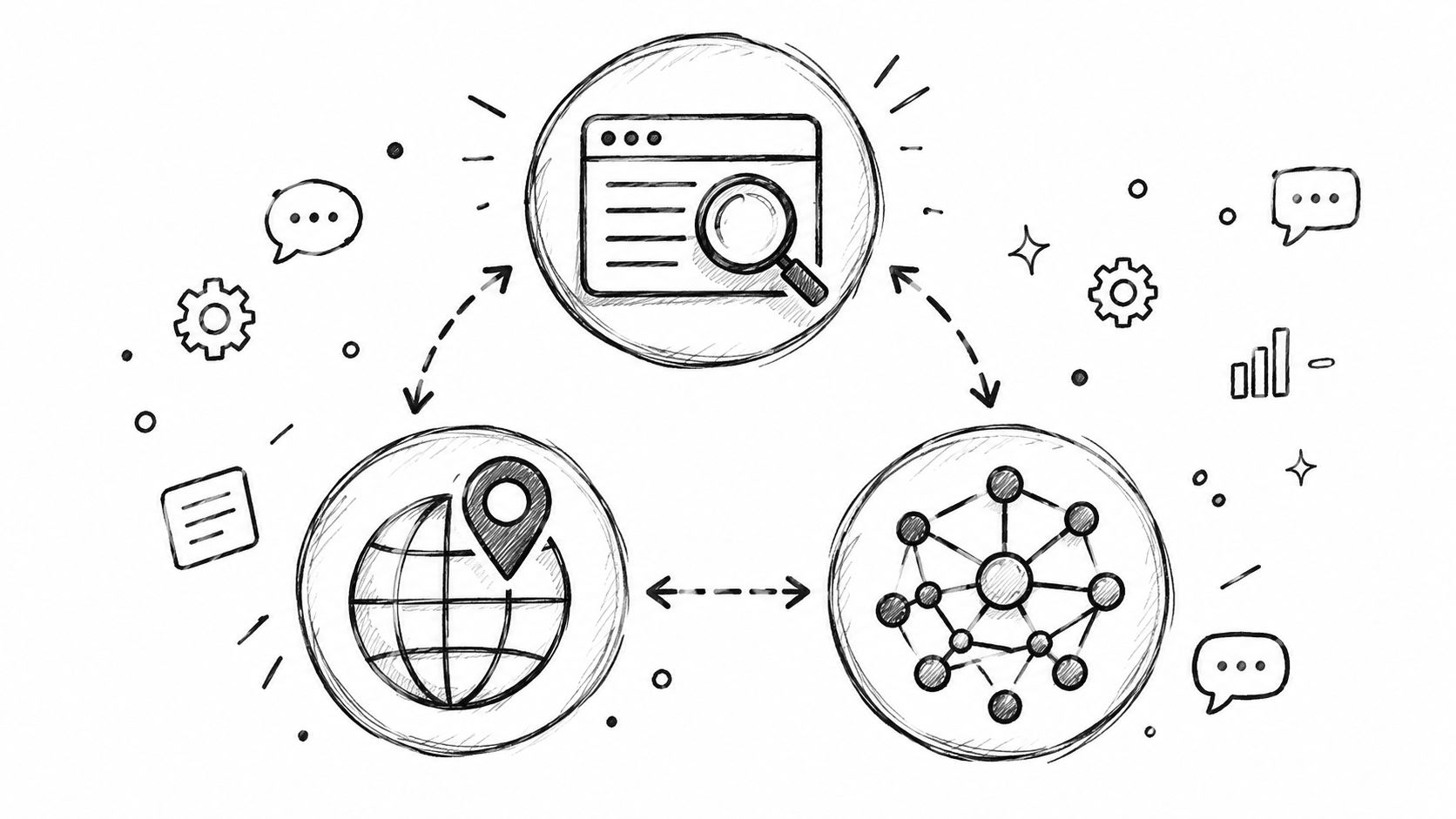
The common advice is too neat. It says SEO, GEO, and AEO are three names for the same job. The evidence points the other way. They map to three different outcomes, and teams that blur them end up measuring the wrong thing.
Traditional search still asks a familiar question, can a page rank. AI answers ask two different questions, was the brand included in the answer, and was it cited as a source. Those are not the same outcome, and the overlap between them is uneven enough that one KPI cannot cover all three.
| Term | Main outcome | What success looks like | What we should measure |
|---|---|---|---|
| SEO | Ranking | A page appears in the organic results and earns clicks | Organic position, impressions, clicks |
| AEO | Answer inclusion | A brand or page is surfaced as a direct answer | Mention in the answer, snippet inclusion |
| GEO | Citation share | A source is cited inside a generative response | Citation presence, citation frequency, source mix |
That distinction matters because the market still uses the labels loosely. Some explainers collapse them into one idea, while others split them into ranking, direct answers, and generative citations. The practical test is simpler. We should ask which outcome a team wants, which surface the buyer uses, and which report can prove it.
Why SEO GEO and AEO Are Not the Same Job
The labels sound interchangeable because they all sit inside search. The work behind them is different. SEO grew up around indexed pages, click-through traffic, and measurable ranking mechanics. GEO and AEO describe visibility inside AI answer surfaces where the result may be a mention, a citation, or a short synthesized response instead of a classic result list.
That difference is not cosmetic. It changes what teams optimize for and what they report upward. A ranking report can show progress even when an AI answer never mentions the brand. A citation report can show the brand was cited even when the page never reaches the top of organic search. We need to stop treating those as substitutes.
The oldest job is still ranking
SEO's historical foundation goes back to the 1990s, when search engines such as AltaVista, Lycos, and Excite leaned on keyword frequency, title tags, and meta tags, which made keyword stuffing common. Google's launch in 1998 changed that by introducing PageRank, a link-based system that shifted authority signals toward backlinks and established the idea that credibility could be inferred from inbound links. That history is the cleanest reminder that SEO is a ranking discipline first. It was built for web index ordering and click-through traffic, not for citation inside generated answers. The historical account is laid out in this SEO history overview.
The newer job is visibility inside answers
The newer labels are much younger. Generative Engine Optimization was formalized in research associated with Princeton, Georgia Tech, the Allen Institute for AI, and IIT Delhi, first published on 16 November 2023 and later presented at KDD 2024 in Barcelona. Industry summaries place AEO as a distinct discipline in 2024 to 2025, alongside mainstream adoption of ChatGPT and Google AI Overviews. That timeline matters because it shows these are recent reframings, not long-standing synonyms. The historical framing is summarized in this search history and terminology piece.
Practical rule: if a report only tracks rankings, it is tracking SEO. If it only tracks whether the brand appeared in an AI answer, it is tracking AEO. If it tracks whether the brand was cited, it is tracking GEO.
The measurement problem starts here. Teams that keep one blended dashboard usually miss one of those outcomes. That is why the rest of this brief separates them.
What Each Term Actually Means Today
The cleanest way to define the terms is by the outcome each one measures. SEO tracks ranking in traditional search and the clicks that follow. AEO tracks answer inclusion, whether a brand appears in a direct response. GEO tracks citation share, whether a source is named inside a generated answer.
SEO is the ranking discipline
SEO remains the discipline most already report on. It is about page-level and site-level signals that help a result appear in traditional search and drive clicks. That report structure fits a search results page. It does not fully describe what happens inside an AI-generated answer.
AEO and GEO are answer-era labels
AEO is direct-answer visibility. The page or brand is surfaced in a response that answers the query outright. GEO is citation visibility. The brand is named as a source inside a generative response. The two overlap in practice, but they are not the same measurement.
The difference matters because the user sees different things on different surfaces. A search result, an answer box, and a cited source do different jobs. For a broader explanation of how answer systems assemble those responses, see how ChatGPT gets its information.
The term GEO is generally traced to a 2023 academic preprint that proposed measuring source visibility in generated answers. That framing treats citation as the object of optimization, not only ranking. The terminology overview is summarized in this GEO and AEO explainer.
The short version stakeholders can use
- SEO: rank in search results and earn clicks.
- AEO: appear as the direct answer.
- GEO: get cited in the generated response.
That split is useful because it keeps the metrics separate. A ranking report can look healthy while answer inclusion stays low. Citation share can also move differently from both. Reports that blend them hide that difference.
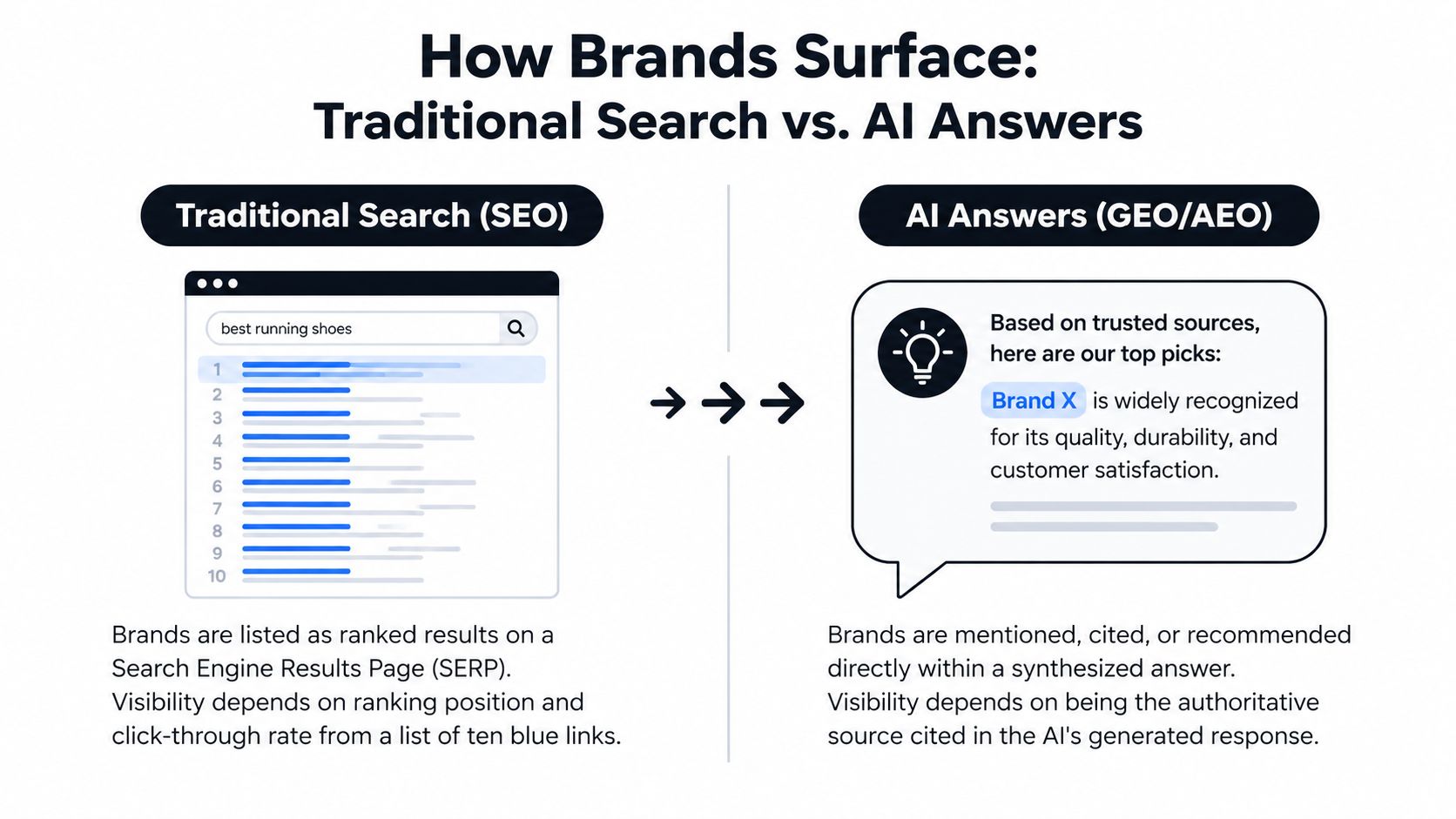
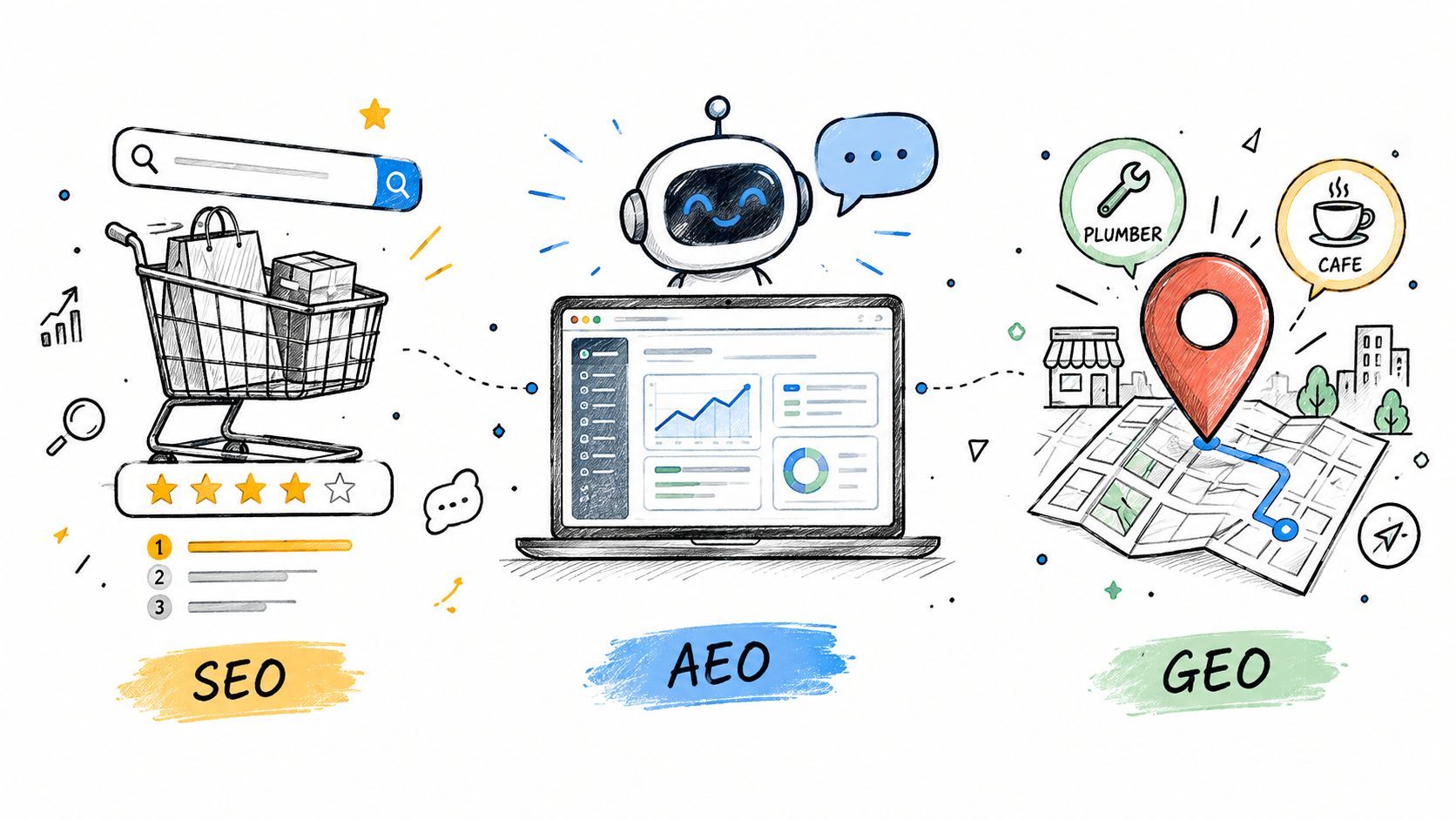
The image below is useful for internal training or a deck, because it shows the old model and the new one side by side.
Search is now hybrid, so one label no longer covers every surface. Teams need terms that map to the metric being measured, not a broad catchall for AI visibility.
How Traditional Search and AI Answers Surface Brands Differently
Traditional search and AI answers surface brands through different measurable outcomes. Search shows whether a page ranks. AI answers show whether a brand is included in the answer layer, and whether it is cited. Those are separate signals. Treating them as one metric hides what is happening.
The products themselves also behave differently. ChatGPT, Claude, Gemini, Perplexity, and Google AI Overviews can mention or cite sources in a response, but that does not make their outputs equivalent. A brand can appear inside the answer layer without ever earning a classic result-page position. That matters because visibility now splits across ranking, answer inclusion, and citation share.
AI answers can cite sources far beyond the first organic set. That breaks the assumption that ranking and citation are the same problem.
The overlap data makes that split visible. A BrightEdge summary reported that 54.5% of AI Overview citations came from pages that also rank organically, while only 16.7% came from first-page results. Most of the remainder came from positions 21 to 100. That is a weak fit with the old page-one model. The overlap summary is in BrightEdge's AI search insight page, and the wider debate is covered in this GEO and AEO coverage note.
A comparison that SEO teams can actually use
| Surface | What we observe | What the user sees | What matters most |
|---|---|---|---|
| Traditional search | A result appears in rankings | Blue links, snippets, ads | Position and click-through |
| Direct answer surface | A response includes the brand or page | An answer box or spoken response | Inclusion in the answer |
| Generative citation surface | A source is cited inside the response | A cited source or reference | Citation presence and source share |
Google AI Overviews also surface outside the classic first page. That same overlap summary showed that many citations came from pages already ranking somewhere in organic search, while a smaller share came from first-page results. The pattern is different from the assumption that page-one rankings map neatly to AI visibility.
ChatGPT is not a universal citation engine
ChatGPT does not cite every answer. A published explanation says citations appear when the browse tool is invoked, typically for current, source-requested, or recency-dependent queries, and cited sources come from the live retrieval layer rather than the model's internal knowledge alone. The same query can therefore produce a response with a citation, a response without one, or no citation at all, depending on the request. The explanation is in this ChatGPT citation guide.
The operational takeaway is direct. Traditional search, answer inclusion, and citation share are separate surfaces. They need separate reporting.
Signals and Formats That Were Observed Alongside AI Citations
The most useful question is not whether AI answers are “better” or “worse” than search. It is what content appeared alongside citations. The data points to a source-ecosystem problem, not just a page-optimization problem. In other words, the brand is competing with articles, videos, reference sites, and platform properties, not only with other brand pages.
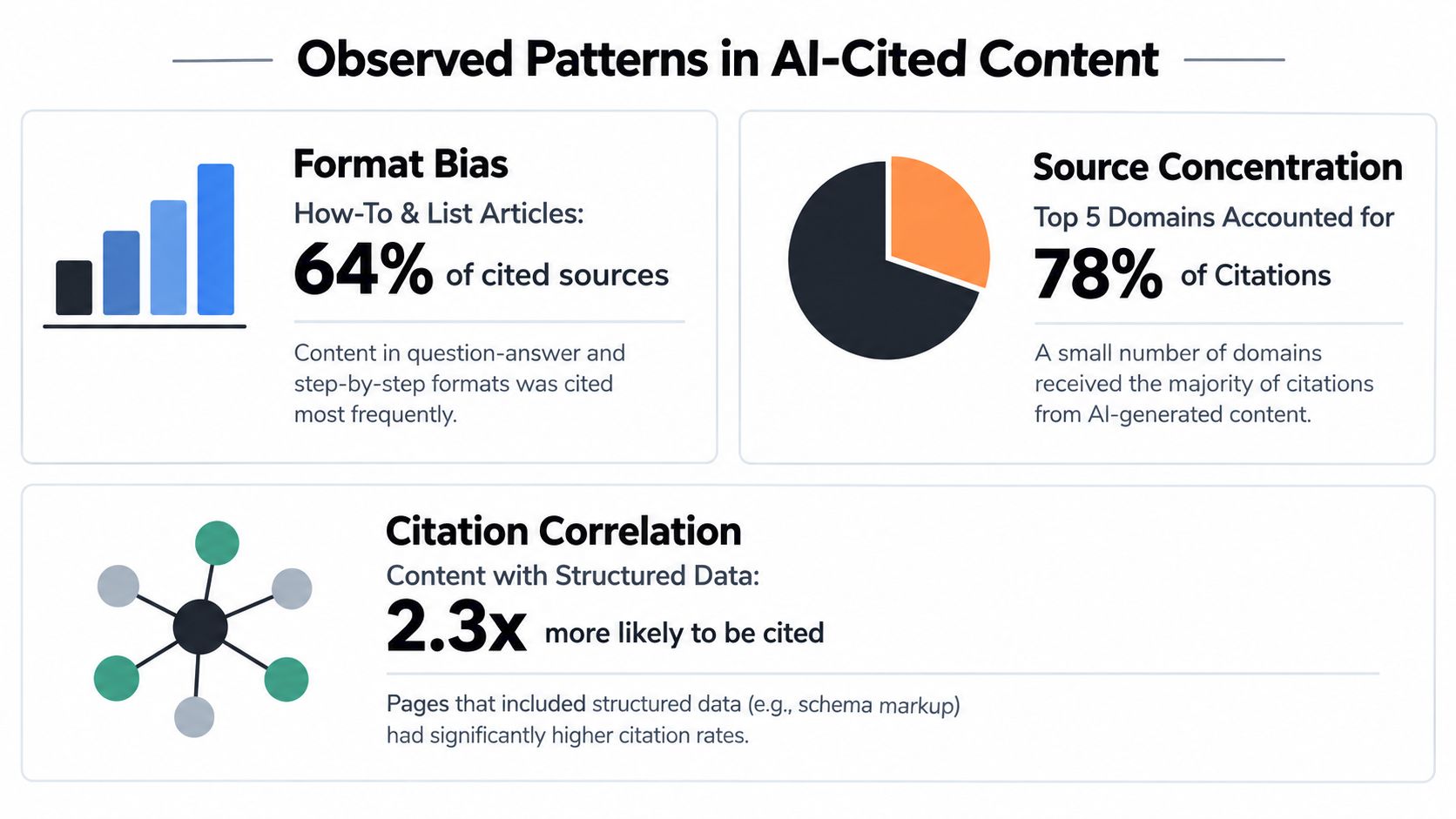
Format bias showed up in the cited set
A 2026 citation breakdown reported that listicles were the most cited format in Google AI Overviews at about 26% of daily citations, ahead of news articles at about 15% and how-to guides at about 12%. A separate Q1 2026 analysis, summarized in the same source stream, described content formats as a real factor in what was cited. The point for teams is not to chase a single format blindly. It is to recognize that format can move with citation visibility. The cited-format summary is in this AI Overviews citation analysis.
The source set is more mixed than many SEO teams expect
Another 2026 citation breakdown reported YouTube at about 23.3% of all AI Overview citations, Wikipedia at about 18.4%, and Google.com at about 16.4%. A separate summary said Wikipedia, YouTube, Google's own properties, Reddit, and Amazon accounted for 38% of all citations. Those numbers point in the same direction. AI visibility is often shaped by source diversity, not only by the quality of one brand page. The source concentration summary is here.
The practical issue is not whether a page is “optimized enough.” The issue is whether the topic has enough citable breadth across the ecosystem.
What to test next without overclaiming
- List-style content: test whether structured comparison pages are more often surfaced than narrative brand pages.
- How-to content: test whether task-oriented pages appear more often when the query asks for steps.
- Third-party mentions: test whether coverage on reference and community sites moves with AI visibility.
- Video assets: test whether YouTube presence appears alongside product or explainer queries.
AEO and GEO work best when teams stop treating the website as the only source of truth. That does not mean abandoning SEO. It means widening the source map.
The internal workflow for this kind of monitoring is straightforward. The AI Search Signals publication has a practical note on AI search problems, which fits well with the evidence here because the recurring problem is not just ranking loss, it is loss of visibility across multiple answer surfaces.
Measuring Ranking Answer Inclusion and Citation Share Separately
One dashboard is too blunt. SEO teams need three KPIs because the outcomes are different. Ranking measures organic position. Answer inclusion measures whether the brand appears in a direct response. Citation share measures how often the brand is named as a source inside generative answers. If one moves and the others do not, the blended number hides the shift.
That separation matters because overlap is inconsistent. As noted earlier, industry estimates on how often AI Overview citations line up with organic rankings range widely, which shows the two systems are not aligned in a stable way. The practical conclusion is simple. Ranking reports cannot stand in for citation reports, and citation reports cannot explain organic traffic on their own.
What to measure for SEO GEO and AEO
| Outcome | Primary KPI | How we check it | When it matters most |
|---|---|---|---|
| SEO | Organic ranking and clicks | Search console and rank tracking | When organic traffic is still the main goal |
| AEO | Answer inclusion | Query testing across answer surfaces | When buyers ask direct questions |
| GEO | Citation share | Logged citations and source mentions | When the goal is visible sourcing in AI responses |
The decision rule is simple
If the business depends on traffic, ranking still matters first. If the business depends on being named in the answer, answer inclusion matters more. If the business depends on being cited as evidence, citation share is the right KPI.
Measurement rule: track the surface that matches the business outcome, not the acronym that sounds newest.
A useful next step is to separate prompt tracking from search reporting. Run the same query set over time, log whether the brand was mentioned, cited, or ignored, and compare that with organic rankings. That gives a clearer read on whether a page is gaining visibility in search, in answers, or in both.
Share-of-voice analysis can help too, especially when several entities appear in the same answer set. The AI Search Signals guide on how to calculate share of voice is useful because citation share only becomes meaningful when it is tracked against a consistent prompt set.
Use Cases That Show When to Prioritize Each Approach
The right focus depends on the buyer's job, not the acronym. Different markets surface different content types, and the useful metric changes with them. A retailer does not need the same measurement stack as a SaaS company, and neither looks identical to a local service business.
Ecommerce
Ecommerce teams usually care about product discovery, comparison, and source trust. When AI answers surface a buying question, citation share can matter as much as ranking because the user may never reach the category page. The observed pattern that listicles and reference-style sources appear often alongside AI citations suggests that comparison content, not just product pages, deserves attention.
SaaS
SaaS buyers often ask about alternatives, features, and implementation details. That makes answer inclusion and citation share more useful than raw keyword rank for some top-of-funnel topics. If a brand page is absent but a third-party guide is cited, the team still learns something useful. It means the topic is visible, but the source set is broader than the company domain.
Local services
Local service businesses still need SEO because proximity, map visibility, and business accuracy remain central. But AI answers can pull in community sources, directory mentions, and platform-owned properties, so a local brand can't rely on its homepage alone. The main check is whether the business details appear consistently across the sources that AI systems surface.
The right question is not “Which acronym wins.” It is “Which surface matches the buyer's question.” That framing keeps the work practical and reduces noise from terminology debates.
Choosing Your Focus Across SEO GEO and AEO
The best first move depends on where the brand is already strong. If organic search still drives meaningful demand, SEO remains the base layer. If the market is shifting toward direct answers, then AEO deserves attention. If the category is getting cited inside generated responses, GEO becomes the clearest visibility test.
The ranking data and overlap data argue against a single-metric strategy. Traditional search and AI citation behavior are close enough to share some signals, but not close enough to merge reports. A strong organic page can still be absent from an AI answer. A cited source can still sit outside the top organic set. That means the team should choose the KPI from the business outcome, then build the content around that outcome.
A practical 30-day checklist
- Audit the current surface: identify which pages rank, which prompts mention the brand, and which responses cite it.
- Separate the reports: keep organic rankings, answer inclusion, and citation share in different views.
- Test citable passages: add evidence-rich sections, concise summaries, and source-ready language where appropriate.
- Broaden source coverage: look beyond the brand site to third-party mentions, reference sources, and video where relevant.
- Document the prompt set: keep the same questions in each run so changes are observable, not guessed.
We do not know a single universal formula that works across every category. The evidence is still mixed, the overlap is still unstable, and the labels are still used inconsistently. That is exactly why a skeptical approach is safer than a hype-driven one.
For teams choosing where to begin, the sequence is straightforward. Keep SEO reporting intact, add answer inclusion checks for the queries buyers ask, and measure citation share where the category is already appearing in AI responses. A focused team can start that process this week, using the same prompt set and a separate report for each outcome.