
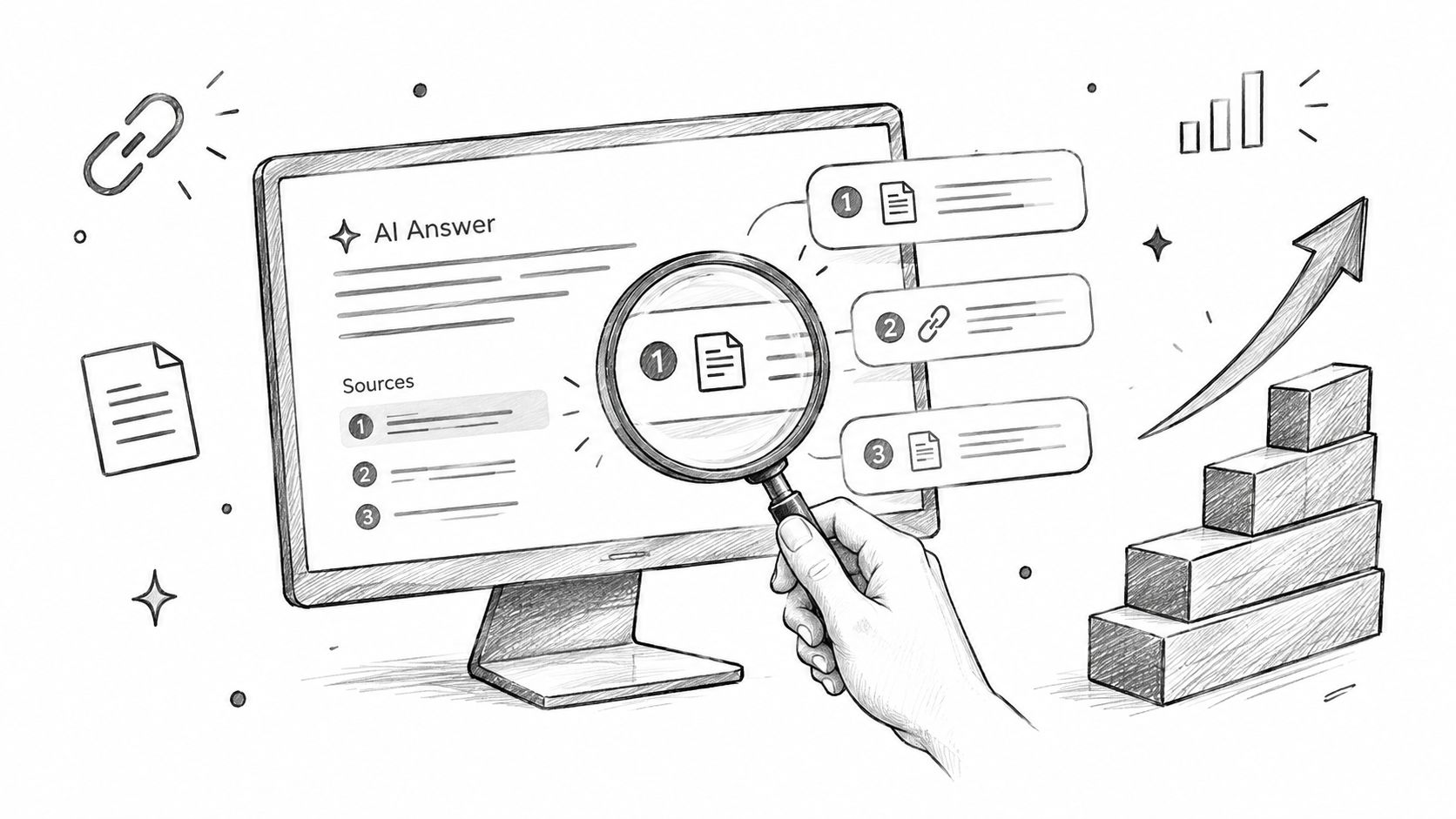
A brand can rank well in Google and still vanish from a Perplexity answer. An SEO lead sees a competitor cited twice, checks the numbered sources, and finds no mention of the company that owns the strongest traditional result. The gap is frustrating because the visible output looks simple, while the causes are difficult to isolate.
That problem now matters to both in-house and agency SEO teams. Perplexity grew from 3,000 queries on its first day to 780 million monthly queries by May 2025, according to reported Perplexity usage statistics. Later estimates on the same page place monthly volume around 1.2 to 1.5 billion queries, but those estimates shouldn't be treated as an audited platform metric.
The practical question isn't whether a brand can “rank” in an abstract AI system. It's whether the brand's pages, authors, and external mentions appear in answers for real customer queries. The tactics are still maturing, and some widely repeated advice has little public evidence behind it.
This guide separates observable behavior from speculation. It gives SEO teams a defensible audit, measure, act loop that can be run with ordinary research and reporting processes.
The Moment a Brand Disappears From an AI Answer
The first useful Perplexity audit often starts with an uncomfortable result. A team enters a comparison query that mirrors a real buying journey. The answer names a competitor, cites an industry publication, and links to a review site. The audited brand has a relevant page and strong Google visibility, yet it receives no inline mention.
That result doesn't prove the competitor has better content overall. It shows that, for that prompt and response, Perplexity surfaced other sources. The distinction matters. A single answer is an observation, not a permanent visibility score.
Perplexity launched its public search engine in December 2022, introduced a publisher revenue-sharing program in July 2024, and added shopping and assistant features across 2024 and 2025, according to this published history of Perplexity AI. Those milestones make the platform commercially relevant, but they don't establish a stable optimization rule for every industry.
What the missing mention actually tells the team
A zero-mention result can point to several different gaps:
- Coverage gap: The site doesn't answer the exact comparison or recommendation question.
- Evidence gap: The page makes claims without clear supporting sources.
- Entity gap: Independent pages discuss the brand inconsistently or barely mention it.
- Freshness gap: The relevant page looks outdated for a time-sensitive query.
- Format gap: The answer may draw from a review, forum, directory, or reference page rather than a product page.
These are working hypotheses. They need to be checked against the cited URLs and the prompt set, not converted into claims about Perplexity's internal operation.
Practical rule: Treat every answer as a recorded observation with a prompt, date, market, device context, cited URLs, and response text.
A defensible workflow begins by collecting enough comparable prompts to reveal patterns. The team should then inspect which pages appeared, what claims they supported, and where the audited brand could supply a more precise source. That process produces actions a content or digital PR team can test, rather than a vague instruction to “optimize for AI.”
How a Perplexity Response Is Built and Cited
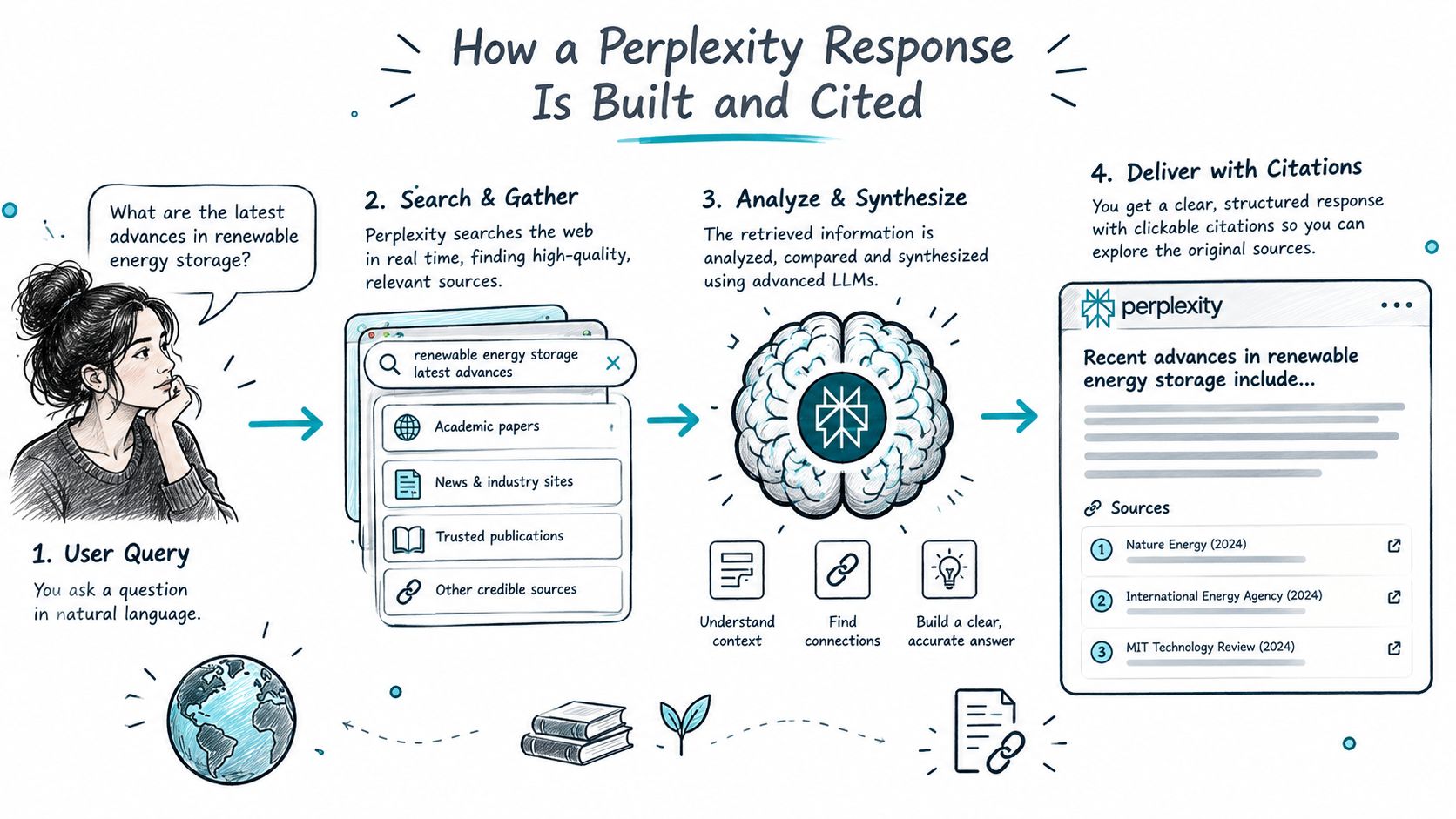
A Perplexity answer has a visible structure. Users see a synthesized response, numbered citation markers attached to parts of that response, and a sources area containing links to the webpages used for the answer. A library guide describing Perplexity's interface also notes the numbered citations and separate source list.
The interface lets a reviewer follow a claim back to a specific URL. That makes the audit more concrete than a brand mention found in an unlinked summary. The reviewer can ask whether the linked page supports the statement, whether the brand appears in the page, and whether a competitor's source offers stronger evidence.
Inline citations and source-list appearances
An inline citation supports a specific passage in the answer. A URL visible only in the sources list may have been considered relevant to the response without receiving a direct claim marker in the text. That difference affects visibility analysis.
A brand should therefore record at least three states:
- Named and cited inline: The brand appears in the answer and its source is attached to a claim.
- Cited without a brand mention: The domain supports an answer passage, but the brand isn't named.
- Listed as a source only: The URL appears in the source area without an obvious inline association.
This distinction also matters when comparing Perplexity with broader AI recommendation engine research. A source can contribute to an answer without becoming the visible recommendation.
User-facing modes change the audit context
Pro Search, Spaces, and Pages should be treated as different user contexts, not as interchangeable test labels. A prompt run in a default session and a prompt run in a research-oriented mode may produce different visible sources, answer depth, or follow-up behavior. The audit should log the mode used.
Follow-up questions deserve their own row as well. A brand absent from the first answer may appear when the user asks for alternatives, pricing context, implementation details, or regional options. That doesn't prove a general visibility gain. It shows that the query path changes the observed answer.
Where Perplexity Citations Come From
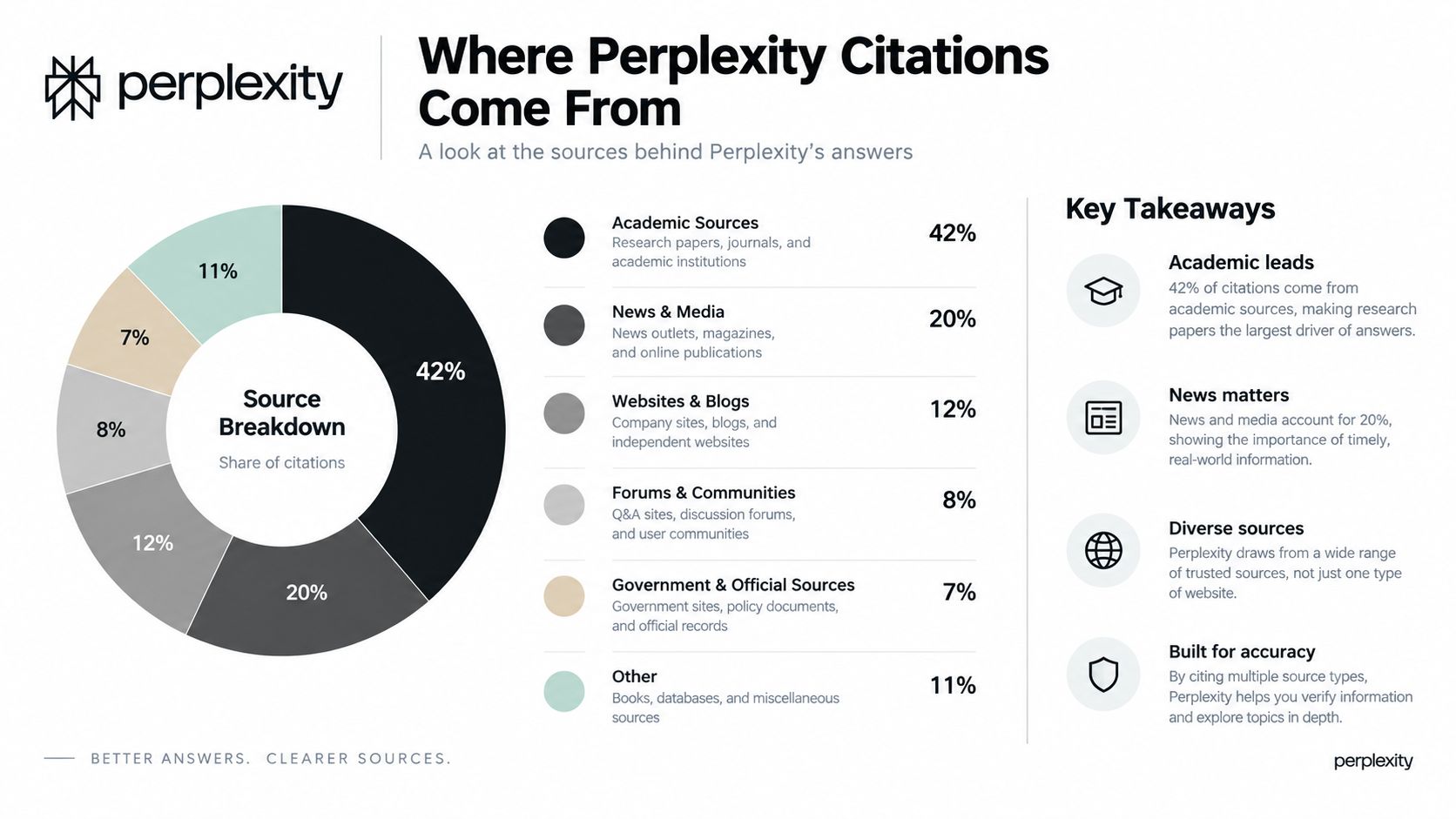
Perplexity citations don't come from one stable source category. The cited mix changes with intent. Definitions often surface reference and encyclopedic domains. Opinion and experience queries can expose Reddit, forums, or specialist communities. Time-sensitive questions can include current news and recently updated pages.
One analysis found that about 60% of Perplexity citations overlapped with Google's top 10 organic results, while roughly 40% came from outside that top-10 set, as reported by Search Engine Land's analysis of Perplexity citations. The same source reported that Perplexity averaged 5.28 citations per response. The figures describe that analysis, not a universal rule for every query.
The overlap with traditional search
Google visibility remains a useful starting point because many cited pages also appear in Google's top results. A page that has no organic visibility, no clear topical relevance, and no external recognition starts with fewer observable routes into an answer.
But the overlap isn't complete. A niche publication, forum discussion, LinkedIn page, or specialist review can appear even when the source isn't among the leading Google results for the tested query. The practical lesson is not to abandon traditional SEO. It's to expand the evidence set beyond the brand's own ranking pages.
The source mix also contains institutional authority. A Search Engine Journal comparison of AI citation patterns reported that Perplexity averaged 19.2 cited sources per answer across a large multi-engine analysis. It identified LinkedIn, YouTube, and Reddit among frequent domains, and reported that about 30% of citations were concentrated in institutional medical, government, encyclopedic, and medical publisher sources.
What this means for an audit
E-E-A-T is most useful here as an inspection lens, not a magic recipe. Review whether the page names the author, supports factual claims, states when information was updated, and connects the brand to credible third-party references. Then compare those properties with the pages Perplexity cited.
Topic and intent can change the result sharply. A SaaS comparison, a medical definition, a local recommendation, and a product troubleshooting query won't produce the same source ecosystem. Any audit that treats one source pattern as universal will create the wrong content priorities.
Perplexity Compared With Other AI Answer Engines
A brand can appear in Perplexity, Google AI Overviews, or another answer engine for the same query, yet the evidence shown to users may differ. Compare the visible response, citations, source placement, and follow-up behavior instead of inferring how each system works internally. Google AI Overviews also presents reference links as support for generated answers, according to research describing Google AI Overviews.
The table separates documented observations from open questions. Where the verified material does not establish a consistent public metric, the correct entry is not established.
| Engine | Typical citation count | Recurring source types | Freshness bias | Follow-up handling |
|---|---|---|---|---|
| Perplexity | One analysis reported 19.2 cited sources per answer across a large multi-engine analysis | LinkedIn, YouTube, Reddit, institutional, encyclopedic, medical, and government sources appeared in the cited analyses | Freshness can be observed in individual responses, but a universal threshold isn't established | Follow-up prompts can be audited as separate response paths |
| ChatGPT search | Not established in the verified material | Not established in the verified material | Not established in the verified material | Not established in the verified material |
| Gemini with grounding | Not established in the verified material | Not established in the verified material | Not established in the verified material | Not established in the verified material |
| Google AI Overviews | Embedded reference links are visible in the generated answer, as noted above | Not established in the verified material | Not established in the verified material | Not established in the verified material |
| Claude with web tools | Not established in the verified material | Not established in the verified material | Not established in the verified material | Not established in the verified material |
The operational difference
For brand teams, the useful comparison is procedural. Perplexity places source inspection near the center of the workflow because citations are visibly attached to answer claims. Google AI Overviews also exposes reference links, but its layout and query experience differ. Other systems may show links in some contexts and omit them in others, so reports should capture the response a user actually receives.
A cross-engine tracker should record brand mention, inline citation, source-list appearance, source URL, and answer position as separate fields. Combining them into one “AI ranking” label hides meaningful differences. A brand can be mentioned without being cited, cited without appearing in the answer text, or listed as a source without holding a stable position.
Run the same prompt set across engines, preserve the exact outputs, and compare changes over time. Product updates can alter visible behavior quickly. This table is therefore a working snapshot of documented behavior, not a permanent verdict on how the engines differ. Audits should distinguish observed patterns from tactics that remain unverified.
Auditing Your Current Perplexity Visibility
A single SEO can run a useful first audit in an afternoon. The work needs a fixed prompt set, a clean logging method, and enough discipline to avoid changing the question after an unhelpful answer.
Build the prompt set
Start with 20 to 30 real queries, split across informational, comparison, and brand-intent categories. The number and workflow are also described in practical LLM visibility guidance, but the audit should adapt the queries to the actual audience.
Use customer language, sales-call wording, support questions, and category searches. Include prompts where the brand should reasonably appear, such as product comparisons, implementation questions, alternatives, and problem-specific searches.
Run and log each response
Use a clean Perplexity session for each prompt. Record the date, exact wording, mode, answer text, numbered citations, source domains, and whether the brand appears in the response.
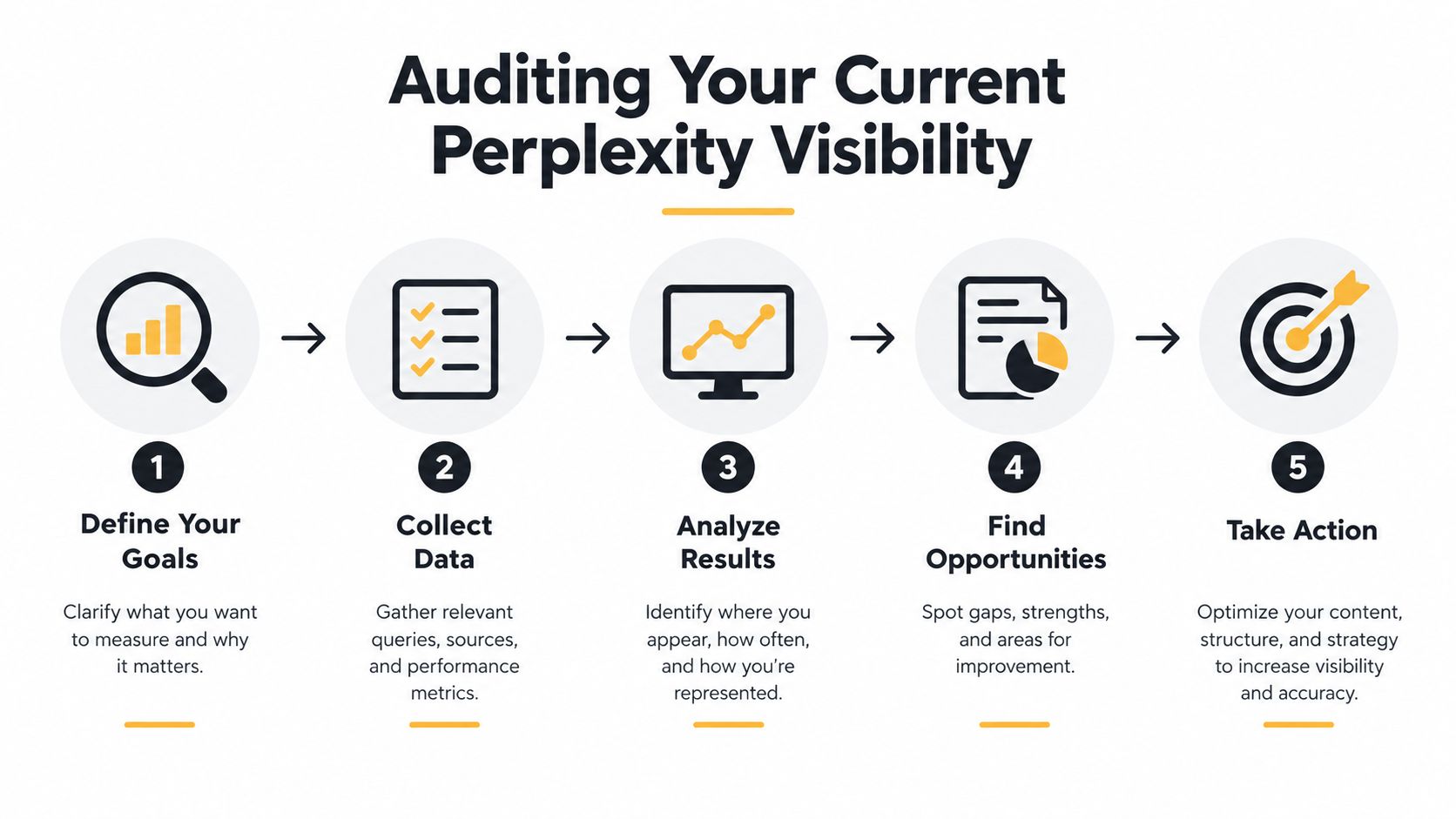
Then classify every cited URL. A simple sheet can use these page types:
- Owned commercial page: Product, service, pricing, or solution page.
- Owned informational page: Blog, guide, documentation, or research page.
- Independent evaluation: Review, roundup, comparison, or directory.
- Community source: Reddit, forum, or discussion thread.
- Institutional reference: Government, educational, medical, or encyclopedic page.
Map the gap and repeat it
Compare the cited sources with the brand's pages and external mentions. If competitors appear through review sites while the brand appears only on its own domain, the likely action is not another generic blog post. It may be a review outreach program, a clearer comparison page, or better documentation of a product claim.
Repeat the same audit monthly. Keep the prompt wording stable, and add new prompts in a separate exploratory set. This separates movement in the tracked sample from changes caused by constantly changing the questions.
Practical Tactics That Move the Needle
The strongest practical case is for improving the sources that already appear in relevant answers. That means looking beyond the brand domain. Industry roundups, comparison pages, specialist reviews, LinkedIn profiles, YouTube explanations, and forum discussions can all matter when they are visible in the audited source set.
A brand shouldn't manufacture praise or seed misleading forum posts. It should make accurate product information easy for independent publishers and communities to verify. The useful work includes supplying documentation, answering technical questions, correcting outdated listings, and earning legitimate mentions from relevant sources.
Make owned pages easy to quote accurately
Content structure helps reviewers and users even when no causal relationship has been established between a specific format and citation frequency. Put the direct answer near the relevant heading. Use clear subheads that match customer questions. Separate facts, conditions, limitations, and recommendations.
A strong product comparison page might define the evaluation criteria, state where each product fits, disclose exclusions, and link each factual claim to a source. A documentation page should identify the feature, explain the steps, and state version or date context where it matters.
Editorial test: If a sentence were copied without the surrounding paragraph, would it still be accurate?
Freshness deserves deliberate testing. A 2026 analysis of Perplexity visibility reported that multiple recent sources claimed Perplexity was materially less likely to cite pages older than 12 to 18 months, and described 394 of 768 citations across 20 questions in one analysis. Those findings concern the cited analyses and shouldn't be treated as a universal cutoff.
Drop tactics that lack evidence
Schema markup may improve machine-readable clarity, but schema alone hasn't been established here as a citation trigger. AI-generated content at scale creates the same problem. Volume doesn't replace firsthand detail, accurate sourcing, or a credible external footprint.
Prompt injection is another poor investment. Attempts to manipulate an answer can create compliance, trust, and brand-safety risks, and no verified evidence here establishes it as a durable visibility tactic. For adjacent work on Google's generated search results, the AI Overview optimization discussion offers a separate context rather than proof of Perplexity behavior.
These tactics are testable patterns, not proven ranking factors. The audit should decide which one deserves the next experiment.
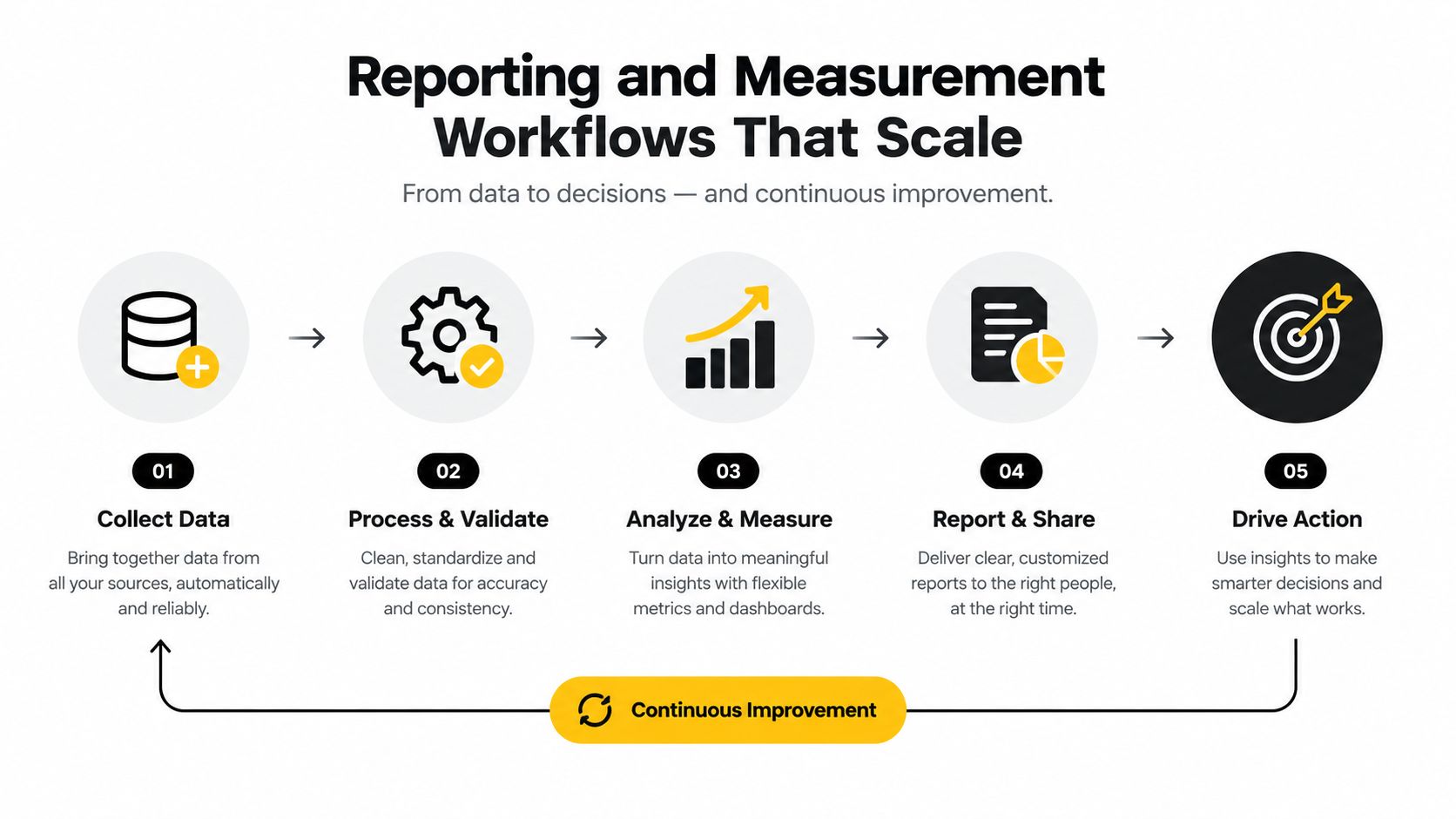
Reporting and Measurement Workflows That Scale
A small team doesn't need a custom business-intelligence project to report Perplexity visibility. A shared spreadsheet, a source-domain ledger, and a short monthly memo can preserve the evidence while keeping the work manageable.
The cadence can run like this:
- Weekly sampling: Re-run a small subset of tracked prompts and capture the visible citations.
- Monthly full audit: Run the complete prompt set under consistent conditions.
- Source ledger update: Record every cited URL, domain, page type, publication date where available, and whether the URL is owned or independent.
- Change log: Note content updates, new external mentions, documentation releases, and major campaign activity.
- Narrative review: Explain what moved, what stayed stable, and what remains uncertain.
Choose metrics that preserve meaning
A team can define a Perplexity Visibility Score that combines citation rate and citation position, but it should publish the formula alongside the score. Citation rate might measure the share of tracked prompts where the brand appears inline. Citation position might record whether the brand appears early, mid-answer, or only in a later recommendation.
The score is an internal reporting device, not an official Perplexity metric. It shouldn't be compared with another company's score unless both teams use the same prompts, sampling rules, modes, and scoring definitions.
Referral traffic adds a separate signal. A monthly AI traffic analytics workflow can help connect visible citations with visits, but traffic shouldn't replace citation review. A cited page may receive no measurable visit, while an untracked prompt may generate a referral that the team hasn't attributed correctly.
Keep the memo short
Each cycle should answer four questions:
- Which prompts produced a brand mention?
- Which URLs supplied those mentions?
- What changed since the previous sample?
- What single action will be tested next?
The AI Search Signals publication is one option for teams researching AI visibility workflows and measurement practices. Whether a team uses it, a spreadsheet, or another system, the reporting standard stays the same. Preserve the raw response, source URL, prompt, date, and interpretation separately.
What We Still Do Not Know About Perplexity SEO
A responsible playbook has boundaries. Public observations show visible citations, source domains, answer wording, and changes across repeated prompts. They don't reveal every process behind source selection, and they don't justify turning correlations into platform rules.
Several questions remain open:
- Query-specific source selection: Does the cited source set change through a consistent, measurable process across informational, commercial, local, and comparison queries?
- Index refresh timing: How quickly does a newly published or updated page become available for citation in different topics and markets?
- Structured data: Does schema produce a measurable change when page quality, relevance, and external visibility remain constant?
- Community mentions: What effect, if any, do accurate Reddit or forum references have when they aren't accompanied by strong owned content?
- Commercial placement: Is there any paid placement system that affects citations, and how would a reviewer distinguish it from organic visibility? The verified material here doesn't establish an answer.
- Mode differences: Do Pro Search, Spaces, or Pages consistently expose a different source pool from a default response, or do differences depend mainly on the prompt and context?
Freshness is especially easy to oversimplify. The cited 2026 analysis discussed pages older than 12 to 18 months and a sample of 394 of 768 citations across 20 questions, but those observations don't establish a universal age threshold for every commercial or informational query. Teams should test updates against stable prompts and record the result rather than applying a blanket publishing schedule.
The defensible position is narrow. Perplexity visibly exposes citations, source lists, and linked webpages. Traditional Google visibility overlaps with many cited sources, while a meaningful portion of cited pages can sit outside the top-ten set in the cited analysis. External validation, clear factual writing, and current information are sensible areas to test. Claims about guaranteed ranking factors remain unverified.
SEO teams should start with a fixed prompt set, capture the cited URLs, and review the sources competitors receive. Build the first audit in a shared sheet, assign one owner to the monthly run, and turn the clearest gap into a specific content or third-party visibility experiment. After the next cycle, keep what the evidence supports and remove what it doesn't.