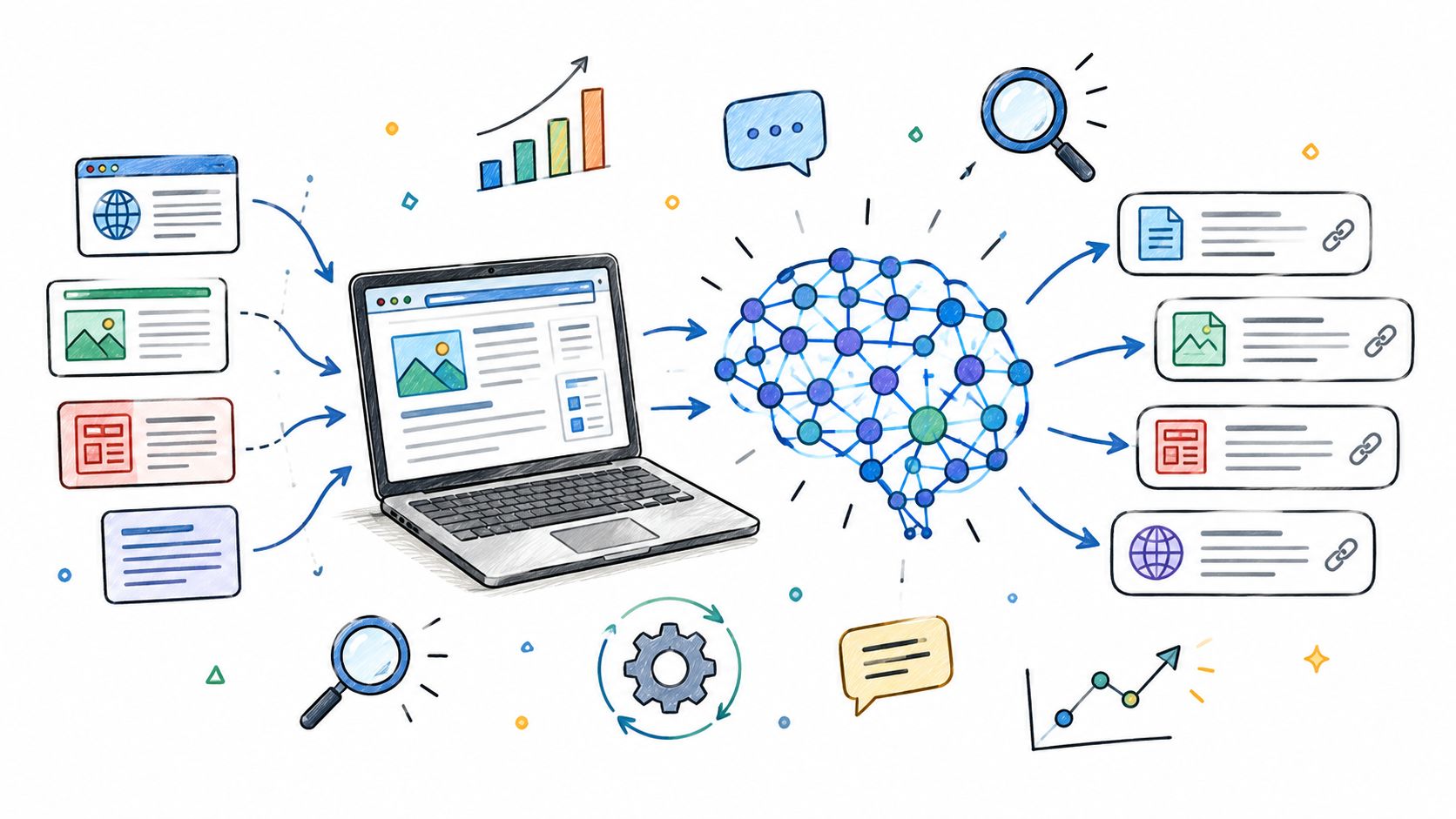

A Monday search meeting still starts with familiar exports. Rankings, clicks, landing pages, and the top ten results sit on the screen. Then a product lead asks why ChatGPT, Perplexity, or a Google AI Overview cited a competitor's article for a question connected to sales, while the company's page never appeared.
That question exposes the limit of traditional reporting. Search marketing intelligence used to describe a disciplined view of demand, rankings, traffic, competitors, and conversions. It now also has to account for cited sources, answer variability, off-site brand presence, and discovery that happens without a conventional organic click.
The practical shift is simple to state but difficult to manage: visibility is no longer one position on one results page. It's a measurement problem across several surfaces, each with different evidence and different uncertainty.
Why Search Marketing Intelligence Feels Different Now
A senior SEO lead can still answer useful questions with a rank tracker. Which pages moved? Which queries lost visibility? Did a SERP feature appear? Those answers remain important, especially because Google held 91.1% of worldwide search engine share in August 2026, while Bing held 4.5%, according to StatCounter's worldwide search market data.
That concentration shaped the old operating model. Teams built keyword sets, sampled Google results, reported average position, and connected those movements to clicks and revenue. Search intelligence became a Google-centered measurement stack because one ecosystem accounted for roughly nine-tenths of worldwide usage in the cited period, and StatCounter's historical series shows Google had already exceeded 90% for much of the 2020s.
The Monday meeting changes when an answer engine produces a different kind of result. A competitor's guide might be cited even though it doesn't appear in the classic top ten for the original query. One dataset reported that 38% of Google AI Overview citations came from pages ranking in the top 10, meaning 62% came from outside the top 10, as reported by Search Engine Journal's analysis of Google AI Overview citations.
Practical rule: A strong organic position is evidence of search visibility. It isn't proof of citation visibility.
The reporting question therefore changes from “Where do we rank?” to “Where does the audience encounter us, which sources appear in the answer, and can the result be measured consistently?” That requires a broader practice, not just another dashboard. A useful starting point is understanding how ChatGPT gets its information, without assuming that one explanation applies to every answer engine or every response.
This guide treats search marketing intelligence as a measurement discipline. The tooling matters, but only after the team defines the observation, records the conditions, and states what the data cannot establish.
The Core Building Blocks of Search Intelligence
A serious program starts with three connected layers. Each layer answers a different question, and each prevents a different reporting error.
Demand shows what deserves attention
Keyword demand data grounds the program in observed interest. Query volume, intent grouping, seasonality, and question patterns help distinguish a commercial opportunity from a topic that merely sounds relevant.
The team should group queries by meaning rather than rely only on individual keywords. A cluster might contain product comparisons, implementation questions, pricing research, and troubleshooting requests. Those groups reveal how people move through a topic and provide a stable unit for later visibility reporting.
Demand data also creates an important boundary. A prompt library invented by a marketer can help test an answer engine, but it doesn't automatically represent real customer demand. The report should separate observed search queries from exploratory prompts and label each one clearly.
Competitive visibility shows the conventional surface
The second layer records which competitors appear for the selected query groups. It should include organic results, paid placements, SERP features, content formats, and changes over time.
A rank tracker can tell a team that a page moved. A broader review asks what appeared around it. Did a competitor add a comparison page? Did a video, forum result, or product module enter the result? Did the intent of the page-one results change?
That context matters because average position can hide a change in the result environment. A page may hold the same position while the surrounding surface becomes more crowded or less commercially useful.
AI-source tracking adds a different observation
The third layer logs which URLs appeared as citations in sampled answer-engine responses. The log should preserve the prompt, engine, location, device where relevant, timestamp, response text, cited URL, citation position if available, and whether the source directly supported the statement.
Research on AI answer engines found that page-level quality signals were strongly associated with citation selection. The strongest associations were with Metadata/Freshness, Semantic HTML, and Structured Data, according to the empirical study of generative engine optimization quality signals. The same study reported a threshold in which pages reached at least 0.70 on the paper's GEO quality score plus at least 12 pillar hits, a result that supports testing structured, machine-readable content rather than treating citations as random appearances.
The three layers form a chain. Demand defines the question set. Competitive visibility describes the established search surface. AI-source tracking records how answer responses cite evidence. Skipping any layer leaves the team unable to explain whether a visibility change reflects demand, competition, source selection, or measurement noise. A plain-language introduction to answer engine optimization can help teams use the terminology without confusing it with a replacement for SEO.
Where AI Search Changes the Signal Mix
A page can hold a strong organic position yet never appear in an AI-generated answer. Another page can supply a cited passage without ranking in the traditional top results. For measurement, these are separate observations, not competing versions of the same metric.
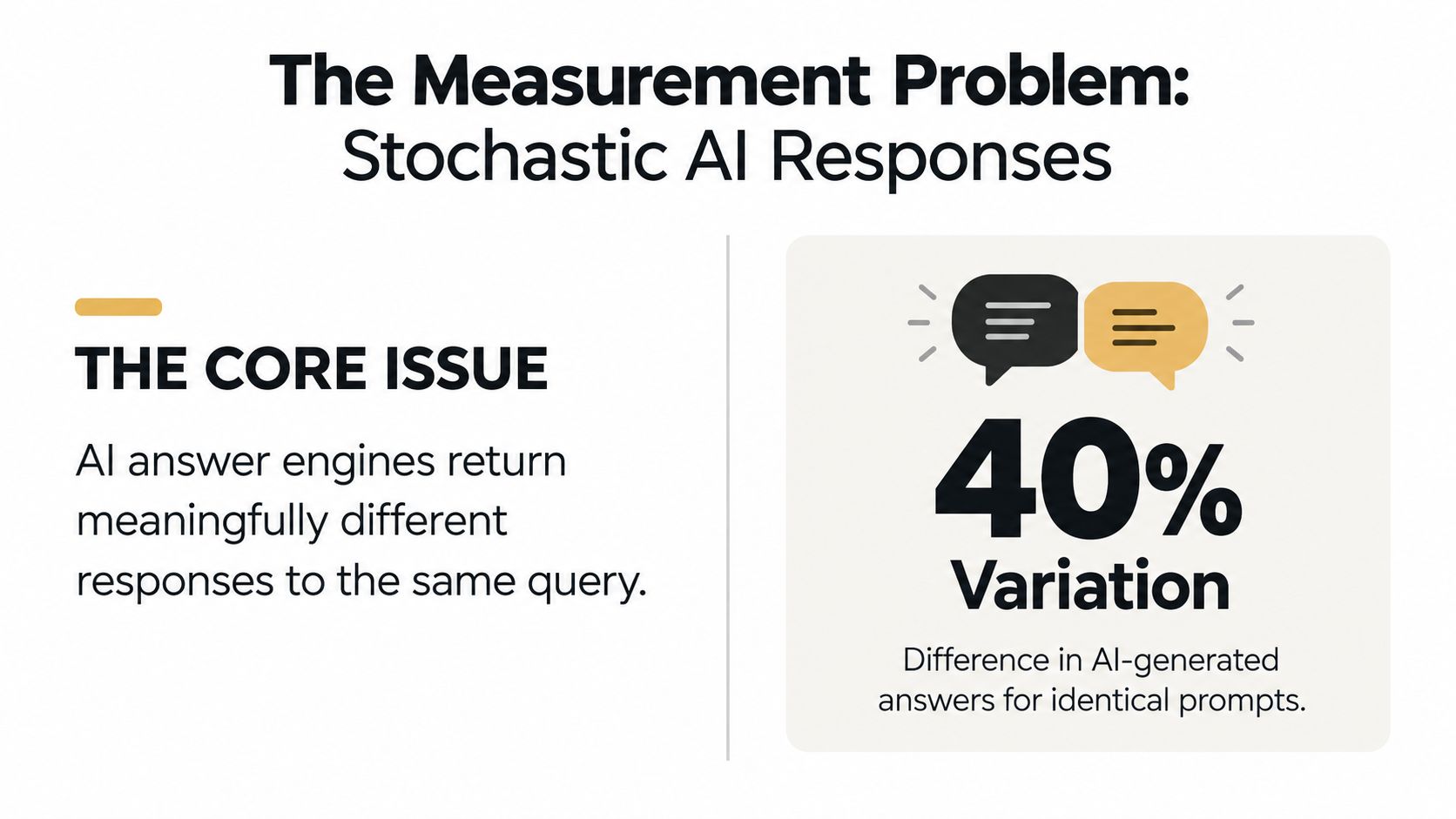
Classic SEO uses ranking as a practical visibility proxy. Teams review relevance, technical access, links, content quality, and user behavior, then track where pages appear. AI answer engines add another surface: whether a response selects the page as evidence. The same prompt can produce different sources, so a single dashboard reading should be treated as a sample, not a precise market total.
The page-level takeaway from earlier research is to audit Metadata/Freshness, Semantic HTML, and Structured Data alongside ranking signals. These fields can show whether a page is current, understandable in its structure, and machine-readable. They do not prove that a markup change caused a citation. They give analysts specific conditions to test rather than a promise of visibility.
Off-site signals need their own measurement track. An independent analysis reported correlations of 0.664 for brand web mentions versus 0.218 for backlinks, while YouTube mentions showed 0.737, using its cited AI visibility analysis and correlation metric. Those figures appear in the comparison of brand mentions and backlinks. They indicate association, not causation. Technical SEO and link evaluation still require separate checks.
| Signal Category | Classic Ranking Weight | AI Citation Weight |
|---|---|---|
| Query relevance | Central to matching a page with a search | Still relevant, but the cited passage must answer the specific question |
| Backlinks | Common authority and discovery input | Useful context, but insufficient to explain citation presence |
| Freshness | Important when the query depends on current information | Flagged as a top freshness signal in the study |
| Semantic HTML | Supports crawlable page structure | Identified as the strongest structural association in the study |
| Structured data | Helps search systems interpret entities and content | Associated with citation selection as machine-readable context |
| Brand and media mentions | Often treated as supporting context | May matter in some categories, especially with video and third-party coverage |
| Position | Direct visibility proxy on a SERP | Does not fully predict whether a source appears in an answer |
The practical setup uses two measurement tracks. Continue tracking rankings, traffic, and conversions. Add citation logs, source-type reviews, structured-content audits, and brand-mention monitoring. A clear distinction between SEO, GEO, and AEO helps keep these observations separate instead of compressing them into one score.
A Map of the Tooling Categories
Search intelligence tools are easier to evaluate when the team starts with the measurement, not the vendor. Each category observes a slice of the journey. None sees the entire journey.
| Category | Primary Measurement | Common Blind Spot |
|---|---|---|
| Rank trackers | Organic positions and SERP features for sampled queries | Personalization, localization, AI modules, and discovery outside the SERP |
| Crawl and audit tools | Indexability, internal links, response behavior, and technical page structure | Content usefulness, brand presence, and answer-engine citations |
| Keyword research platforms | Query demand signals, related terms, clusters, and intent patterns | Real user demand inside answer-engine conversations |
| AI-visibility monitors | Sampled responses, brand mentions, and cited URLs across selected engines | Narrow query coverage, multimodal answers, and response variability |
| Log-file analyzers | Crawler and bot requests observed on the site | What systems do with the content after crawling |
| Share-of-voice tools | Aggregated visibility across selected search surfaces | Uneven weighting between organic, paid, SERP features, and AI answers |
Rank tracking remains useful, within limits
Rank trackers work well for stable query sets and controlled comparisons. They can expose competitor movement, page changes, and SERP-feature shifts. They don't tell the team whether a buyer discovered the brand through a forum, a video, an answer response, or a recommendation that never produced a click.
Audits explain access, not meaning
Crawlers identify technical barriers, internal linking patterns, duplicate content, and other structural conditions. They can't decide whether a page is the best evidence for a nuanced question, and they can't establish that a citation would occur in an answer response.
AI monitors require methodological scrutiny
AI-visibility monitors can make repeated sampling easier. The important questions are how they define a prompt, how they record response conditions, how they handle citations, how often they sample, and whether they expose uncertainty. The presence of a score doesn't answer those questions.
The AI Search Signals is one publication-based option for tracking how brands appear in AI-powered search and answer systems and for examining the sources cited in responses. It should be evaluated by its documented measurement approach, just like any other monitoring system.
A tool is only as credible as the observation it records and the uncertainty it exposes.
Treat the categories as a coverage checklist. A team may need several sources to answer one business question, but adding platforms without defining the question usually creates duplicate dashboards rather than intelligence.
Use Cases for SEO and Growth Teams
The same data can serve different decisions. Problems begin when every team receives the same dashboard and is expected to find its own meaning.
An SEO lead conducting a quarterly content review needs a practical evidence set. Crawl health shows whether important pages remain accessible. Ranking distribution shows movement across the established search surface. Citation source lists show which URLs appeared in sampled answers for relevant questions. Together, these inputs help identify pages that need rewriting, clearer structure, stronger evidence, or better internal linking.
A growth manager has a different job. Suppose a new landing page targets a commercial query cluster. The manager needs organic click-through behavior, assisted conversions, and visibility by query group. A page that earns impressions but produces no meaningful downstream action may deserve a different message, offer, or audience definition. The answer-engine layer can show whether the page or its supporting sources appeared during discovery, but it shouldn't be treated as proof that the response caused the conversion.
Product marketing needs the category story
A product marketer monitoring a category narrative should track which brands appear in sampled answers, how those brands are described, and which competitor pages recur as cited sources. Reviews, comparison pages, publisher coverage, community discussions, and videos can all provide context.
The report should preserve the exact language of the response and distinguish a direct brand mention from a citation of a page that merely discusses the category. Sentiment labels also need review. A machine-generated classification can be a useful screening device, not a final interpretation.
Content strategy needs questions and entities
A content strategist planning a topic cluster can combine question-shaped query expansion with citation-source review. The first shows how the topic is expressed in search demand. The second shows which entities, pages, formats, and supporting concepts appeared in sampled answers.
This process may reveal a gap that conventional keyword research misses. A site might cover the head topic well but lack an explanatory page that defines a key entity, compares alternatives, or answers an implementation question.
Technical SEO needs evidence from access patterns
A technical SEO specialist investigating traffic loss needs log-file crawl patterns, index coverage changes, and SERP-feature shifts. AI citations add a separate question: are important pages being surfaced as sources, and are those pages technically clear enough for machines and people to interpret?
The mistake is assigning every job to one dashboard. Each role needs a small, defensible input set linked to a decision.
The Measurement Problem Nobody Wants to Talk About
AI visibility reporting becomes unreliable when a team treats one sampled response as a stable market fact. A statistical study covering Perplexity Search, OpenAI SearchGPT, and Google Gemini found citation distributions that followed a power-law pattern, with substantial variation across repeated samples and unstable rank ordering among frequently cited domains. Its conclusion was practical: reporting should include uncertainty estimates and repeated sampling, as described in the study of citation variability across generative search systems.
That finding changes the reporting unit. “The brand was cited” is an observation tied to a specific prompt, engine, time, and response. “The brand owns this topic” is an interpretation that requires a broader sample and careful language.
Classic SERP tracking has its own instability through location, device, personalization, and changing result features. Historically, teams could often use rank as a workable approximation. Generated answers make that approximation weaker because the response can combine several sources and express the result differently across repeated samples.

What a defensible sample records
A useful sample records more than the prompt text:
- Prompt version: Preserve the exact wording and label whether it represents observed demand or exploratory research.
- Engine and surface: Record the answer system and whether the observation came from an overview, conversational answer, or another interface.
- Time and conditions: Log the timestamp, location, device, language, and account state where known.
- Response evidence: Save the response, cited URLs, brand mentions, and the passage associated with each source.
- Repeat observations: Run the same prompt repeatedly enough to identify whether a result recurs or appears as an isolated response.
The report should show agreement across repeated observations, not only a single percentage. It should also avoid implying that prompt-simulation output equals total market demand. Synthetic prompts are useful for controlled trend tracking. They aren't a substitute for real query, referral, and conversion data.
A visibility number without its sample conditions is an incomplete observation.
Teams don't need to pretend the noise can be removed. They need to make it visible. Use ranges, repeat sampling, and confidence language. If the difference between two brands falls inside the observed variation, the responsible conclusion is that the data doesn't establish a meaningful gap.
A Reporting Framework That Holds Up
A durable report separates four questions: what people ask, where the brand appears, what users do, and what the business receives. Mixing those layers encourages false attribution.
Layer one measures demand
Use query groups based on observed search behavior, supported by intent labels and time context. Keep exploratory prompts separate. A demand report should make clear whether it describes search queries, internal site searches, customer language, or a constructed testing set.
Avoid reporting total impressions without device and query-group context. A large impression total can conceal weak commercial relevance or a shift toward branded demand.
Layer two measures visibility
For classic search, report impression share or visibility within defined query groups and conditions. For answer engines, report citation frequency across a repeated sample, with the engine, prompt set, timestamp range, and uncertainty visible.
A domain-level mention count can hide the page that supplied the evidence. Store the full URL and classify the source type. One later analysis reported that YouTube, Reddit, Wikipedia, Forbes, and LinkedIn appeared among the most cited domains in Google AI Overviews. It also reported that those top sources, together with ten more, captured roughly 68% of every citation across ChatGPT, Claude, Gemini, Perplexity, and Google AI Overviews, according to the citation-source analysis. That directional finding makes source-mix reporting more useful than a single brand score.
Layer three measures engagement
Connect organic sessions to landing pages and inspect click-through behavior. A particularly useful cut is the behavior of users who land on pages that also appeared as sampled AI sources. The report should describe association, not claim that the citation caused the session.
Layer four measures revenue
Revenue attribution needs the longest view. Track assisted conversions tied to non-branded discovery, but use conservative rules when several channels influenced the journey. AI referral traffic may be undercounted unless analytics separates those sources deliberately, so “no recorded referral” shouldn't be treated as “no answer-engine exposure.”
| Layer | Reliable Metric | Misleading Metric | Cadence |
|---|---|---|---|
| Demand | Query-group demand with intent and source conditions | A single undifferentiated keyword total | Monthly or by planning cycle |
| Visibility | Repeated citation frequency with sample metadata and uncertainty | One-run AI visibility percentage | Weekly sampling, reviewed over time |
| Engagement | Organic click-through and behavior on relevant landing pages | Total impressions without query or device context | Monthly |
| Revenue | Conservatively attributed assisted conversions | Revenue assigned to one surface without journey context | Quarterly |
This framework is a minimum standard. Teams can add channel-specific measures, but every addition should answer a defined decision and expose its measurement limits.
What to Keep Doing When the Numbers Get Noisy
Raw visibility isn't business value. A brand can appear in many answers and still fail to convert because the cited description is inaccurate, the landing page is weak, the offer is unclear, or the audience isn't commercially relevant. A ranking can rise while the query cluster becomes less valuable. A citation can appear once and never recur.
The durable practice is to preserve context. Maintain a rolling 90-day window for SERP and answer-engine sampling, as a reporting convention rather than a claim about engine behavior. Store the prompt, query, location, device, engine, timestamp, response, cited URL, and classification. Without that metadata, later analysts can't tell whether a movement reflects a real change or a changed sample.
Separate exploratory questions from money queries in every report. Exploratory prompts help teams understand coverage and language. Money queries connect more directly to commercial intent and deserve stricter sampling, clearer attribution, and closer review of landing-page outcomes.
Habits that keep the program defensible
- Sample before trusting: Repeat important observations and report the range or agreement level.
- Version every dashboard: Preserve prompt sets, query definitions, filters, and calculation rules.
- Separate surfaces: Don't merge organic position, paid visibility, citations, mentions, and referrals into one unexplained score.
- Attribute revenue conservatively: Treat exposure as context unless the analytics evidence supports a stronger conclusion.
- Audit source quality: Review the actual cited page, not only the answer summary. The MLA guidance on citing Google AI Overviews recommends clicking through to the underlying source and citing that source instead of citing the generated summary.
- Revisit the framework quarterly: Engines, interfaces, source mixes, and user behavior change. Measurement rules need review as well.
The central question isn't whether a brand appears. It's whether the observed presence is repeatable, relevant, properly sourced, and connected to a business outcome. Search marketing intelligence becomes durable when the team can say what happened, under which conditions, how uncertain the observation is, and what decision it supports.
Build the next reporting cycle around one defined query set, one documented sampling protocol, and one conservative attribution model. Record every prompt and cited URL, compare answer-engine observations with organic and referral data, and review the findings with SEO, content, product marketing, and growth leads before changing the roadmap.