

Most budget SEO plans still assume that a page-one Google result is the finish line. That assumption is incomplete. A large-scale study of Google AI Overviews found that nearly 30% of cited domains didn't appear in the co-displayed first-page results (the study on arXiv), while an independent analysis found that only 33.2% of AI Overview cited URLs also ranked in Google's organic top 10 (Position Digital's citation analysis). Traditional rankings still matter, but they don't explain every appearance in an AI-generated answer.
A workable SEO on a budget plan therefore needs to clear two tests. It must be inexpensive enough for a small ecommerce, local, or SaaS team to execute, and it must produce something measurable, such as better query coverage, clearer citations, stronger page engagement, or more accurate brand mentions. That doesn't require paid enterprise suites, an agency retainer, or an original research budget. It requires disciplined prioritization, careful documentation, and content that answers specific questions clearly.
The eight tactics below focus on work that can be staged, measured, and maintained by a lean team.
1. Use free and freemium tools for keyword research
Keyword research doesn't need to start with a costly subscription. Google Search Console, Google Trends, and the free tier of Ubersuggest can reveal the language people already use around a site, a service, or a product category. Search Console is especially useful because it exposes queries that generated impressions, including terms the content team may not have considered.
AI search adds a second research source, but it must be handled as observation rather than as a replacement for keyword data. Teams can manually submit questions about a category, record the wording that appears in answers, and compare those phrases with Search Console queries. A local plumber might find that customers search for “emergency boiler repair near me,” while AI answers use a longer formulation about response time, service area, and boiler type. A SaaS team may discover that buyers ask for alternatives, migration concerns, or comparisons that don't appear in its traditional keyword list.
Build a small, useful query map
A lean workflow can combine several sources:
- Search Console queries: Look for pages with impressions but weak click performance, then inspect the wording and intent behind those searches.
- Trends comparisons: Compare related phrases and note whether a question pattern is becoming more prominent in the selected market.
- AI answer wording: Save the exact questions and phrases that appear in tested responses. Don't reduce them to a single keyword.
- Competitor alerts: Set up Google Alerts for competitor names and important industry terms to identify emerging topics worth checking manually.
The trade-off is precision. Free tools won't provide the same breadth of historical data or competitor intelligence as paid suites. That matters for large sites, but a small team usually gets more value from a focused list of real questions than from an enormous export nobody has time to interpret.
2. Improve pages that already have traction
Updating an existing page is often a better use of limited production capacity than starting another article from a blank document. A page already receiving impressions has an established relationship with search demand. Its weaknesses may be structural, factual, or editorial rather than fundamental.
Start with pages sitting within striking distance of stronger visibility, such as those appearing in the top 20 to 50 positions. That range is a practical filter, not a guarantee. A page about home gym equipment might need clearer sections on space, budget, and equipment alternatives. A healthcare page may need current sourcing, publication dates, and a more direct explanation of what readers should understand before exploring treatment options.
AI answer visibility depends on whether a page contains extractable, trustworthy answers. A long introduction can bury the definition an answer system needs. Dense paragraphs can obscure qualifications. Unsupported claims can create accuracy problems even when the page attracts traffic.
Make the answer easy to identify
Effective updates usually include:
- A concise topic summary: State the main answer near the top, then explain the reasoning and limitations.
- Specific subheadings: Use headers that match real questions, such as “Which equipment works in a small room?” rather than vague labels.
- Visible evidence: Add source links, methodology notes, publication dates, or update notes where the claim needs support.
- Useful internal pathways: Link readers to related products, services, or deeper explanations without forcing them to hunt.
A fitness brand can expand an existing workout guide with equipment substitutions and clearer progression sections. A healthcare publisher can replace outdated information and distinguish established guidance from editorial interpretation. Before making broad changes, teams can test the revision on a lower-risk page or in staging.
A practical framework for structuring pages for AI answers is available in this guide to AI Overview optimization. The trade-off is that optimization can expose deeper content problems. If a page has no first-hand insight, weak sourcing, or an unclear purpose, rewriting its headings won't solve the underlying issue.
3. Connect related pages with internal links
A site can often demonstrate more topical depth without publishing another article. The first step is to map existing pages by subject. A product guide, comparison page, use-case article, and support document may already form a useful cluster, but visitors and crawlers may not see the relationship if those pages aren't connected.
An ecommerce site selling coffee equipment could link brewing guides, grinder comparisons, maintenance instructions, and product pages to a central buying guide. A SaaS company could connect workflow tutorials, feature explanations, integration pages, and use cases to a platform capabilities page. The links don't create expertise on their own. They make the site's existing knowledge easier to access and evaluate.
Build the map before changing the menus
A spreadsheet is enough. List each page, assign its main topic, note related pages, and identify the page that should act as the central reference. Then add links where the relationship is natural.
Use descriptive anchor text. “Compare accounting integrations” tells the reader more than “click here.” Prioritize links to useful pages that receive little traffic, but don't add links mechanically to every available destination. Excessive linking can make a page harder to read and can dilute editorial emphasis.
Practical rule: An internal link should help a reader answer the next obvious question, not merely give a target page another link.
Check the implementation quarterly. Broken destinations, renamed products, outdated anchor text, and discontinued services can weaken the path through a cluster. Local teams can connect service pages to location-specific advice. SaaS teams can connect comparison content to implementation guidance. Ecommerce teams can connect buying advice to category and product pages.
Internal linking also gives AI answer research a clearer set of relationships to inspect. It can help a team identify missing definitions, comparison content, or supporting explanations, but it shouldn't be described as a guaranteed way to appear in an answer. This guide to SEO for AI answers provides a practical way to connect content structure with observed answer visibility. The main trade-off is labor. Mapping a mature site takes attention, but it usually costs less than producing a new content library.
4. Monitor AI mentions manually
Paid visibility platforms can automate prompt runs and reporting, but small teams can learn a great deal from a controlled manual log. Search the brand name, product names, category questions, competitor comparisons, and alternative queries across the AI systems relevant to the audience. Record what appeared, what was cited, and whether the answer described the company accurately.
The record must preserve the exact response. Paraphrasing removes details that matter, such as a missing product qualification, an outdated service area, or a cited third-party page the brand hadn't seen before. A SaaS company may find that its product appears in answers about one workflow but not in adjacent comparison questions. A local service provider may see competitors cited while its own site is absent from answers about availability or pricing considerations.
Keep the log simple
Useful columns include:
- Date and system: Record when and where the response appeared.
- Prompt: Save the exact question, including location or product qualifiers.
- Brand status: Note whether the brand appeared, was mentioned incorrectly, or was missing.
- Cited material: Capture the URLs and the role each source played in the response.
- Answer position: Record where the mention appeared in the response without treating position as a stable ranking.
- Correction required: Flag claims that need a page update, a clearer explanation, or a reputation response.
Don't turn a small sample into a market-share claim. AI responses vary, and a manual log shows what appeared under the tested prompts at the recorded times. It doesn't establish universal visibility.
A documented workflow for this process appears in the brand monitoring guide for AI results. The trade-off is coverage. Manual checks won't scan every possible prompt, but they can reveal high-value gaps before a team spends money on a monitoring platform.
5. Use customer language as evidence
Customer reviews and testimonials give budget content something many pages lack, specific wording from people who used the product or service. That wording helps explain the problem, the alternatives, and the outcome buyers cared about. It also gives content teams better raw material for service pages, use-case pages, comparison copy, and the kinds of phrases AI answers tend to surface.
A local service provider should not bury that material on a general reviews page. Put permissioned testimonials on the service page they support. A SaaS team can publish customer stories that describe the workflow, setup context, and result without turning every quote into polished sales copy. Ecommerce teams should mine recurring review phrases for product guidance and objection handling.
Use a post-purchase email prompt that asks: “What problem were you trying to solve before choosing [product]? What almost stopped you? What changed after you started using it?” Save the responses in a simple sheet, then tag repeated phrases by theme, such as speed, price, setup, or support. Those tags make it easier to update FAQ sections and product copy with the language customers already use.
Ask for detail, not praise
Generic requests produce generic testimonials. Ask for the original problem, the decision context, the actual use, and the outcome. Include a line for identity, such as name, role, company, or other relevant context, if the customer is willing to share it.
Customer names, roles, companies, and outcome details should only be published with permission. Anonymous feedback can still shape the copy, but it gives readers less context. Do not pad a quote into a case study. Keep the customer's wording intact, then edit only for clarity.
Put the proof beside the claim it supports. A migration story belongs near the migration guide, and a service review belongs near the local service page. That placement matters more than polishing every sentence. The trade-off is governance. Collecting usable material takes coordination, and regulated industries may need an extra review before publication.
6. Create one strong cornerstone page
A cornerstone page does not need a fresh study or a large content budget. It needs one clear subject, sources you can stand behind, practical structure, and enough detail to answer the questions buyers or readers ask before they act. Small teams usually get farther by organizing what they already know, published evidence, product docs, support notes, and repeated customer questions, than by trying to invent a big original angle.
A fitness business might build a home workout guide that covers routines, equipment substitutions, space limits, and progression. A healthcare publisher can create a conditions overview that connects diagnosis, treatment, and lifestyle pages while staying close to published medical sources. A SaaS company can publish a platform hub that brings together use cases, integrations, implementation, and security details.
The page should do real work, not just collect links.
Curate without pretending to research
Start with the claims you can support. Record the exact source for each point before drafting, then keep recommendations separate from findings. A practical suggestion is still a suggestion, not research. Move from the main topic to subtopics, then to the questions people ask before they convert or contact sales. Add the responsible author, reviewer, publication date, and update history where that makes sense. Connect the pillar to related pages, and link those pages back when the relationship helps readers.
That structure can help AI systems cite the page, but it does not guarantee inclusion. The page still needs useful synthesis, not a rewritten version of competitor content. If it only summarizes what others already said, it will usually feel thin to both search systems and readers.
Trade-off is capacity. One cornerstone page can absorb a lot of time for a small team, especially in healthcare or another regulated category. A better bet is to choose a topic the team already understands, publish a solid first version, and improve it as supporting pages and customer questions expose the gaps.
7. Add structured data carefully
Structured data helps search systems identify what a page contains, from products and articles to local business details. That clarity may support how AI-generated answers interpret and reference a page, but schema alone does not create visibility. It works best when the markup matches the page's visible content and the business information remains consistent.
For an ecommerce team, mark up product details that shoppers can verify on the page. A publisher can identify the headline, author, publication date, and article body. A local business can describe its organization and location. Do not add unsupported ratings, prices, availability, or claims. Misleading markup can create review work without improving how a page is understood.
Use a maintained template for recurring page types, then check each implementation before release. Google's Structured Data Markup Helper can help generate an initial version, while Google's Rich Results Test can identify implementation problems. CMS-level deployment reduces manual work, but only if templates reflect the page types they serve.
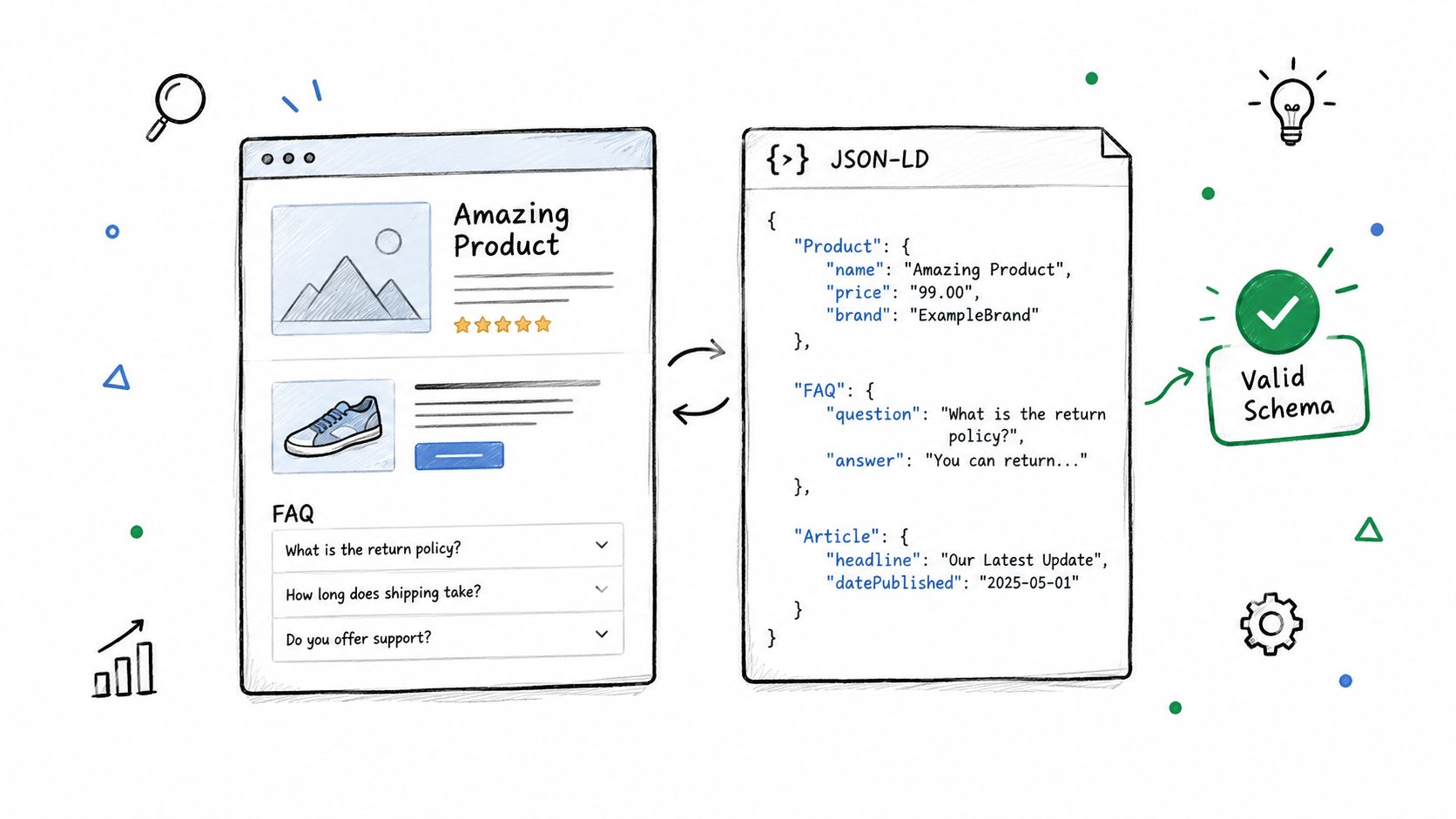
Review the markup after substantial content edits. A snippet can pass a syntax check and still describe the wrong page. Teams without development support should involve someone familiar with the CMS, templates, and release process before applying schema across the site.
For small ecommerce teams, product markup is usually easier to maintain than elaborate custom schemas. Local teams gain more from accurate business details than from adding every available property. SaaS teams should mark up only content types that match their pages. The trade-off is measurement: separating schema's effect from content, indexing, and layout changes is difficult. Treat it as technical hygiene, not a guaranteed route into AI answers.
8. Earn credible bylines and guest placements
Credible bylines can influence AI-generated answers, but only when the publication and contribution are relevant. A random backlink package adds little value. For budget teams, a small number of useful placements usually beats a long list of weak links, although each contribution requires time that could have gone into owned content.
Start with the audience, then judge the editorial fit. A SaaS founder might write about workflow design for a business publication. A healthcare company could provide expert commentary to a publication with suitable editorial standards. An ecommerce specialist might contribute buying guidance where readers already research that category. The author bio should identify the contributor accurately and, where permitted, point to a relevant company or author page.
A practical pitch should answer five questions:
- Who reads the publication? Confirm that its audience matches the market the business wants to reach.
- What does the publication cover? Review recent work for tone, depth, and subject boundaries.
- What is the proposed idea? Offer a narrow, useful topic rather than a generic promise to write about SEO.
- How will attribution work? Confirm the author bio and company reference before investing substantial effort.
- Is the placement editorially sound? Avoid paid link schemes where the main purpose is manipulating search visibility.
The strongest placements can support more than referral traffic. Teams can cite a published contribution from a relevant guide, share it with sales, or develop its argument into a deeper resource. A reputable external source may also be cited in an AI answer, but that result is inconsistent and should never be promised.
Publication quality matters more than link volume. A byline on a relevant site can give AI systems another clear source for associating a person or company with a subject. It does not replace useful first-party content, and it may take as much work as writing an owned article. Small ecommerce teams should prioritize category publications, local businesses should favor trusted regional or professional outlets, and SaaS teams should choose sources their buyers already consult.
The publication controls future updates, placement, and removals. Treat guest work as credibility building first, with search and AI visibility as possible secondary benefits.
8 Budget SEO Strategies Compared
| Strategy | Implementation complexity | Resource requirements | Expected outcomes | Ideal use cases | Key advantages |
|---|---|---|---|---|---|
| Keyword research using free and freemium tools | Low, basic accounts and manual AEO tracking | Minimal, free tools, time, spreadsheets | Question-focused keyword ideas and early intent signals | Budget SEO, small teams discovering question phrasing | Zero cost, direct Google data, AEO insights |
| Content optimization for existing pages | Medium, audits, edits, and testing | Moderate, editors, analytics access, time | Improved rankings, CTR, and faster gains on pages with history | Sites with existing traffic or large content libraries | Leverages existing pages; measurable uplift; improves AI scannability |
| Building topical clusters and internal linking strategy | Medium, planning and systematic linking | Low–moderate, content inventory and editorial time | Stronger topical authority and improved thematic rankings | Sites with many related pages (ecommerce, SaaS docs) | No new content needed; distributes authority; aids AI topic evaluation |
| Monitoring and responding to AI mentions without paid tools | Low–medium, manual searches and documentation | Time-intensive, recurring checks, spreadsheets | Qualitative visibility insights; identify citation gaps and inaccuracies | Brand reputation monitoring and small teams tracking AI presence | Zero tool cost; direct observation of AI answers; actionable gaps |
| Leveraging user-generated content and customer testimonials | Low, collection and publication workflows | Minimal, outreach, moderation, CMS updates | Increased trust signals, engagement, and fresh content | Local services, ecommerce, SaaS with active customers | Authentic social proof; low production cost; boosts credibility |
| Creating pillar content and cornerstone pages with minimal resources | Medium–high, research and synthesis | Moderate, writing time, source curation, maintenance | Long-term topic authority, backlinks, and AI citation potential | Establishing topic hubs and competitive category coverage | Compounding value over time; authoritative resource without primary research |
| Implementing schema markup and structured data without developers | Low–medium, use templates/tools and validate | Minimal, free tools, basic technical copy, occasional dev help | Better content understanding by search/AI and richer SERP features | Ecommerce, recipes, FAQs, product and local business pages | Improves snippet eligibility; low-cost; clearer AI categorization |
| Building authority through strategic guest posting and byline placements | Medium, outreach, pitching, and editorial coordination | Moderate, writing, research, relationship-building | Backlinks, expanded audience, and increased author/domain credibility | Brand awareness, expert positioning, competitive niches | Efficient authority gains; wider reach; builds author credibility |
Pick Three, Run Them for a Quarter
Running all eight tactics at once is usually a mistake for a small team. Each tactic competes for the same limited resources: editorial time, subject-matter review, development attention, and measurement capacity. A longer task list can create the appearance of progress while leaving every item half-finished.
Choose three tactics that match the current constraint. A team with a large content library but weak organic performance can start with existing-page optimization, internal linking, and structured data. A local business with thin customer proof can combine query research, testimonials, and service-page updates. A SaaS team that already has solid technical foundations may get more insight from AI mention monitoring, comparison content, and a focused cornerstone page.
Set a baseline before changing pages
The baseline should reflect the business model. Track relevant Search Console queries, page impressions, clicks, conversions, indexed pages, and assisted actions where those measures are available. For AI visibility, log the exact prompts, systems tested, brand mentions, cited URLs, factual errors, and missing product or service information.
Don't treat a single answer as a trend. Manual AI monitoring is sensitive to prompt wording and timing, so the record needs consistent questions and clear notes. The point isn't to manufacture a precise visibility score from a small sample. It's to identify repeatable gaps that the team can address and review.
Budget decisions should also reflect the actual market range. Recent summaries place typical monthly SEO spending for SMBs around $500 to $2,500, while broader small-business ranges often extend to $500 to $5,000 (Revenue Memo's SMB marketing budget summary). Another summary reports an average monthly SEO fee of $1,348 for freelancers and $3,209 for agency-led programs in its 2026 data (the same Revenue Memo report). Those figures describe market benchmarks, not a required investment. They do show why freelance or in-house execution can be more realistic than a full agency team for a constrained business.
Protect the work that compounds
Free tools can cover much of the basic workflow. Google Search Console remains free, and independent small-business survey data reports that 84% purchase at least some search-marketing software, while 23% spend under $1,000 per month on SEO and 46% stay under $5,000 per month (Service Direct's small-business search marketing survey). A lean stack therefore usually needs one reliable first-party data source and, if necessary, one affordable specialist tool. It doesn't need a shelf full of subscriptions.
Organic search can also justify sustained investment when it fits the business model. A 2026 compilation reports about $31 per lead for organic channels versus $181 per lead for PPC, and describes organic leads converting at 14.6% versus 1.7% for outbound channels (Revenue Memo's small-business marketing statistics). Those metrics shouldn't be transplanted into every business forecast. They do support a practical principle: budget SEO works when limited funds go toward technical quality, useful content, local visibility, and measurement rather than cheap volume.
The real cost isn't the absence of software. It's starting too many projects and finishing none.
Review the selected tactics after the quarter, retain the work that produced useful movement or insight, and replace the tactic that didn't fit the team's capacity. The next phase should be earned by evidence, not by pressure to publish more.
For teams learning how brands appear in AI-generated answers, The AI Search Signals publishes practical coverage of mentions, cited sources, prompt research, and measurement. Use that kind of evidence-led guidance to refine the next test, while keeping traditional SEO reporting intact.
Choose three tactics this week, assign an owner to each, and record the baseline before making changes. Start with the pages, queries, and customer questions closest to revenue. Review the results at the end of the quarter, keep the work that produced a clear business signal, and stop paying for activities that only create reports.