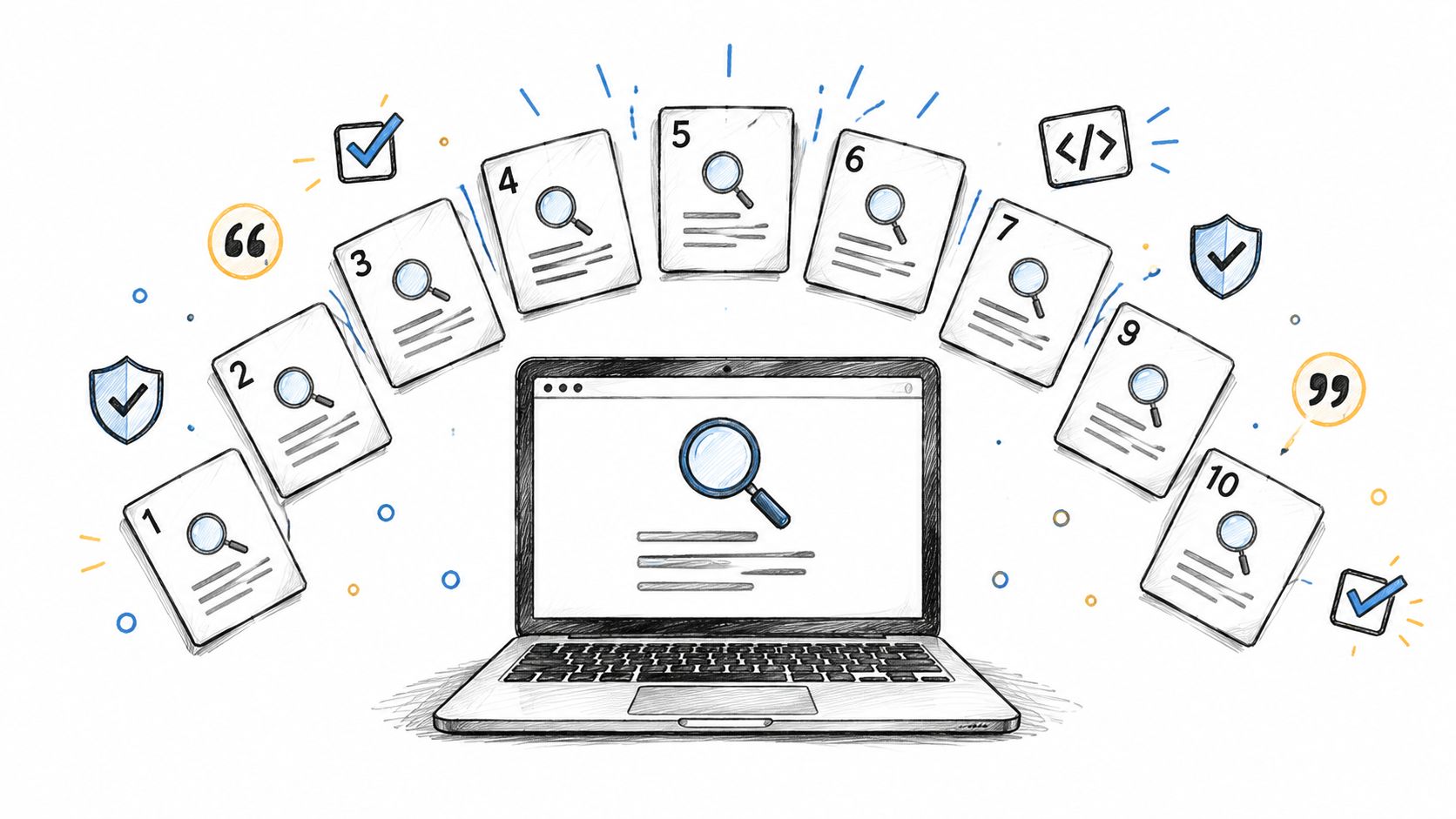
There isn't one top AI search engine for every research task. The strongest choice changes with the question being tested. A marketer checking whether a brand was mentioned needs a different workflow from an SEO professional auditing cited sources, a researcher tracing primary evidence, or a privacy-conscious user comparing web coverage.
This comparison uses four practical dimensions: answer usefulness, citation visibility, source coverage, and suitability for brand testing. It includes general search engines, privacy-focused services, developer platforms, mobile answer interfaces, and one research-specific resource. The focus is not on unsupported claims about how these systems operate internally. It is on what users can observe in their answers, links, controls, and research workflows.
The market itself already points to a split outcome. Average monthly AI search users rose from 851 million in Q4 2025 to 904 million in Q1 2026, while AI search platforms recorded more than 27.4 billion visits in Q1 2026, according to Wix Studio's AI search comparison. Yet traditional search remains important. A survey summary reported that 79.8% of consumers still prefer Google or Bing for general information searches, as documented by Search Engine Land.
The useful question, then, isn't which engine wins every category. It's which resource gives a team the clearest evidence for a specific visibility decision.
1. Perplexity
Perplexity is the clearest fit for citation-led exploration. Its answers usually present linked sources alongside a synthesized response, making it practical for checking which pages appear in an answer and whether a brand is supported by external references.
That makes it useful for source discovery, citation inspection, and prompt research. A marketer can ask a narrow comparison question, inspect the cited domains, then repeat the prompt with different audience, location, or product constraints. The result is more informative than checking only whether a brand name appeared. It shows which pages appeared to support the answer and whether the framing was positive, neutral, or qualified.
Perplexity's own product surface includes deeper research options, project-style organization, file and image inputs, and model selection on some paid plans. Those details should be verified directly in the Perplexity product interface, since availability can change by account and region.
Best use for visibility work
Perplexity is a strong starting point for long, specific questions. It can help an SEO team identify recurring sources across product comparisons, category research, and problem-led queries. It also exposes a useful distinction between being mentioned and being cited. A brand can appear in an answer without receiving a supporting link, while another brand may be tied to a source that shapes the recommendation.
One source reported that Perplexity processed over 540 million queries per month in Q1 2026, compared with 230 million in Q1 2025, a 135% year-over-year increase. The figures and the source's comparison with Google's roughly 8.5 billion searches per day are documented in Perplexity usage research from Presenc.
Practical rule: Record the cited URL, not just the cited domain. Two pages from the same publisher can present very different claims about a brand.
The limitation is navigational intent. Someone looking for a known website, a specific account page, or a simple location may get more synthesis than needed. Teams should also treat paid-plan limits and promotional behavior cautiously unless the current account terms are clear. For an operational framework, how to rank in Perplexity is relevant to the visibility questions raised by this engine.
2. Google Search with AI Overviews and AI Mode
Google Search remains the broadest baseline for mixed-intent discovery. Its AI Overviews and AI Mode add synthesized answers, follow-up questions, and links to supporting pages, while the familiar search results, local features, shopping surfaces, and other verticals remain part of the same environment.
For SEO teams, Google is valuable because it connects AI visibility with conventional index eligibility. Google has stated that pages need to be indexed and eligible for standard search snippets to qualify for citation in AI Overviews, as summarized in Google AI Overviews citation guidance. That gives teams a concrete first check. If a page isn't eligible for ordinary search visibility, it shouldn't be treated as a dependable AI Overview candidate.
What to record
Google is especially useful for testing mixed discovery. A prompt can produce an AI Overview, standard results, shopping elements, local listings, or some combination. Teams should record which format appeared, whether the brand was named, which URLs were linked, and whether the same page appeared in the conventional results.
A 2025 empirical analysis of 70 product-intent prompts collected 1,702 citations across Brave Summary, Google AI Overviews, and Perplexity, then audited 1,100 unique URLs. The study reported that metadata, freshness, semantic HTML, and structured data showed the strongest associations with citation, according to the published arXiv analysis.
Google also announced labels in AI Overviews and AI Mode to make links from previously selected sources easier to identify, and said the system would indicate when an article explicitly references a Highly Cited source. That update is described in Google's Search announcement about original and high-quality content.
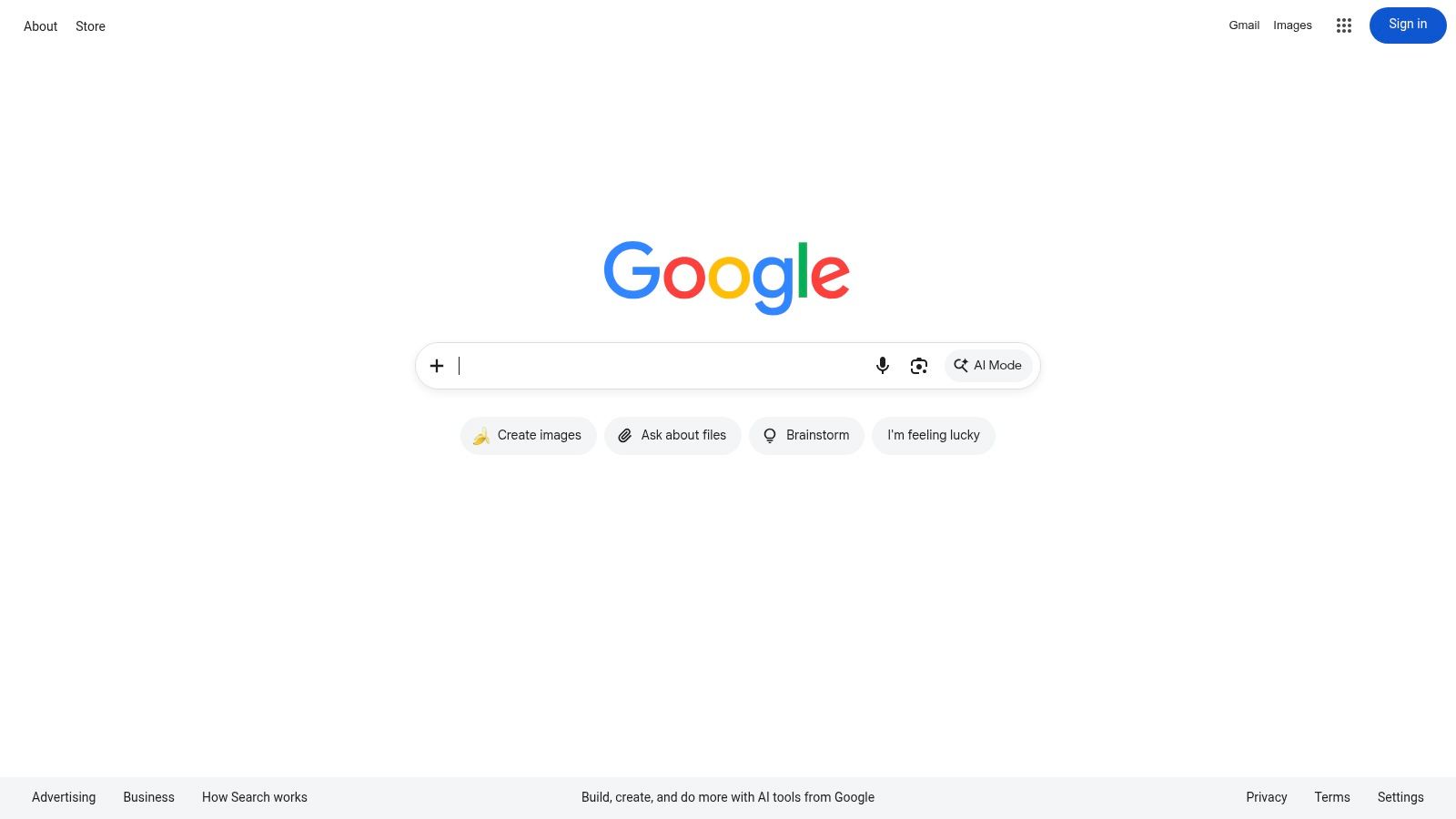
The weakness is control. AI Overviews don't appear for every query, and complex or unusual prompts can produce uneven answers. Teams should therefore avoid treating one Google response as a stable ranking position. AI search problems provides useful context for interpreting those inconsistencies without confusing an observed answer with a permanent rule.
3. Microsoft Copilot
Microsoft Copilot is most useful when the audience includes Microsoft users, office workers, or enterprise buyers. Its consumer experience presents web-grounded answers with citations, while Microsoft documents its relationship with Bing search and offers business integrations that can bring internal organizational information into the workflow.
For visibility testing, Copilot belongs in a B2B and enterprise query set. A SaaS marketer can test vendor comparisons, implementation questions, security topics, and product research. The key observation isn't whether a company appears. It is whether the answer links to the company's documentation, pricing pages, support material, or third-party coverage.
Where it fits
Copilot can be practical for general questions that sit between search and work. Microsoft 365 connections and enterprise controls may matter to organizations already operating in that environment. Those controls shouldn't be assumed to apply to every account. Enterprise features can depend on licensing, tenant configuration, and regional rollout.
The interface may also expose deeper search options or skill-like integrations in some contexts. Because availability changes, a testing record should include the account type, interface, date, and enabled features. Without that context, two teams can report different Copilot behavior and both be describing valid observations.
A useful Copilot audit includes:
- Web citations: Note whether a source was linked and whether the link supported the surrounding claim.
- Brand framing: Record whether the company was presented as a provider, comparison option, example, or omission.
- Asset coverage: Check whether documentation, PDFs, pricing pages, and support articles appeared.
- Uncertainty: Capture caveats, missing information, and requests for clarification.
Copilot is less suitable as a universal proxy for every AI search user. Its value is strongest when the target audience overlaps with Microsoft's search, browser, productivity, or enterprise ecosystem. That makes it a strategic test surface, not an automatic replacement for Google or Perplexity.
4. Brave Search with Answer with AI, Ask Brave, and Deep Research
Brave Search combines a privacy-focused search experience with AI Answers, conversational search, and deeper research options. Its independent index gives it a different source environment from tools that are commonly associated with Google's or Bing's web results.
That difference matters for source coverage testing. When a page appears in Brave but not in another engine, the finding can reveal an index or retrieval difference rather than a simple content-quality difference. Marketers should record those discrepancies instead of collapsing every result into one blended visibility score.
Useful controls for audit work
Brave lets users move between classic search and AI-assisted answers. That creates a clean comparison within one service. A team can run the same query with AI assistance enabled, inspect the cited sources, then review the conventional result set without synthesis. This helps separate source availability from answer presentation.
The service also presents developer-facing search and summarization options. Those are relevant when a company wants to build an internal prompt-testing workflow rather than inspect answers manually. The published Brave Search website should be used to verify current product names, access conditions, and API availability before implementation.
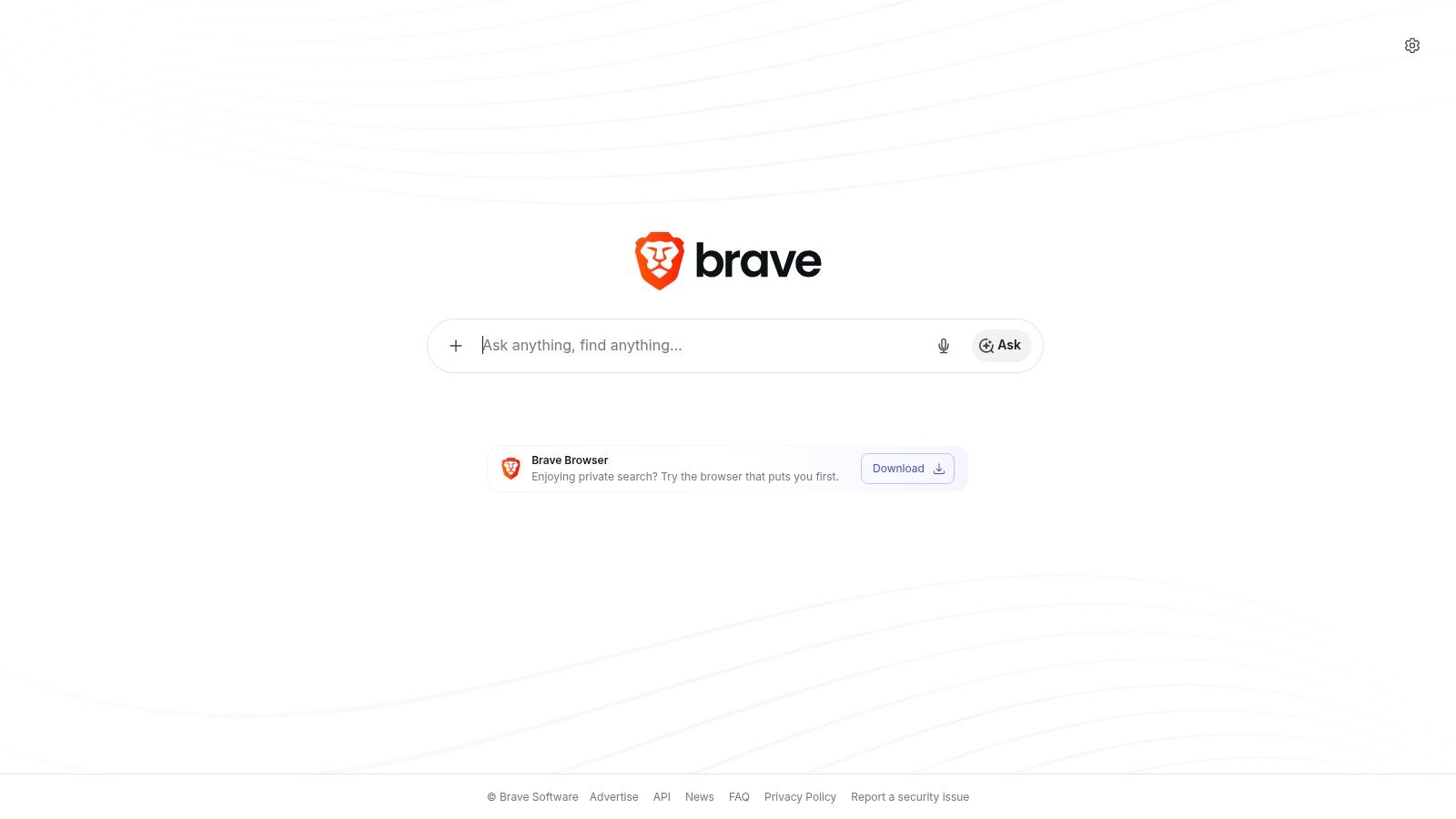
Brave can be slower for longer synthesized answers, and niche coverage may vary by subject. Those limitations are important for brand monitoring. A missing mention isn't proof that the brand lacks visibility across AI search. It may indicate that the query, index, or interface produced a narrower result set.
For research-grade citation work, Brave should still be checked against the original pages. Independent testing of citation-focused queries found that AI search engines failed to retrieve correct information in more than 60% of 1,600 queries, with failure rates ranging from 37% to 94% depending on the tool. The findings, including Perplexity's position as the best performer in that test, are reported in the citation-quality analysis. A cited link is evidence of retrieval, not proof that the answer is correct.
5. Kagi Search and Kagi Assistant
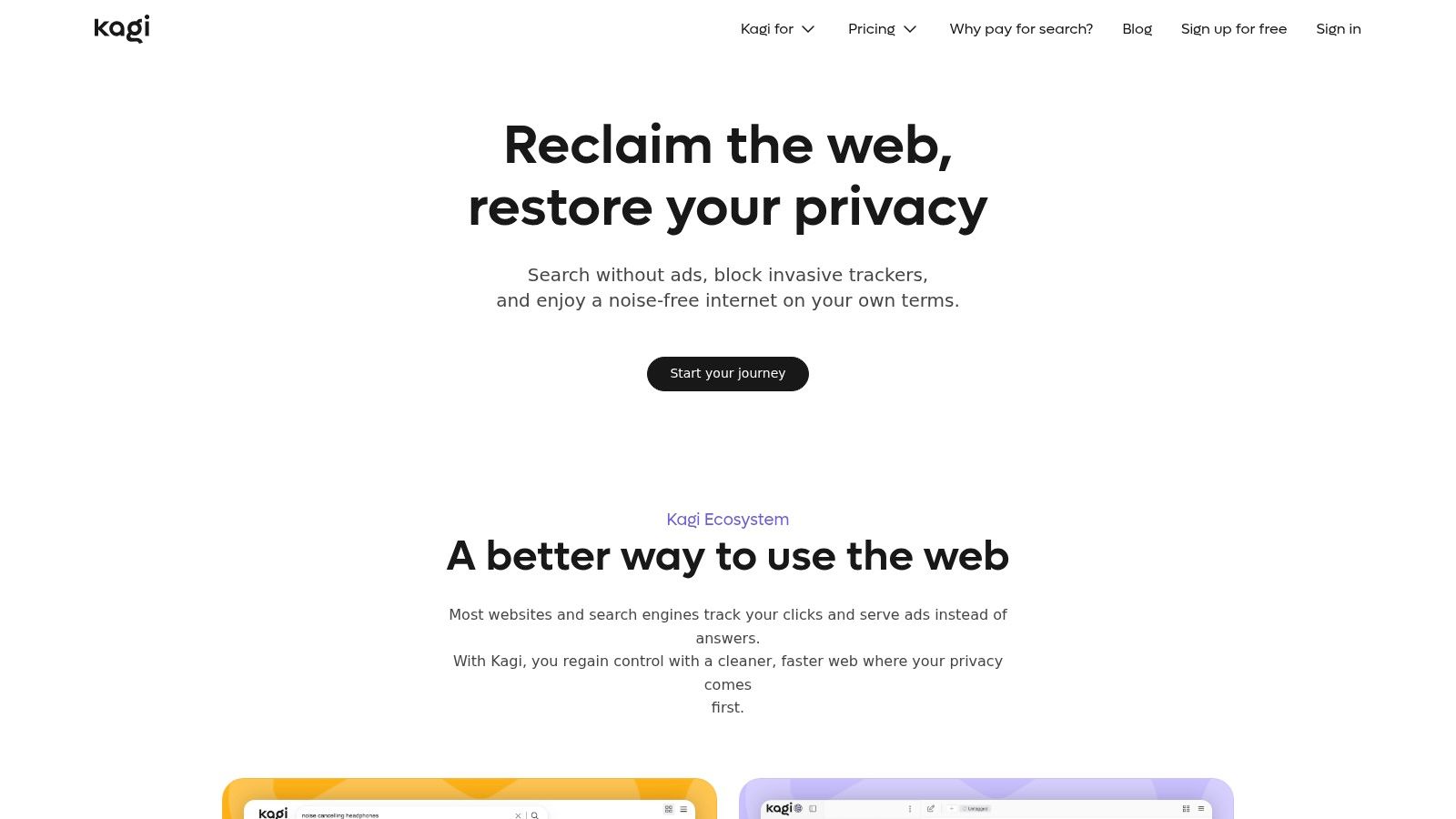
Kagi combines paid, privacy-focused search with an assistant that can access multiple models. For AI-visibility work, its main value is control over the retrieval environment. Lenses and result customization let researchers alter the source set before assessing an assistant's summary.
That makes Kagi particularly useful for controlled source discovery and prompt research. A marketer can narrow results by topic or source type, then compare those pages with the assistant's response. The comparison separates two possible causes of a missing brand mention: limited retrieval or a different synthesis of the available material.
Kagi suits researchers who want to adjust search settings instead of accepting one default results page. Its paid model also removes the ad-led context associated with mainstream engines, which can make source review more focused for some teams.
Coverage remains the main qualification. Gaps in very recent or obscure material may affect source discovery and brand monitoring. A missing result therefore cannot establish weak public visibility. Compare Kagi with at least one larger search index before treating an absence as a market signal.
A useful audit records three layers:
- Result controls: Note the active lenses and filters.
- Source set: Save the publishers and pages returned by ordinary search.
- Assistant output: Check which pages were used, cited, or omitted in the response.
This record also supports prompt research. Run the same visibility question with different lenses, preserve the wording and constraints, and compare changes in retrieved sources and brand framing. The useful finding may be that a prompt is sensitive to source selection rather than that one answer is universally representative.
Kagi is not the obvious first choice for broad market monitoring. It is better suited to examining source quality, query formulation, and citation behavior in an adjustable environment. Alternative search engines provides context for comparing privacy-focused and nontraditional search services.
6. You.com
You.com combines a consumer search interface with developer tools. Its web search, answer, contents, research, and finance research APIs support applications that need current web context, structured retrieval, or synthesized responses.
For AI visibility work, its value lies in repeatability. A developer can test a defined prompt set, collect returned sources, and compare whether a brand appears, which pages are cited, and how the answer frames it. The generated wording is only one layer. The stronger audit connects the prompt, retrieved pages, citations, and final brand description.
A practical fit for integrations
You.com may suit teams building internal research tools, agent workflows, or monitoring prototypes. Its platform materials include enterprise compliance options, but current access, data handling, and usage terms should be checked directly. Free credits, request limits, latency, and value at scale also require current vendor verification.
Its consumer interface is less established as a default navigation tool than Google or Microsoft. For visibility teams, that makes You.com more useful as an operational research component than as a proxy for broad consumer search behavior.
An API-based test should preserve four records:
- The exact prompt: Keep the wording, constraints, location, and date.
- The returned sources: Save URLs, titles, and source order where available.
- The answer claim: Record whether the brand appeared and how it was described.
- The repeat result: Run the query again later and document changes without assigning them to algorithmic causes.
This evidence supports several distinct tasks. Source discovery shows which publishers enter the answer. Citation review shows which pages support the response. Prompt research reveals whether wording changes retrieval or brand framing. Repeated runs can support monitoring, provided the team treats each result as evidence from that API configuration rather than a universal market signal.
The platform is especially relevant to SaaS companies assessing live-web context in their own products or reporting systems. Teams focused on broad public visibility should pair it with larger consumer search services, since API behavior alone cannot represent every search environment.
7. DuckDuckGo with optional AI Answers and Duck.ai
DuckDuckGo is useful for AI-visibility work because its AI features are optional. Conventional results remain available alongside AI Answers and the separate Duck.ai chat experience. This lets teams compare a brand's standard search visibility with its appearance in an AI-assisted response, instead of treating one interface as representative of every user.
Privacy-sensitive audiences are another relevant test group. Browser and app experiences emphasize privacy controls, while subscription bundles may add services and expanded AI access. Availability varies by platform and region, so each monitoring record should identify the device, interface, country, and account state used.
A two-layer visibility test
The key comparison is straightforward. A brand can appear prominently in conventional results yet be absent from an AI answer. The reverse can also occur when the answer draws on a page that was not prominent in the visible result set. Record both surfaces to separate mention tracking from source discovery and citation review.
A practical test should capture:
- Standard results: Save the visible ranking, brand mention, and relevant source pages.
- AI Answers: Record whether DuckDuckGo mentions the brand, cites a page, or adds a qualification.
- Answer framing: Compare how the AI response compresses, changes, or omits the brand's proposition.
- Prompt intent: Repeat the check with informational, commercial, navigational, and local wording.
Duck.ai can extend prompt research by showing how a conversational interface responds to the same topic, although its output should be logged separately from conventional search and AI Answers. That separation matters when assessing citations, source selection, and brand description.
Coverage and freshness may be weaker for niche queries than on larger engines. Interpret an omission as evidence about DuckDuckGo's interface, retrieval, and privacy-oriented audience, not as a universal conclusion about brand visibility.
DuckDuckGo belongs in tests aimed at privacy-conscious segments and at the difference between user-controlled AI exposure and AI-default search. It should receive less monitoring weight when those conditions do not match the audience being measured.
8. Arc Search with Browse for Me
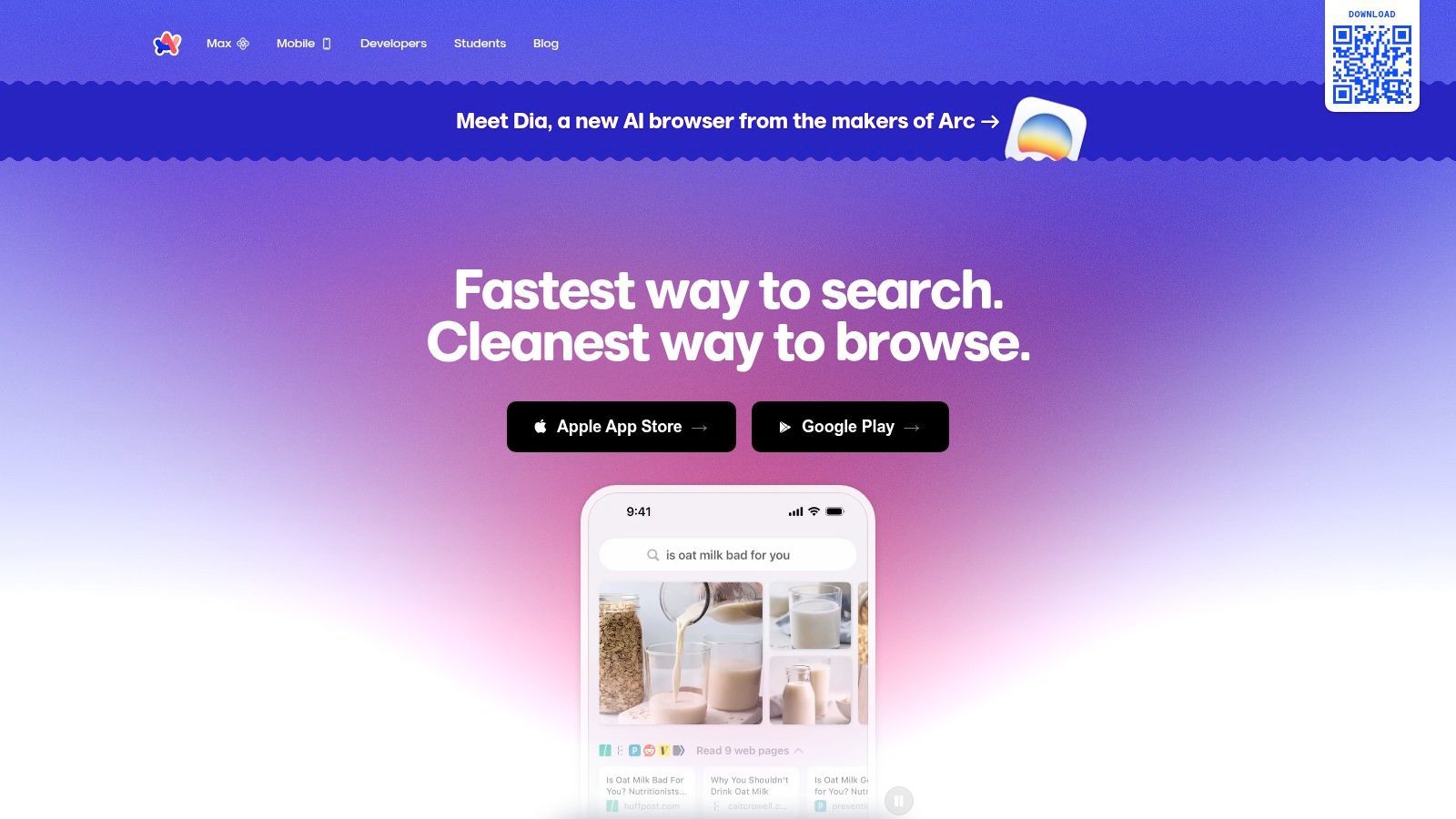
Arc Search is a mobile-first search experience built around Browse for Me, which produces a synthesized page from multiple web sources. Its appeal is speed and presentation. A user receives a compact digest with links instead of moving through several tabs.
For brand testing, Arc is useful when the audience uses mobile research for quick overviews. A marketer can ask a product, travel, local, or comparison question and record whether the brand appeared in the digest, which pages were linked, and whether the summary preserved the brand's key qualification.
A different visibility surface
Arc's shareable answer pages make the output easy to pass between colleagues. That can help teams preserve an observed response during a monitoring cycle. The shared page should still be treated as a snapshot. It doesn't establish that every user received the same answer or that the result will remain unchanged.
The product also includes voice search and mobile gestures such as summarization. Those features make it useful for quick research, but they don't turn it into a full citation-audit platform. A marketer checking source quality should open the linked pages and verify whether they support the digest's claims.
Arc's mobile focus creates a clear boundary. Desktop parity depends on the wider Arc ecosystem, and users may encounter variation with VPNs or app link handling. Those conditions should be captured in a test log because they can affect the route from answer to source.
A digest is a convenient research artifact, not a substitute for reading the cited page.
Arc belongs in a mobile audience test, especially for brands whose discovery journey starts with short, practical questions. It has less value as the only engine in a broad SEO monitoring program. Its best contribution is showing how a source-backed summary is experienced when users want a quick answer rather than a research workspace.
9. Andi AI Search
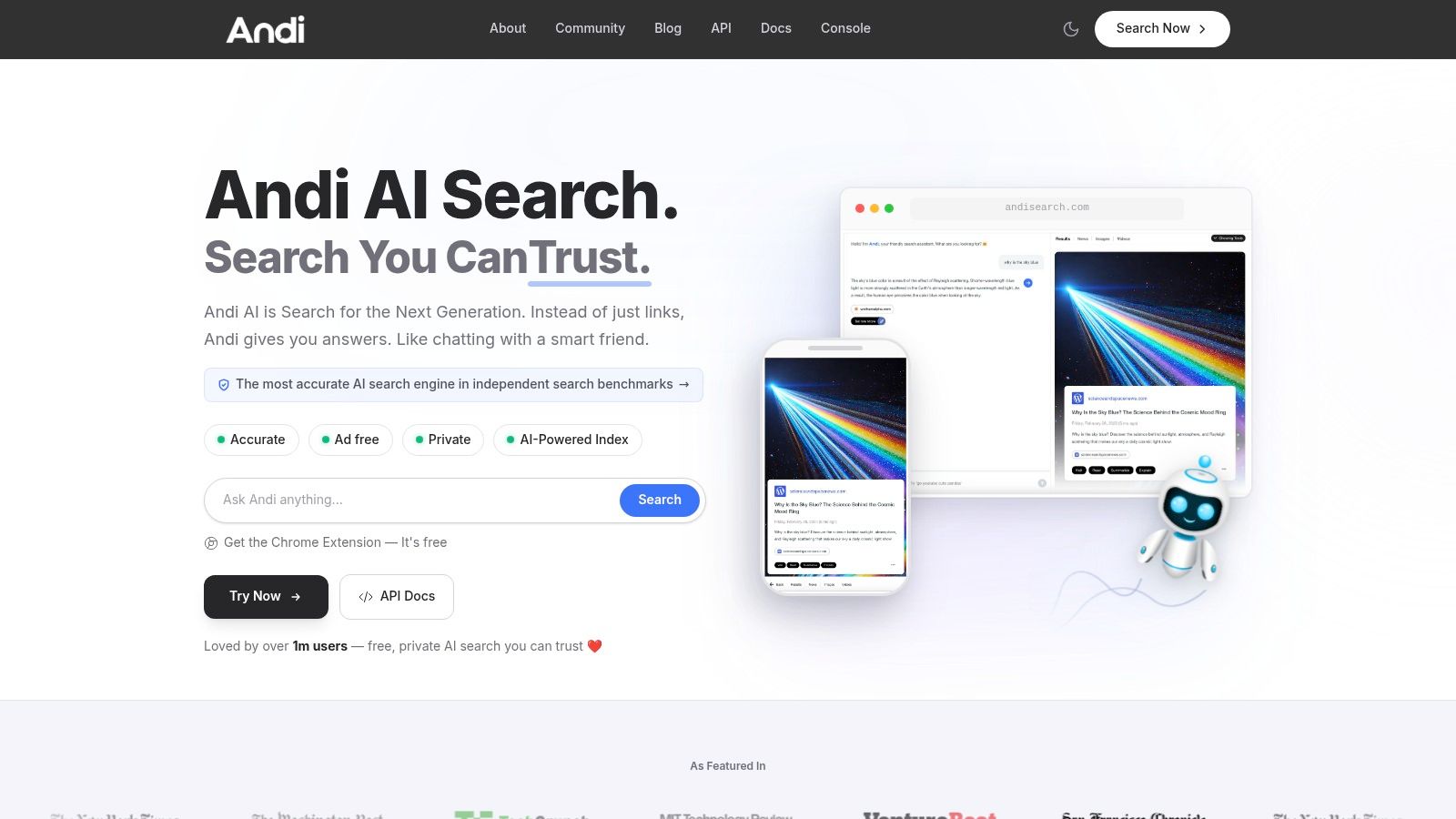
Andi AI Search is useful for a narrow AI-visibility check: enter a factual query, inspect whether a brand or source appears, then follow the citation. Its lightweight interface keeps the observation clear, with fewer workspace features than larger search products. That makes it practical for manual checks of mentions, citations, and source discovery.
The product's value is diagnostic rather than all-encompassing. A small team can record the query, answer, brand mention, cited page, and visible uncertainty without setting up an extensive research workflow. The same simplicity limits what the test can reveal about more complex prompts, repeatable monitoring, or broader market coverage.
Use Andi to answer four practical questions:
- Mention checks: Does a concise answer include the brand, product, or source?
- Citation review: Does the linked page support the wording and scope of the answer?
- Prompt research: How does a minimal interface respond to factual variations of the same question?
- Brand monitoring: Does the brand appear consistently enough to justify comparison with other engines?
Andi's smaller team and index produce a different coverage profile from Google, Bing, and other large search environments. Limited project, file, and model-selection features also reduce its usefulness for assembling extended research. Those constraints matter when deciding whether to include it in a recurring monitoring program or use it only for exploratory tests.
Its published benchmark material may provide context, but performance claims still require checking on the specific page and against the benchmark's subject. Recognition or an external comparison does not establish current performance for a particular industry or query set.
A citation should be opened and checked, not accepted because it appears beneath an answer. Andi can make manual visibility checks accessible, but it is not a proxy for the wider AI search market. Compare absence or presence with other engines before changing content or reputation strategy.
10. Consensus
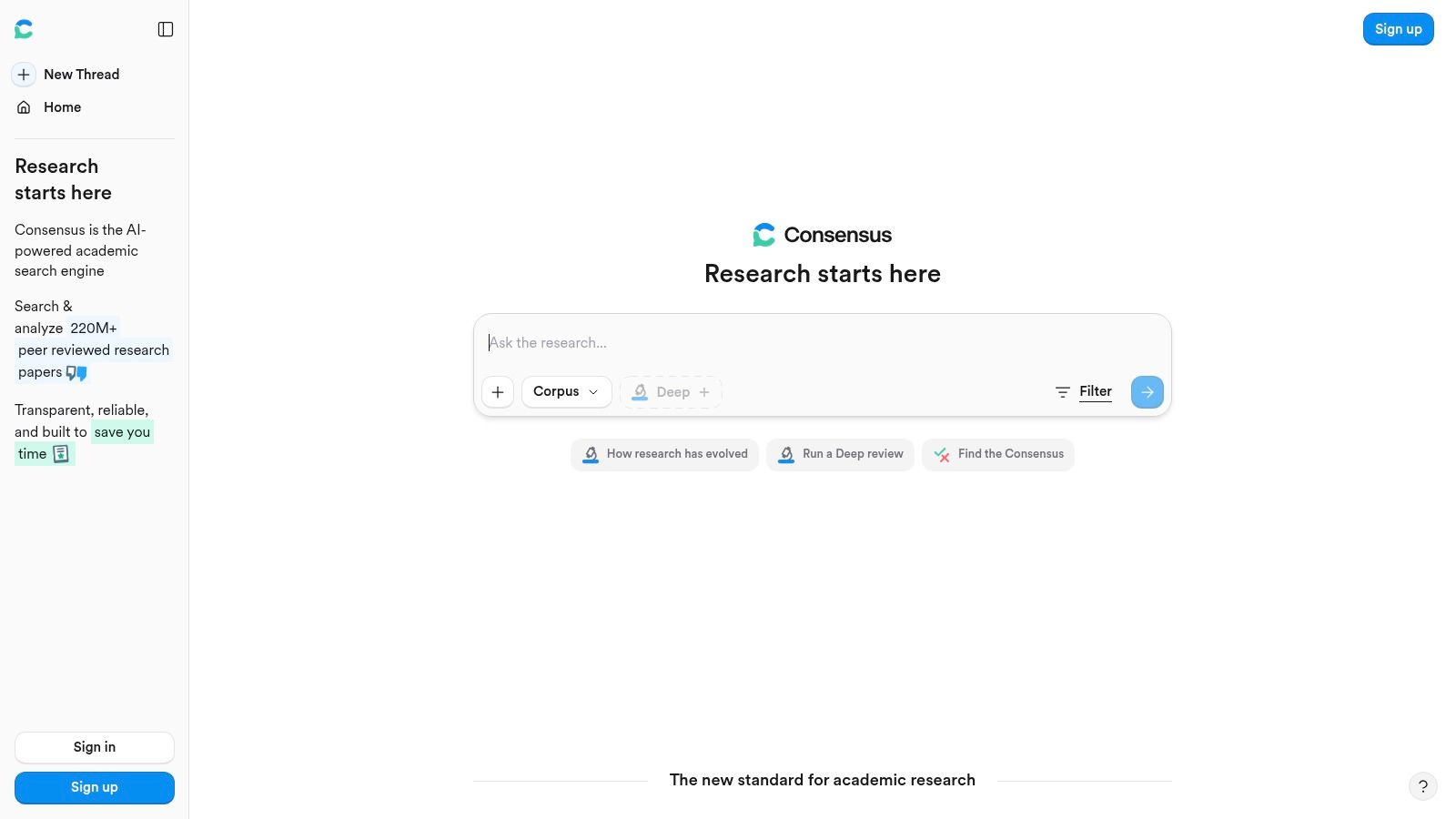
Consensus is a research-focused resource for scientific literature, not a general web search engine. Its paper search, AI summaries, study snapshots, review workflows, and research integrations support a narrower question: does a claim connect to published evidence?
That focus makes Consensus useful for healthcare, biotech, education, and scientific SaaS teams. It can support evidence discovery, literature triage, and claim verification, while offering little coverage for broad consumer brand mentions, product visibility, or open-web reputation checks.
Evaluate the evidence, not just the citation
Consensus uses the paper as its primary source unit. Reviewers should examine the study context, methods, findings, and limitations, then compare the original paper with the wording produced in the summary. A commercial page may turn a qualified research result into a broad product claim, so citation presence alone does not establish support.
The platform also offers API and MCP-style integrations for research workflows. Teams should confirm current access, full-text availability, and plan limits on the Consensus website before building a recurring process. Lower-tier plans may restrict deeper review work.
Consensus has limited value for four visibility tasks:
- General brand monitoring: Its corpus is not designed to measure consumer-search mentions.
- Competitor discovery: Product, category, and market searches require broader indexes.
- Local research: Scientific coverage does not indicate local business visibility.
- Open-web source auditing: Paper-focused retrieval addresses a different source set.
For AI-visibility work, Consensus is a specialist check rather than a market-wide monitor. Use it when a brand's positioning depends on scientific support, and compare the answer with the underlying paper. The practical test is whether the evidence fits the claim, remains relevant to the intended audience, explains its methods clearly, and is represented without overstating the finding.
Top 10 AI Search Engines: Side-by-Side Comparison
| Engine | Best for / Use case | Source grounding & citations | Target audience | Unique selling point | Pricing / access |
|---|---|---|---|---|---|
| Perplexity | Exploratory research & multi-step synthesis | Inline, source-backed citations; model picker on Pro | SEOs, content researchers, agencies | Pro/Copilot modes, projects & research workflows | Free + Pro tiers (model choice, limits) |
| Google Search (AI Overviews / AI Mode) | Mixed-intent discovery, shopping & local queries | Gemini-powered syntheses with verification links | Broad marketers, local & ecommerce SEOs | Massive index + integrated verticals (shopping/local) | Free (features roll out progressively) |
| Microsoft Copilot (Bing) | Web-grounded chat + productivity workflows | Bing grounding with citations; integrates M365 data | Enterprise users, Office-centric teams, SEOs | Tight Microsoft 365 integration and enterprise controls | Consumer & enterprise licensing; gated rollouts |
| Brave Search | Privacy-first AI answers and research | Verifiable sources from an independent index | Privacy-minded marketers, developers | Independent index + easy AI toggle and APIs | Free core; paid premium features |
| Kagi Search (+ Assistant) | Power-user, customizable search & ranking | Transparent result controls; assistant with multi-model access | Consultants, power users, developers | Lenses for custom ranking; ad-light paid model | Paid subscription; API available |
| You.com | Chat-style search + developer APIs for agents | Web-grounded snippets & citations for APIs | Developers building agents, startups | Turnkey APIs and free credits for prototyping | Free tier + paid research/enterprise plans |
| DuckDuckGo (Search + Duck.ai) | Traditional SERP with optional AI; privacy-first | Optional AI Answers in Search; separate Duck.ai chat | Privacy-focused users, small businesses | Clear user controls for AI; strong privacy stance | Free; optional Plus subscription bundles |
| Arc Search ("Browse for Me") | Mobile-first synthesized overviews & shareable digests | Synthesizes multiple pages into one cited answer page | Mobile researchers, on-the-go SEOs | Mobile gestures (voice, pinch-to-summarize); shareable digests | Free within Arc browser; ecosystem features vary |
| Andi AI Search | Fast, minimal UI factual lookups | Direct cited summaries; published benchmarks | Users wanting quick factual answers, reviewers | Minimal clutter and speed; benchmark-transparent | Free core |
| Consensus | Evidence-led literature search & summaries | Built over peer‑reviewed papers with "Study Snapshots" | Healthcare researchers, evidence-driven teams | Purpose-built scientific corpus and transparent sourcing | Free + Pro tiers; API and caps on lower plans |
Turn the Shortlist Into a Repeatable Test
A shortlist becomes useful only when a team can compare observations consistently. The first step is to define the audience and task. A local service, ecommerce brand, and B2B SaaS company shouldn't use the same prompt set. Each needs queries that reflect how its buyers ask for recommendations, comparisons, alternatives, evidence, and practical help.
The query set should include brand-led and category-led prompts. It should also include competitor comparisons, problem-led questions, product-intent questions, navigational searches, and location-specific variants where relevant. The wording needs to remain fixed during a test cycle. If the prompt changes, the record should treat it as a new test rather than a failed repeat.
Record the answer, not just the mention
For every engine, save the date, interface, account context, prompt, and visible response. The core fields are straightforward:
- Brand presence: Record whether the brand appeared, was omitted, or was mentioned only in a comparison.
- Citation details: Save every linked URL that supported the answer, not only the publisher name.
- Answer framing: Note whether the brand was described as a recommendation, example, alternative, market leader, specialist, or caution.
- Source coverage: Record which publishers, content types, and first-party pages appeared.
- Uncertainty signals: Capture caveats, missing information, conflicting claims, and requests for clarification.
- User path: Note whether the interface exposed links, follow-up prompts, shopping features, local results, or a shareable digest.
This record separates mention visibility from citation visibility. It also prevents a common analytical mistake. A brand can appear often while receiving weak source support, or appear less often while being tied to a highly relevant page. Those are different outcomes and need different actions.
Citation reliability deserves its own review. Independent testing found that AI search engines failed to retrieve correct information in more than 60% of 1,600 citation-focused queries, with tool-level failure rates from 37% to 94%. The result is a reason to verify original pages, not a reason to abandon citations. Citation presence and citation accuracy are separate fields in the test log.
Compare by engine and query type
Teams shouldn't declare a universal winner from one prompt or one visibility score. A market snapshot reported ChatGPT at 80.1% of AI search traffic, while the same source set reported that roughly 41% of UK internet users aged 16 and older used generative AI in the past year, and 48% of UK adults used AI-assisted tools to find information. Those figures from the SEO Works AI SEO statistics summary describe different measures, so they shouldn't be merged into one market conclusion.
Source overlap also varies across AI search surfaces. One 2026 analysis found cited-source overlap ranging from 16% at the low end to 59% at the high end, as reported in the AI search citation quality review. The practical implication is that a page absent from one engine isn't automatically invisible everywhere.
A useful reporting cycle groups findings by task. Review recommendation prompts separately from factual prompts, scientific questions, local searches, and product comparisons. Then connect each observation to an action. Improve a page when the answer cites an outdated or incomplete source. Build third-party coverage when competitors repeatedly appear through external publishers. Clarify product attributes when answers omit information that is easy to verify on the site.
For teams that need ongoing tracking of AI visibility, citations, recommendations, prompt research, and reporting, The AI Search Signals is one relevant resource to evaluate against those requirements. Its published website is the verification point for current coverage and capabilities.
The most defensible outcome isn't a single top AI search engine. It's a documented view of which engines matter to the audience, which sources they surface, how they frame the brand, and where the evidence fails. Teams should run the same prompt set monthly, review material changes manually, and assign a content, technical, or reputation action to each confirmed gap.
SEO and content teams should start with a small fixed query set, test the engines that match their audience, and record URLs and answer framing before changing strategy. Build that baseline now, then use the results to decide which pages, sources, and monitoring workflows deserve deeper investment.