The most popular advice here is wrong. There isn't one best AI visibility product for every team, because the buying decision is about the problem being measured. Some teams need Google AI Overviews governance, some need broader assistant visibility, some need enterprise reporting that reaches leadership, and some just need a practical layer on top of rank tracking.
That's also why the phrase what are the best AI visibility products needs a narrower answer than most roundup posts give it. AI visibility is now a measurement problem, not just a screenshot problem. A recent paper on AI search visibility argues that practitioners should run at least 7 prompt repetitions per day for brand monitoring, and at least 8 runs when source-level coverage matters, because single outputs are too unstable to represent sustained visibility. The same paper frames visibility as the frequency and prominence of brand mentions in generated answers and treats these tools as sampling systems, not simple dashboards. AI search visibility paper
1. BrightEdge for enterprise AI Overview governance
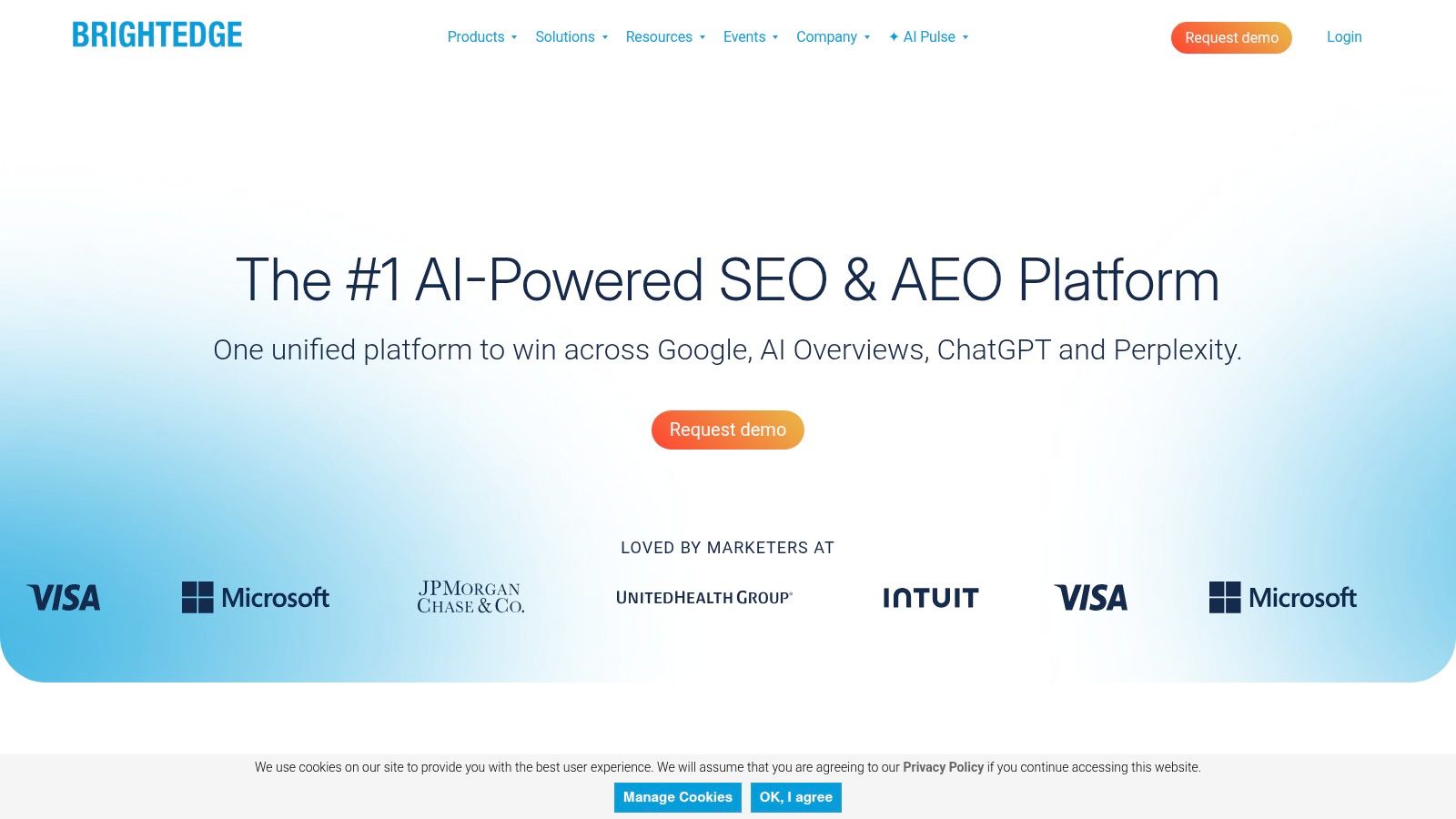
BrightEdge makes the most sense when the question is not just whether a brand appears in AI answers, but how that visibility fits into an enterprise SEO program. Its AI search reporting sits beside classic search workflows, which matters because teams still need one operating view for keyword coverage, competitor movement, and executive reporting. The platform's website is the right place to verify current packaging and scope. BrightEdge
Why it fits enterprise governance
BrightEdge is strongest for teams that want AI Overview monitoring tied to existing SEO governance, not bolted on as a separate novelty layer. In the enterprise setting, that matters because visibility work usually has to travel through dashboards, approvals, and reporting cadences before anyone can act on it. The platform's documented AI visibility work fits that model better than a lightweight tracker.
The broader market context also supports that enterprise framing. AI observability tooling is expanding quickly, with market reports valuing the category at USD 1.5 billion in 2026 and projecting USD 3.6 billion by 2035 in one report, and another placing the broader market at USD 1.24 billion in 2025 and USD 12.75 billion by 2032. Those numbers don't prove product quality, but they do show where budget is moving. AI observability tools market report
Practical rule: choose BrightEdge when leadership wants AI visibility measured inside an established SEO operating model, not in a separate analyst sandbox.
2. Semrush One for unified SEO and AI visibility reporting
Semrush One is the cleaner choice for teams that already live inside Semrush and want AI visibility folded into familiar SEO workflows. Its AI Visibility Toolkit says the AI Visibility Score measures how often a brand is mentioned in AI-generated answers versus the median mentions of top industry competitors, and it supports worldwide or region-specific analysis. That comparative framing is useful because AI answer systems don't expose stable keyword rankings the way classic search does. Semrush AI Visibility Toolkit
The value here is workflow continuity. Teams can move from keyword and domain analysis into AI visibility without changing vendors, which reduces friction for SEO leads who need reporting they can hand to stakeholders without translating between systems. Semrush also documents AI visibility inside broader analytics rather than as a standalone curiosity, so the reporting context feels closer to standard SEO operations.
Where it is a better fit than a specialist
The trade-off is depth. Semrush One is well suited to teams that want broad competitive and keyword context around AI visibility, but it is not the most specialized option for source-level governance or broader LLM monitoring. The category itself is moving toward citation and competitive intelligence, and a 2026 market report says citation and source tracking plus competitor AI visibility analysis accounted for about 25.3% of generative engine optimization platform revenue in 2025. That supports the view that the most valuable layer is still the one that can tie visibility to competitive positioning. Generative engine optimization platform market report
The AI Search Signals roundup on AI visibility software is useful if the team wants a second editorial lens on how this category is being packaged.
3. Conductor for AI search performance and content workflow
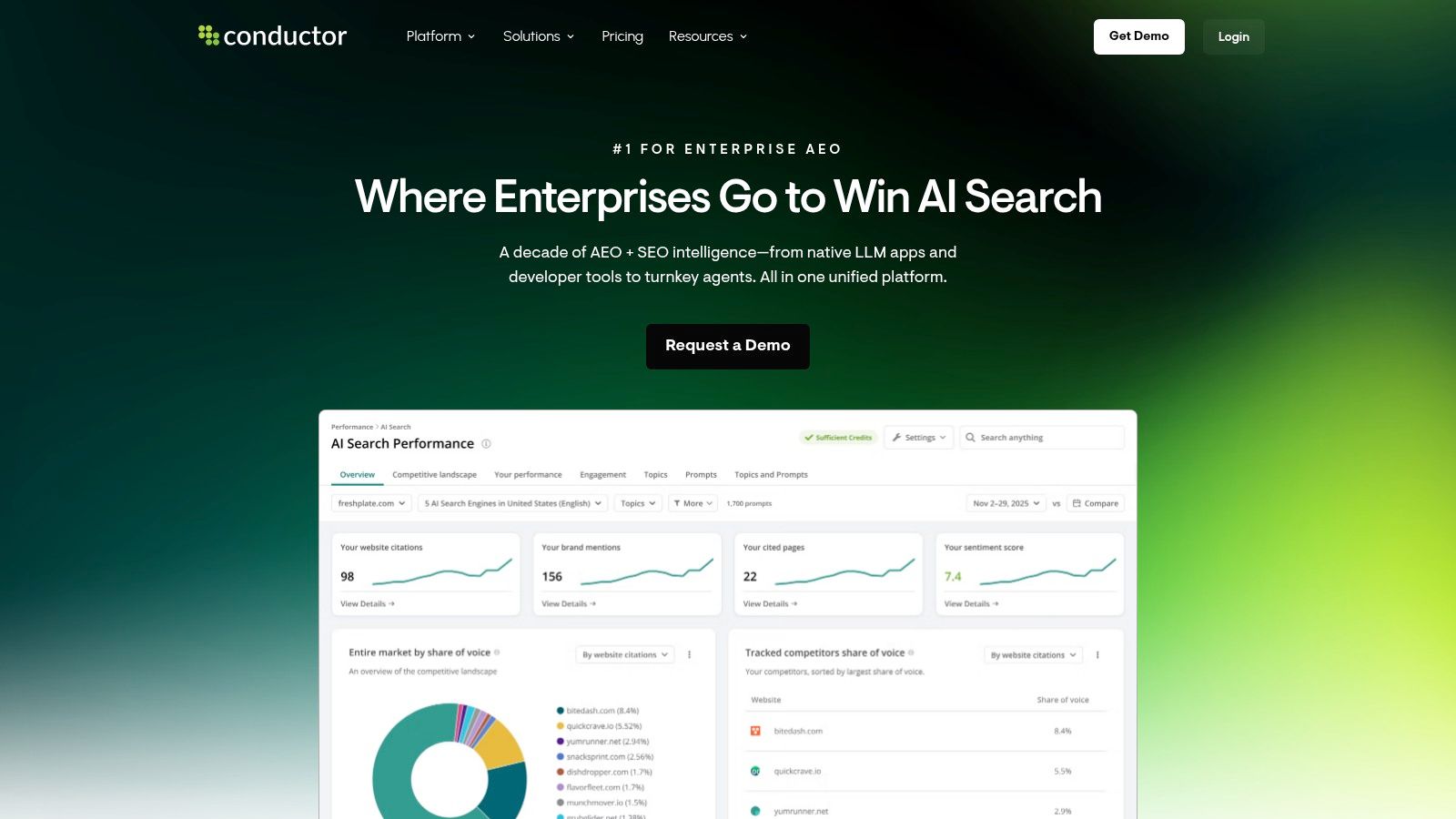
Conductor stands out when the problem is not only measurement, but what happens after the measurement. Its AI Search Performance module is built around brand share-of-voice, mentions, citations, and sentiment across ChatGPT, Perplexity, Google AI Overviews, and AI Mode, then links those signals to content workflows on the platform. That combination makes it more suitable for enterprise content teams than for buyers who only want a reporting layer. Conductor
Measurement that points to action
Conductor's appeal is that it treats AI visibility as something that should feed directly into editorial decisions. That matters because many vendors now sell prompt quotas and dashboards, but fewer platforms connect answer-engine measurement to content creation and governance. The market gap is clear enough. Independent comparisons describe a category where many products are converging on monitoring, while fewer offer strong optimization workflows beyond measurement.
Practical rule: if the team needs one environment for reporting, collaboration, and content follow-through, Conductor is closer to that operating model than a passive tracker.
The enterprise trade-off
The downside is also clear. Smaller teams may not need this much process, and pricing is not publicly listed. The editorial question is whether the platform helps teams move from visibility to execution, and Conductor is one of the few tools in this set that appears built around that loop. For buyers comparing enterprise suites, that distinction matters more than a polished dashboard.
The AI Search Signals article on AI search problems is a relevant companion piece if the team is trying to separate measurement issues from execution issues before buying.
4. Similarweb for AI visibility tied to traffic and demand
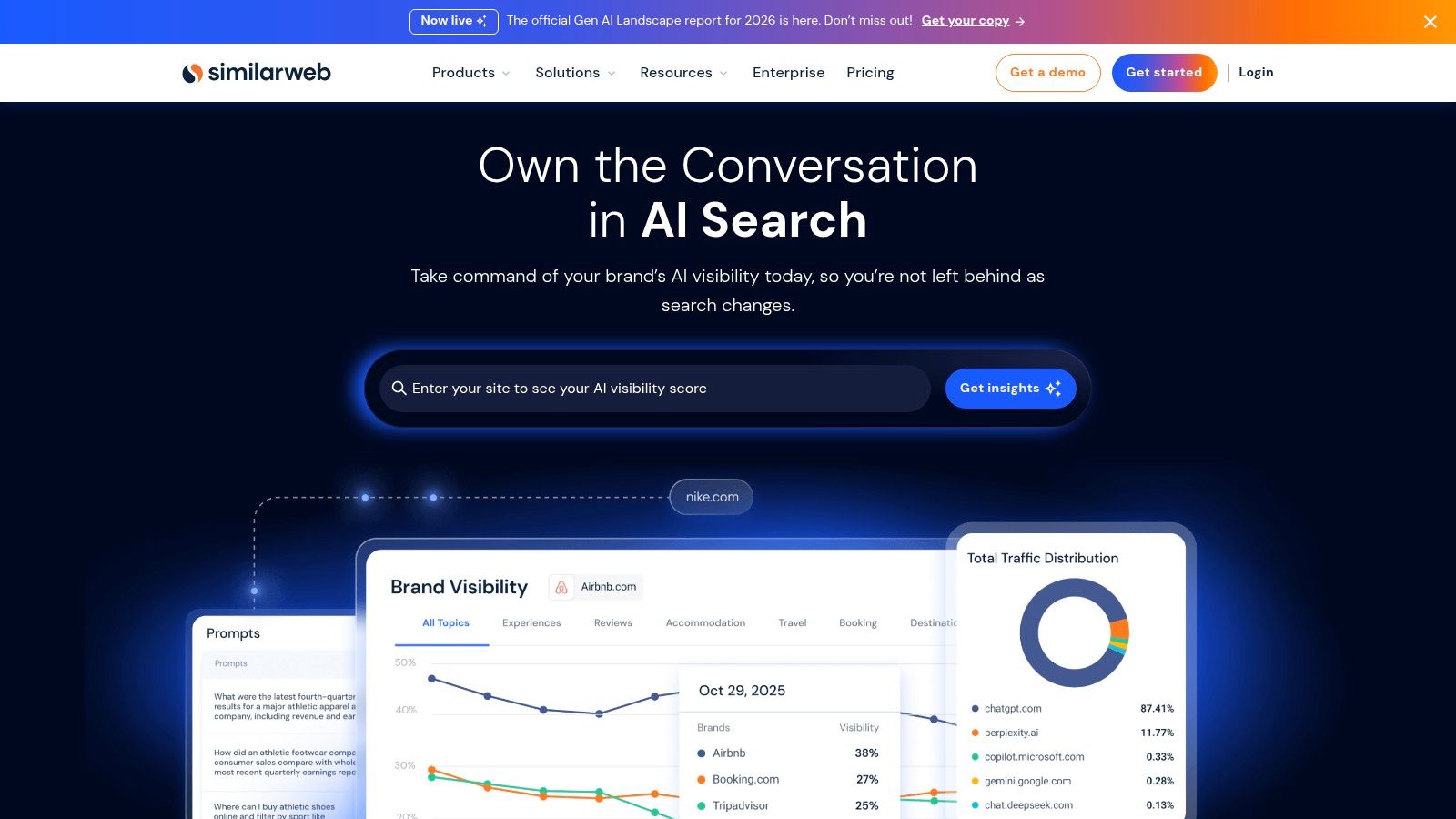
Similarweb is the strongest fit when the question is bigger than brand mentions. Its Gen AI Intelligence offering connects brand visibility in LLMs with citations, sentiment, and AI Traffic views, which gives strategy teams a way to place AI exposure beside traffic and demand signals. That makes it useful for executives who want to know whether AI visibility is showing up alongside broader market movement. Similarweb Gen AI Intelligence
Best for strategy, not page remediation
Similarweb's strength is macro visibility. Country-level and category-level benchmarking make it easier to compare where a brand is appearing across markets, and the API story is more mature than many point solutions. That said, the platform is less obviously built for page-level remediation than SEO-first suites. Teams looking for a direct fix list after a visibility gap will probably need another layer.
This is the right product when leadership wants a single view that links AI mentions to broader digital demand. The platform sits closer to market intelligence than to rank tracking, which is exactly why it belongs on this list.
The AI Search Signals piece on AI traffic analytics is the right reference point if the team is deciding whether traffic context matters more than answer-engine detail.
5. SE Ranking for practical AI Overview tracking
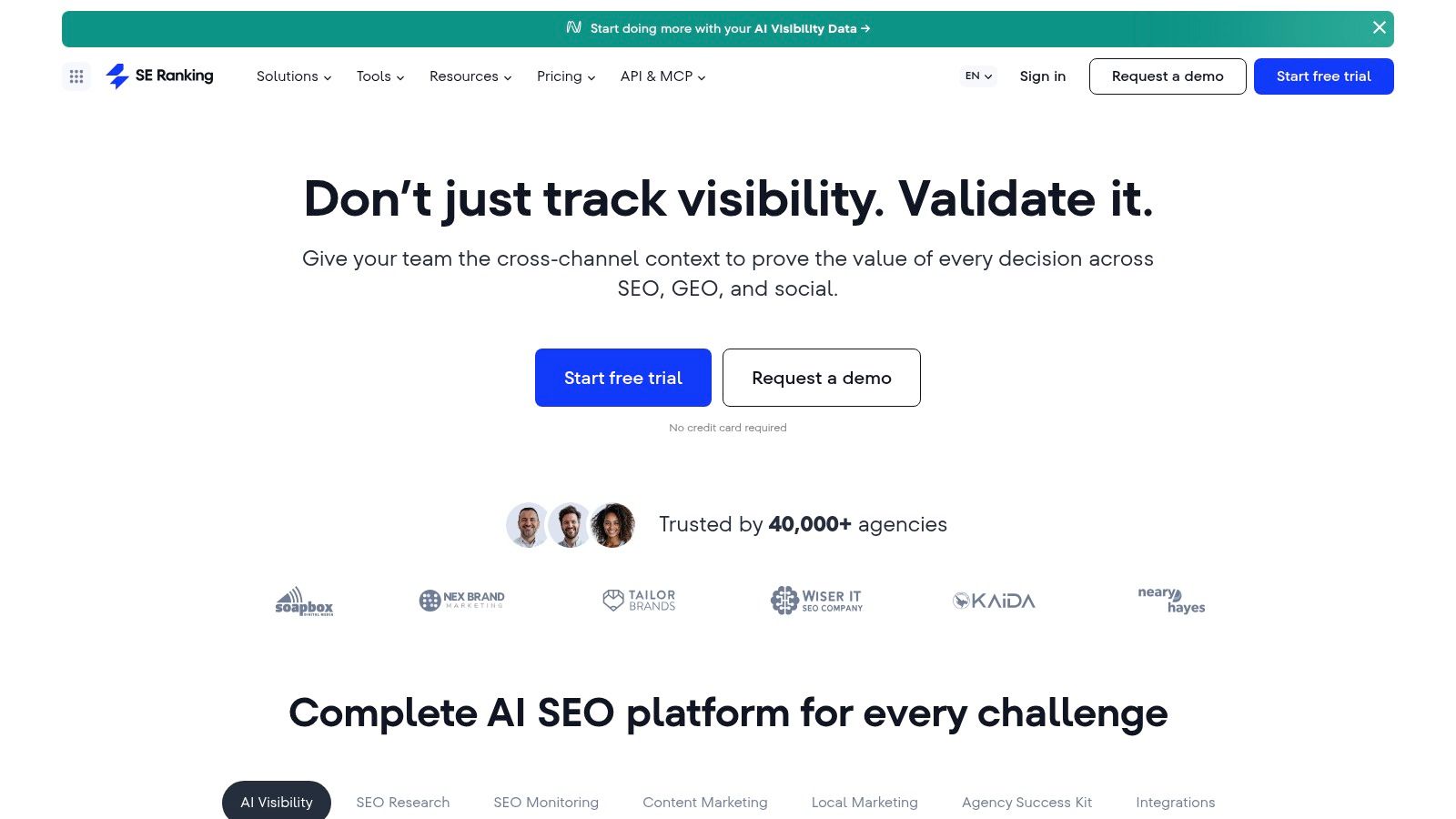
SE Ranking fits the mid-market buyer who wants Google AI Overviews visibility without an enterprise contract. Its AI Overviews Tracker detects when AI Overviews appear for tracked keywords and shows how a site appears within those summaries. That is a practical step up from classic rank tracking for agencies and SMB teams that need something deployable now. SE Ranking
The value of keeping it simple
This is one of the clearest “add AI visibility to the workflow you already have” options. SE Ranking pairs AIO tracking with audits, content tools, and reporting, which keeps the daily operating model familiar for smaller teams. It's not trying to become the system of record for every AI surface, and that restraint is part of the appeal.
The trade-off is narrower coverage. It is primarily a Google-focused solution, so teams that need broader LLM monitoring will outgrow it faster than they would a more enterprise-oriented suite. Still, for many agencies, the first visibility problem is knowing when AI Overviews appear and whether the site is represented there.
Practical rule: if the budget is mid-market and the goal is to add AIO tracking to existing rank reporting, SE Ranking is one of the most efficient starting points.
6. seoClarity for unified SEO and AEO coverage
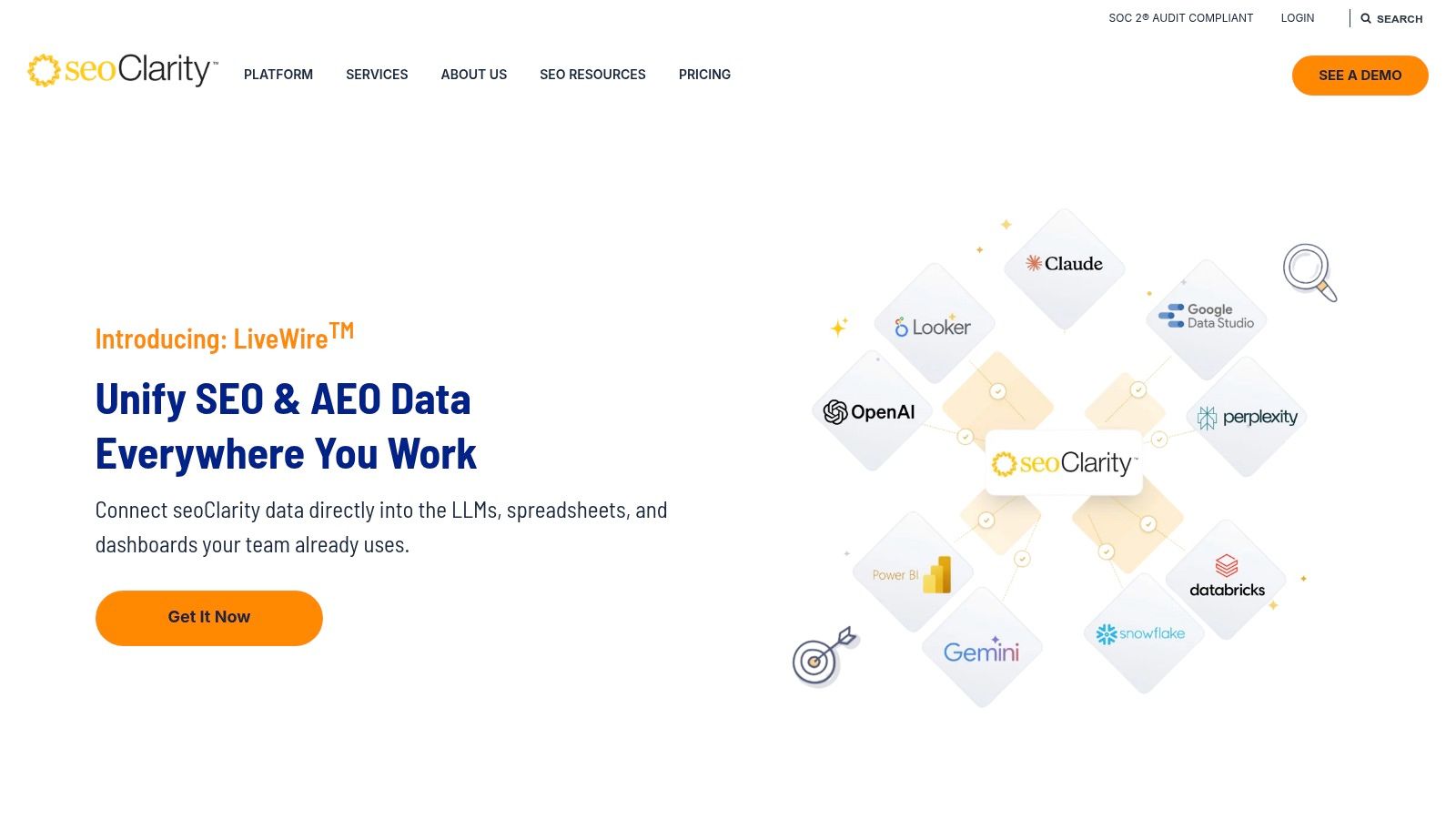
seoClarity is the choice for teams that want AI visibility inside a larger technical SEO stack. The platform treats AI Overviews as a SERP feature and includes tracking that evolved from early SGE monitoring, which gives it a strong bridge between classic search operations and newer answer-engine work. seoClarity
Good for technical teams that want one system
The main advantage is breadth. seoClarity gives technical SEO, content prioritization, and AI discoverability a place in the same platform, which is helpful when the team already standardizes around it for rank intelligence. That integrated structure matters because AI visibility problems often show up next to crawl, content, and entity issues.
The limitation is that LLM-level brand and citation analytics are lighter than what specialist AI visibility tools usually emphasize. Buyers should treat it as a unified SEO and AEO platform first, not as a pure AI answer-engine intelligence product. That's not a weakness if the team values operational simplicity over deep platform sprawl.
The AI Search Signals explanation of AI search problems is a useful adjacent read for teams trying to decide whether they need unified SEO coverage or a more specialized visibility stack.
7. AccuRanker for fast rank tracking with AI Overview monitoring
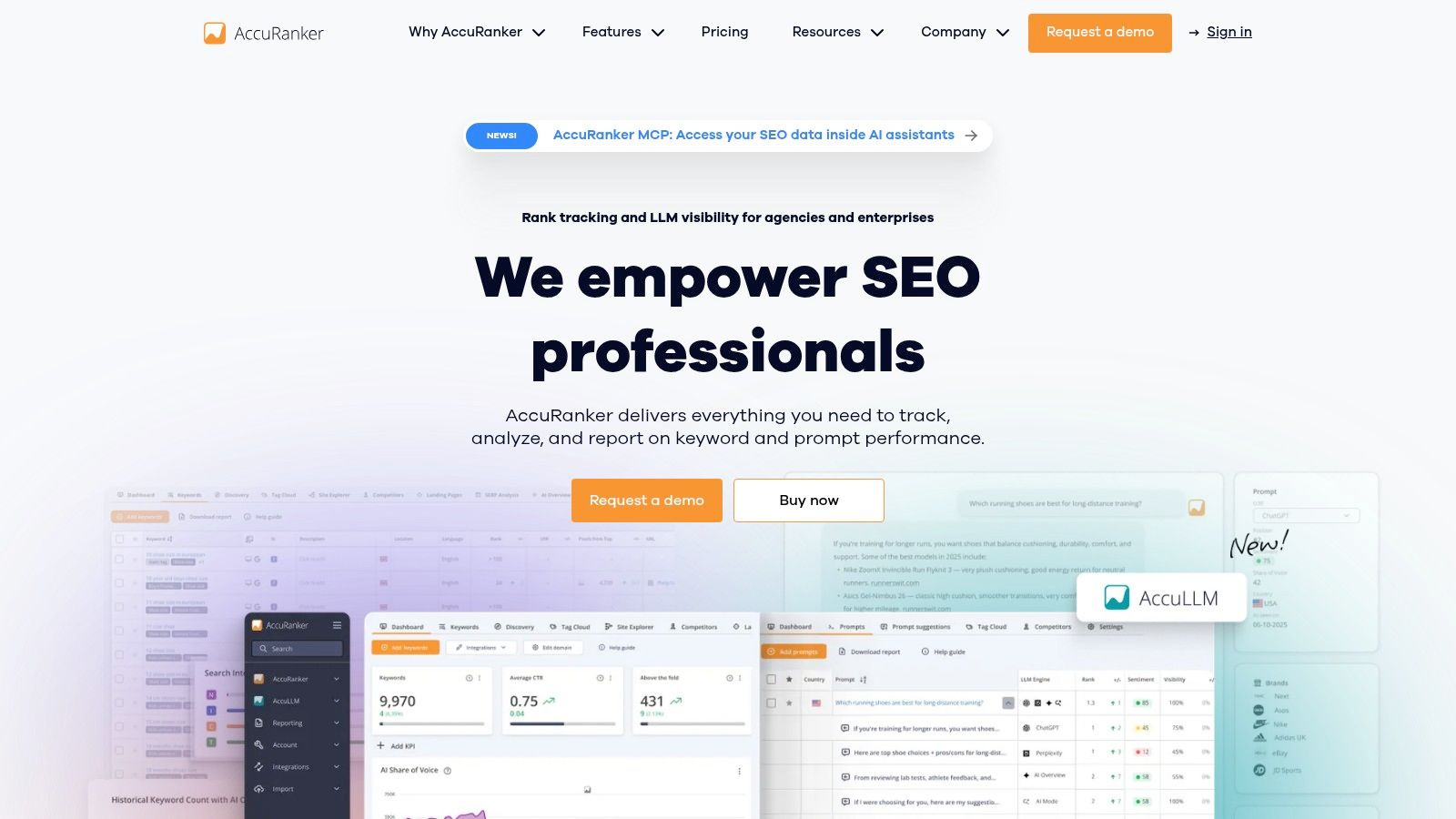
AccuRanker is the best fit for teams that still think in rank-tracking terms but want a reliable AI Overview layer on top. It adds an AI Overview page to monitor AIO presence and related SERP dynamics, and it keeps the reporting style close to what agencies already understand. AccuRanker
A practical option for agencies
The appeal is speed and flexibility. High-frequency updates, winners-and-losers views, white-label options, and API support make it a natural fit for agency reporting and quick internal reviews. It also has transparent, tiered pricing and a trial-friendly policy, which lowers the barrier for teams that want to test workflow fit before committing.
The limitation is scope. The AI Overview layer is narrower than full AI visibility suites, so teams that need broader LLM coverage or stronger remediation guidance will probably need a more complete platform. Still, for many search teams, the first useful step is not a grand observability system. It's a dependable way to see how AI Overviews intersect with the keywords they already track.
AI visibility tools work best when the measurement model matches the decision the team needs to make.
Top 7 AI Visibility Platforms Comparison
| Product | Implementation complexity | Resource requirements | Expected outcomes | Ideal use cases | Key advantages |
|---|---|---|---|---|---|
| BrightEdge – Enterprise SEO and AI Search Platform | High, enterprise setup and integrations | Large teams, enterprise budget, longer deployment | Market-level AIO benchmarking, executive dashboards, citation visibility | Large organizations needing governance and scale | Deep AIO research, citation tracking, executive-ready reporting |
| Semrush One – AI Visibility + SEO Suite | Moderate, integrates into existing workflows | Mid-to-large teams, subscription (some features on higher tiers) | Unified AI + SEO reporting, cross-report insights | Teams wanting single-vendor SEO + AI analytics | Familiar toolset, broad keyword/competitive context, GSC/GA integrations |
| Conductor – AI Search Performance (AEO Platform) | High, module-based enterprise deployment | Enterprise content/SEO teams, API/integration work | Measurement→recommendation→content workflows, SOV and citation mapping | Enterprises needing guided execution and governance | Built-in content workflow linkage, admin controls, API access |
| Similarweb – Gen AI Intelligence (AI Brand Visibility + Traffic) | Moderate–High, data integration and API usage | Enterprise budgets, analytics resources for traffic correlation | Macro AI visibility tied to traffic and demand trends by region | Strategy, benchmarking and executive demand analysis | Strong traffic/demand correlation, country/category benchmarking, mature estimates |
| SE Ranking – AI Overviews Tracker (Mid‑Market) | Low–Moderate, fast to deploy within rank tracking | SMBs/agencies, affordable mid-market pricing | Keyword-level AIO detection within rank reports | SMBs and agencies adding AIO coverage without enterprise contracts | Accessible pricing, quick deployment, integrates with SEO tools |
| seoClarity – Unified SEO and AEO Platform | High, enterprise-focused platform integration | Enterprise teams, existing seoClarity users preferred | Unified technical SEO and AEO coverage, hallucination and mention checks | Organizations standardizing on one SEO/AEO platform | Broad SEO→AEO coverage, unified tracking from technical to AI visibility |
| AccuRanker – Rank Tracker with AI Overview Monitoring | Low–Moderate, straightforward rank-tracker add-on | Agencies and teams needing frequent updates; tiered pricing | High-frequency AIO and rank monitoring, winners/losers insights | Agencies, teams requiring fast refreshes and white-label reporting | Fast updates, reporting flexibility, transparent tiered pricing and trials |
Choose coverage before you choose a vendor
The cleanest buying sequence is straightforward. Define the AI experiences and markets that matter first, then list the prompts or tracked keywords that reflect buyer behavior. After that, decide whether citation analysis, sentiment, and traffic context are necessary, or whether simple Google AI Overview monitoring is enough for the current phase.
That order matters because the category is still separating into different product types. Some tools are built for enterprise governance, some for SEO suite integration, some for traffic intelligence, and some for agency-friendly rank tracking. The reader should not assume that a higher price or a broader dashboard means better measurement. The most useful tool is the one that can show repeatable results across the exact AI surfaces the team cares about, and the research on prompt instability makes that a methodological issue, not a cosmetic one. AI search visibility paper
It also helps to verify current packaging and published evaluation criteria before buying. Vendor pages change, feature names shift, and some capabilities sit behind higher tiers. That's especially important in a market where tool vendors are converging around prompts, credits, and dashboards, while buyers still need proof that the reporting model fits their workflow.
For teams that want independent reporting as a reference point, The AI Search Signals publishes AI visibility analysis, tool comparisons, and methodology-focused coverage across ChatGPT, Claude, Gemini, Perplexity, Google AI Overviews, and Google AI Mode. Use that kind of evidence to pressure-test claims, then choose the product that matches the visibility problem at hand.
If the next step is procurement, ask each vendor for its published evaluation criteria, then test the product against a small set of your own prompts and tracked keywords before signing anything.