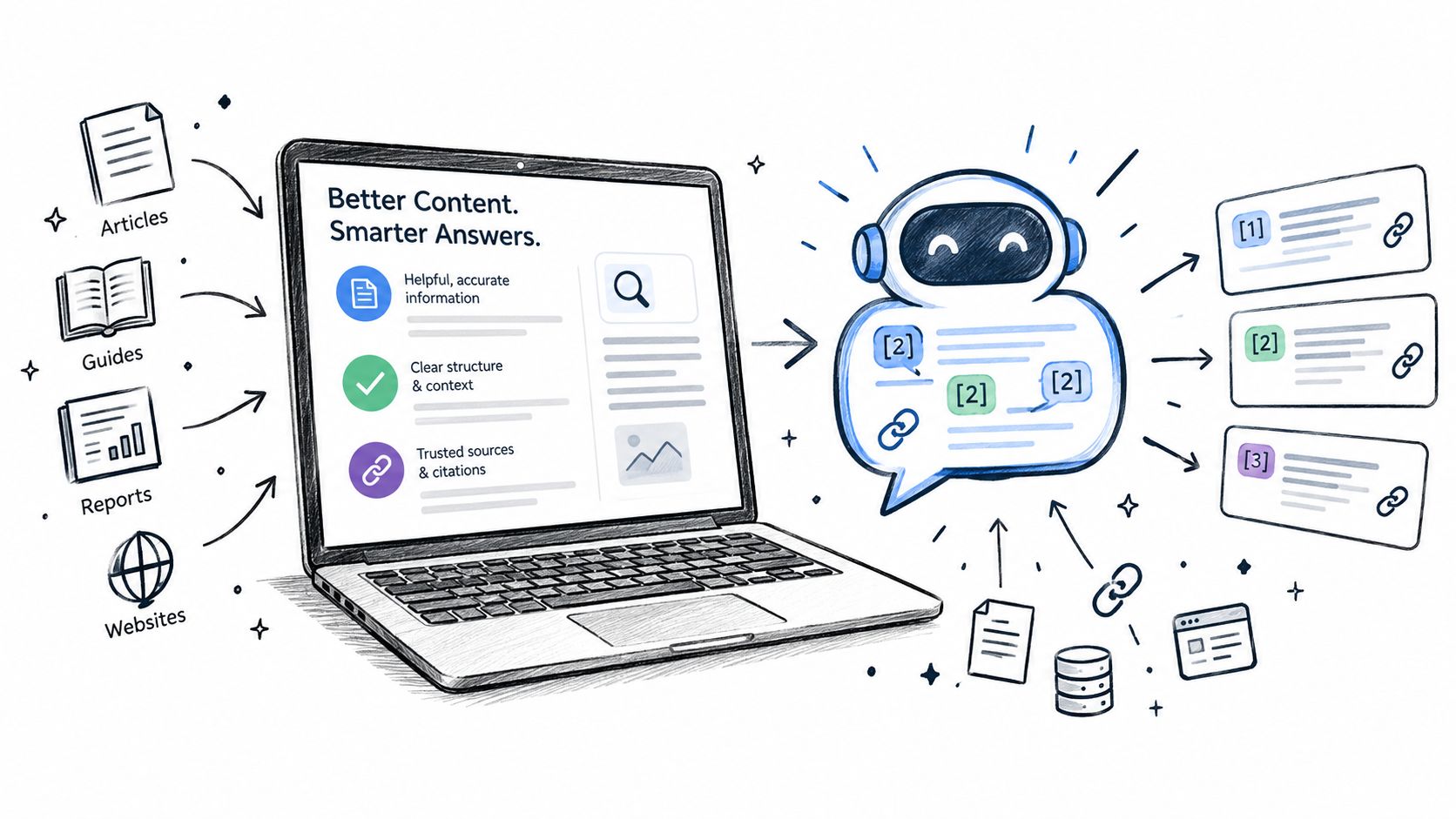

Brand monitoring is the ongoing observation and classification of how a brand is discussed across public channels, so teams can react in near real time and measure visibility over time. In AI search, a practical starting point is a fixed query set of 20 to 50 queries and repeated checks because one run isn't enough to understand what appeared.
A familiar Monday problem now looks different. A senior SEO opens saved Google AI Overview snapshots for a set of commercial queries. Two competitors were cited. Their own brand didn't appear at all. Traditional rank tracking still looks fine, but the buyer may never reach the blue links.
That's the moment this stops feeling like a PR or social listening topic and starts feeling like a measurement problem for search teams. The old question was where a page ranked. The new question is whether the brand was present in the answer, whether a source from the brand's domain was cited, and whether competitors were surfaced instead.
The Moment a Brand Needs Monitoring
The need usually shows up before anyone names it clearly.
A team notices that branded traffic is steady, non-brand rankings haven't collapsed, and review volume hasn't changed much. But sales calls start including a new pattern. Prospects mention competitor names that weren't coming up this often before. Internal stakeholders ask why the company is absent from AI-generated answers even though classic SEO reports don't show a crisis.
That's where brand monitoring becomes useful in plain terms. It is the ongoing observation and classification of how a brand is discussed across public channels, so teams can react quickly and measure visibility over time.
Why classic rank tracking no longer answers the whole question
Traditional SEO tools were built for result pages. They tell teams where URLs appear, whether snippets changed, and how visibility shifts across keyword sets. That's still useful.
But generated answers create a second surface. A brand can have strong rankings and still be missing from the response a user reads first. Or a publisher page can be cited even when the brand itself isn't named in the answer text.
Practical rule: if buyers can get a shortlist without clicking, then teams need measurement for the shortlist itself.
That urgency isn't limited to AI assistants. Current brand monitoring guidance already defines the practice as ongoing, real-time tracking across channels such as social media, news, forums, and review sites, with modern measurement focused on signals like sentiment mix, response time, competitor comparison, and share of voice rather than raw mention counts alone, as outlined in SurveyMonkey's overview of brand monitoring.
The pressure point for SEO teams
What makes this feel new isn't that brands are discussed online. That has been true for years. What's changed is where that discussion gets surfaced back to users.
SEO teams used to ask whether the site earned the click. Now they also need to ask whether the brand appeared in the answer at all. That shift doesn't replace search measurement. It adds a layer above it.
What Brand Monitoring Means in Practice
The easiest way to make sense of this discipline is to separate monitoring from tracking.
Monitoring is the live feed. Tracking is the scheduled checkup.
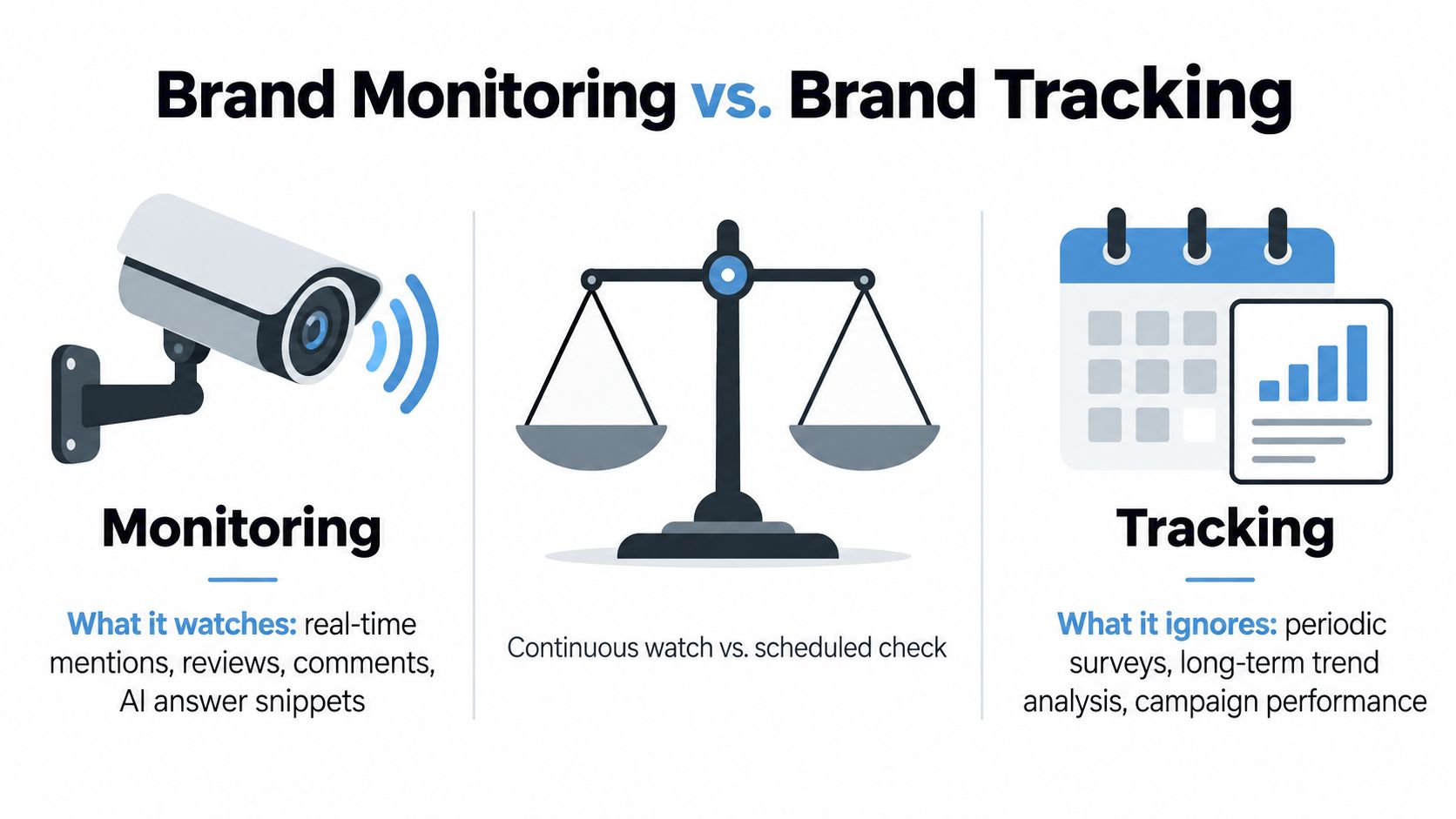
Monitoring watches public signals
Monitoring collects and classifies public mentions across places like social platforms, news coverage, reviews, forums, blogs, and podcasts. The point isn't only to count references. The point is to turn messy discussion into usable signals.
As Onclusive's definition of brand monitoring puts it, the process involves classifying mentions by source type, sentiment polarity, audience size, and urgency so teams can route issues faster and compare brand performance against competitors over time.
That means a mention log should answer questions like these:
- Where did it appear: Was the brand named in a review, a forum thread, a news story, or an AI response?
- How was it framed: Was the surrounding language positive, neutral, or negative?
- How urgent was it: Did it look like routine discussion, a complaint, or a fast-moving reputational issue?
- Who else appeared nearby: Were competitors named in the same conversation or answer?
Tracking asks a different question
Brand tracking is slower and broader. It looks for durable movement in awareness, sentiment, and market position over time.
A useful distinction comes from Pulsar's explanation of brand tracking, which separates near-real-time monitoring from longitudinal measurement. Monitoring tells teams what's happening now. Tracking helps answer whether the brand is gaining or losing mindshare over a longer period.
That difference matters because teams often confuse a spike with a trend.
Monitoring is the security camera. Tracking is the quarterly report you review to see whether the pattern changed.
What monitoring ignores on purpose
Good monitoring isn't trying to explain every outcome. It doesn't tell teams why an answer system surfaced one source rather than another. It doesn't prove that a mention changed a user's decision. It doesn't replace conversion analysis or brand-lift research.
What it does offer is a reproducible record of observed public output. For SEO teams meeting AI answers for the first time, that's the right starting point.
The Core Signals Worth Tracking
A smaller set of signals works better, especially when each one has a defined job, because beginning with too many metrics and too little clarity is counterproductive.
Four core signals
| Signal | What it measures | Where it works | Where it falls short |
|---|---|---|---|
| Mentions | Any public reference to the brand | Reputation checks, broad visibility reviews, competitor scans | Includes noise, jokes, irrelevant contexts, and low-value appearances |
| Citations | Attributed source references or linked URLs connected to the brand | AI answer analysis, source footprint reviews, content attribution checks | Doesn't capture whether the brand name appeared in the answer text |
| Sentiment | The tone around the mention, often grouped as positive, neutral, or negative | Early warning for narrative drift, support and reputation workflows | Sarcasm, mixed sentiment, and product nuance can be misread |
| Share of voice | The brand's mention volume as a proportion of category total | Competitive benchmarking across a fixed query or channel set | Raw share can hide quality differences in source type and context |
Mentions are broad by design
A mention is the widest net. If a blog post, Reddit comment, review, or answer snippet names the brand, that counts.
This is useful because it catches presence before teams know what matters. It is also messy. Not every mention reflects authority, demand, or even relevance. A complaint about an old pricing page and a positive recommendation in a buying guide both increase count, but they don't mean the same thing.
Citations are stricter
A citation is more specific. In AI responses, it refers to an attributed source reference or linked URL.
That stricter definition matters because AI-era monitoring needs more than simple inclusion counts. Adobe's explanation of mentions versus citations in AI search draws the line cleanly: a mention is the brand appearing in answer text without a link, while a citation is an attributed source reference or linked URL. The same answer can contain both, and teams should record them separately.
Sentiment adds context, not certainty
Sentiment gives teams a fast read on tone. That can help identify whether the brand is being praised, criticized, or discussed neutrally.
But sentiment systems break in familiar ways. They miss sarcasm. They flatten mixed reviews. They may treat a technical complaint as negative even when the broader evaluation is favorable. That's why sentiment works best as a triage layer, not as the final truth.
Share of voice makes counts comparable
Raw counts are hard to interpret in crowded categories. Share of voice helps by turning mention volume into a relative measure against the category total. That makes it more useful than simple mention totals when teams need to compare themselves with direct competitors in the same conversation set.
For AI search work, that usually means comparing presence across the same fixed prompt set rather than comparing totals from unrelated queries.
How Monitoring Changes in AI Search
The biggest change in AI search isn't that monitoring becomes obsolete. It's that the unit of analysis changes.
Traditional search gives teams pages, positions, and snippets. AI answers give teams responses. Inside those responses, two fields matter immediately: mention and citation.
Mention and citation are not the same thing
A response can mention a brand without citing its site. It can also cite a page from the brand's domain without naming the brand in the answer text. Those are different observations and should be logged separately.
Many early AI visibility reports get blurry. They mix all forms of presence into one score, then imply more certainty than the observation supports.
| Scenario | Mention Present | Citation Present | What It Signals |
|---|---|---|---|
| The answer names the brand but links elsewhere | Yes | No | The brand appeared in the response, but another source was surfaced |
| The answer cites the brand's domain but doesn't name the brand in prose | No | Yes | A brand-owned source was surfaced without direct brand inclusion |
| The answer names the brand and cites its domain | Yes | Yes | The brand appeared and a brand-related source was attributed |
| The answer includes neither | No | No | The brand was absent from that tested response |
What teams should observe now
The old workflow often asked a simpler question: did the page rank?
The new workflow needs parallel fields:
- Brand appearance: Did the brand appear in the answer text at all
- Source appearance: Did a URL from the brand's domain appear as a citation
- Competitor overlap: Which competing brands appeared in the same response
- Response context: Was the brand recommended, criticized, or only mentioned in passing
A practical walkthrough of this reporting logic appears in this guide to LLM visibility measurement.
Presence is observable. Explanation is usually inferred. Teams should keep those separate.
Why AI search adds urgency without adding certainty
This is also where honesty matters. Teams can observe what appeared, what was cited, and what was absent. Teams usually can't explain with confidence why one source was surfaced and another wasn't.
That doesn't make monitoring weak. It makes it properly scoped.
An undercovered angle in recent industry guidance is that monitoring now needs to extend into answer engines because mention behavior and citation behavior differ from classic search and social surfaces. That same discussion notes that a Pulsar guide on brand monitoring strategy cites a study across 75,000 brands that reported a Spearman correlation of 0.664 between brand web mentions and Google AI Overview visibility. The useful takeaway isn't causation. It's that earned web reference footprint appears alongside AI visibility often enough to deserve measurement.
Setting Up a First Monitoring Workflow
A first workflow doesn't need a large platform stack. It needs consistency.

Start with a fixed query set
One published approach recommends a fixed query set of 20 to 50 queries that represent the brand's core topic areas, with teams recording whether the brand appeared in the answer text, whether a linked source from the domain was included, and which engine produced the answer, as described in HubSpot's AEO note on mentions versus citations.
The fixed set matters because changing prompts every week destroys comparability. Pull queries from real customer language, sales calls, support logs, category pages, and known commercial searches. Then leave the set alone long enough to see pattern change instead of prompt drift.
Capture structured fields every time
A clean log beats a messy dashboard.
For AI search reporting, one operational guide recommends treating mentions and citations as separate fields and capturing the exact response text, cited domains or URLs, response timestamp, and query metadata. It also says to repeat each prompt three to five times per platform because a single run creates noise, according to GrowthX guidance on tracking brand mentions in AI search.
A basic sheet can include:
- Query text: The exact prompt used
- Engine used: ChatGPT, Claude, Gemini, Perplexity, Google AI Overviews, or another tested surface
- Timestamp: Date and time of the run
- Mention field: Present or absent
- Citation field: Present or absent, plus cited URLs when available
- Context note: How the brand was framed in the surrounding sentence
- Null result marker: A clear note when nothing appeared
One practical example of this workflow appears in a guide to brand monitoring for AI results.
Keep the process boring
The first workflow should feel repetitive. That's a feature.
Teams often fail here by over-customizing too early. They add too many prompts, switch categories midway, or stop recording null results because empty rows look unhelpful. In reality, absence is data. If a competitor appears across your commercial prompt set and your brand doesn't, that's one of the clearest signals you can capture.
Log the misses. A missing brand mention is often more informative than a weak positive mention.
What Is Observation and What Is Hype
AI visibility reporting is full of claims that sound precise and aren't.
Some dashboards imply that a single score can summarize presence across answer engines. Some vendors suggest that certain wording patterns improve the chance of being surfaced. Others blur observed citation patterns into explanations about how systems make decisions internally.
That leap is where good monitoring turns into hype.
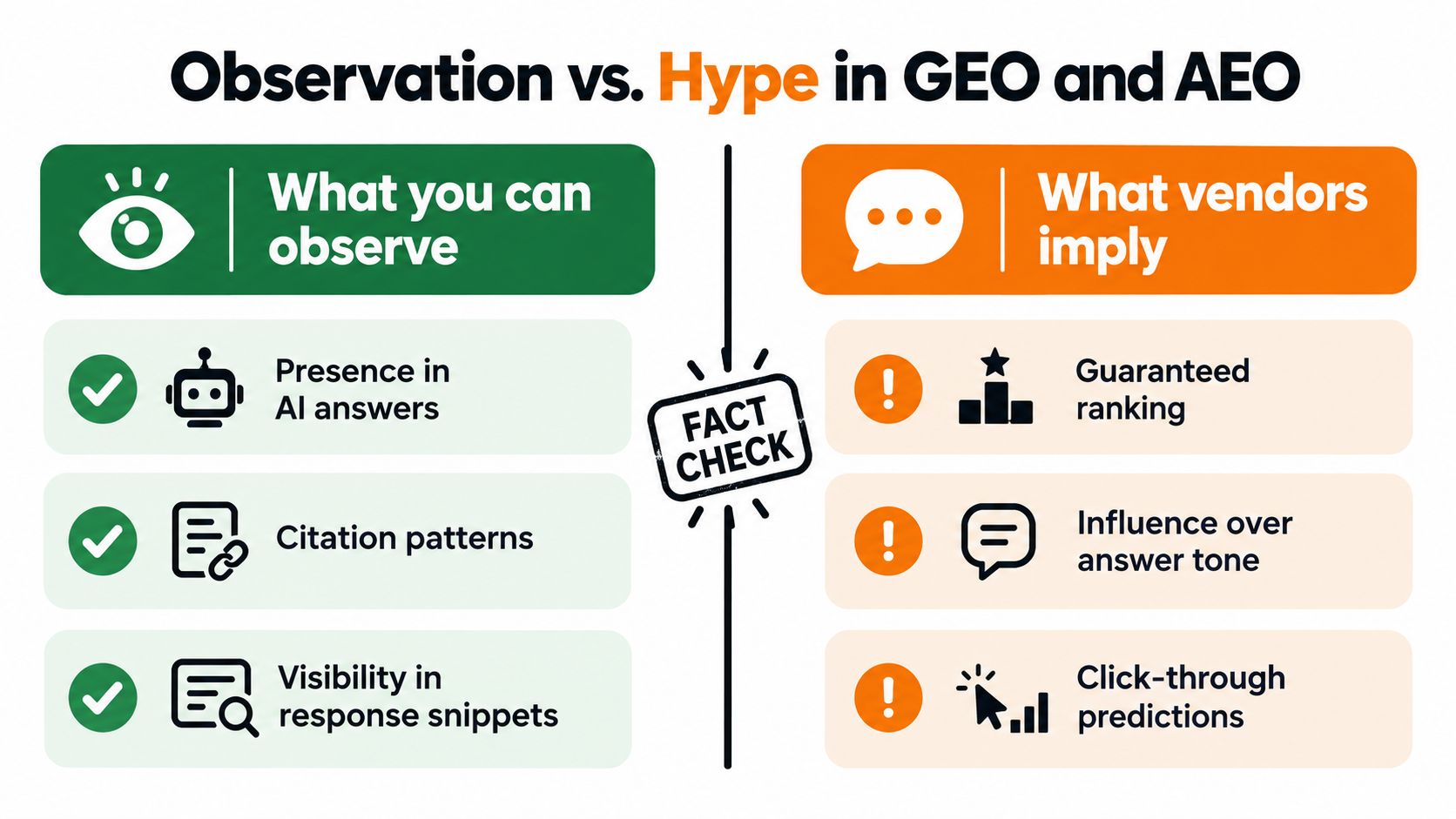
What teams can actually observe
Observed output is fair game.
Teams can say that a brand appeared in a response, was absent from another, or was cited by URL in a tested answer. They can compare mention frequency across a fixed prompt set. They can record whether competitors were surfaced more often in the same test window.
They can also compare those observations over time if the method stays stable.
Where vendors often overreach
The problem starts when reporting moves from output to mechanism.
A vendor may notice that brands with stronger mention footprints appear more often in AI answers. That's an observation. It does not prove why any specific response included a specific source. It does not prove that one formatting change or one citation tactic changed the outcome. It does not prove a stable ranking system exists behind every answer surface in the same way SEOs are used to from traditional search.
A careful monitoring program should treat vendor dashboards as descriptions of what appeared, not as reliable explanations of internal decision logic.
Useful skepticism for SEO teams
A few habits help here:
- Ask what was observed: Was the report measuring mention presence, citation presence, or both
- Check whether prompts were fixed: If the input changed, the output comparison may be weak
- Look for repeat runs: Single snapshots can mislead when responses vary
- Separate scores from raw records: If a tool reports a score, teams still need the underlying prompts and response logs
We don't know why a system surfaced one source over another in many cases. We only know what appeared in the tested response.
That answer can feel unsatisfying to search teams trained to look for ranking factors. But it's the honest one.
First Steps and Honest Limits
A program to begin doesn't need to be large. A routine is what's needed.
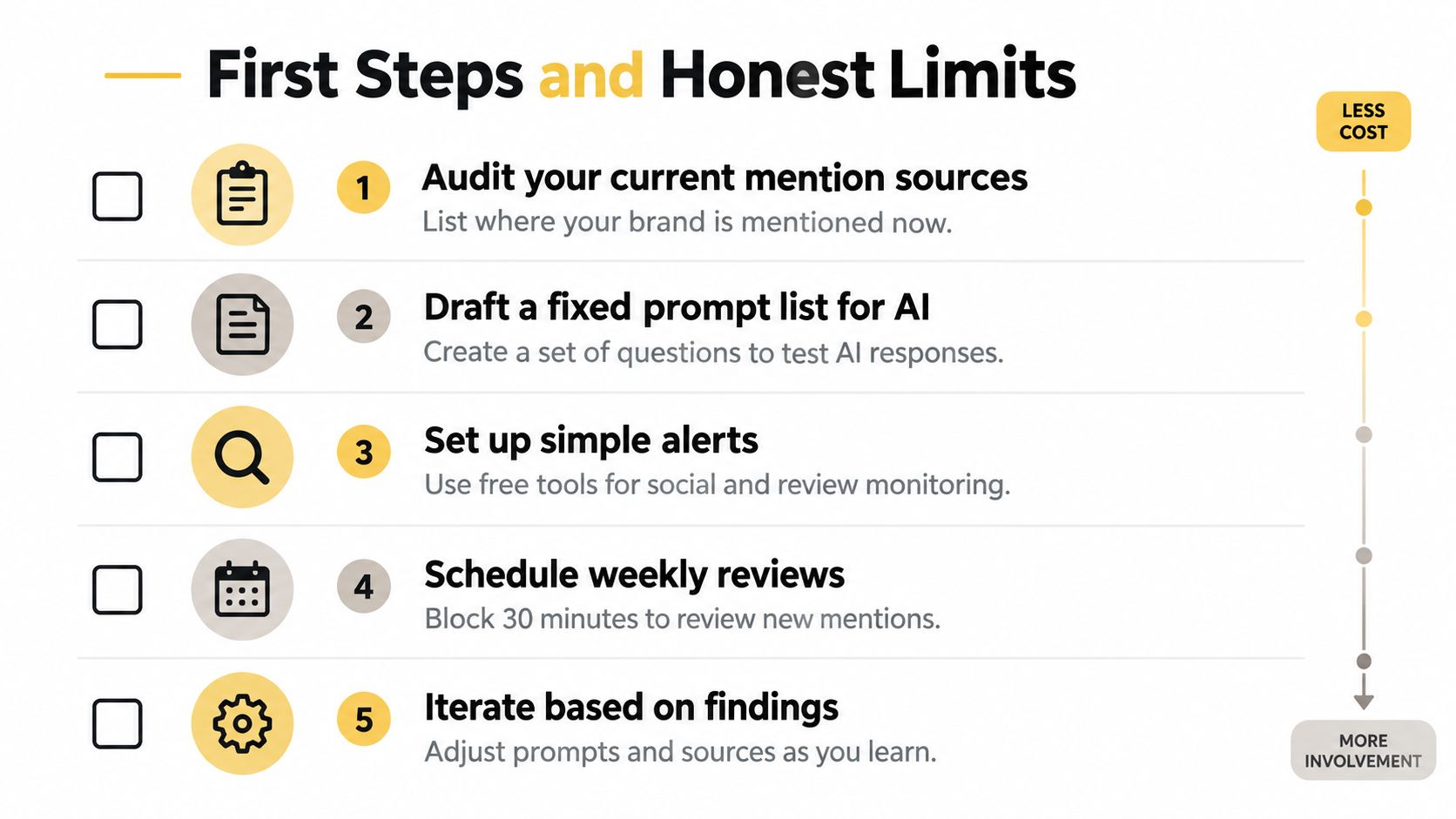
A practical first-week checklist
- Audit current mention sources: List where the brand already appears across reviews, forums, social threads, industry coverage, and owned pages that are commonly cited.
- Draft a fixed AI prompt list: Build prompts from real customer language, then keep the set stable for the first cycle.
- Create a shared log: Record date, platform, prompt, mention presence, citation presence, and context notes in one sheet.
- Assign one owner: Someone should run the checks on schedule and keep the method consistent.
- Review weekly: Look for repeat absences, recurring competitor appearances, and brand framing changes.
If teams want to connect this work back to downstream analytics, this overview of AI traffic analytics is a useful companion because visibility and traffic aren't the same metric.
What we still can't measure well
Some limits are easy to forget because dashboards make them look solved.
We don't know, in many cases, why one source was cited over another. We don't know the internal weighting behind most answer outputs. We don't know whether a cited mention changed a user's decision. And we don't know how stable a given answer pattern will remain as products change.
That's why what is brand monitoring has to be answered carefully now. It isn't a magic diagnostic system. It's a disciplined observation layer.
One option in this category is The AI Search Signals, which publishes workflows for running the same prompts across answer engines and logging mentions and citations as separate fields. That kind of method is useful because it keeps the unit of analysis visible instead of hiding it behind a score.
Brand monitoring matters now because search teams need a way to measure presence where buyers increasingly get answers. Its job isn't to explain everything. Its job is to record what appeared, compare it over time, and give teams a stable base for decisions.
If a brand team starts this week with a fixed query set, separate mention and citation fields, and a shared log reviewed on schedule, that's enough to move from guesswork to evidence. In AI search, that shift is more valuable than a confident story built on assumptions.